Friday, February 9, 2018

Meditating on Altered Carbon

As I have stated in the past, I am not a huge fan of modern science fiction. That doesn’t mean I don’t hope that there might still appear on the horizon a good or even great modern sci-fi tale worth taking in. Thus, I occasionally dip my toe in the water to see if anybody comes close. Altered Carbon happens to be one of those tales that does get close.

For those who have not yet taken a look at the new Netflix sci-fi show, it is based on a 2002 novel by Richard K. Morgan about what might today be called a transhumanist culture where people’s consciousness is recorded into what are called “stacks” and inserted into different bodies. Originally intended to be a means of space exploration (transfer your consciousness to a body light years away without having to physically cross space), it ends up being used to create a man-made version of immortality.


To its credit, Altered Carbon does a very good job of depicting what a world without God looks like: it is hedonistic, brutal and miserable even for those who hold all the wealth and power. It is the Marque de Sade writ large. It also acknowledges that Christianity (in this case the “Neo-Catholics”) would stand in opposition to the idea of stacking.

Unfortunately, like much of entertainment today, the mouthpieces for what passes for a theological discussion are cookie-cutter, inflexible, intolerant and have the rhetorical skills of a piece of cardboard. This show could have been great had it taken this aspect of the story more seriously, because it is a fascinating exploration of what is the soul, what does it mean to be human and where does God fit in to all of this.

To that end, I would like to present the case historical Christianity would actually make should such a technology ever be made available (and Note to Sci-Fi authors: the Church will survive all the philosophical crap thrown its way despite the existence or non-existence of aliens or fantastic technology so you don’t need to cheapen your stories by coming up with crap names like “Neo-Catholics”):

Christianity has long maintained that the body is an integral part of the human person, Christ became incarnate in order to save us, after all. Thus, from very early on, people have been asking the question where in the body does the soul reside, because one doesn’t want to go around getting manicures if the soul happens to reside in the fingernails.

St. Athanasius the Great actually tackled this question in a way that directly speaks to the story presented in Altered Carbon. He understood that the soul would not reside in a part of the body that the body could survive without. Thus, it is not in hair or the fingernails, or limbs or eyes or even things like the kidney or the frontal lobe of the brain. Human beings can survive without all of these things (maybe not well or for very long, but life would continue). He posited three areas of the body that life cannot do without:

  • Arteries (destroy an artery and the human body bleeds out very quickly and dies)
  • Heart (pretty self-explanatory)
  • Back of the Head (the place where the Medulla Oblongata is, that part of the brain that controls involuntary functions like the heart beating, etc.)

This last observation is the most intriguing in terms of Altered Carbon because that is where the “stacks” are placed inside the body. Therefore, it could be argued that they contain a human soul based on the part of the body they function in. A conversation could be had about whether or not the whole soul was contained therein (having left behind both the heart and the arteries) but the Church has long been comfortable with organ transplants. The first recorded transplant was done by Sts. Cosmos and Damianos (a leg) some sixteen hundred years ago.


Due to the fact that a donor is preserving life, there has been no serious objections, even to heart transplants other than the admonition that the recipient is now responsible for not only their own soul, but for that of the person who saved their life.

Thus, from a practical and theological point of view the objections that the Neo-Catholics have for the “stacking” technology bear little resemblance to historic Christianity. That doesn’t mean the Church wouldn’t have objections to the society depicted in Altered Carbon and the way it uses stacks.

As I stated above, the human body is an integral part of the human person. Preserving one’s consciousness or even one’s soul does not mean that the human person is being preserved. More critically, however, is the use of clones by the uber-rich to emulate immortality and the treatment of human bodies in general (they are derogatorily called “sleeves” as if they are clothing rather than people).

Despite the fact that cloning technologies are popularly associated with science fiction, clones already exist among us: they are normal called identical twins, triplets, etc. I have been blessed to know several pairs of identical twins in my life. While it is almost spooky how similar twins are in their likes and dislikes, etc. there is no question that each one of them is a unique and unrepeatable human person. It would be considered unconscionable for the eldest twin to “own” their sibling because they came from the same genetic code or for one twin to harvest the organs of a living twin because those organs “belong” to them.

In other words, when we gain the ability to make clones of ourselves, each and every one of those clones will be a unique and unrepeatable human person in the same way identical twins are. To treat them as property to be used to emulate immortality would do so on the back of slaves. Actually, they would be worse than slaves, because even their basic humanity would be denied them. They are just “sleeves” that aren’t even allowed the freedom to consciously be forced to serve their masters.

At the core of the story told by Altered Carbon is the question: What does it mean to be human? Specifically, is death part of what makes us human? A society that has replaced God with demigods who fake their immortality through technology is depicted as vile, violent, stagnant and bored. It is even hypothesized that they have ceased to be human.

Had this show bothered to have more than a cardboard caricature of Christianity (and a fundamental misunderstanding of it to boot), this show could have plumbed the depths of the questions it asks in a far more interesting and, dare I say, entertaining way. It could even have been one of those great science fiction tales.

Wednesday, February 7, 2018

Rinn's Journal Part 2

Fifthday, 2 Februa

What a vile and horrible place Redwraith is! I desperately want to go home and just spend my days mixing ingredients to make salves and medicines. Why I am here I do not know.

I will admit that, while I was terrified as we approached the city, some of my fears gave way to awe when we came upon the main gate of Redwraith. We had heard rumors that a giant beast had attacked the city, but I had no idea how huge the thing was until we saw the skeletal remains still poised to break down the walls of the city.

Its mouth is now used as the main gate and a horse drawn wagon can easily fit through. The bones of the creature now provide some shade and shelter to a tent city filled with merchants shouting out to customers and trying to sell them all sorts of things I had never imagined, let alone set eyes on.

Morivam inquired one such merchant about a dagger he had squirreled away in the back of his tent. I was quite taken aback when I saw that the weapon was forged steel. The man rightly had an asking price of 100 gold coins for such a fine and rare weapon.

Once, when I was a child, a friendly dwarf traveling through Headwaters on his way to the Bronze Citadel was kind enough to show me a small ingot of steel. He intended to make enough money off it to “make his son,” what ever that means. Since that day, this dagger is only steel I have ever had the privilege to see.

Of interest (to me at any rate), the merchant tried to convince Morivam to purchase the weapon before the Dwarves did, because they were buying up all the steel they could afford. How on earth did so much steel suddenly show up in Redwraith?

I was so intrigued and, dare I say, excited that I completely failed to notice that some of the City Guard watching the gate were actually undead. It wasn’t until we found the Lost Wyvern Inn (evidently the only Inn in town that survived the battle) that I realized the true horror of this place. The Inn actually had raw brains on the menu for its undead clientele and my meal was served to me by an animated skeleton. No wonder the citizenry of this place didn’t think it macabre to sell its wares in the shadow of a dead thing.

Lord, please tell me why Fr. Valinor insisted on me coming to this horrid place. I really just want to go home.

Sixthday, 3 Februa

This trip has been very revealing about my companions. Morivam is insatiably curious. Now that we have arrived in town, he is constantly asking questions and getting into conversations with complete strangers. He even insisted on getting a room so that he could study some of the items we found in the gnoll camp without interruption.

I have known Cuinn since I was a child. He always seemed to be a gruff sort of person that you would want on this sort of venture, but not really someone you would sit down and eat dinner with; however, he is a surprisingly gentle soul. He was the first of us to realize the extent of the danger I was in as an Instenite cleric in a town filled with undead and he made sure that not only if I was okay but that he had my back, as it were.

Tenel took one look at the food and service of the Lost Wyvern and noted that there was a serious business opportunity here in town. He figures that some good old fashioned halfling food and hospitality could radically change the way these people look at food and service.

I am afraid that my first impression of Holton may very well have proven correct. He has disappeared on us. He probably lost himself in the crowds and is gone forever.

While Morivam studied and Tenel kept watch, Cuinn and I decided to chase down a piece of information the yellow mage picked up in one of his conversations: there is a sick house possibly run by Istenites. We are looking for a person named Penael.

The northern part of the city is in ruin. Evidently, that was the only flank that the invading army had any kind of success. I must say I almost felt sorry for these people. The Sick House was cobbled together from one of the buildings that still had most of its wall intact. A make shift roof of oiled canvas sheltered those within.

Inside we found a number of beds occupied by people struck by disease or recovering from what looked to be magical wounds. Both Cuinn and I have skills at healing and we very quickly offered our assistance. There was a young man by the name of Grick who seemed to run the place and he was grateful to have another pair of hands.

Cuinn and I spent the day giving comfort. On one of the more severe cases, a young girl who had burns on much her body, I tried to use my healing magics. They did not work, but Grik took notice and scribbled a note which he secreted to me while clandestinely showing me that he wore an Istinite Wolfhook. Had we found the Church? Could we finally get in touch with the Bishop so that I can go home?

Seventhday, 4 Februa

Lord, will the horrors of this place never cease? Why do you try me so? Is this why you called me to this place? To be surrounded by this savagery everyday the rest of my life? Why me, O Lord? Why me?

I must make apologies to Holton. I thought basely of him. When we made to follow the map Grick had given me to find the Church here in Redwraith, we were put upon by those same talking spiders that we encountered on our way here. They informed us that we had two days to bring them an elf otherwise they would eat “our Elfsie spy.” The poor soul must had been abducted the moment he went wandering alone. To boot, Cuinn has informed us that he believes hobgoblins have infiltrated the city and he thinks he knows one of the places they are hiding. But, Lord have mercy, this is not the worst of it.

The bishop is dead. Murdered in his own chamber.

The Church has been decimated. Only a dozen of them survived the battle. Like everyone else in the city, they manned the walls. Unfortunately, the Istinites were largely on the northern wall. So many were killed on the day of the battle. Have they even had a chance to properly bury their dead?

Penael, a paladin it seems, was left as the defacto head of the Church and when he learned of me, he praised God that a cleric was sent to the Church in Redwraith to lead them into the future. Cuinn actually smiled at that and whispered in my ear “This is what we call a field promotion.”

Truly God, how can going from happily taking care of the sick in Headwaters to living in constant terror be a promotion? Why me?

Tuesday, February 6, 2018

SWCL Adventure Module: The Hermit Caves

I've been slowly grinding away at my own version of The Temple of Elemental Evil, and I have finished the first section: The Hermit Caves. As I mentioned in a previous post, I am releasing this SWCL megadungeon piecemeal. In this way, I can get the parts of this project I've finished out more quickly (as opposed to waiting until the whole project is done), but I also get to experiment with the design goal of flexibility. This module can be run as-is, easily attached to an existing dungeon or be used in conjunction with my other MyToEE adventures.


As per usual, this comes with the disclaimer that I am a hobbyist and have edited this as best as I am able, but there will be mistakes. Please consider the comment section a thread for any typos etc. that you catch. Thank you!

The file can be found here.

Saturday, February 3, 2018

Saintly Saturday: The Righteous Simeon

Today is the Feast of The Righteous Simeon the God-Receiver. Simeon appears in the Gospel According to Luke when Mary and Joseph, according to the Law, appear at the Temple 40 days after the birth of Christ to present Him and the proper sacrifice (two turtledoves or two pigeons). Simeon sees them, takes the child into his arms and cries out:

Lord, now let Your servant depart in peace, according to Your word, for my eyes have seen Your salvation, which You have prepared before the face of all people, a light to enlighten the Gentiles, and the glory of Your people Israel!

In other words, Simeon is asking God to allow him to die just as God promised him. On its face, this seems like an odd thing to say. That is, however, until you read about his life. According to the tradition of the Orthodox Church, Simeon was around 360 years old when he met Christ at the Temple.

He was on of the Seventy Jewish Scholars that answered the call of Ptolemy II, Pharaoh of Egypt, to translate the Old Testament into Greek so that it could be included in the Great Library of Alexandria. Initially, the plan was for all seventy scholars to independently translate the Pentateuch (the first five books of the Old Testament) and then gather together to see what the differences were and argue from there. When they gathered together again, all seventy translations were identical. It was therefore accepted as a divinely inspired translation.

What eventually came out of that work is today called the Septuagint (coming from the word for “seventy”). When we read the New Testament (written in Greek) all of the quotes of the Old Testament come from the Septuagint. Interestingly, the Septuagint is the oldest version of the OT that we have. The Hebrew version of the OT we have today (called the Mesoretic Text) is itself a translation made by Jews who wished to get rid of all the Hellenic influence out of Judaism after the fall of Jerusalem in the 1st century A.D. It is considered a translation because the original Hebrew did not have vowels. Thus, it was possible to make several different readings out of the same passage by inserting different vowels. The earliest Mesoretic Text we have dates from the 9th century A.D. Today’s English OT translations are based on the Mesoretic, not the Septuagint which explains why there can be such variance in the quotations the NT makes of the OT.

Simeon was translating Isaiah when he came across Isaiah 7:14
Behold, a virgin shall conceive in the womb, and shall bring forth a Son
He didn’t think the word “virgin” should be used and went to change it, but an angel appeared before him and stayed his hand. He was told:
You shall see these words fulfilled. You shall not die until you behold Christ the Lord born of a pure and spotless Virgin.
Thus, Simeon lived in anticipation of being able to die for almost four centuries.


I am fascinated by this story because it subverts expectations. How many people throughout time have fantasized (and even sought) a way to cheat death? The whole vampire phenomenon is rooted in this primal desire. Yet, here is Simeon hoping to die and even asking God Himself to allow him to taste death.

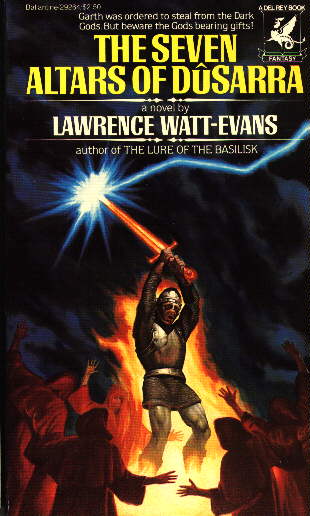
It also reminds me of one of my absolute favorite characters in all of fantasy fiction: the Yellow King from Lawrence Watt-Evans’ The Seven Altars of Dusarra. In context of an RPG, he plays the role of patron. He is the one who sends the main character on his quests. What makes the Yellow King stand out, however, is that his goal is not money or power but rather, much like Simeon, he is an immortal looking for something that will kill him.


This, of course, is an awesome template for an NPC in any RPG, let alone a FRPG: the patron that pulls strings behind the scenes and helps out the PCs but whose real agenda is actually totally against all expectations.

As I have often repeated on this blog, one of the best things about RPGs is its ability to surprise. An NPC who appears to do one thing that narratively makes sense, but is actually doing something completely different is one of the most entertaining surprises we have available to us.

Saturday, January 27, 2018

Saintly Saturday: The Transfer of the Relics of St. John Chrysostom

Today is the Feast of the Translation of the Relics of St. John Chrysostom. Thirty years after St. John's death in exile, St. Proclus, Patriarch of Constantinople, persuaded the Emperor Theodosius II (A.D. 408-450) to allow the relics of St. John to return to Constantinople. The emperor’s mother, Empress Eudoxia, had sent St. John into exile because he, as the Patriarch of Constantinople, openly criticized her vices. Theodosius issued an edict for the return of St. John’s relics; however, those sent to retrieve could not lift his reliquary. It was not until the emperor wrote a letter of apology and humbly asked the saint to return that the reliquary was able to be moved.

The moniker “Chrysostom” means Golden-mouthed because St. John was a gifted homilist. Fortunately for us, St. John is one of the most well-documented saints in the history of the early Church. We have more of his writing than just about any other saint, including his analysis of the Gospels according to St. Matthew and St. John as well as the Letters of St. Paul.

There is a story of St. John from the time when he was writing on St. Paul that a man who had come to see the saint was turned away because St. John was seen to be meeting with someone at his writing desk who was leaning over and whispering into the saint’s ear. This went on for three days. When St. John openly wondered at what had happened to the man, who he had arranged to meet, those around him became aware of the icon of St. Paul hanging over St. John’s desk and realized that the person they saw whispering in St. John’s ear was St. Paul himself. To this day, that ear remains incorrupt (and I can attest to that because I have seen it myself).


St. John looms very large in the life of the Orthodox Church, because the liturgy we do most of the year is attributed to St. John. Indeed, because of the large number of surviving writings by St. John, modern textual analysis confirms that the Anaphora of the Liturgy of St. John Chrysystom was indeed written by St. John himself. It is a rather humbling and awesome thing to pray his words knowing that 1600 years of Christians before me have prayed the very same thing.

It is a reminder that in our present age, we delusionally believe we have progressed beyond our forbears. While we may have some pretty amazing technology at our fingertips, human beings knew just as much (if not more) about being human hundreds and even thousands of years ago. St. John’s writing is as relevant today as it was in the 4th century. My daughter recently had to read Thucydides for school. I challenge anyone to read that with “United States” in the place of Athens and “Soviet Union” or “China” or “North Korea” in the place of Sparta and be able to tell me that (beyond the technology involved) that the conflict was any different.

We doom ourselves by ignoring the wisdom of those who came before.

In a way, this is why the OSR has been so important for this hobby. We refuse to ignore the past. Indeed, some of us insist that past versions of D&D are better than what came after. I count myself among them. I recently got back together again with some high school buddies of mine to play. Despite a lot of talk about how good 3.5 is and how we all should give 5e a go, we ended up going back to B/X because the wisdom there just cannot be ignored.

I pray we all apply this axiom beyond the gaming table. Pick up a classic and realize that humanity has always been human (both wise and foolish) and that we have a lot to learn from those who came before.

Thursday, January 25, 2018

Rinn's Journal Part 1

Fifthday, 25 Janus 1143

Today the initiates were very excited when news came from town that a yellow robed mage was visiting Headwaters. I must confess that I was rather giddy myself. My own interest in alchemy always had me curious as to the differences between my hobby and the arcane. Had I lived closer to the influence of the Mage’s Guild I might have chosen a different vocation.

Imagine everyone’s surprise and delight when the mage himself showed up at the monastery with a letter of introduction asking for an audience with Fr. Valinor. Lord forgive me, but my curiosity got the better of me and I went to see the man himself as he waited on our kindly village priest.

Despite being travel-worn, he seemed a rather respectable fellow whose ruffled appearance could not hide what many would consider to be a handsome countenance. The most striking thing about the man, however, was the owl that so calmly sat upon his shoulder. There was a majesty and intelligence behind those eyes I had never seen in an animal. It made me wonder if the rumors of mages having magical animal servants were true.

Lord, forgive me for eavesdropping, but I managed to overhear Fr. Valinor exclaim something about his friend Tarlo as he was glancing at the letter and leading the yellow mage into his chambers.

In our excitement at such an event, many of the initiates (including myself, I am afraid to say) were speculating why Fr. Valinor had chosen Cuinn to be the yellow mage’s chaperon. The half-elf had long abandoned the path of an initiate to help the Rangers of the Order of the Archangels patrol the area for any humanoid incursions. Were they planning some kind of expedition?

Why, Lord, couldn’t I have been chosen?

Sixthday, 26 Janus 1143

Why, Lord, did you have to listen to my prayer?

I have been asked by Fr. Valinor to accompany Cuinn and the yellow mage to Redwraith on a fact-finding mission. There was a great battle there a few months ago and no one knows what is happening now. When I protested, Fr. Valinor insisted that it was time for me to get out and see the wider-world before I settled down into my lab and take my vows. When I insisted that I was still needed because of the disease that still afflicted the camel herds, he reminded me that we had plenty of my elixirs in storage. He even insisted that I take one with me!

O Lord, please let me see beloved lab again. I promise I will watch my tongue and not let gossipy excitement get the better of me ever again…

Seventhday, Janus 27 1143

The monastery is abuzz getting our supplies ready for the journey. We must carry all of our own equipment and food, since the camels are not healthy. This doesn’t seem to bother either Cuinn or the yellow mage, whose name I have discovered is Morivam. He hails from Trisagia and has the habit of finishing my sentences, as if he knows what I am about to say. It might seem rude, but he has never misconstrued any of my intentions.

Our band of explorers has picked up two additions. Tenel of the Delver Clan will add his sword and halfling expertise with a sling to our endeavor (which makes me feel slightly less anxious about the coming days); however, I cannot say that I am happy about a mysterious fellow who only showed up in town recently. His name is Holton and despite having a chronic cough, boasts that he know the wilderness area around Headwaters well.

Lord, forgive me for being suspicious, but I have heard rumor that a bandit crew was recently put down by the Paladins of the Order but one or two managed to escape. I wonder if that is not the real story behind this fellow.

We leave tomorrow early. I must admit, the part of me that isn’t terrified is rather excited.

Thirdday, Janus 30 1143

Oh, what a terrifying and exhausting three days this has been! After an feet-stinging first day of trudging through the hill country north of Headwaters, Cuinn asked me to take the second watch, considering I was used to getting up in the middle of the night to pray. Not long after wiping the sleep from my eyes, I realized that there was movement all around the camp, beyond my ability to see clearly. I woke Cuinn, knowing that his elven blood allowed him to see more clearly at night than I. He quickly roused everyone from sleep and insisted that we retreat post-haste.

Just as I began to realize that we were in danger, arrows came raining in from the sky, and we heard a battlecry and the sounds of metal on metal. It took me several moments to realize that two of the arrows had hit their mark, both into the back of poor Tenel. Thank Isten he was still breathing, but he was in no shape to move. If he were to survive, we had to make a stand, at least long enough for me to use my magical healing.

I did not see what happened next, but when I had done my work on Tenel and he was back from the brink of death, there were several sleeping goblins around us and I heard the sound of several more retreating into the dark.

Unsurprisingly, Holton was ready to slit the creatures throats when Cuinn and (surprisingly) Morivam stayed his hand. It was decided that we would disarm the goblins and then put as much distance between us and them during the rest of the night.

When the sun rose, it revealed to us a camp of gnolls punishing a group of goblins (were they the same that attacked us the previous night?) They did not spy us, so it was our turn to rain missile fire. One was felled, and the goblins turned tail. As the gnolls charged, Holton appeared behind one and managed to kill it with one well-placed thrust of his blade. Their charge thus blunted, the rest fell easily to our own blades.

Realizing we were still not safe from the roving band of humanoids, we wandered far and wide looking for a defensible piece of ground we could use as a camp and some much needed rest. Cuinn reported that he had found something suitable, but it was already occupied (something about leaving a hippogriff mother alone being the better part of valor).

Now, finally, three days on we are weary but watchful in a rocky recess of a hill overlooking a small valley. Lord, I have never been so tired in my whole life. Thanks be to Isten that we all live to tell this tale…

Fourthday, 1 Februa

Lord, give me strength! If I thought the last several days were frightening, I was sorely mistaken. Cuinn noticed movement ahead of us today, which turned out to be three giant spiders. This was a strange sight. Not that no one hadn’t heard of the existence of such creatures. On the contrary, they are quite common in the jungles south of Headwaters. Seeing them out in the open, so far north concerned us all. The half-elf warned us that these creatures were known to be surprisingly intelligent, so when they split off in three directions, Cuinn was not only not surprised, but surmised that they might be circling around to flank us. We decided to follow the trail of one that veered of to the East.

We came upon the creature clinging to a rock face. I was not prepared for its size: the abdomen was likely five feet long, but then it began to speak! It accused us of spying on them for the elves, noting that he could smell Cuinn’s elven blood. Fortunately, it seemed uninterested in a fight unless we insisted on one. We were able to convince it we were not the spies it suspected us to be.

None of us were prepared for the realization that these creatures were intelligent enough to have language. Knowing that they also appeared to be going toward Redwraith has us all worried about what exactly we are heading into.

Saturday, January 20, 2018

Saintly Saturday: St. Euthymius the Great

Today is the Feast of St. Euthymius the Great who was born in Melitene in Armenia to faithful parents about the year A.D. 377. His parents were older and barren. They received a vision and conceived in their old age. His parents died shortly after he was born and he was taken in by the bishop of Melitene. He was tonsured as a monk and ordained as a priest. In this role, the bishop placed him charge of all the monasteries in the city.

St. Euthymius, however, yearned for the life of a hermit and left for the wilderness. What follows is a typical pattern of great monastic saints: they go out into the wilderness, attract the attention of the faithful through their piety and the miracles performed through them, a community with a monastery at its center forms and the saint goes off to the wilderness and the pattern repeats itself.

One of the monasteries that St. Euthymius founded in this way was in a cave situated on a cliff overlooking a gorge in the desert of Coutila. Despite its terrifying location (one, BTW, that would make a very interesting encounter area for a campaign), it became the location of a monastery and was very popular with the villages in the surrounding area.

He converted a tribe of Arabs. Their leader was ordained and became known as the Bishop of Tents (an interest FRPG title, if I’ve ever heard of one).

There are several great saints that were taught and/or influenced by St. Euthymius including St. Theoctistus (Sept. 3), Symeon the Stylite (Sept. 1) and St. Sabbas the Sanctified (Dec. 5).

He foresaw his death at the age of 82 and passed on January 20, A.D. 473.


The lives of monastic saints like St. Euthymius are, in many ways, one of the reasons I believe the framework of D&D works so well within a Christian context. The monastic is the adventurer who goes out into the Wilderness (Chaos) to make it safe for Civilization (Law).

The basis for my understanding comes from Scripture. If we look at the geography of Genesis, we have three areas:

  • Eden (which is most likely some kind of plain because the name originally meant “open wastes”)
  • The Garden (which is in Eden and has as its center the Tree of Life a.k.a The Cross whose fruit is Christ Himself)
  • The Land of Nod (which is “across” from Eden and means “a place of restlessness or wandering” — wilderness)

In Leviticus, Aaron is commanded to cast lots on two goats. One is sacrificed as a sin offering, the other is presented alive for the atonement of sins and sent away into the wilderness of Azazel. The name Azazel literally means “rugged of God” which emphasizes “wilderness.” According to the Book of Enoch, Azazel is a fallen angel and leader of the Watchers — he is a demon. Thus, the wilderness of Azazel is a demonic wilderness. This is the origin of the word “scapegoat” — the sins of the people are placed upon the goat and sent into the Demonic Wilderness to feed the demons  in place of people. Thus, especially since Cain is exiled there, the Land of Nod is the place where demons live.

The first great wave of monastics went into the deserts of Egypt — the wilderness where demons reside — in order to fight the enemy in their own territory. Again, this is the model for the classic D&D campaign: the adventurers go into the wilderness full of monsters and humanoids in order to fight the enemy were they live. Upon clearing the wilderness of theses monsters, they build a Stronghold and thus make it safe for Civilization. Then the pattern repeats itself again and again.

Saturday, January 13, 2018

Saintly Saturday: St. Hilary of Poitiers

Today is the Feast of St. Hilary of Poitiers. Born in the 4th century A.D. of pagan parents in Gaul (modern day France), he was trained in philosophy and rhetoric. In his adult life, he saw the weaknesses of a pagan world-view and embraced Christianity. In A.D. 350 he was elected bishop of Poitier were, along with St. Athanasius the Great (who was his contemporary), defended the Orthodox Faith in a sea of Arianism. In other words, most of Christendom under the leadership of the Arian Emperor Constantius believed that Christ not only did not share the same nature as the Father but that there was a time when the Son was not. In contrast, St. Hilary insisted that the three persons of the Holy Trinity were of one nature.

In A.D. 355, the Emperor required all of the bishops to sign a letter condemning St. Athanasius. St. Hilary refused and was sent into exile in Phrygia, which is in west-central modern-day Turkey. It was there that St. Hilary wrote his seminal work On the Trinity. The Emperor soon found that having St. Hilary in such close proximity to the capital was actually causing more trouble than it was worth and St. Hilary was returned to his see in A.D. 360 where he served until his death in A.D. 368. St. Martin of Tours was his protege and after founding a monastery near Poitiers continued St. Hilary’s legacy when elected to be bishop of Tours in A.D. 370.


We are also in the season of Epiphany, which for the Orthodox Church is a celebration of the Trinity:
As You were baptized in the Jordan, O Lord, then the worship of the Trinity became manifest, for the voice of the Father bore witness to You, naming You the Beloved Son; and the Spirit, in the form of a dove, confirmed the certainty of the word. O Christ God, who appeared and illumined the world, glory to You. — Apolytikion of the Feast of Epiphany [emphasis mine]
Many years ago now, JB of B/X Blackrazor asked the question Wherefore Art Thou Religion? In response, I declared Religion Art Right Here where I detailed some of the default fantasy analog for Christianity I use in a lot of my campaigns. This post, however, does not explain the Trinitarian nature of the Istinite God. I delve into my thinking on this with this Saintly Saturday post on St. Athansius himself.

This is all a prelude to adding to this tapestry of a fantasy analog of Christianity by taking an early Christian hymn attributed to St. Hilary and passing it through the metaphoric engine I proposed based on the paradigmata of St. Athansius the Great.

First, lets look at the Hymn Gone are the Shades of Night by St. Hilary:
Gone are the shades of night,
The hours of rest are o'er;
New beauties sparkle bright,
And heaven is light once more.
To Thee our prayers shall speed,
O Lord of light Divine;
Come to our utmost need,
And in our darkness shine.
Spirit of love and light,
May we Thine image know,
And in Thy glory bright,
To full perfection grow.
Hear us, O Father blest,
Save us, O Christ the Son;
Thou Comforter the best,
Lead us till life is done.
Note that the metaphoric theme here is Light vs. Dark. The metaphor I use to describe the fantasy analog of the Trinity for my campaign world is borrowed from D&D: Law vs. Chaos or Civilization vs. the Wilderness:
Nomos (which roughly translates as Law)
Isten (which roughly translates as Crown or King)
Thikeosyni (which roughly translates as Citizenship or Righteousness)
Thus, in order to make this hymn an analog, it is necessary to shift the metaphor and images from Light vs. Dark to Law vs. Chaos.
Gone are the designs of the demonic wilderness
The hours of fear have passed
Remade are the citizens of our metropolis
The people of the New Kingdom are massed
To You our prayers shall speed
O King of the City Divine
Come to our utmost need
In the Chaos it is your rule for which we pine
Citizenship of all that is good and right
May we Your crown know
And in your reign of might
To full perfection grow
Hear us, O Law most blest,
Save us, O Isten the King,
You Righteousness best,
Lead us to life everlasting.
And thus, an analog hymn for my fantasy analog for Christianity based on the work of St. Hilary of Poitiers is born.

Sunday, December 31, 2017

Saintly Saturday: St. Anysia the Virgin Martyr of Thessalonica

(Yesterday was) the Feast of the Virginmartyr Anysia of Thessalonica. Although I had every intention of writing about this yesterday, life got in the way of me having the time, so I am up early today to get these thoughts down.

Anysia lived during the reign of Maximian (A.D. 286-305). She was raised in a pious Christian home and dedicated her life to strict fasting, vigil and prayer after the death of her parents. During the persecution of Christians under Maximian, it was decreed that anyone had the right to kill Christians with no consequences. During this period, Anysia was on her way to church when she was stopped by a pagan soldier. He demanded that she accompany him to a sun festival and offer sacrifice. When she demurely declined, he began to be aggressive. She then spit in his face and declared that, “My Lord Jesus Christ forbids you!” He immediately drew his sword and ran her through.

Christians secretly gathered up her remains and buried her near the city gates. Eventually, a chapel was built over her grave.


There are a couple of FRPG tropes that come to mind when I read the life of St. Anysia: Murder Hobos and Temple Street. Interestingly, her story offers a way of dealing with the first and a refutation of the latter.

Way back when I first starting DMing my group of friends in Jr. High, our very first session was very short. The TPK happened as the PCs were gathering info about the adventures in the area when the thief decided to be a pick pocket. He failed miserably. The City Guard showed up and the party decided that they could fight their way out of the problem. Didn’t happen. My friends were upset, until I explained why their characters couldn’t behave that way and we rolled up a new party which went on to adventure for several years.

The story of Anysia reminds of that, but offers a rather dark twist to the tale as well as a very interesting challenge. Long-time readers know that I love Arneson’s 1 xp = 1 gp of treasure spent. This necessitates players to interact with the world in ways that would not normally happen because they need to creatively get rid of their treasure in order to advance in levels. What if, however, the town or city that was most readily available declared that certain PC classes or races were illegal and could be killed on site? On the one hand, it would offer Murder Hobos all the excuse they need to go on a killing spree, but to what end? All the gold they might get from such an endeavor would be useless. On the other hand, threat of immediate death coupled with the need to get rid of gold to get higher levels might just prove to create a whole new level of creativity as players figure out ways to game the system.

As a kid I never really read any of the popular fantasy stuff that everyone else did. As the guy who usually had to be DM, I liked to go to books that no one had read so that I could have a unique source of ideas that players could be surprised by, rather than having full knowledge of the source material and ruining some of the surprises. One of my favorite of these books was The Seven Altars of Dusarra by Lawrence Watt-Evans. It played hard to the fantasy trope of Temple Street, where our hero, Garth of Ordunin, had to steal objects from the altars of each of the seven temples in the city of Dusarra.


This is great stuff, if you are aping the classic tales of REH, CAS, etc. While one might find such a situation in places like medieval India, there are very few historical examples of Temple Street in the medieval world that is suggested by most FRPGs. The reality is far more likely to be like the story of St. Anysia where Christians found an out of the way place and worshiped in relative secrecy. The medieval world is dominated by monotheistic (or singular) religions and adherents of other faiths live their religious lives quietly and out of the way.

While this may not be as exciting as Temple Street, it does give opportunities for adventure. Adventure locations can be built around different eras of different dominant faiths and the treasure or location the party is after could be a grave hidden near a gate by a religious group now out of favor by the powers that be.

Monday, December 25, 2017

Christ is Born!

Merry Christmas!

A great and paradoxal miracle has taken place today. A Virgin has given birth, and there is no damage to her womb. The Word becomes flesh, and He is not separated from the Father. Angels and Shepherds give glory, and we join them in shouting: "Glory in the highest to God, and on earth let there be peace." — Aposticha of Christmas

Saturday, December 23, 2017

Saintly Saturday: Ten Martyrs of Crete

Today is the Feast Day of the Ten Martyrs of Crete: Theodulus, Saturninus, Euporus, Gelasius, Eunician, Zoticus, Agathopus, Basilides, Evarestus and Pompey. About the year A.D. 250, during the persecution Decius, these martyrs were brought before the governor from all over the island of Crete: Panormus, Cydonia, Heraklion, and Gortynia. When they refused to renounce Christ, they were tortured in many and sundry ways for thirty days. At this point, the governor was so frustrated he had them all beheaded.

I may have mused on this point before (because it is a point that I make a lot in various milieus), but decapitation was a citizen’s death in the Roman Empire. All of the various nasty things they did to Christians, they did because the crime they were accused of was treason. To refuse to offer sacrifice at the idol of the Emperor was to refuse a citizen’s civic duty.

Thus, when a martyr was beheaded, the official overseeing the trial was admitting that the crime for which the Christian was accused of was false. They were not traitors because they were given a citizen’s death, not the death of a traitor.

Besides the theological victory over death through Christ, many martyrs were also victorious over their persecutors by forcing them to acknowledge the falsehood of the charges against them through beheading.


This leads to an interesting line of questions when it comes to world-building in RPGs: what does it mean to be a citizen? Throughout history, citizenship came with certain privileges as well as responsibilities. For example: feudal societies required those nobles underneath a King to provide taxes and military might when called upon. Likewise, citizens of a City State were called upon to defend the city militarily when in need.

I must admit, this is an aspect of world-building that I have often let go by the wayside. Has it ever been a feature in one of your campaigns? If so, how?

Thursday, December 21, 2017

On Adventure Design

Back in December of 2011, I did a review of a module penned by Matt Finch called Demonspore. In it I stated that is the best module produced by the OSR. In the most critical way, I still maintain this position: Demonspore remains one of the very few modules written in the last ten years I have actually used at the table and would do again in a heartbeat.

The reason is quite simple. Whereas there have been some amazing ideas out there that form the foundation of some great material (many of which blow Demonspore out of the water), very few adventures go out of their way to be as flexible as Finch’s Demonspore. In Matt’s own words:
The module is extremely flexible in terms of how to fit it into an ongoing campaign; there are four possible approaches to the Halls of the Toad-King, two of which are underground passages that can be linked to one of your own dungeons or might simply lead to the surface. There are also two river entrances, one of which is guarded, allowing a frontal assault or a negotiation type of adventure, and the other of which is more difficult to enter, but is not guarded. This second river entrance might be used if the adventure is to be more of an infiltration.
In other words, I could drop this module into my existing megadungeon without a hitch and had several sessions of great adventuring that ultimately led to the story behind why stirge meat is a delicacy in Headwaters in my Lost Colonies campaign.


At the time, I challenged other adventure designers to follow suit. Indeed, I hoped enough folks would produce similarly designed material that could be pieced together seamlessly as an ever growing community designed megadungeon that could be dropped into any campaign. Alas, Demonspore remains one of the more obscure adventures in Matt Finch’s library and no one (to my knowledge) heeded my call.

In thinking about how to do my own version of ToEE, it occurred to me that I had an opportunity to head my own advice. I will release the various pieces and parts of my version of ToEE as individual adventure modules under the moniker of Adventure Tools. Like Demonspore before them, they can be dropped into any campaign, stand on their own, be an add-on to a extant dungeon or collected together and run as the semi-megadungeon that I am in process of putting together. At some point, I’ll do an omnibus edition where all of them are stitched together as the module I originally had in mind, but I really want to highlight this idea of flexibility and usability in an adventure module.

Hopefully, someone besides me will see the value in this simple design concept.

Saturday, December 16, 2017

Saintly Saturday: The Prophet Haggai

Today is the Feast of the Prophet Haggai who prophesied in the year 520 B.C. during the post-exilic era in Jerusalem. Not a lot is known about him. The book in the Bible that bears his name is only two chapters long. It's message can be simply summed up thusly: Quit lallygagging and get the Temple built!

According to Rabbinic Teaching, Haggai is credited with three teachings:
  1. A man whose brother married his daughter (as a co-wife) cannot conssumate a levirate marriage with his deceased brother’s co-wives.
  2. Jews living in Ammon and Moab need to separate the poor man’s tithe during the Sabbatical year
  3. Proselytes should be accepted from the peoples of Tadmor and Kardu
Apparently, Haggai was on good terms with the political leaders of his time, Zarubbabel the Governor under the Persian King Darius I as well as Joshua the High Priest. There is some evidence that he saw in the weakness of Darius and Persia an opportunity to re-establish a Davidic monarchy:
On that day, says the Lord of hosts, I will take you, O Zerubbabel son of Shealtiel, says the Lord, and make you like a signet ring; for I have chosen you, says the Lord of Hosts — Haggai 2:23


From a RPG perspective, there are a lot of things that can be mined out of this.

First and foremost is a traditional Keep on the Borderland kind of set-up with a religious and political undertone not normally found in such set-ups. Normally, the “Bright Empire” collapsed a long time ago and the remnants are either trying to hold on to or are trying to restore what was once Civilized Lands overtaken by the Wilderness. In this particular case, the Keep is manned by a conquered people of a different faith than the Empire. In addition, that Empire is in process of collapsing (with the peoples of Tadmor and Kardu in process of abandoning ship). Thus, ambitious PCs could take advantage of the situation and cause all kinds of mischief.

Second is the idea of the Signet Ring. Admittedly, Haggai uses this image as a simile, but making such an item a relic would be like fuel to the fire in a set-up like that above. Imagine all of the various factions that want to get a hold of the Signet Ring in order to impose their political will on the growing chaos of a collapsing Empire…

Finally, we come to what is probably the most fiddly thing that can be mined from the Book of Haggai: a Lunar Calendar. One of the reasons that we can confidently place Haggai in Jerusalem in 520 B.C. is because he prefaces his three prophetic statements with dates. While the Jews used a lunisolar calendar (which combined cycles of both the sun and the moon) for the purposes of an RPG world, in would be easier to simply use a Lunar Calendar. This shouldn’t be too hard, given the fact that a typical lunar month on earth is approximately 30 days. Basing an FRPG world on a Lunar Calendar shouldn’t be much of a stretch. The fiddly bits come with what one can do with the waxing and waning of the moon.

I mention this because I was going through some dusty back-up discs and found a digital copy of Avalon Hill’s Dragon Pass which uses the phases of the moon to affect the forces of Tarsh (aka the Lunar Empire). The Book of Haggai suggests that one of the major differences between the two religions is the use of a Lunar Calendar because of a dependence upon the lunar cycle for effective magic use. The collapse of the Empire might actually be predicated on a change in the lunar cycle (which could be a long term mystery to be solved by the players).

As I have said multiple times before: the Bible (especially the OT) proves over and over again to be as much as a font of inspiration for FRPGs as anything in Appendix N.

Saturday, December 9, 2017

Saintly Saturday: Conception of the Theotokos & Ever-Virgin Mary

Today is the Feast of the Conception of the Theotokos & Ever-Virgin Mary. Yes, you read that right: the Orthodox Church is celebrating a sexual act today and glorifying the result of the act. Western Christianity, for better or worse, is heavily influenced by St. Augustine when it comes to sex and he had a major problem with it. In contrast, the East has always had a far more positive view of the marriage bed:
And how become they one flesh? As if you should take the purest part of gold, and mingle it with the other gold; so in truth here also the women as it were receiving the richest part fused by pleasure, nourishes it and cherishes it, and throughout contributing her own share, restores it back to the man. And the child is a sort of bridge so that the three become on flesh, the child connecting, on either side, each to each… What then? When there is not child, will they not be two? Not so, for their coming together has this effect; it diffuse and commingles the bodies of both. And as one who has poured ointment into oil has made the whole one; so in truth is it also here — St. John Chrysostom, On Marriage and Family Life.
Notice the bed...

The origin of this feast, of course, is not to be found in the Bible. Rather, it reflects the story told in the Protoevangelium of James. This brings up a common theme with anti-Christian apologetics, that there were lots of books written in the first couple of centuries after Christ about Christianity and that many of them were “banned,” “suppressed,” or “concealed.” Yes, there are a bunch of books. A lot of them are heretical. A lot of them do not share the tight focus of the New Testament: the crucifixion and resurrection of Christ. Some of them were written by people who did not know Christ or his Disciples.

A fact that often gets lost in the shuffle is that the Bible was compiled over the course of almost three centuries. The first time we see the books of the bible listed as we know it today was in the fourth century by St. Athanasius the Great. Even he considered books outside this list to be “good for reading.” Examples include the Letters of Clement, The Shepherd of Hermas and the Protoevangelium of James. Some were even read in context of Church Services; however, ultimately, none of these made it into the Bible for a variety of reasons.

This illustrates an important axiom when it comes to the Bible: the New Testament was written by Christians for Christians. They had every right to determine what was going to be in the New Testament and what wasn’t.

This axiom is actually very relevant today in context of D&D because, living in a Golden Age of RPGs as we do, there is a proliferation of different versions of the game. Just in the last couple of months, for example, I have produced three. Not only do we have 0e, 1e, 2e, 3e, 3.5e, 4e and 5e but we have of the various iterations in the world of retro-clones and their ilk.

Imagine for a moment someone who doesn’t play RPGs comes in to say that Rune Quest was “suppressed” and represents true Dungeons & Dragons. While the history of Rune Quest has its origins in D&D, it is rarely accepted by those of us who actually play these games as D&D.

The axiom above is applicable to D&D in the sense that these games are written by gamers and for gamers. Therefore, we, to a large extent, get to determine what is and isn’t “D&D.” I will grant from a legal POV this isn’t entirely true because there are legal ramifications for using “Dungeons & Dragons” on a product without permission from WotC, but you can’t tell me the phrase “We’re playing D&D tonight” cannot be applied to anything from 0e to S&W to LL to Pathfinder to 4e to 5e. Despite all of the edition wars that have been fought over the years, ultimately, it is we who play the game that really determine what is and isn’t ‘D&D.’

Thursday, December 7, 2017

Isometric Map Experiment

Of all the iconic and popular TSR modules, the one I probably dislike the most is I6: Ravenloft. While it reads like a pretty decent dungeon crawl with some nice innovations (like the different goals of the Count and his variable locations through the castle, etc.), I have always found it to be unplayable. 

The reason for this is simple: trying to read and make sense of that isometric map gives me a headache. I actually tried to run Ravenloft once in a session and practically abandoned the module in favor of making stuff up on the spot because that was far more enjoyable that trying to figure out where everything was on the map.

Ever since the release of Ravenloft, I have avoided isometric maps like the plague. I would even be tempted to say that I hate them because they render otherwise good material into real or digital toilet paper. I say almost because I will certainly admit that a well done isometric map is a pretty thing to look at. I will also concede that I have wondered if there aren't times when an isometric map could actually do a better job at the table of presenting certain ideas.

As I am gearing up to actually do my own version of ToEE, I got an idea that might very well fall into this category: it is a four story tall room with entrances on all four stories. As an experiment, I ventured to produce an isometric map. I then produced the exact same map in a more traditional way to see which of the two did a better job.

Please note: these two maps are not finished products. I kept the maps relatively simple so that I could easily wrap my head around both versions; however, as rough drafts of an idea I think they both do a very good job of being proofs of concept.


Putting aside which one is "prettier," because I am not really interested in that at this point, which one would you rather have at the table to run a game?

Sunday, December 3, 2017

It's Re-Imagination Time!

As those who have followed this blog over the years are probably aware, my favorite TSR module of all time is T1:The Village of Hommlet. There really is no contest. It is one of the very few TSR modules I have actually ran as a Referee and it is the only one I have ran multiple times. I have even re-skinned it on numerous occasions. Headwaters in my Lost Colony Campaign started life as the map from T1.

It should come as no surprise, then, that I was sore disappointed when T1-4: The Temple of Elemental Evil finally made its way to publication. While I have used the surface temple map as an entrance to other dungeons, I have never actually bothered to run it outside of a failed attempt at a solo campaign from some summer when I was in college and was desperate for some gaming.

Therefore, it has been the TSR module I have most wanted to re-imagine a la Slave Pits of Abhoth are to A1: Slave Pits of the Undercity and The Caves of Cormakir are to B2: The Keep on the Borderland. I have drawn maps, re-skinned Druids as elemental monsters and fiddled with the idea for years. Unfortunately, nothing has ever really inspired me to go beyond tinkering.

While I have been working on my various alternate versions of SWCL, I have been trying to wrack my brains as to what kind of adventure I could write up to support SWCL since it has set up permanent residency in my gamer heart and mind. It occurred to me that I could write up a mega-dungeon based on maps I’ve done in the past and ran in my Lost Colonies Campaign (with mixed results, thus justifying the re-write). It also occurred to me that these maps could be the foundation of my version of ToEE. Once I had that thought, ideas just started flowing.

The first big idea, the one where this will most obviously be a re-imagining, is to ditch the 4-part European elemental system and replace it with the 5-part Asian system. In terms of gaming, it offers a lot of world-building and factional goodness that the 4-part system lacks. For example, each element has two “opposites,” one element it likes to work with and another that likes to work with that element. Therefore, there is a given structure to motivations and factional disputes that is really easy to re-skin for use in an RPG.

There are also a bunch of associations that are made with each element that are not necessarily obvious at first glance, but not only make some sense but suggest a much richer elemental creature catalog than that suggested by a 4-part elemental structure. For example, here are how the animal associations are described:
Wood = Scaly
Fire = Feathers
Earth = Human
Metal = Fur
Water = Shelled
Given that we are talking about a corruption of nature, this gives me the ability to assign two different archetypal creatures to each element: one is ideal and the other is corrupt:
Wood = Dragonborn/Troglodyte
Fire = Kenku/Dire Corby
Earth = Human/Humanoid
Metal = Ratling/Wererat
Water = Crabmen/Spiders and Driders
Once you start skinning these creatures in elemental clothes and add in other related creatures this very quickly becomes a fertile ground for all kinds of ideas.

Finally, there is one really punny idea that really started this ball rolling and one that as an Old Grognard I cannot resist: Hermit Crabmen.

Saturday, December 2, 2017

Saintly Saturday: The Prophet Habakkuk

Today is the Feast of the Prophet Habakkuk. Not much is known about this Prophet, because, unlike almost every other prophet, his book does not give any biographical information. Several things can be gleaned from Scripture, however. He speaks of the Chaldeans and therefore places him at or about the destruction of Jerusalem by the Babylonians. There is also a book popularly known as Bal and the Dragon and is understood to be apocryphal by the Protestants and deuterocanonical by the Catholics. In the Orthodox Christian tradition, it is included in the book of Daniel. Habakkuk is preparing a meal and is approached by an angel who tells him to make enough for two. He does so and then is taken by the angel to the pit where Daniel has been imprisoned with the lions. The second meal is lowered to Daniel and Habakkuk is returned home.


The Book of Habakkuk is one of my favorites. He is one of the only Prophets to directly challenge God:
O Lord, how long shall I cry,
And You will not hear?
Even cry out to You, “Violence!”
And You will not save.
Why do You show me iniquity,
And cause me to see trouble?
For plundering and violence are before me;
There is strife, and contention arises.
Therefore the law is powerless,
And justice never goes forth.
For the wicked surround the righteous;
Therefore perverse judgment proceeds.
How many of us have said something like this to God? Here is one of His prophets giving us voice.

It is also short, so it is not that difficult of a read from a time perspective and yet is one of the most challenging book in Scripture because of all the amazing imagery he uses. Check out these verses from Chapter 3:
God came from Teman, the Holy One from Mount Paran.
His glory covered the heavens, and the earth was full of his praise.
The brightness was like the sun; rays came forth from his hand, where his power lay hidden.
Was your wrath against the rivers, O Lord? Or your anger against the rivers, or your rage against the sea,when you drove your horses, your chariots to victory?
You brandished your naked bow, sated were the arrows at your command.
You marched through the land in indignation;
You trampled the nations in anger.
You went forth for the salvation of Your people,
For salvation with Your Anointed.
Chapter 3 is actually acknowledged to be a song and, believe it or not, the Orthodox Church actually uses it as the basis for many of her of hymns. Metaphorically, this whole chapter speaks to the incarnation of Christ. He comes from the Virgin (the mountain) and conquers the nations as the Anointed One (which is what “Christ” means). Growing up I hated Christmas, and this hymn made me look past my own pain and appreciate the awesome nature of the Feast.

From the perspective of an RPG, consider this description of the Chaldeans from Chapter 1:
Their horses are swifter than leopards, more fierce than the evening wolves; their horsemen press proudly on.
Yea, their horsemen come from afar; they fly like an eagle swift to devour.
They all come for violence; terror of them goes before them. They gather captives like sand.
Imagine that as the description for a monster type. Imagine that as the basis for the main baddies of a campaign world. Is there a FRPG monster that fits this bill? One of the more mundane possibilities would be Worg riding Goblins. Or would you just make something up whole cloth?

Wednesday, November 29, 2017

Gene Wars (SWCL)

For those wondering where I have been the last couple of weeks, I have been fighting with Gene Wars, my third installment of Swords and Wizardy Continual Light alternate versions. And I do mean fighting. I went through three editorial choices on this puppy before it finally relented and I could stop thinking about it. Whenever I started to actually write something for the blog, an idea for Gene Wars would intrude and off I was trying to make the thing leave me alone.

At any rate, I present to you Gene Wars:


You can find it here.

As per usual, I am pretty sure there are errors throughout. If you are so inclined, please leave comments below of any you happen across. Thank you!

Saturday, November 11, 2017

Saintly Saturday: St. Menas of Egypt

Today is the Feast of St. Menas of Egypt. His moniker comes from his birthplace and his martyrium. His life, however, took place mostly in Phrygia (central Turkey). During the reign of Diocletian, he not only distinguished himself as a soldier, but embraced the monastic life of a Christian. When orders came to persecute Christians, he renounced his rank and withdrew to the mountains. This took place in the city of Cotyaion (modern day Kütahya).

Once, when he was passing through the city, a pagan festival was going on. St. Menas loudly condemned the fete as impious. The prefect Pyrrhus had him arrested and, when the saint refused to take up his military rank as a bribe to denounce Christ, had St. Menas tortured.

As normally happens with martyrs, he endured many vile and cruel tortures through strength given him by God. When none of these worked, Pyrrhus was forced to have the saint beheaded. This is significant, because beheading is a citizen’s death. The crime Christians were accused of was treachery. Therefore, they didn’t deserve a citizen’s death. Over and over again, however, Christians were beheaded. Thus, the very state that was persecuting and killing Christians was declaring that the crime they were accusing Christians of was false.

After his death, Christians gathered up his relics, hid them and later moved them to Alexandria, Egypt. There, his relics became famous due to the number of miracles worked through them. His martyium became a place of pilgrimage. Evidence shows that these journeys came from all over the world, even from as far away as Ireland. To this day, he is still invoked as a healer, a protector from demons and as a finder of lost objects.


The idea of people in the ancient world traveling thousands of miles to visit a relic suggests a very interesting FRPG adventure set-up or even a campaign. There are plenty of examples of saints not allowing their relics to be moved and plenty of saints whose relics are incorrupt (thus suggesting that they cannot be destroyed). Thus, in a FRPG campaign world there could be a well known saint whose relics lie deep within (insert your favorite humanoid/monster race here) territory. The area once belonged to Civilization, but when it was overrun by monsters, the saint refused to leave and the monsters could not destroy the relics.

Today, there is still demand among the faithful to go on pilgrimage despite the dangers. Thus, an adventure could be written around the idea of a prince or other important person afflicted with a magical disease that they believe can only be cured by visiting the saint’s relics. The adventurers are hired to help with the expedition. Enterprising characters (especially clerics) could then spend a campaign rooting out the monsters so that the relics become the centerpiece of their Stronghold.

Friday, November 10, 2017

Advanced Edition SWCL + Mutants

As I was meditating on an “Advanced” version of SWCL and looking through some of my old gaming notes, it occurred to me that Goblinoid Games produced Mutant Future before it produced Advanced Edition Companion for LL. I also noted that I have endeavored a couple of times to create a Thundarr the Barbarian-esque take on D&D. Therefore, the beginning of idea began forming in my head: what if “Advanced” SWCL was a mash-up of stuff from SWCL, the stuff I’ve done with MMII and FF as well as elements from a Mutant Future/Gamma World-type setting?

Here is how I would do it:

Rather than the classic trope of a nuclear holocaust leading to the kinds of mutations one expects out of MF/GW, I would steer in the direction of Star Trek II: The Wrath of Khan. In other words, the thing that destroys civilization as we know it isn’t a nuclear conflagration, but rather the attempt to avoid such an event through genetic manipulation to create the perfect soldier. Thus, the end of the world comes with a "Gene War" rather than a nuclear one.

This scenario justifies the existence of elves, dwarves, halflings, beastmen and even mutants. All of these are attempts at super soldiers. It even justifies all kinds of cosmetic weirdness in human characters. What to play a blue-skinned warrior with a pink mohawk? Sure. Chalk it up to instability in the over-manufactured human genome.

An intro might look something like this:

Sometime in the future, the human race embarks on a journey to transform themselves by playing with their own genetic makeup. This coincided with the expansion of humanity into space. Inevitably, war happened. What the exact reason for fighting or who fought who is lost to time. In fact, no one rally even knows if they are over or still ongoing. Due to the genetic quest to find the perfect soldier, the conflicts that arose came to be known as the Gene Wars.

The planet that is now know as Ur is the site of a major space battle took place during the Gene Wars. Scores of damaged ships crash landed on Ur, bringing with them humanity, technology, and a menagerie of genetically engineered monsters. The space battle look place generations ago, and its significance is lost on all those who have descended from the survivors. However, the crash sites remain and there are still technologies and treasures of a much more advanced society still riddling the landscape.

Ur is now a planet of many races and monsters. Individuals from each generation rise up to brave the wilderness to find treasures and monsters at crash sites of the spaceships damaged from that long-forgotten battle.

I already have a collection of monsters I would deem MF/GW-worthy organized into three broad categories: Machine, Mutant and Alien. I would need to stat up some more classes/races: Mutants, Clones and Purebred Humans.

Thus, the final project in all this would include:

  • Humans
  • Dwarves
  • Elves
  • Halflings
  • MMII Elves
  • MMII Dwarves
  • Mongrelmen
  • Ursani
  • Tengi
  • Tabaxi
  • Mutants
  • Clones
  • Purebred Humans

In addition, it would contain all the monsters from SWCL, Swords & Shapeshifters, Fiends & Falchions as well as 30 more that fit in the MF/GW mold.

I can even imagine future/alien technology being described in terms of extant magic items from SWCL. For example:

Plasma Gun: Functions as a Magic Wand (Magic Missile usable 3 x a day); however, rather than being limited to the Magic-user class, it is usable by anyone but requires a Save to activate. 
Grenades: Function as a Scroll, but (again) usable by anyone but requires a Save to activate. Thus, you could have a Stun Grenade (Hold Person spell).

Or, should I just do up another Alternate Version of SWCL that just encompasses MF/GW and let folks mix and match as they wish?

Thursday, November 9, 2017

Advanced Edition SWCL

One of my favorite (if not the favorite) retro-clones is Labyrinth Lord. As I have said on many occasions, the reason I like it so much is its modularity. Goblinoid Games has produced a whole line of compatible titles from different genres so that you can port into your game whatever ideas, races, classes, magic, items, etc. you want. In terms of playing AD&D, Labyrinth Lord Advanced Edition Companion is my favorite version because it gets rid of all the fiddly stuff I don’t like about 1e and smooths out the corners with all the stuff I love about B/X.

I have been busy of late making alternate versions of SWCL and I thought it would be fun to do an Advanced Edition treatment to the rules. The questions becomes, what exactly is missing from SWCL that would justify an “Advanced Edition?” Here are a few ideas:

  • Gnomes
  • Half-Elves
  • Half-Orcs
  • Illusionists
  • “Gygaxian” Monsters
  • Artifact/Relic-like Magic Items
  • Ability Inflation

In terms of the missing races, I want to take advantage of Moldvay’s description of Gnomes:
Gnomes are a human-like race related to dwarves
Sounds a bit like a half-dwarf. Thus, all the missing races can be understood to be half-bloods. As such, they can be any class just like their human parent; however, they don’t get the full-blown the racial abilities of their non-human parent. Rather, they get to advance in one of the Optional Classes without having to put in an extra adventure every level to advance. The Optional Classes would be as follows:

  • Half-Elf: Ranger
  • Half-Orc: Assassin
  • Gnome (Half-Dwarf): Illusionist

Speaking of the Illusionist Optional Class, we need to make one:
Illusionists function exactly as Thieves, except they can cast a limited number of Magic-user spells as if they were a magic-user of one level lower. The spells Illusionists can cast are as follows:
1st Level: Charm Person, Detect Magic, Light
2nd Level: Illusion, Invisibility
3rd Level: Dispel Magic, Summon (Illusory) Monster
By “Gygaxian” Monsters, I mean those monsters that suggest a monster ecology. For example, Hobgoblins can speak the language of carnivorous apes and these creatures can be found in Hobgoblin lairs. Therefore, the plan is to find 10 or so monsters that can interact with the monsters provided in SWCL to create more "Gygaxian" monster ecologies.

The Magic Items in SWCL are wonderfully simple and generic. The Magic Items of AD&D are often quite specific. For example: Sword +1 Flame Tongue +2 vs. regenerating creatures, +3 vs. cold-using or avian creatures, +4 vs. undead. What I am suggesting is that rather than introduce Hand of Vecna-level magical artifacts to the game, add some of those wonderfully specific magic items found in the 1e DMG as one-of-a-kind magic items worthy of going on a quest for.

Finally, for me, one of the most iconic aspects of AD&D (and one of its most ridiculous features) was exceptional Strength: all those fighters running around with 18/xx Strength. I have no real desire to go there; however, something must be done to encourage and reward players for being human, otherwise there are no human rangers, assassins, illusionists, etc. Thus, the Optional Rule that humans get to switch out their lowest stat with a 15 will become standard.

Tuesday, November 7, 2017

Fiends & Falchions (SWCL)

Well, my latest alternate version of Swords & Wizardry Continual Light is finished, but this one feels different. It is SWCL. It is D&D stripped down to its essentials. Yet, it isn't.

I'll be interested to hear folk's impressions as they read this. Again, I really haven't done much to the nuts and bolts of SWCL, so I am curious if this reads any different for you.

As per usual, I have done my best to edit out typos and errors, but I am sure there are several riddled throughout that have gotten past these efforts. Please also consider this a thread for pointing out these errors. Thank you.

In the meantime, I hope everyone enjoys! You can find the link here.

Sunday, November 5, 2017

FF Monsters and SWCL Part 2

Back when I first started looking into the FF seriously, I made the observation that the number of monster entries per page was significantly lower than the MMI. I chalked it up to the growing complexity of D&D and its inevitable crawl towards the rules-heavy editions to come. I also admitted that, despite being my favorite of all the early monster collections, there were a number of monsters I’d never used specifically because of the verbose entires and all the little fiddly bits associated with these creatures.

Now that I am actually converting a selection of FF creatures to SWCL, I find myself struggling to keep the texts describing several of these monsters short. Of course, by “short” I mean the one sentence descriptions that characterize so many of the creatures in SWCL. For example:
Zombie
AC: 8[11] HD: 2 Attacks: +2, slam (1d6) Move: 6 Special: Undead
Shambling corpses who crave the blood and brains of the living.
Compare that to a similar HD undead creature that I’ve endeavored to convert from the FF:
Huecuva
AC: 2[17] HD: 2
Attacks: +2, claw (1d4) Move: 6
Special: Undead; Immune to Normal Weapons; Disease; Spellcasting; Vulnerable to Silver
Robed, worm-eaten walking corpses can cast Illusion on themselves three times a day to appear to be normal. When hit, victims must make a Save or get a diseased that prevents all magical healing until the victim receives a Cure Condition spell. Huecuva take +1 damage from silver weapons.
Note that I have seriously trimmed this down from its original and even from its simplified version in the S&W edition of Tome of Horrors Complete.

To put this more concretely, SWCL averages 6 monster entries per page. When I put together Swords & Shapeshifters, I managed to get 7 monster entries per page. I am guesstimating that I’ll be around 4 entires per page when I am done typesetting my FF version of SWCL.

It's fascinating that, despite my efforts at finding the simplest way to present these monsters, I am finding myself following in the footsteps of Don Turnbull and company. I am writing verbose monster descriptions and I am beginning to understand why.

The monsters that inhabit both SWCL and MMI are largely creatures that pervade our cultural consciousness. Even if someone who doesn’t play D&D or has never read Tolkien will still have an idea of what an orc is. Certainly the word “zombie” needs little to no description at all.

In contrast, the FF is full of creatures that the average person may have never heard of before. Huecuva certainly falls into this category. Whereas I can assume most people will be able to fill in the blanks when it comes to goblins, orcs and zombies, I can’t when it comes to creatures like the huecuva, volt and even the somewhat familiar flind.

In retrospect, this may be what has so powerfully drawn me towards the FF: there are very little cultural preconceptions about the creatures found in its pages. Therefore, I am more free to expect more of what I want from them than I ever could from an orc.

Saturday, November 4, 2017

Saintly Saturday: St. Joannicius the Great

Today is the Feast of Joannicius the Great. He was born in A.D. 752 in Bithynia (in modern-day Turkey) to faithful but very poor parents. Their only wealth was some cattle, which Joanicius would tend, often using it as a means of prayer and using the Sign of the Cross to ward away both beast and thief.

When emperor Leo IV came to power in A.D. 775, he instituted a draft and Joannicius was chosen from his village to serve. He did so with bravery and earned the respect of his fellow soldiers. He was rewarded more than once by both his commanders and the emperor himself for striking fear into the hearts of his enemy. He served in the military for six years, but he knew that the life of a soldier was not his calling.

When he was able to leave the imperial army he wanted to become a hermit, but at the direction of a spiritual elder, he spent a couple of years in a monastery to learn the monastic life. He then went into the wilderness to finally become a hermit. He spent time with other monastics saints, became known as a miracle worker and finally retired to Antidiev monastery were he died at the age of 94 in A.D. 846.


From the perspective of RPGs, I find the life of St. Joannicius fascinating because it demonstrates how grounded in reality the character creation system of Classic Traveller is, one of my favorite subsystems of any RPG in existence. Though he is famous for being a hermit, along the way he was, for lack of a better term, a cattle rancher, a soldier and a monk. If he were an RPG character, his character creation process would have gone through a couple of careers, garnered a wide variety of skills prior to becoming an adventurer (a hermit wandering the Wilderness).

The closest to this idea that I have ever seen in FRPGs is Warhammer Fantasy Roleplaying Game; however, the career changes happen as part of character advancement, not as a precursor to becoming an adventurer. A close second is the 0-level character concept that I first encountered in Goodman Games modules like DCC35A: Halls of the Minotaur. Neither of these, though, scratch the itch for a Classic Traveller-esque mini-game of character creation.

In the ACKS Players Companion there might just be a foundation upon which to build one for B/X. Therein is a section called Custom Classes which reverse engineered all the B/X classes to come up with a system to build campaign-specific classes with all variety of possibilities. A character gets a total of 4 points to spend on Hit Point Value, Fighting Value, Thieving Value, Divine Value and Arcane Value. Certain aspects of these can be traded in for special abilities which can further be expanded if they are delayed across levels.

Using these concepts, it might just be possible to create a series of tables to, like Classic Traveller, create a fantasy character, their life prior to becoming adventurer and the skills/abilities that they picked up along the way.

This is where I must disappoint. I don’t have the time or energy to put something like this together at the moment; however, I am going to bookmark this idea and come back to it at some point. Or, maybe someone else can have a go…

Friday, November 3, 2017

FF Monsters and SWCL

I am in process of converting a bunch of FF monsters to SWCL and it is actually kind of a fascinating process, assuming that one can only use the FF as a source (which I am). Besides the various systemic differences (which, to be honest, are really just figuring out ways to trim down the mechanics to their most elegant simplicity) I am facing three larger issues:

  1. Non-OGL monsters. One of the most iconic monsters of the FF (the Githyanki) and one of my favorite (and criminally under-utilized) monsters (the Slaad) are non-OGL and therefore have to be re-imagined in ways that feel familiar but, for legal reasons, are different.
  2. References to creature outside the FF. The best example of this is the Flind. These are a special type of Gnoll, which don’t exist within the confines of the FF. To a lesser extent, this is also an issue with the Githyanki because their lore so heavily relies upon the Mind-Flayer, which not only doesn’t exist within the confines of the FF, but are also non-OGL.
  3. There are about 160 monster entries in the FF. Due to the scope of SWCL, that number needs to be trimmed to about 30 and those 30 need to present something that resembles a cohesive science-fantasy world-view.

The first is actually probably the easiest of the three to solve because I have already treaded these waters before. I have a collection of monsters I used when I wrote The Caves of Cormikir, which was my version of B2:The Keep on the Borderlands that conceptually would have been part of the Basic D&D boxed set had the FF been the source of all the monsters. I also have my own version of the Githyanki that I have used for years in my Lost Colonies campaign.

Nonetheless, I still have to cut out the creature references from sources outside of the FF. There are two main ways I plan to do that:

In the case of the Flind, being described as hyena-men gives me leeway to create an entire class of monsters called “Beastmen” of which the Flind is a type. This then gives me the freedom to re-skin virtually all the of various humanoid monsters as some variation of the “beastman type.” Bullywugs become frogmen. Kuo-Toa become fishmen. Grimlocks become molemen, etc. This also allows me to re-skin Flinds, Ogrillons and Lizard Kings as exceptional types that exist within all variations of beastmen.

The second main strategy is to re-write the narrative behind the Githyanki (Sons of Cyn). Rather than their ancient conflict being with the Illithid, that conflict will be with the Slaad. Since the the number if demons and devils in the FF is rather sparse and since their really is no significant difference between Chaotic Neutral and Chaotic Evil in my book, the Slaad will also be a nice stand-in for demons and devils (I’ll call them Fiends of Entropy as a little nod to the title of FF).

This conflict, rather than happening across various planes of Gygax’s cosmology, happens, for lack of a better phrase, in the Prime Material Plane. As a consequence, creation itself has begun to rebel. This is the origin of things like dragons, who are more personifications of elemental forces than a traditional D&D dragon. Since FF dragons are “Oriental” I’ll use the five-point Asian elemental system rather than the four-point European. This will give a framework from which to understand all of the creatures I choose: they have evolved out of this greater conflict between the Sons of Cyn and the Fiends of Entropy.

This, then, gives me a criteria to trim the fat, as it were. If I can’t see a way to include a creature in these two frameworks (beastmen and the conflict between the Sons of Cyn and the Fiends of Entropy), I just won’t include it.

Wednesday, November 1, 2017

SWCL + FF

Long before I ever went through the Monster Manual 2 to see what would happen to B/X if the only monsters available to Moldvay came from the MMII, I did the very same thought experiment with my personal favorite the Fiend Folio. Since I have already produced a version of SWCL that uses only MMII monsters, I thought I'd do the same with the monsters of the Fiend Folio. So, as a preview, here is the cover art: