Showing posts with label Saintly Saturday. Show all posts

Tuesday, July 8, 2025

St. Prokopius the Great


Today is the Feast of St. Prokopius, after which I named this blog. I realize I haven’t been very active in quite awhile and that I still have a couple of projects awaiting my return: both the Suleiman Subsector map as well as a Five Parsecs From Home Campaign. What hobby time I have has been eaten up by an even more agressive version of Gamer ADD that afflicts those of us who love to paint minis. One might call it “OOoo I want to paint THAT!”

Here are a couple of examples:


In the meantime, I wanted to tell the story of how I met St. Prokopius. I was travelling with a group to Mt. Athos (the center of monasticism on the Orthodox World) with the intention of visiting 4 or 5 monasteries. Unfortunately, I had injured my foot just a few days prior on a stone step and it was swollen and angry. Our supervisor decided to try and find any kind of medical advise or treatment upon our arrival. I was placed on a bench to await any possible outcome. This bench was placed in front of a young soldier saint, whose name I did not know. While trying to make out his name, and wondering about his story, I was told that there was a doctor that would see me.

I was led through a maze of byzantine hallways until a pair of ancient doors revealed a white, modern, hospital examination room with several very cool looking pieces of medical equipment. My doctor introduced himself as a convert from Mexico City and proceeded to conclude that my foot was probably not broken, but that I should have it X-Rayed when I got home. He gave me some ant-inflammatory cream and sent me on my way.

I managed to hobble through the next several days and monasteries, but I noticed something peculiar. Everytime I would find a place inside the chapel where we were doing services, I found this young soldier saint standing in front of me as an icon. Every single time.

When I got home, a thourough examination of my foot found absolutely nothing wrong and I learned that the young soldier was St. Prokopius the Great Martyr. He served under the Emperor Diocletian and was appointed as Duke of Alexandria, where he was sent to persecute Christians. After having a Road to Damascus moment, he became a Christian to horror of his mother. In an attempt to persuade her son to change his mind, his mother turned him in to the authorities.

As you might expect, the ploy failed spectacularly and Prokopius underwent all kinds of tortures. This inspired even his own guards to become Christians only to be executed as martyrs. His mother, seeing all of this joined them. She, St. Theodosia, is celebrated today along with her son.

He has been inpiring me since.

I hope to have more soon.

Friday, April 9, 2021

How to Write Strong Women Characters Pt. 2

The Magnificat

My soul magnifies the Lord, and my spirit has rejoiced in God my Savior. For He has regarded the lowly state of His maidservant; for behold, henceforth all generations will call me blessed. For He who is mighty has done great things for me, and holy is His name. And His mercy is on those who fear Him from generation to generation. He has shown strength with His arm; He has scattered the proud in the imagination of their hearts. He has put down the mighty from their thrones, and exalted the lowly. He has filled the hungry with good things, and the rich He has sent away empty. He has helped His servant Israel, in remembrance of His mercy, as He spoke to our fathers, to Abraham and to his seed forever. —Luke 1:47-55
In my last post, I gave a recent positive example of strong women characters; however, these women were playing roles normally filled by men — professional wrestlers. I do not want to take anything away from women who want to excel in those types of rolls; however, it is indicative of our current culture that the best positive example of strong women I could find is were women are exhibiting masculine strength. As a consequence, I am inclined to go back to the greatest story of all time to find the archetype of feminine strength: the Virgin Mary and the Mother of our God. I lift her up not only because of her prophecy from the Gospel of St. Luke — every generation will call me blessed — but because Orthodox Christianity sees her as the best of humanity. In our churches, she sits at the right hand of Christ on the iconostasis and we sing of her almost every day:
Greater in honor than the Cherubim, and in glory greater beyond compare than the Seraphim; you without corruption gave birth to God the Word, and are truly Theotokos. You do we magnify.
No other saint has more hymns sung in their honor than the Virgin Mary, who has been given the title Theotokos — the Mother of God.

Of course, from the perspective of modern feminism, we run into a problem with the virtues that this archetype champions — Chastity and Motherhood. I mention feminism specifically because phrases such as "because it's time" and "young white men have been pandered to" find their source in that philosophy. In addition, our current cultural landscape celebrates, in the name of feminism, the antithesis of Chastity and Motherhood — Promiscuity and Abortion — as virtues.

Couched in the language of empowerment, we have been told that women armed with birth control can stand on equal footing with men in their ability to have sex without consequence and with that most extreme form of birth control options, abortion, can pursue careers over families. This is shouted to the rooftops despite growing evidence that women are less and less happy the further away from the Archetype of the Virgin Mary and Mother of God we get.

Allow me a moment to critically examine what our modern culture calls "empowerment." Promiscuity is never risk-free. There is no type of birth-control that is 100% effective outside of abstinence. Additionally, multiple partners increases the chance of disease. Regardless of all the medical advances we have made, women are still taking the greater risk when engaged in promiscuous behavior.

This risk becomes even greater when coupled with the denigration of men. We have an entire generation of young men that have been told that they are the source of evil in the world, that their natural behavior towards women is hateful, and have been accused of rape for engaging in consensual sex. In other words, we have a culture that expects women to have a lot of sex and for men to behave badly. We live in an upside down world where men are interested in long-term monogamous relationships and women are interested in multiple partners. Given this reality, the type of man who would willingly participate in the promiscuity of women is not the type of man a women is safe to be promiscuous with.

As much as conservatives balk at the existence of rape culture, the #metoo movement has clearly demonstrated that a rape culture does exist in the very institutions that promote the idea: Hollywood, the Media, and other forms of Entertainment. For decades, men who see women as mere objects to use for their own desires have been able to maintain their positions of power by selling us the feminist ideal of female empowerment.

In contrast, Chastity actually empowers women to manipulate the behavior of men. It is quite simple: you want a piece of this? then live up to what I want in a man and commit to being that man for the rest of your life.

Our current culture celebrates abortion as a positive experience. All of the troubles and sacrifices necessary to see a pregnancy through are gone in an instant. What the brochure and abortion clinics across the country fail to mention is that there are consequences. Killing your own child in the womb can and does have long term physical and mental repercussions. Once done, it can never be taken back.

While Motherhood does, in fact, require sacrifice and a radical shift in life priorities, it also is a source of feminine power. Nothing motivates like trying to do your best for your children. Everyone knows not to mess with a mother bear, the same can be said of a mother trying to protect her children. In addition, throughout the ages, women have had access to political power through their children. The term Queen Mother exists for a reason. Let me give an example from Church history:

In the Orthodox Church, we celebrate Sts. Irene and Theodora as critical players in the defeat of Iconoclasm. Both acted as regents for their sons. Both sons were children when they were crowned Emperor. Both women were married to Iconoclasts. Both lovingly bided their time knowing that they would be able to effect change through their children.

While it is true that women can (and even should) excel in professions normally dominated by men (as can men excel in professions normally dominated by women), these are exceptions. While female characters that succeed through masculine characteristics can and do work, the number of good stories that can be told are limited. This can be seen in the failures of modern cinema to shoehorn women into normally masculine roles.

If we are truly interested in strong women and if we are truly interested in telling stories about strong women, I would propose that we embrace the archetype personified by the Virgin Mary. Tell stories where Chastity and Motherhood are not only embraced, but celebrated.

Sunday, September 6, 2020

Saintly Saturday: The Miracle of Archangel Michael at Colossae

…on Sunday 

It has been quite awhile since I did a Saintly Saturday, where I look to the Feasts of various Saints as an inspiration for RPG world-building and adventure. In my last post, I noted how James Maliszewski of Grognardia fame published a post about a map I drew for him about a decade ago. The map is of a ruined monastery that once guarded the world from foul aberrations of Chaos that bubble forth from the crags of Urheim. 

It occurred to me that the The Feast of the Miracle of the Archangel Michael at Colossae, celebrated on September 6th, tells a tale that could have been an inspiration for someone running a campaign around the concept of The Monastery of St. Gaxyg-at-Urheim. 


In what is now southwestern Turkey, there was a region called Phrygia and a city called Hierapolis. 

Roman Amphitheater at Hierapolis

Not far from the city was a church dedicated to the Archangel Michael. It was built by a pagan who had a vision of the Archangel directing him to have his mute daughter drink from a spring. After partaking, she gained her speech. He converted and had the church built over the spring.

The region had once been dominated by a pagan cult dedicated to some kind of serpent god. According to a 5th-7th century account of the Miracle at Colossae, Sts. John the Evangelist, Philip the Apostle, and Mariamne, Philip’s sister:

Slew the viper with prayer, as with a spear, putting it to death through the power of Christ.

The Tomb of St. Philip at Hierapolis

It should also be noted that there was a pagan underwater spring called the Plutonium. It emitted poisonous gas and was thought to be an entrance into Hades. 

Plutonium: Enter at Your Own Risk

About ninety years after the church was built, a boy called Archippos traveled to the Plutonium. Repelled by the gas, he went to the spring at the church and decided to dedicate his entire life to Christ. This was a pattern that repeated itself enough that the local pagans decided to destroy the church. For ten days, they worked to divert two rivers in order to wash away the church and the spring that was attracting so many to Christ. Archippos remained in the church praying fervently for the protection of God. Just as the pagans released their dam to unleash the rivers, the Archangel appeared and drove a staff into the ground, causing an earthquake that opened a chasm down which the waters flowed. 

Waterfalls at Honaz

The pagans ran and the locals changed the name of the place from Colossae to Chonae, which means “plunging.” Today the city is called Honaz. In subsequent years, the area was ravaged by Persian invasion, multiple earthquakes, and civil war. The ruins of Hieropolis are a tourist spot where people bathe in baths and springs to this day. 

Thermal Springs near Hierapolis
This story has everything for the beginnings of a megadungeon-centered campaign:

  • A snake cult 
  • The tomb of a saint that fought the snake cult
  • A ruined church/monastery
  • A chasm with a waterfall
  • Magical pools
  • An entrance into the underworld
  • An earthquake revealing parts unknown underground
  • A miracle describing the local geography
  • Invasions and civil wars of civilizations past
I think the lovely part of all this is that implied in this story are multiple entrances into the dungeon where the snake cult  still harbors hatred for the civilizations of humanity that rejected it. How cool is this?

Saturday, June 9, 2018

Saintly Saturday: St. Cyril of Alexandria Revisited

Today is the feast of St. Cyril of Alexandria. I have been writing this blog long enough that I am having to go back and check if I have already written stuff about various saints. And I have written about St. Cyril before. To quote myself:
Today is the feast of St. Cyril of Alexandria. Born into a Christian family of means, he grew up studying science, philosophy and Holy Scripture. In his youth, he became a monk and was later chosen to be Patriarch of Alexandria in A.D. 412.

St. Cyril looms large in the politics and Christological controversies of the 5th century. For anyone who is interested in history, this is a fascinating chapter in life of the Church. Heresy (most notably Nestorianism), political rivalries, rivalries between bishops, Ecumenical Councils, the Robber Council, violence and exile all swirl around the life of St. Cyril. He was the primary advocate of the orthodox position against Nestorius at the Third Ecumenical Council and though he died in A.D. 444, his theology played a large role at the Fourth Ecumenical Council in Chalcedon in A.D. 451. Ironically, both those who accepted and rejected the Council of Chalcedon hold up St. Cyril as their champion.

There is a very rich history here, both historically and theologically that can be mined for all kinds of things; however, I want to return to St. Cyril because of something that is happening outside our hobby.

I take great interest in apologetics and one of the more interesting Christian apologists on Youtube is a fellow named David Wood. I initially took interest in him because, like me, he comes to Christianity from an atheist background; however, his main interest is Islam. His best friend and roommate in college was Muslim and the two (both being on the debate team) took great interest in trying to convince the other that their religion is incorrect. In the end, David’s friend became a Christian.

Currently, there is a series of videos being released on Wood’s channel called Islamize Me. The series is inspired by the movie Super Size Me where a documentarian decided to see what would happen to his health after eating only fast-food for a month. Wood and some of his friends pretend to become Muslim to see what the effects would be after a month. Given all of the various oddities one can find in Islamic sources, this series comes across as comedy with a sizable dose of biting satire.

Other Christian apologists have been questioning and even condemning Wood’s approach, claiming that Christians just don’t do that sort of thing. To which I respond with this quote from St. Cyril of Alexandria:
This is nothing but foolishness and stupidity, the frenzy of a crazed mind. – On the Unity of Christ
When one bothers to read the apologetic works of the Church Fathers, one will frequently find insults like this one. It is all part of the rhetorical style of their era, when debate was as much entertainment as it was serious and purposeful.

I mention this because for so long we Christians have been told that we have no place in this hobby from both fellow Christians and people within the hobby. One of the main reasons I started this blog was to thumb my nose at this notion, inspired by the likes of St. Cyril.

If a saint can defend the nature of Christ and the Gospel by declaring that the ideas of his theological opponent are the foolish frenzy of a crazed mind, surely I can play RPGs from a Christian point of view and create gaming material that speaks to that world view.

Not surprisingly, I have had a lot of fun along the way, produced more stuff than I ever thought possible and have been able to meet a plethora of good folks out there in the hobby who I’d gladly spend an evening rolling some dice with.

In the end, it goes to show that God gave us everything we have and that with Him is it possible to give Him glory using everything that He gave us, including RPGs, humor, satire and even the odd insult.

Saturday, May 19, 2018

Saintly Saturday: St. Cornelius the Abbot of Komel

Today is the Feast of St. Cornelius the Abbot of Komel, Vologda. Born into a boyar family in the 15th century, his brother Lukian served at the court of the Great Prince of Moscow. Both brothers decided to enter into monasticism at the monastery of St. Cyril of White Lake (how cool is that name!?).

Desiring for a more solitary life, St. Cornelius left White Lake to enter other monasteries, but eventually chose to live in the inhospitable environs of the Komel forest. Other monks began to gather around him and in 1501 he built a wooden church dedicated to the Entrance of the Theotokos. By 1512, the brethren had grown so numerous that he built a stone church and compiled a Monastic Rule based on those written by Sts. Joseph of Volokolamsk and Nilus of Sora.

St. Cornelius died at the age of 82 on May 19, 1537.


As I explained in this seven-year-old (!?) post, there are two basic forms of monasticism: cenobitic (communal) and eremitic (hermit-like). The monastic rules found in Russia tend to be of a third type: the skete. It takes elements of both eremitic practices, allowing for the isolation of individual monks, and cenobitic practices, allowing for a community of monks to live in close proximity.

In other words, there really is no single “right way” to be a monastic. Depending upon the individual and the relationships that individual forms, one can be called to be a part of several different styles of monasticism. Indeed, many monastic saints, St. Cornelius included, practice several different types over the course of their lifetime.

In the comment section of my last Saintly Saturday post, there was a joke about edition wars in D&D. Admittedly, when I first started to blog about RPGs, I wrote several serious criticisms of “new-school” D&D and I will openly admit that the idea of playing 3e, 3.5e, Pathfinder or 4e sounds about as much fun as doing some major dental work. Today, however, I won’t begrudge (too much) someone else’s fun. Sure, I believe they would have more fun at my table and the way I like to play, but I also know from experience that isn’t a universal rule I can depend upon.

I have argued that we live in a Golden Age for RPGs. One of the reasons for that is that we, as players, have at our finger tips 0e-5e D&D and all the various clones of those editions out there to choose from and hack ourselves for our particular proclivities and our particular needs. In the same way monks have a plethora of opportunities to pursue the ascetic life, we gamers have a plethora of choices as to which rules we want to bring to the table to have fun with.

Recently Eric of Tenkar’s Tavern reported that WotC estimates that there are 12 to 15 million D&D players in North America and that there was a 44% growth for the D&D brand in 2016. Note that this is just the brand, not a specific edition. While I will openly admit that most of the growth can probably be attributed to 5e (and that is not a bad thing), I am guessing that no small percentage of that comes from older editions. Else, why does WotC keep on churning out publications for older editions in both PDF and POD forms? There was a time when I thought such a move by WotC would never happen and I cannot tell you how happy I am that they continue to open up that library.

In other words: play the version of D&D that you want to play and have fun! If that version doesn’t exist, make it! Today, we have so many tools at our disposal to do just that, we barely have an excuse not to.

To that end, one of my episodes of Gamer ADD which I have been subject to of late, was due to the WotC news Eric reported. I like the concept of 5e, but I don’t like its presentation, its editing or the relative complexity of the rules as they exist today. Erik took what were really simple rules (S&W White Box) and stripped them down as much as possible to still have a game we would recognize as D&D and S&W: SWL and SWCL. My Gamer ADD-addled brain thought why can’t I do that for 5e?

Thus, one of my wayward projects is editing the 5e SRD down to a rules-lite version of the game which I would gladly play and even Referee. Hopefully, I’ll have some presentable stuff done sooner rather than later to share.

Saturday, May 12, 2018

Saintly Saturday: St. Dionysius the Archimandrite of St. Sergius Monastery

Today is the Feast of St. Dionysius the Archimandrite of St. Sergius Monastery. Born in 1570, St. Dionysius was the head of the Staritsky Dormition monastery (northwest of Moscow) and then, beginning in 1611, St. Sergius Monastery (northeast of Moscow). He died in 1633. Thus, he lived through the entirety of the Time of Troubles, an era plagued by succession wars, foreign invasions and famine. He was foremost aid to St. Hermogenes, Patriarch of Moscow who himself was imprisoned by Polish-Lithuanian invaders who sought to impose Catholicism on the Russians. St. Dionysius also set up a house and hospice for the injured, sick and homeless. He also ordered that his own monks distribute the best food they had to the poor while surviving on the left-overs.

Dionysius himself was jailed. Ironically, it was by his fellow Orthodox and not the Catholics. During the chaos of the Times of Trouble, discrepancies began showing up in service books. Therefore, Dionysius got involved in trying to remedy the situation by comparing current editions with both ancient Slavic texts and Greek texts. Without understanding what he was doing, the local officials accused him of heresy at Council in 1618. At the intervention of Patriarchs of both Moscow and Jerusalem, he was released and reinstated in 1619.

He is buried at St. Sergius Monastery.


For those who like to put a bunch of politics in their campaigns to create adventure ideas, interesting background noise and opportunities for players to have a huge impact on the campaign world, the Time of Troubles is excellent source material. The Time of Troubles refers to the years in-between the death of the last Tsar of the Rurik Dynasty in 1598 and the establishment of the Romanov Dynasty in 1613. There are several events that could provide center-pieces for major campaign events:
  • The last Rurik Tsar, Feodor, is described as being “mentally-challenged” and the realm was actually being run by his brother-in-law, the boyar Boris Godunov.
  • Prior to Feodor’s death, his younger brother Dmitri was assassinated in mysterious circumstances (some suspect at the order of Godunov).
  • Upon the death of Feodor, Godunov was elected Tsar; however, his reign is plagued by problems.
  • From 1601-1603 summer temperatures at night in Russia fell below freezing, killing crops. One third of the population starved to death.
  • Brigands freely roamed the countryside.
  • Tartars began raiding the southern borders.
  • The princes balked at the idea of taking orders from a mere boyar (akin to a Duke or Earl taking orders from a Baron). Conspiracies against the new Tsar abounded.
  • Godunov was painted as an usurper and rumors that Feodor’s younger brother Dmitri was still alive and in hiding.
  • False Dmitris started to declare themselves and were supported by both the Polish-Lithuanian Commonwealth (Catholic) and the Kingdom of Sweden (Protestant) to justify getting involved in a series of succession wars and political assassinations.
In the end, all of this foreign meddling (especially the attempts to impose Catholicism) united the Russians as a people across classes and out of the ashes rose what became the Russian Empire.

This sounds like the perfect place to drop a bunch of creative players to see what kind of mischief could be done…

Saturday, April 21, 2018

Saintly Saturday: St. Maximian Patriarch of Constantinople

Today is the Feast of St. Maximian, Patriarch of Constantinople. He was born in Rome of wealthy parents and used his inheritance to provide tombs for those who led holy lives. He preferred a simple, unadorned life, which actually caught the attention of Sisinius, who was Patriarch of Constantinople from A.D. 426-427. Maximian was ordained as a priest. After the heretic Nestorius was deposed as Patriarch of Constantinople in A.D. 431, St. Maximian replaced him. He then died peacefully in A.D. 434.


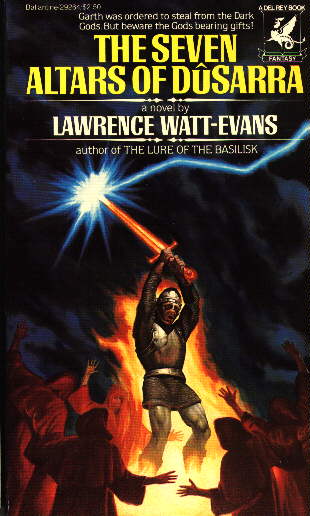
In a round about way, the life of St. Maximian reminds of one of the more influential books in my own personal Appendix N: The Seven Altars of Dûsarra by Lawrence Watt-Evans. In this particular tale, the protagonist is sent off to steal whatever is on the seven altars from the title of the book. Each altar was from a different temple dedicated to one of the “Lords of Dûs” — gods of darkness.


In a reverse of this structure, a campaign inspired by St. Maximian might center around the idea of seven lost temples. In the high days of Civilization, during the reign of a Maximian-like ruler or religious leader, great temples dedicated to the saints (literally “holy ones”) were built all across the Empire. When the Empire collapsed, seven of the greatest of these temples were “lost” — they now lie in lands claimed by the forces of Chaos.

The locations of some are well known (i.e. the ones corresponding to lower level adventures) while the locations of others are lost to the mists of time (and/or might have been moved by some great feat of magic which may very well have been the catalyst for the collapse of the Empire).

The campaign, then, would center around the recovery of seven relics, each associated with one of the seven temples. Fill in your favorite trope here as to why these relics need to be recovered. One that I might be tempted to use is that should all seven be joined together something extremely powerful can be made and various factions have recently come upon the blueprints to make it all possible. Thus, everyone is in a race to secure all seven relics.

Saturday, April 14, 2018

Saintly Saturday: the Holy Martyrs Anthony, John and Eustathius of Lithuania

Today is the feast of the Holy Martyrs Anthony, John and Eustathius of Lithuania. During the reign of Prince Olgerd, these brothers became Orthodox Christians due to the influence of Princess Maria Yaroslavna, Oglerd’s wife. After her death, however, Olgerd turned toward paganism and persecuted the Christians. Imprisoned and tortured, they were all hung from an oak considered sacred by the pagans. Later, the Christians built a church at the site and the stump of the tree became the altar.


This all took place during what can called the Northern Crusades, a fascinating and criminally ignored history. Beginning in the 13th century, Bishop Albert of Riga founded a military order called the Livonian Brothers of the Sword (sometimes referred to as the Sword Brethren). Sanctioned by Pope Innocent III, this group of German warrior-monks were established to aid in the Christianization of the pagans in what today is Estonia, Latvia and Lithuania. Politically, they were there to aid Albert carve out a fiefdom granted to him by Philip of Swabia who laid claim to be Emperor of the Hohenstaufen Holy Roman Empire.

In the end, they suffered high casualties and were absorbed into the Teutonic Order as an autonomous branch called the Livonian Order. It was this order which clashed with the Alexander Nevsky-led Novgorod forces at the Battle on the Ice — so-called because in the swampy environs of the Baltics, winter was campaign season because the frozen ground was the best time to move troops. Lake Peipus was frozen over and was perfect for a calvary charge.

In terms of influential movies on me, Sergei Eisenstein’s Alexander Nevsky has a pull than is even stronger than Star Wars. I saw both in my youth and both have lasting visual, emotional and musical impressions that still resonate will me today. I don’t think I would have been as enthusiastic a D&D player as I still am today without Alexander Nevsky.


This time period is ripe for using as campaign fodder. Take a look at this map:


You have competing bishops, competing denominations of Christianity, you have militaristic monastic order, pagans and lurking off the map the Golden Horde ready to wreck havoc. I would love to see the chaos caused by a group of players in a political situation like this.

As an aside, for those who argue there are no historical examples of the D&D cleric, look no further than this period of history where the concept of the “battle bishop” is not very far from the truth.

Saturday, March 10, 2018

Holmes & Cook: Monk Redux (Saintly Saturday)

Today is the Feast of St. Quadratus of Nicomedia. He was from a rich family and spared no expense helping fellow Christians imprisoned for their faith during the reign of Emperor Decius (A.D. 249-251). When Decius sent his proconsul Perennius to persecute the Christians in Nicomedia, Quadrates voluntarily appeared before him. The saint wanted to encourage those in prison by demonstrating his courage in the face of certain torture and death.

These, of course, followed. In the end, a fire was lit under an iron grate in order to burn Quadratus to death. After the iron was red hot, the saint voluntarily laid down as if he were crawling into bed, unharmed by the heat and fire. Out of sheer frustration, the proconsul had the saint beheaded.

This past week I posted about a possible “Western” version of the monk for my Holmes + Cook thought experiment using the Turning mechanic as a means of fitting the concept into the idea of a cleric subclass. It produced some really interesting comments.

One theme was to make the monk a “buffing” class and the bard was cited as an example. While I think this is quite an excellent idea, my Holmes + Cook thought experiment already has a buff-type class. My suggested version of the Paladin is as a leader-type that has a floating bonus that can be added to various party members. Thus, to have the monk do the same through Turning would be to blur the lines between the two.

That being said, the story of St. Quadratus is a clear example of the type of miracles that inspired the cleric spell Resist Fire and suggests that JB’s idea that the monk be an “inward channeling” character might be a very interesting way to go. In other words, instead of buffing others (like my Holmesian Paladin), the monk uses faith to push himself beyond normal physical boundaries.

Here is a list of cleric spells from Cook that could possibly fit the bill:

  • Cure Light Wounds (1st level)
  • Remove Fear (1st level)
  • Resist Cold (1st level)
  • Resist Fire (2nd level)
  • Silence 15’r (2nd level) — in a nod to the idea of Cadfael and Friar Tuck having thief skills
  • Cure Disease (3rd level)
  • Remove Curse (3rd level)
  • Striking (3rd level)

As I have pointed out before, both Holmes and Cook have eight different types of targets for a cleric’s Turn Undead ability. Above is a list of eight special effects. The question is, what order of difficulty should each of these effects have in terms of the Turning mechanic?

If one were to duplicate the Turn Table exactly as it appears in Cook and replace each undead type with a spell effect from the above list, I would propose the following (from easiest to most difficult):

  1. Remove Fear
  2. Resist Cold
  3. Cure Light Wounds
  4. Silence
  5. Resist Fire
  6. Striking
  7. Cure Disease
  8. Remove Curse

This way all the first level spell effects are available immediately, with the most useful/powerful (Cure Light Wounds) being the hardest to accomplish. The most powerful 3rd level spell (Remove Curse, in my opinion) would be available at 5th level (approximately when 3rd and 4th level spells become available to a cleric at 6th level).

I would place some kind of limit on how many times each of these abilities can to used over the course of an adventure. Once per encounter? A set number of times per day/ per adventure?
Otherwise, a monk at 11+ level would be able to do all of these abilities at will and that seems way too much to me.

Since these Turning abilities are spell-like abilities, I would remove the spell-casting abilities of the monk, but leave their fighting ability alone.

Thoughts?

Saturday, March 3, 2018

Holmes & Cook: Illusionist (Saintly Saturday)

Today is the feast of the Martyrs Eutropius and Cleonicus who were betrayed to the Governor Asclepiodotus of Amasia (northern Turkey) during the reign of Diocletian (A.D. 284-305). They were tortured and crucified. Both of them were kinsmen of the Great Martyr Theodore the Recruit who had been martyred under the previous governor.

This last fascinating piece of information has me meditating on such things as legacies, mantels and traditions of what has come before. In context of RPGs, my first was Holmes Basic D&D. Recently, this reality has hit home because I’ve been watching Matt Finch run Swords & Wizardry Complete on YouTube. 


One interesting quirk about the Complete edition of S&W is that it offers up several different ways to do initiative, one of which emulates Holmes. Fascinatingly, it is this version that Matt uses when running his games. I’ve always wanted to try it out, and I’ve got to admit that it is a lot more elegant that I ever imaged.

This got me reminiscing about my own meditations on Holmes and the thought experiment I had about using it in conjunction with Cook’s Expert D&D. Specifically, this quote:
There are a number of other character types which are detailed in ADVANCED DUNGEONS & DRAGONS. There are sub-classes of the four basic classes. They are: paladins and rangers (fighting men), illusionists and witches (magic-users), monks and druids (clerics), and assassins (thieves).
I’ve postulated an Assassin class (which still needs work), a Paladin class, a Ranger class and a Witch class (reskinned as an Alchemist). Since my last post reskinned magic in terms of language I decided to see what would happen if I used some of the principles I postulated there to come up with a spell list for a Holmesian Illusionist class.

The principles I used look like this:

  • All the spells come from either Holmes or Cook no new spells
  • I took all the spells (from both the magic-user and cleric lists) that could be understood as illusion magic and moved them one spell level down. For example, Mirror Image (a 2nd level magic-user spell) becomes a 1st level Illusionist spell.
  • I then filled out the rest of the spell list with mostly utility spells, moving most to be one spell level higher. For example, Floating Disc (a 1st level magic-user spell) becomes a 2nd level Illusionist spell.
  • I went half-way in-between clerics (8 spells per spell level) and magic-users (12 spells per spell level) to give the illusionist spell list 10 spells per spell level.

Finally, there weren’t enough spells to justify a 6th level spell list, so I limited the Illusionist to 5 spell levels:

1st Level

  1. Audible Glamer
  2. Charm Person
  3. Dancing Lights
  4. Detect Illusion
  5. Invisibility
  6. Light
  7. Magic Mouth
  8. Mirror Image
  9. Phantasmal Force
  10. Read Magic

2nd Level

  1. Cause Fear
  2. Dispel Illusion
  3. Floating Disc
  4. Hold Portal
  5. Invisible 10’r.
  6. Shield
  7. Silence 15’r.
  8. Sleep
  9. Snake Charm
  10. Suggestion

3rd Level

  1. Charm Monster
  2. Confusion
  3. Continual Light
  4. Detect Illusion
  5. ESP
  6. Hallucinatory Terrain
  7. Invisibility 10’r.
  8. Levitate
  9. Massmorph
  10. Wizard Lock

4th Level

  1. Clairvoyance
  2. Dispel Magic
  3. Feeblemind
  4. Fly
  5. Haste
  6. Hold Person
  7. Infravision
  8. Magic Jar
  9. Protection from Normal Missiles
  10. Water Breathing

5th Level

  1. Cloudkill
  2. Dimension Door
  3. Geas
  4. Hold Monster
  5. Invisible Stalker
  6. Projected Image
  7. Remove Curse
  8. Telekinesis
  9. Teleport
  10. Wizard Eye
Spell progression would look like this:
Level…Spells Slots per Spell Level
1st…1
2nd…2
3rd…2…1
4th…2…2
5th…2…2…1
6th…3…2…2
7th…3…2…2…1
8th…3…3…2…2
9th…3…3…3…2…1
10th…4…3…3…2…2
11th…4…3…3…3…2
12th…4…4…3…3…3
13th…5…4…4…3…3
14th…5…4…4…4…3
Otherwise, they function as magic-users.

Saturday, February 24, 2018

Saintly Saturday: St. Cumine the White

Today is the Feast of St. Cumine the White, abbot of Iona. Not much is known of this monastic saint. He was the seventh abbot of Iona, the monastic community on one of the Hebrides — a series of islands off the west coast of Scotland. He was nephew to Segenius who was the fifth abbot of Iona.

During his tenure, he visited Ireland about A.D. 661, the Synod of Whitby took place, which declared that Northumbria would follow the practices of Rome when it came to tonsuring and the calculation of when to celebrate Easter, and the Book of Durrow was completed.

The Book of Durrow is the oldest extant insular illuminated gospel, over a century older than the Book of Kells. While there is much academic debate over where this text was created, one of the contenders is the Iona of St. Cumine.

He also wrote the Life of St. Colum Cille.

He died in A.D. 665 after being abbot for 8 years.

The opening verses of
the Gospel of St. Mark
from the Book of Durrow

Despite the fact the St. Cumine’s hagiography is so thin on details, I find it so inspiring that I am actually going to have to limit myself. I could wax poetic on how the moniker “the White” sounds very Tolkien or how awesome something similar to the Synod of Whitby would be as background noise for a campaign.

Rather, I want to focus on the Book of Durrow and the power of language. In Scripture, words have immense creative power. God creates by speaking: “Let there be light.” God also asked Adam to be a co-creator with him by allowing Adam to name all the animals. When Moses asked for God’s name at the burning bush, it was an audacious act, so God gave him a name that cannot be contained by language: I AM — a sentence that is both complete and yet incomplete (I am….righteous, merciful, love, etc.). Several people throughout the Old and New Testament are renamed by God:

  • Abram becomes Abraham
  • Jacob becomes Israel
  • Saul becomes Paul
  • Simon becomes Peter

In addition, different languages bring different aspects to revelation. For example, in Genesis 3:15 God tells the serpent:
I will put enmity between you and the woman,
    and between your seed and her seed;
he shall bruise your head,
    and you shall bruise his heel.
This particular translation reflects the Greek version of this verse, because it differs from both the Hebrew and the Latin. The “he” and “his” in the second half of the verse appear as “it” and "its” in Hebrew and “her” and “her” in Latin. All three are correct:

  • The Hebrew reflects the eternal enmity between humanity and the devil.
  • The Latin is a prophecy of the Virgin Mary.
  • The Greek is a prophecy of Christ.

This all inspires me to re-skin the Vancian magic of D&D with two additional ideas in mind:

The retro-clone Delving Deeper has clerics memorize spells the same way magic-users do and I have always wanted the spell Read Magic to be something far more important than merely a spell every magic-user has because it uselessly is a prerequisite for writing spells into a spell book.

In this re-skinning, the difference between “divine” magic and “arcane” magic is not the source of the magic, but rather the language. In the same way that the Hebrew, Latin and Greek bring out different aspects of Genesis 3:15, the language used to do magic brings out a different “type” of magic. Arcane magic uses a complex language that is both difficult to learn and results in powerful magics. Its practitioners spend so much time learning the language that they don’t have the time to train with armor or most weapons. Divine magic uses a far more intuitive language that, while easier to master, does not produce the powerful magics the arcane language can. As a consequence divine magic practitioners do have the time to train with armor and (some) weapons. One could even extend this out to other various spell-casters like druids and illusionists.

Since the mechanism of all magic is the same — language written in spell books — this gives us the opportunity to give Read Magic a really interesting twist. Rather than simply being a spell that every magic-user has and is the mechanism for writing spells down in a spell book, it is a spell that can allow a practitioner of one type of magic to memorize a spell from another language — another spell list.

Due to the fact that this spell is being memorized via a spell rather than by actually knowing the language, the spell takes a spell slot one level higher than normal. For example, if a magic-user wanted to memorize Cure Light Wounds it would count as a 2nd level spell.

This, in part, explains why certain spells that appear on more than one list are different levels depending on the caster. For example, Hold Person is a 2nd level cleric spell but a 3rd level magic-user spell. In other words, this spell was originally in the language of divine magic, but was well known enough by arcane users to be translated into the arcane language — as a 3rd level spell.

Thus, Read Magic becomes a really important spell that every one will want rather than the spell that simply takes up space and no one bothers to ever memorize.

This re-skinning also offers all kinds of interesting possibilities in terms of how magic interacts with a campaign world. Rather than having different schools of arcane magic-users, the different schools teach different languages and therefore result in different classes. Each type of magic might bring with it a different culture. One could go so far as to have entire nation-states based upon a different type of language and thus a different type of magic.

Thus, a wizard with the name and moniker Cumine the White might be a magic-user, a cleric, a druid or an illusionist depending on the language he uses to study magic.

Saturday, February 17, 2018

Saintly Saturday: St. Theodore the Recruit

This year, in the Orthodox Church, an unusual occurrence happens. We get to celebrate The Great Martyr St. Theodore the Recruit (sometimes rendered “Soldier”) two Saturdays in a row. February 17th is the Feast of St. Theodore and we also always celebrate him on the first Saturday of Lent (of which I write about here) which falls on February 24th this year.

St. Theodore was a soldier in the Pontine district of Asia Minor (northeast Turkey along the Black Sea). When his commander ordered him to sacrifice to idols, he refused. The saint was given several days to reconsider, during which time he set fire to a temple dedicated to Cybele, “the mother of the gods.” For this he was tortured and sentence to burn to death. He boldly stepped into the fire, and though he gave up his sprint, his flesh was not burned.


There is another St. Theodore who is also a Great Martyr and who also is a soldier. Thus, each is given a different moniker to differentiate the two. Today’s Theodore is called “the Recruit” and the other is called “the Commander” because of the different ranks they held as soldiers.

There is a bit of confusion, however, when it comes to the moniker “The Recruit.” In the Greek it is “Tyronos” which comes from the Latin “tiro” meaning “recruit.” In Greek, when one reads the Feast of the Day, the name of the saint of always in genitive — the 17th is the feast of  Theodore the Recruit. Therefore, the “the” in “the Recruit” is also in genitive. Since “tyronos” is Latin, not Greek, is sometimes mistakenly understood to be a place: St. Theodore ofTyronos. Of course, there is no such place (at least that I or Google Maps are aware of). There is, however, the city of Tyre in modern-day Lebanon. In the genitive is is rendered in Greek “Tyrou” — close enough that might the two might be conflated.

This is a reminder that names and language are important tools in our tool belt as RPGers, designers and players. It also puts a nice spin on a troptastic campaign idea:

There are plenty of examples of folks out there that have posited re-skinning the Lost Caverns of Tsojcanth, The Tomb of Horrors and other classic modules as the end-goal of a campaign-long quest (especially if the said dungeon holds within it a critical magic artifact that several different factions want to get their hands on).

Imagine if there existed a map or a legend or a song that was believed to be the key to finding said quest-ending dungeon. Here is where language becomes very important: as with St. Theodore’s moniker having multiple meanings depending upon grammar and language, this map/legend/song would have a different meaning depending upon which language thought to be its origin.

Thus, depending upon whether or not the party has access to Dwarfish, Elvish, Orcish, etc. the map/legend/song points in a very different direction.

Sunday, February 11, 2018

Guns & SWCL (St. Haralmbos the Hieromartyr)

Yesterday was the Feast of St. Haralambos, also known as the man who would not die. He was a 3rd century priest when he was arrested at the age of 103 or 113 depending on the source. He was subjected to multiple tortures: flesh stripped from his skin, dragged by horses, iron spikes driven into his flesh, flames, etc. He not only endured it all, but miracles poured forth from him convincing many who witnessed these things to become Christian. Admittedly, I struggled to find a way to apply St. Haralambos’ story to RPGs.

Yesterday was also a very busy day for me, so in the end a gave up and let my Saintly Saturday post pass. Then, as I was going to sleep, a thought came to me about Damage Resistance. This then led me to think about my own attempts to use it (despite my negative experiences with it while playing 3.5) in an attempt to remedy D&D’s weakness for simulating why armor disappeared from the battlefield once guns were introduced. I playtested DR and guns and it was not fun.

The impetus for this is a campaign that keeps boiling up every now and then as a consequence of meditating upon the lives of the saints: a fantasy version of Alaska.

As folks who have been reading this blog for the past several months know, my Gamer ADD has been surprisingly focused upon SWCL its possibilities. I have been pleasantly surprised by how forcing oneself into the minimalism of SWCL how easy it is to express really complicated ideas and worlds.

So, my tired, Haralambos-addled brain started to wonder what would happen if I were to apply SWCL’s minimalism to guns in an attempt to emulate the transition away from armor that happened when guns became prevalent?

The problem is Armor Class. D&D’s combat is all about over-coming armor and guns made armor largely irrelevant. Thus, there has to be a minimalist way that guns can ignore AC. As far as I am concerned, the simplest mechanic to use would be the Save.

In other words, guns would operate much in the same way that a Magic Wand works in SWCL:
Magic Wand: cast one 1st level magic-user spell (chosen by referee), 3 times per day.
The one 1st level spell that does damage is Magic Missile:
Magic Missile:
Range: 250 Duration: Instant.
A magic dart unerringly strikes a single target for 1d6 damage.
This, of course, bears little resemblance to a muzzleloader: the range is off as well as the accuracy; however, this allows for some fiddling to make this "Magic Wand" function more like an 18th century musket or pistol.

SWCL gives bows a Range of 100 ft. Of course, this seems historically inaccurate. An English Longbow probably had a range of around 400 yards. Two things to remember, however:

  • Bowmen did not fire at individual targets in battle, they fired at an area in volleys.
  • The Range given in SWCL can be interpreted to be either short range or point blank range and therefore its effective ability to target individuals could be increased to upwards of 300 ft. which seems reasonable given combat conditions.

Napoleonic era tactics had 100 yards as the outside effective range for a volley of musket fire. This would place an effective SWCL range for targeting individuals at 25ft. Given the classic image of the 18th century duel, this sounds fairly reasonable.

Muzzleloaders are infamously inaccurate, so targets should be able to make a Save in order to avoid damage.

In terms of frequency (given the short range and the Save) and given the time to reload, it could be ruled that a gun may be used once per combat.

Thus, what we are left with is the following:
Muzzleloader:
Range: 25 Duration: Instant.
A gun that may be fired once per combat. Target must make a Save or take 1d6 damage.

Saturday, February 3, 2018

Saintly Saturday: The Righteous Simeon

Today is the Feast of The Righteous Simeon the God-Receiver. Simeon appears in the Gospel According to Luke when Mary and Joseph, according to the Law, appear at the Temple 40 days after the birth of Christ to present Him and the proper sacrifice (two turtledoves or two pigeons). Simeon sees them, takes the child into his arms and cries out:

Lord, now let Your servant depart in peace, according to Your word, for my eyes have seen Your salvation, which You have prepared before the face of all people, a light to enlighten the Gentiles, and the glory of Your people Israel!

In other words, Simeon is asking God to allow him to die just as God promised him. On its face, this seems like an odd thing to say. That is, however, until you read about his life. According to the tradition of the Orthodox Church, Simeon was around 360 years old when he met Christ at the Temple.

He was on of the Seventy Jewish Scholars that answered the call of Ptolemy II, Pharaoh of Egypt, to translate the Old Testament into Greek so that it could be included in the Great Library of Alexandria. Initially, the plan was for all seventy scholars to independently translate the Pentateuch (the first five books of the Old Testament) and then gather together to see what the differences were and argue from there. When they gathered together again, all seventy translations were identical. It was therefore accepted as a divinely inspired translation.

What eventually came out of that work is today called the Septuagint (coming from the word for “seventy”). When we read the New Testament (written in Greek) all of the quotes of the Old Testament come from the Septuagint. Interestingly, the Septuagint is the oldest version of the OT that we have. The Hebrew version of the OT we have today (called the Mesoretic Text) is itself a translation made by Jews who wished to get rid of all the Hellenic influence out of Judaism after the fall of Jerusalem in the 1st century A.D. It is considered a translation because the original Hebrew did not have vowels. Thus, it was possible to make several different readings out of the same passage by inserting different vowels. The earliest Mesoretic Text we have dates from the 9th century A.D. Today’s English OT translations are based on the Mesoretic, not the Septuagint which explains why there can be such variance in the quotations the NT makes of the OT.

Simeon was translating Isaiah when he came across Isaiah 7:14
Behold, a virgin shall conceive in the womb, and shall bring forth a Son
He didn’t think the word “virgin” should be used and went to change it, but an angel appeared before him and stayed his hand. He was told:
You shall see these words fulfilled. You shall not die until you behold Christ the Lord born of a pure and spotless Virgin.
Thus, Simeon lived in anticipation of being able to die for almost four centuries.


I am fascinated by this story because it subverts expectations. How many people throughout time have fantasized (and even sought) a way to cheat death? The whole vampire phenomenon is rooted in this primal desire. Yet, here is Simeon hoping to die and even asking God Himself to allow him to taste death.

It also reminds me of one of my absolute favorite characters in all of fantasy fiction: the Yellow King from Lawrence Watt-Evans’ The Seven Altars of Dusarra. In context of an RPG, he plays the role of patron. He is the one who sends the main character on his quests. What makes the Yellow King stand out, however, is that his goal is not money or power but rather, much like Simeon, he is an immortal looking for something that will kill him.


This, of course, is an awesome template for an NPC in any RPG, let alone a FRPG: the patron that pulls strings behind the scenes and helps out the PCs but whose real agenda is actually totally against all expectations.

As I have often repeated on this blog, one of the best things about RPGs is its ability to surprise. An NPC who appears to do one thing that narratively makes sense, but is actually doing something completely different is one of the most entertaining surprises we have available to us.

Saturday, January 27, 2018

Saintly Saturday: The Transfer of the Relics of St. John Chrysostom

Today is the Feast of the Translation of the Relics of St. John Chrysostom. Thirty years after St. John's death in exile, St. Proclus, Patriarch of Constantinople, persuaded the Emperor Theodosius II (A.D. 408-450) to allow the relics of St. John to return to Constantinople. The emperor’s mother, Empress Eudoxia, had sent St. John into exile because he, as the Patriarch of Constantinople, openly criticized her vices. Theodosius issued an edict for the return of St. John’s relics; however, those sent to retrieve could not lift his reliquary. It was not until the emperor wrote a letter of apology and humbly asked the saint to return that the reliquary was able to be moved.

The moniker “Chrysostom” means Golden-mouthed because St. John was a gifted homilist. Fortunately for us, St. John is one of the most well-documented saints in the history of the early Church. We have more of his writing than just about any other saint, including his analysis of the Gospels according to St. Matthew and St. John as well as the Letters of St. Paul.

There is a story of St. John from the time when he was writing on St. Paul that a man who had come to see the saint was turned away because St. John was seen to be meeting with someone at his writing desk who was leaning over and whispering into the saint’s ear. This went on for three days. When St. John openly wondered at what had happened to the man, who he had arranged to meet, those around him became aware of the icon of St. Paul hanging over St. John’s desk and realized that the person they saw whispering in St. John’s ear was St. Paul himself. To this day, that ear remains incorrupt (and I can attest to that because I have seen it myself).


St. John looms very large in the life of the Orthodox Church, because the liturgy we do most of the year is attributed to St. John. Indeed, because of the large number of surviving writings by St. John, modern textual analysis confirms that the Anaphora of the Liturgy of St. John Chrysystom was indeed written by St. John himself. It is a rather humbling and awesome thing to pray his words knowing that 1600 years of Christians before me have prayed the very same thing.

It is a reminder that in our present age, we delusionally believe we have progressed beyond our forbears. While we may have some pretty amazing technology at our fingertips, human beings knew just as much (if not more) about being human hundreds and even thousands of years ago. St. John’s writing is as relevant today as it was in the 4th century. My daughter recently had to read Thucydides for school. I challenge anyone to read that with “United States” in the place of Athens and “Soviet Union” or “China” or “North Korea” in the place of Sparta and be able to tell me that (beyond the technology involved) that the conflict was any different.

We doom ourselves by ignoring the wisdom of those who came before.

In a way, this is why the OSR has been so important for this hobby. We refuse to ignore the past. Indeed, some of us insist that past versions of D&D are better than what came after. I count myself among them. I recently got back together again with some high school buddies of mine to play. Despite a lot of talk about how good 3.5 is and how we all should give 5e a go, we ended up going back to B/X because the wisdom there just cannot be ignored.

I pray we all apply this axiom beyond the gaming table. Pick up a classic and realize that humanity has always been human (both wise and foolish) and that we have a lot to learn from those who came before.

Saturday, January 20, 2018

Saintly Saturday: St. Euthymius the Great

Today is the Feast of St. Euthymius the Great who was born in Melitene in Armenia to faithful parents about the year A.D. 377. His parents were older and barren. They received a vision and conceived in their old age. His parents died shortly after he was born and he was taken in by the bishop of Melitene. He was tonsured as a monk and ordained as a priest. In this role, the bishop placed him charge of all the monasteries in the city.

St. Euthymius, however, yearned for the life of a hermit and left for the wilderness. What follows is a typical pattern of great monastic saints: they go out into the wilderness, attract the attention of the faithful through their piety and the miracles performed through them, a community with a monastery at its center forms and the saint goes off to the wilderness and the pattern repeats itself.

One of the monasteries that St. Euthymius founded in this way was in a cave situated on a cliff overlooking a gorge in the desert of Coutila. Despite its terrifying location (one, BTW, that would make a very interesting encounter area for a campaign), it became the location of a monastery and was very popular with the villages in the surrounding area.

He converted a tribe of Arabs. Their leader was ordained and became known as the Bishop of Tents (an interest FRPG title, if I’ve ever heard of one).

There are several great saints that were taught and/or influenced by St. Euthymius including St. Theoctistus (Sept. 3), Symeon the Stylite (Sept. 1) and St. Sabbas the Sanctified (Dec. 5).

He foresaw his death at the age of 82 and passed on January 20, A.D. 473.


The lives of monastic saints like St. Euthymius are, in many ways, one of the reasons I believe the framework of D&D works so well within a Christian context. The monastic is the adventurer who goes out into the Wilderness (Chaos) to make it safe for Civilization (Law).

The basis for my understanding comes from Scripture. If we look at the geography of Genesis, we have three areas:

  • Eden (which is most likely some kind of plain because the name originally meant “open wastes”)
  • The Garden (which is in Eden and has as its center the Tree of Life a.k.a The Cross whose fruit is Christ Himself)
  • The Land of Nod (which is “across” from Eden and means “a place of restlessness or wandering” — wilderness)

In Leviticus, Aaron is commanded to cast lots on two goats. One is sacrificed as a sin offering, the other is presented alive for the atonement of sins and sent away into the wilderness of Azazel. The name Azazel literally means “rugged of God” which emphasizes “wilderness.” According to the Book of Enoch, Azazel is a fallen angel and leader of the Watchers — he is a demon. Thus, the wilderness of Azazel is a demonic wilderness. This is the origin of the word “scapegoat” — the sins of the people are placed upon the goat and sent into the Demonic Wilderness to feed the demons  in place of people. Thus, especially since Cain is exiled there, the Land of Nod is the place where demons live.

The first great wave of monastics went into the deserts of Egypt — the wilderness where demons reside — in order to fight the enemy in their own territory. Again, this is the model for the classic D&D campaign: the adventurers go into the wilderness full of monsters and humanoids in order to fight the enemy were they live. Upon clearing the wilderness of theses monsters, they build a Stronghold and thus make it safe for Civilization. Then the pattern repeats itself again and again.

Saturday, January 13, 2018

Saintly Saturday: St. Hilary of Poitiers

Today is the Feast of St. Hilary of Poitiers. Born in the 4th century A.D. of pagan parents in Gaul (modern day France), he was trained in philosophy and rhetoric. In his adult life, he saw the weaknesses of a pagan world-view and embraced Christianity. In A.D. 350 he was elected bishop of Poitier were, along with St. Athanasius the Great (who was his contemporary), defended the Orthodox Faith in a sea of Arianism. In other words, most of Christendom under the leadership of the Arian Emperor Constantius believed that Christ not only did not share the same nature as the Father but that there was a time when the Son was not. In contrast, St. Hilary insisted that the three persons of the Holy Trinity were of one nature.

In A.D. 355, the Emperor required all of the bishops to sign a letter condemning St. Athanasius. St. Hilary refused and was sent into exile in Phrygia, which is in west-central modern-day Turkey. It was there that St. Hilary wrote his seminal work On the Trinity. The Emperor soon found that having St. Hilary in such close proximity to the capital was actually causing more trouble than it was worth and St. Hilary was returned to his see in A.D. 360 where he served until his death in A.D. 368. St. Martin of Tours was his protege and after founding a monastery near Poitiers continued St. Hilary’s legacy when elected to be bishop of Tours in A.D. 370.


We are also in the season of Epiphany, which for the Orthodox Church is a celebration of the Trinity:
As You were baptized in the Jordan, O Lord, then the worship of the Trinity became manifest, for the voice of the Father bore witness to You, naming You the Beloved Son; and the Spirit, in the form of a dove, confirmed the certainty of the word. O Christ God, who appeared and illumined the world, glory to You. — Apolytikion of the Feast of Epiphany [emphasis mine]
Many years ago now, JB of B/X Blackrazor asked the question Wherefore Art Thou Religion? In response, I declared Religion Art Right Here where I detailed some of the default fantasy analog for Christianity I use in a lot of my campaigns. This post, however, does not explain the Trinitarian nature of the Istinite God. I delve into my thinking on this with this Saintly Saturday post on St. Athansius himself.

This is all a prelude to adding to this tapestry of a fantasy analog of Christianity by taking an early Christian hymn attributed to St. Hilary and passing it through the metaphoric engine I proposed based on the paradigmata of St. Athansius the Great.

First, lets look at the Hymn Gone are the Shades of Night by St. Hilary:
Gone are the shades of night,
The hours of rest are o'er;
New beauties sparkle bright,
And heaven is light once more.
To Thee our prayers shall speed,
O Lord of light Divine;
Come to our utmost need,
And in our darkness shine.
Spirit of love and light,
May we Thine image know,
And in Thy glory bright,
To full perfection grow.
Hear us, O Father blest,
Save us, O Christ the Son;
Thou Comforter the best,
Lead us till life is done.
Note that the metaphoric theme here is Light vs. Dark. The metaphor I use to describe the fantasy analog of the Trinity for my campaign world is borrowed from D&D: Law vs. Chaos or Civilization vs. the Wilderness:
Nomos (which roughly translates as Law)
Isten (which roughly translates as Crown or King)
Thikeosyni (which roughly translates as Citizenship or Righteousness)
Thus, in order to make this hymn an analog, it is necessary to shift the metaphor and images from Light vs. Dark to Law vs. Chaos.
Gone are the designs of the demonic wilderness
The hours of fear have passed
Remade are the citizens of our metropolis
The people of the New Kingdom are massed
To You our prayers shall speed
O King of the City Divine
Come to our utmost need
In the Chaos it is your rule for which we pine
Citizenship of all that is good and right
May we Your crown know
And in your reign of might
To full perfection grow
Hear us, O Law most blest,
Save us, O Isten the King,
You Righteousness best,
Lead us to life everlasting.
And thus, an analog hymn for my fantasy analog for Christianity based on the work of St. Hilary of Poitiers is born.

Sunday, December 31, 2017

Saintly Saturday: St. Anysia the Virgin Martyr of Thessalonica

(Yesterday was) the Feast of the Virginmartyr Anysia of Thessalonica. Although I had every intention of writing about this yesterday, life got in the way of me having the time, so I am up early today to get these thoughts down.

Anysia lived during the reign of Maximian (A.D. 286-305). She was raised in a pious Christian home and dedicated her life to strict fasting, vigil and prayer after the death of her parents. During the persecution of Christians under Maximian, it was decreed that anyone had the right to kill Christians with no consequences. During this period, Anysia was on her way to church when she was stopped by a pagan soldier. He demanded that she accompany him to a sun festival and offer sacrifice. When she demurely declined, he began to be aggressive. She then spit in his face and declared that, “My Lord Jesus Christ forbids you!” He immediately drew his sword and ran her through.

Christians secretly gathered up her remains and buried her near the city gates. Eventually, a chapel was built over her grave.


There are a couple of FRPG tropes that come to mind when I read the life of St. Anysia: Murder Hobos and Temple Street. Interestingly, her story offers a way of dealing with the first and a refutation of the latter.

Way back when I first starting DMing my group of friends in Jr. High, our very first session was very short. The TPK happened as the PCs were gathering info about the adventures in the area when the thief decided to be a pick pocket. He failed miserably. The City Guard showed up and the party decided that they could fight their way out of the problem. Didn’t happen. My friends were upset, until I explained why their characters couldn’t behave that way and we rolled up a new party which went on to adventure for several years.

The story of Anysia reminds of that, but offers a rather dark twist to the tale as well as a very interesting challenge. Long-time readers know that I love Arneson’s 1 xp = 1 gp of treasure spent. This necessitates players to interact with the world in ways that would not normally happen because they need to creatively get rid of their treasure in order to advance in levels. What if, however, the town or city that was most readily available declared that certain PC classes or races were illegal and could be killed on site? On the one hand, it would offer Murder Hobos all the excuse they need to go on a killing spree, but to what end? All the gold they might get from such an endeavor would be useless. On the other hand, threat of immediate death coupled with the need to get rid of gold to get higher levels might just prove to create a whole new level of creativity as players figure out ways to game the system.

As a kid I never really read any of the popular fantasy stuff that everyone else did. As the guy who usually had to be DM, I liked to go to books that no one had read so that I could have a unique source of ideas that players could be surprised by, rather than having full knowledge of the source material and ruining some of the surprises. One of my favorite of these books was The Seven Altars of Dusarra by Lawrence Watt-Evans. It played hard to the fantasy trope of Temple Street, where our hero, Garth of Ordunin, had to steal objects from the altars of each of the seven temples in the city of Dusarra.


This is great stuff, if you are aping the classic tales of REH, CAS, etc. While one might find such a situation in places like medieval India, there are very few historical examples of Temple Street in the medieval world that is suggested by most FRPGs. The reality is far more likely to be like the story of St. Anysia where Christians found an out of the way place and worshiped in relative secrecy. The medieval world is dominated by monotheistic (or singular) religions and adherents of other faiths live their religious lives quietly and out of the way.

While this may not be as exciting as Temple Street, it does give opportunities for adventure. Adventure locations can be built around different eras of different dominant faiths and the treasure or location the party is after could be a grave hidden near a gate by a religious group now out of favor by the powers that be.

Saturday, December 23, 2017

Saintly Saturday: Ten Martyrs of Crete

Today is the Feast Day of the Ten Martyrs of Crete: Theodulus, Saturninus, Euporus, Gelasius, Eunician, Zoticus, Agathopus, Basilides, Evarestus and Pompey. About the year A.D. 250, during the persecution Decius, these martyrs were brought before the governor from all over the island of Crete: Panormus, Cydonia, Heraklion, and Gortynia. When they refused to renounce Christ, they were tortured in many and sundry ways for thirty days. At this point, the governor was so frustrated he had them all beheaded.

I may have mused on this point before (because it is a point that I make a lot in various milieus), but decapitation was a citizen’s death in the Roman Empire. All of the various nasty things they did to Christians, they did because the crime they were accused of was treason. To refuse to offer sacrifice at the idol of the Emperor was to refuse a citizen’s civic duty.

Thus, when a martyr was beheaded, the official overseeing the trial was admitting that the crime for which the Christian was accused of was false. They were not traitors because they were given a citizen’s death, not the death of a traitor.

Besides the theological victory over death through Christ, many martyrs were also victorious over their persecutors by forcing them to acknowledge the falsehood of the charges against them through beheading.


This leads to an interesting line of questions when it comes to world-building in RPGs: what does it mean to be a citizen? Throughout history, citizenship came with certain privileges as well as responsibilities. For example: feudal societies required those nobles underneath a King to provide taxes and military might when called upon. Likewise, citizens of a City State were called upon to defend the city militarily when in need.

I must admit, this is an aspect of world-building that I have often let go by the wayside. Has it ever been a feature in one of your campaigns? If so, how?

Saturday, December 16, 2017

Saintly Saturday: The Prophet Haggai

Today is the Feast of the Prophet Haggai who prophesied in the year 520 B.C. during the post-exilic era in Jerusalem. Not a lot is known about him. The book in the Bible that bears his name is only two chapters long. It's message can be simply summed up thusly: Quit lallygagging and get the Temple built!

According to Rabbinic Teaching, Haggai is credited with three teachings:
  1. A man whose brother married his daughter (as a co-wife) cannot conssumate a levirate marriage with his deceased brother’s co-wives.
  2. Jews living in Ammon and Moab need to separate the poor man’s tithe during the Sabbatical year
  3. Proselytes should be accepted from the peoples of Tadmor and Kardu
Apparently, Haggai was on good terms with the political leaders of his time, Zarubbabel the Governor under the Persian King Darius I as well as Joshua the High Priest. There is some evidence that he saw in the weakness of Darius and Persia an opportunity to re-establish a Davidic monarchy:
On that day, says the Lord of hosts, I will take you, O Zerubbabel son of Shealtiel, says the Lord, and make you like a signet ring; for I have chosen you, says the Lord of Hosts — Haggai 2:23


From a RPG perspective, there are a lot of things that can be mined out of this.

First and foremost is a traditional Keep on the Borderland kind of set-up with a religious and political undertone not normally found in such set-ups. Normally, the “Bright Empire” collapsed a long time ago and the remnants are either trying to hold on to or are trying to restore what was once Civilized Lands overtaken by the Wilderness. In this particular case, the Keep is manned by a conquered people of a different faith than the Empire. In addition, that Empire is in process of collapsing (with the peoples of Tadmor and Kardu in process of abandoning ship). Thus, ambitious PCs could take advantage of the situation and cause all kinds of mischief.

Second is the idea of the Signet Ring. Admittedly, Haggai uses this image as a simile, but making such an item a relic would be like fuel to the fire in a set-up like that above. Imagine all of the various factions that want to get a hold of the Signet Ring in order to impose their political will on the growing chaos of a collapsing Empire…

Finally, we come to what is probably the most fiddly thing that can be mined from the Book of Haggai: a Lunar Calendar. One of the reasons that we can confidently place Haggai in Jerusalem in 520 B.C. is because he prefaces his three prophetic statements with dates. While the Jews used a lunisolar calendar (which combined cycles of both the sun and the moon) for the purposes of an RPG world, in would be easier to simply use a Lunar Calendar. This shouldn’t be too hard, given the fact that a typical lunar month on earth is approximately 30 days. Basing an FRPG world on a Lunar Calendar shouldn’t be much of a stretch. The fiddly bits come with what one can do with the waxing and waning of the moon.

I mention this because I was going through some dusty back-up discs and found a digital copy of Avalon Hill’s Dragon Pass which uses the phases of the moon to affect the forces of Tarsh (aka the Lunar Empire). The Book of Haggai suggests that one of the major differences between the two religions is the use of a Lunar Calendar because of a dependence upon the lunar cycle for effective magic use. The collapse of the Empire might actually be predicated on a change in the lunar cycle (which could be a long term mystery to be solved by the players).

As I have said multiple times before: the Bible (especially the OT) proves over and over again to be as much as a font of inspiration for FRPGs as anything in Appendix N.