Showing posts with label Swords & Wizardry. Show all posts

Thursday, July 6, 2023

Some Really Good Swords & Wizardry News

For those who did not back Matt Finch's most recent edition of Swords & Wizardry on Kickstarter, he just announced, what is for me, really exciting news. It looks as if Mythmere Games will pass on using the ORC license and will instead produce its own based on the OGL but with some tweaks to shore up some of the weaknesses of the OGL.

Ever since the WotC OGL debacle earlier this year, Matt has been considering making his own license, but wanted to wait on the work being done on ORC. When I heard that, I was really excited, because while S&W may not be my go to ruleset to use at the table, it is my go to ruleset to write for. Personally, based on what I have seen of the ORC license, it is not something I would choose to use. So, if Matt does produce said license, a good number of the stuff I have written in the past and the stuff I will write in the future will have a home.

Given that Matt was one of the pioneers in the world of retro-clones (he also had a hand in OSRIC), I would suggest going over to Mythmere Games and giving him some support.

Wednesday, June 3, 2020

Home brewing a "High-Level" "Dungeon"

So, one of the comments on my post on How I Homebrew a Dungeon, I was asked If I could do the same for a dungeon for characters 6-9th level. My short answer to the question is: No.

I have never been a fan of high-level play and neither were most of my friends. We loved those low-level campaigns and usually accomplished something earth shattering by 6th or 7th level. Indeed, I have only ever gotten one character from 1st to 9th level in my entire career as a player and have only ever seen one character survive to 9th level from 1st as a Referee. Both characters are retired.

In other words, by the time my players have advanced to 4-6th level, they have accumulated enough power and influence that the focus of the campaign shifts from that of dungeon exploration to politics, clearing out wilderness areas, and spending a bunch of money on building stuff (this is nicely encouraged by the Arneson rule where 1 xp = 1 gp spent).

So, I have never really had to homebrew a 6-9th level dungeon. As predicted by Cook’s Expert edition of D&D, by the time my players’ characters get to 4th level, I am usually designing wilderness areas, encounters, and lairs — not dungeons.

That doesn’t mean I can’t or I won’t, especially since folks seemed to find my last outing useful. This endeavor, however, does come with a major caveat. What I have in mind doesn’t really qualify as a dungeon…it is more of an elaborate lair. For me, the word “dungeon” is indicative of the Mystic Underground where no matter how deep you go, there is always something else deeper and more dangerous and the place itself is trying to kill you, not just the monsters.

There are two main reason I am choosing this particular path. First, without the previous 5 levels of a megadungeon and a campaign to riff off, doing the 6th level of such a place is both too daunting and too boring. Secondly, I’ll probably never see a day when I’d actually use it in play. By going the route I am, this will go into my folder of stuff I can pull out on a moments notice to fill a need in an ongoing campaign.

Since this is to be a type of lair, I need to figure out what monster lives there before I go to making or finding a map. So, I pulled out The Tome of Adventure Design and rolled up a person associated with the place, the last significant event that happened there, and the original purpose of the place.

As an aside, when I use random tables (especially one where a d100 is concerned), I freely read the dice in as many ways as I am allowed in order to give me more than one option when it comes to results. This allows me a bit a wiggle room and the ability to be inspired.

For example, I wanted to keep my options open on this one to see what kind of stories might emerge from the random rolls. The person in question was either going to be an Assassin or a Cleric and the place in question was either a place of guilt or a place of burial. Music was involved and it created something that would be dangerous to intruders about 10 years ago.

I then rolled an original purpose and who built it: that was when things began to crystalize. I rolled up a Scriptorium that was built by a unique type of Giant.

The Cleric no longer made much sense, so I went with the Assassin and I ended up using both a place of burial and a place of guilt.

This place was built by a blind giant who was a scribe and a scholar. He needed a way to record the research he had done and so came up with a writing method akin to Braile (note to self, Read Magic is necessary to interpret his writings). For this purpose, he needed someone to dictate various texts to him so that he could study and record his findings.

This role is taken up by an Annis Hag and the two end up falling in love with each other. Whether or not the Giant’s love was voluntary at first or not, the important part here is that the Annis Hag ended up in love with the Giant because he saw past the ugly exterior.

This love story, however, has an ugly underside because the Annis Hag still had an appetite for human flesh. When she made the mistake of lunching on a local prince, an assassin was hired to take her out. The killing blow, however, fell upon the Giant who sacrificed himself for his love.

Among the things and knowledge collected by the Giant was the True Name of a demon and a magical harp that would summon it. In a fit of anguished rage, the Annis Hag used the harp to summon the demon and commanded it to torture the assassin as long as she was alive. Unfortunately for her, summoning the demon destroyed the harp. Caught in the magical explosion, she suffered grievous wounds which have never fully recovered. In order to make sure the assassin suffers as long as possible and to guard her own life, she has since drawn a protective circle around the demon and its prey. At this point the demon is kept at bay virtually by will alone.

In the meantime, a group of hobgoblins have taken up residence. According to my own calculations, hobgoblins are eugenicists who love to experiment with breeding techniques.

Thus, they see value in the knowledge found in the Giant’s lair, the demon trapped there, and the hag that keeps it at bay. They have turned the lair into a house of horrors and feed the rejects of their experimentation to the hag to help keep her alive. For her part, she is grateful for every day the assassin is tortured.

So here is the challenge for the players: this is the location of a McGuffin. Whether a magic item in possession of the assassin, a particular piece of information on one of the Giant’s “scrolls,” or something else, it is inside the protective circle keeping the demon at bay.

Since this set-up is kinda mean, I want to reward the characters by providing a lair that could be converted into a stronghold if they so desire. As a consequence, I am looking for a map of a castle with a dungeon. I found that here. As I did with my 1st level dungeon, I proceeded to number each of the rooms:


Between the castle and the dungeon below there are 63 rooms. Using Moldvay’s “Stock the Dungeon Table” we get the following break down:
11 Monsters without Treasure (technically 10.5)
11 Monsters with Treasure (technically 10.5)
6 Traps
4 Trap with Treasure (technically 3.5)
10 Specials (technically 10.5)
18 Empty Rooms
3 Empty Room with Treasure (technically 3.5)
I rounded up on the number of monsters and traps with treasures and rounded down on Empty rooms to make the math work. I erred in the direction of more stuff.

Holmes suggests that it is possible to encounter wandering monsters within a range of two levels up and two levels down. Thus, at 6th level, it would be possible to encounter creatures anywhere from the 4th level through the 8th level. The math would look like this:
2 Level 4 Monsters
5 Level 5 Monsters
8 Level 6 Monsters
5 Level 7 Monsters
2 Level 8 Monsters
I can already sense some confusion because the main monster group I will be using are hobgoblins, which are Level 2 monsters according to Moldvay. This is where S&W becomes really useful. The Wandering Monster Tables found therein are organized according to Challenge Level. Hobgoblins are CL 1; however, Carnivorous Apes (which hobgoblins are known to associate with) are CL 4. The Wandering Monster Tables suggest combinations of different CL monsters and since hobgoblins are interested in genetic and breeding experiments, it opens up a lot of possibilities for higher level monsters:

  • Ape-like creatures like Flying Apes (CL 6), Gorilla Bears (CL 4), and Girallons (CL 6)
  • Thouls (CL 3)
  • Creatures necessary for breeding the above such as Basilisks (CL 8), Cave Bears (CL 7), Ghouls (CL 3), Perytons (CL 6), and Trolls (CL 8) and Cave Trolls (CL 7)
  • Experimental failures represented by Gibbering Mouthers (CL 6)

Following the suggestions from S&W we come to the following totals:
1 Annis Hag (1400 xp)
3 Basilisks (2400 xp)
26 Carnivorous Apes (3120 xp)
3 Cave Bears (1800 xp)
8 Cave Trolls (4800 xp)
1 Demon, Erinyes (1400 xp)
2 Flying Apes (800 xp)
28 Ghouls (1680)
7 Gibbering Mouthers (2800xp)
15 Girallons (6000 xp)
14 Gorilla Bears (1680 xp)
112 Hobgoblins (1680 xp)
3 Perytons (1200 xp)
42 Thouls (2520 xp)
4 Trolls (3200 xp)
Total xp = 34,800
In case anyone is wondering where I am going to fit 117 hobgoblins, remember that this place was built by a Giant. Thus, everything is twice the size a map normally would be — giving me plenty of room to stuff all these creatures wherever I want.

The average Treasure Roll is going to be 2.5, so the base treasure is going to be 87,000 gp. Going by math (because I don’t want to roll this many times), the 100 gp Trade Outs will result in 83 Minor Gems and Jewelry and 4 Minor Magic Items. The 1000 gp Trade Outs will result in 8 Medium Gems and Jewelry and 1 Medium Magic Item.The 5000 gp Trade Outs will result in 2 Major Gems and Jewelry and no Major Magic Items.

Thus, there will be 13,500gp in Minor Gems and Jewelry, 5,200 gp in Medium Gems and Jewelry, 6,500 gp in Major Gems and Jewelry, and 67,000 gp in Miscellaneous treasure for a grand total of 92,200 gp.

There are 18 rooms with treasure. If each has 5000 gp I will have 2200 gp left over to place where I deem fit in the moment (probably with the Annis Hag hidden inside the tomb of the Giant).

There is a total of 127,000 xp available, or 31,750 per character in a party of 4. This should be enough for most characters to go from 6th to 7th level easily.

Now to place all of this stuff in the dungeon:

The Annis Hag will be in Room 1.38, an appropriate place for a bedroom turned tomb.
The Erinyes will be trapped in Room 2.21, being the lowest part of the entire structure.

As for the rest of the monsters, they can be categorized into three types:

1. Hobgoblins and their allies
2. Prisoners used to do breeding experiments
3. Failures

The failures would be the Gibbering Mouthers, which are locked away in Room 2.20, since that is nice and isolated.

The prisoners could all be stored away in Rooms 2.3-2.10. These include the basilisks, cave bears, cave trolls, ghouls, perytons, and trolls.

To fill out the dungeon level, I would place Thouls in Rooms 2.12 and 2.18 as guards.

The rest of the monster populate the upper floor, with the hobgoblins, carnivorous apes and gorilla bears primarily occupying the towers — Rooms 1.35-1.37 and 1.39-1.43.
girallons and flying apes would occupy Rooms 1.1 and 1.9.

That’s 22 rooms with monsters. Also note: I’ll probably sprinkle hobgoblins, thouls, and carnivorous apes throughout the last 20 rooms to demonstrate the basic theme of its current use.

Now I need 10 Specials:

Room 1.3 is a magical hall of perfumes. The central section of the hall rains down clouds of the stuff from the ceiling when someone passes through. The stuff is so strong it reduces the chances of surprise to 1 in 6 for 24 hours.
Room 1.5 is a magical hot tub that automatically undresses anyone entering and drying and clothing anyone leaving (with a small percentage of some kind of screw-up)
Room 1.6 is a magical gallery; however, the “pictures” are designed for the blind.
Room 1.8 is a magical music room with various levers and buttons that create various sounds. The music is designed to play throughout the castle, alerting everyone of the player’s presence.
Room 1.21 is a magical kitchen and 1.22 is be a magical ice room for storing food.
Room 1.27 is a library with a device that fetches certain books, but only works if the commands are given in the language of giants.
Room 1.33 is the scriptorium, with a special device used to create the “Braile” scrolls created by the Giant.
Rooms 2.11 and 2.13 are incubating and birthing chambers for the breeding experiments.

Now for 4 rooms with treasure guarded by a trap:
Rooms 1.14, 1.16, 1.30, and 2.2 all suggest themselves because they are dead-ends.

The six remaining traps:

Rooms 1.15 and 1.17 are suggestive because of the portcullises indicated on the map.
Rooms 1.2 and 1.31 are good candidates to alert the hobgoblins in the towers.
Room 2.17 has access to the demon.
Room 2.19 keeps the Gibbering Mouthers at bay.

Finally, I need two Empty Rooms with treasure:

I like Rooms 1.25 and 2.16 for this for no real particular reason.

For the rest, I might note some things to indicate this was once the home to a scholar with servants. Servants quarters, storage rooms, guest rooms, supplies necessary for scholarly work, etc.

Done.

Note: I have sprinkled some cool features within this castle that might prove useful should the players ever want to claim this as their own. Consider it an incentive and a reward for putting up with my dark sense of humor.

Also note: The chances of me ever actually using this are not high. But who knows, it may one day prove useful...if not to me than someone out there who wants to take this and run with it.

Thursday, May 28, 2020

How I Homebrew a Dungeon

Justin Alexander has an interesting post about the decline of D&D Adventure Modules. His is a fascinating observation, and one that I am afraid I have to generally agree with. Although, as an aside, I must admit that in my experience as a Referee there are not many “good” adventures in the overall D&D library. I long for the shared experience of running particular adventures, but it is very rare that I find using a module at the table a good experience.

Since I have been thinking about how to prep a sandbox campaign with my middle child in mind, I thought it might be fun and useful to share some of my own techniques and thought processes when creating a 1st level dungeon adventure.

As another aside, I tend to use Swords & Wizardry to design adventures because its Monster Stat Blocks and treasure generation system are both nicely stripped down and simple. This saves on a lot of prep time. Also, at the table, I prefer converting from simplicity to complexity rather than the other way around.  

I tend to start with a map. I am a highly (if not extremely) visual person. Thus, “seeing” the adventure helps me visualize what I want the adventure to be about. So, I went to the archives of maps that Dyson Logos provides and chose a “good” map.

By “good” I mean something that immediately introduces choice to players and offers several different routes to various locations via “loops.” I also like maps that have evocative features. In this particular case I like the underground “lake” as well as the natural dais in one of the large caverns.

Once chosen, I labeled each encounter area with a number:


Strictly following the percentages of Moldvay’s “Stock the Dungeon Table” on B52 of his Basic D&D we get the following:
4 Monsters without Treasure
4 Monsters with Treasure
3 Traps
1 Trap with Treasure (technically 1.33)
4 Specials
7 Empty Rooms
1 Empty Room with Treasure (technically 1.33)
In order to get an idea of what Monsters to use, I pulled out The Tome of Adventure Design and rolled up an interesting name for the dungeon: The Dais of Imprisonment. Seems apropos, given my initial attraction to the natural dais in Room 19. It also suggests that there be some kind of monster dangerous enough to need a special prison. I also rolled up why the dungeon was abandoned: a disease wiped out the inhabitants 1000 years ago.

In his edition of Basic D&D, Holmes also has a useful table for stocking dungeons. He suggests that monsters up to “Three Levels Below Ground” can be found wandering on the First Level of a dungeon. Strictly applying the math of Holmes results in the following:
5 Level 1 Monsters
2 Level 2 Monsters
1 Level 3 Monster
My first thought when it came to a “Level 3” monster to occupy “The Dais of Imprisonment” was a mummy, due to the disease factor implied by my random roll in The Tome of Adventure Design; however, the idea really didn’t inspire me much. Then I took a look at what monsters Moldvay has on his Wandering Monster Tables. That is where I saw a Medusa(!) on his Level 3 Wandering Monster list. Now that sounds interesting!

So, Room 19 has a magically sealed coffin suspended by chains atop the natural dais. Trapped inside is a Medusa, once a beloved ruler of her people and then cursed by her own lust for power. (Something to keep in the back of my head, but not something important until the players ask: can the curse be broken and how?)

For my Level 2 Monsters, I wanted to evoke the idea of diseased undead that were once the guardians of the prison. So, I chose Leper Zombies (found in Monstrosities). These two will be in isolated areas of the dungeon: Room 4 (which can only be opened by figuring out how to use the mechanism in Room 3) and Room 23.

This leaves the northern section of the map to populate with a tribe of kobolds and their pet boars who avoid the southern part of the map because they instinctively know better. They will occupy Rooms 10-14 with the chief and guards in Room 11.

Behind a Secret Door (which has not been found by the Kobolds), Room 15 is a nice place for a Treasure guarded by a trap.

Room 5 suggests a natural Trap of a collapsing ceiling.

Given their access to the Dais of Imprisonment, Rooms 17 and 18 are also good candidates for traps.

Technically, I have already placed a “special” in Room 3 so that leaves three:

Room 8 is very suggestive, given the coffins of the former guardians of the place. It could very well be a place of visions which suggest the dungeon’s past.

Given the long standing trope of magic pools, Rooms 22 and 24 are also good candidates.

Given its simplicity, I am very much attracted to hiding some treasure in Room 2.

As an aside, Room 16 is a set of collapsed stairs which gives me room to expand this dungeon if I want to.

That’s all my monsters, traps, specials and empty rooms.

In total I have the following monsters (and S&W XP values):
42 kobolds (210 xp)
3 goblins (kobold chief and guards) (30 xp)
2 wild boars (240 xp)
2 leper zombies (120 xp)
1 medusa (800 xp)
(Total xp = 1400)
According to S&W, base treasure value is 1d3+1 times the total xp value. I am going to assume a roll of '3' for a pair of reasons. First, I want to give PCs an opportunity to level up. Second, I have a couple of "1.33" treasures according to the strict math of Moldvay's Stocking Table.

This gives me 5600gp of treasure value to play with.

500gp will be traded out for Minor Gems which result in 1100 gp in gems and jewelry.

Thus, there is a grand total of 6200 gp in treasure. Given that there are 6 Rooms with treasure, that means each room has approximately 1000gp with an extra 200gp to fill in wherever I think is cool in the moment. Note: This value can take the form of anything. For example, the treasure found with the Leper Zombie in Room 4 could take the form of 1000gp worth of burial urns and the the Kobolds could be enamored by the fact that they have a "massive" treasure of 100,000cp.

In total, there are 7800 potential xp for PCs to earn in this dungeon, or 1950 xp per PC in a party of 4 characters. With some XP bonuses, that gets us to approximately 2000 xp and a level up for Clerics, Thieves, and Fighters. Should Wandering Monsters be added to the mix, this dungeon is within spitting distance of giving everyone a good shot at leveling up.

Speaking of which:
Wandering Monster Table
1. 2d6 Kobolds
2. Wild Boar
3. 1d6 Skeletons
4. 1d6 Zombies
5. 1d6 Fire Beetles
6. 2d6 Giant Rats
Some notes:

There are two keys necessary to open the sealed coffin of the Medusa. The two Leper Zombies have one each.

Items dipped into the waters of Room 24 produce the effects of the spell Gaze Reflection for 1 day. If a magical shield should be dipped into those waters, the effect of the spell is permanent.

I know my rolls did not produce a magic item, but to give players a chance at taking advantage of the waters in Room 24 I will place a +1 shield in the hands of the Leper Zombie in Room 4.

Despite all these opportunities to get an amazing weapon against the medusa, my dark sense of humor is tempting me to make the Medusa blind after being imprisoned for 1000 years in the dark. While robbing players of an easy kill (given that they have a mirror or the Gaze Reflection effect), it also means that the medusa is going to be at -4 on all her to-hit rolls.

The Skeletons and Zombies on the wandering monster table indicate that any dead who are left inside this dungeon are affected by the events of 1000 years ago and rise as undead.

Kobolds encountered outside of their lair are those that got too curious for their own good.

The Fire Beetles and Giant Rats are standard dungeon vermin.

I might make some simple notes about what various things are on the map (like maybe some crumbling mosaics on the columns in Room 1)

The rest, I'd improvise at the table using visual cues from the map and the basic background information I've determined so far.

Done.

Given my own experience at the table, this sparse little document will result in a much more dynamic and fun experience than virtually any published module out there. Rather than having to wade through walls of text, I just have to describe what my imagination comes up with in the moment. An emergent story will be enhanced by player choice, action, and questions. In the end, I will have a mythology based purely on play that will go on to inform whatever campaign this exists in and possibly many others as well (depending on how cool that story becomes).

Wednesday, May 27, 2020

Resources for Making a Sandbox from Scratch

So, with school officially ending and with no summer programs in sight, I decided to challenge my middle child with the task of creating a sandbox campaign. Although well-versed in the video gaming scene, he has only played in a few D&D campaigns, all run by yours truly. As a consequence, he really had no idea where to start. This got me to deal with the practical reality of how to make a sandbox campaign from scratch: what resources did I actually recommend and what actually worked?

1. An Atlas

Rather than trying to explain the realities of geography, weather, etc in order to make a plausible world, I just turned an atlas upside down and said, pick a page that looks cool. Not only did this make the mapmaking step of the process easy, it follows in the footsteps of giants:

The basic campaign area reproduced on a large mapsheet outside this book, was originally drawn from some old Dutch maps. — Dave Arneson, "The First Fantasy Campaign" (1977).

2. Kilgore’s Sub-Hex Quad and Master Sheet for Hex Quads Maps

Having chosen the upside-down Aegean Sea as a starting point, I had him transfer the map as best he could to Kilgor’s Master Sheet for Hex Quads. Having done that, I asked him where Civilization was and where the Wilderness was. Once that was determined, I had him pick one Quad in the Wilderness to focus on for the campaign. This was then transferred to one of Kilgor’s Sub Hex Quad sheets.

3. The Wilderness Encounter Tables in Swords & Wizardry

These are simple, organized by terrain type and produce some pretty bog-standard results that won’t challenge a new Referee too much. I had him roll a d10 for every hex on his map. Every ‘1’ resulted in a creature from the encounter table living there. Frost Giants, Lycanthropes and Berserkers dominated the landscape. Oh, and a Purple Worm right next to some old ruins.

4. My own Interpretation of Holmes on Cultures

Based on the monsters that lived in the Wilderness, he decided that the Ancient Culture were the Giants that “dug too deep” and were destroyed by Purple Worms, the Old Culture was a human culture roughly based on Russia that succumbed to madness and Lycanthropy. Then he decided that there were two competing Present Cultures. One is based roughly on the Incan Empire (with virtually no magical tradition) and the other roughly on the Republic of Texas (which is heavily magical). My eldest was thrilled at the idea of playing a magic-wielding cowboy (which eventually morphed into a society where the rite of passage to adulthood involves getting a tattoo that allows the recipient the ability to cast one first level spell a day).

5. Dave’s Mapper

This quickly produced a tent-pole megadungeon sideview and first level that “looked cool” and was thus inspiring. What more can you ask from a map?

6. The Tome of Adventure Design

I have said it before, and I will say it again: this may be the best RPG product I have ever purchased. It is chuck full of inspiration and ideas. I first had him roll up names for each of the level of the megadungeon. Then, it was used to create the various “Traps” and “Specials” that resulted from using the next resource.

7. Moldvay’s Basic D&D “Stock the Dungeon Table”

Found on page B52, this has been my go-to stocking tool for decades. While it doesn’t produce perfect results, it gets you in the ballpark as long as you understand that the results are there to inspire and not be set in stone. As long as you understand why things exist in your dungeon and it makes sense to you, it will make sense to the players.

8. Monstrosities and Swords & Wizardry

Despite voicing a desire to play 1e AD&D, I decided on Monstrosities and Swords & Wizardry for a resource on monsters to stock a dungeon because of the guidelines S&W gives for the Challenge Level of dungeon encounters. I have been quite satisfied with how well this works in game play. As a consequence, it provides a great starting point on understanding how difficult a particular dungeon area/encounter is going to be. Monstrosities also provides an example encounter for every monster in the book. So, it is also instructive about what those encounter and dungeon areas can look like.

Finally, generating treasure using S&W is dead simple and flexible. Whatever gets rolled indicates total value, not a specific coin count. So, a treasure could very well be in barrels of whisky, rolls of silk, or whatever tickles your fancy.

9. The Question “Why?”

Why do think the goblins are there? Why are they on the same level as those spiders? Why are they risking their lives to be there?

Again, if your dungeon makes sense to you, that confidence and knowledge will be communicated to the players and it will make for a better game.

10. Dyson’s Maps

Once the first level of the megadungeon was squared away, I had him choose three maps from Dyson’s collection to represent various lairs in the vicinity of the starting village. I had him repeat the various steps he used to do the first level of the megadungeon.

In the end, I had to cut him short when he told me he had an idea for his various dungeons. “Just write it down” became a mantra. It goes to show, however, how useful all of these resources are: they inspired a newbie to create a world where things make sense to him and enough choices for his players that he won’t be having to improvise that much any time time soon.

In other words, he’s confident he can do this.


Saturday, March 3, 2018

Holmes & Cook: Illusionist (Saintly Saturday)

Today is the feast of the Martyrs Eutropius and Cleonicus who were betrayed to the Governor Asclepiodotus of Amasia (northern Turkey) during the reign of Diocletian (A.D. 284-305). They were tortured and crucified. Both of them were kinsmen of the Great Martyr Theodore the Recruit who had been martyred under the previous governor.

This last fascinating piece of information has me meditating on such things as legacies, mantels and traditions of what has come before. In context of RPGs, my first was Holmes Basic D&D. Recently, this reality has hit home because I’ve been watching Matt Finch run Swords & Wizardry Complete on YouTube. 


One interesting quirk about the Complete edition of S&W is that it offers up several different ways to do initiative, one of which emulates Holmes. Fascinatingly, it is this version that Matt uses when running his games. I’ve always wanted to try it out, and I’ve got to admit that it is a lot more elegant that I ever imaged.

This got me reminiscing about my own meditations on Holmes and the thought experiment I had about using it in conjunction with Cook’s Expert D&D. Specifically, this quote:
There are a number of other character types which are detailed in ADVANCED DUNGEONS & DRAGONS. There are sub-classes of the four basic classes. They are: paladins and rangers (fighting men), illusionists and witches (magic-users), monks and druids (clerics), and assassins (thieves).
I’ve postulated an Assassin class (which still needs work), a Paladin class, a Ranger class and a Witch class (reskinned as an Alchemist). Since my last post reskinned magic in terms of language I decided to see what would happen if I used some of the principles I postulated there to come up with a spell list for a Holmesian Illusionist class.

The principles I used look like this:

  • All the spells come from either Holmes or Cook no new spells
  • I took all the spells (from both the magic-user and cleric lists) that could be understood as illusion magic and moved them one spell level down. For example, Mirror Image (a 2nd level magic-user spell) becomes a 1st level Illusionist spell.
  • I then filled out the rest of the spell list with mostly utility spells, moving most to be one spell level higher. For example, Floating Disc (a 1st level magic-user spell) becomes a 2nd level Illusionist spell.
  • I went half-way in-between clerics (8 spells per spell level) and magic-users (12 spells per spell level) to give the illusionist spell list 10 spells per spell level.

Finally, there weren’t enough spells to justify a 6th level spell list, so I limited the Illusionist to 5 spell levels:

1st Level

  1. Audible Glamer
  2. Charm Person
  3. Dancing Lights
  4. Detect Illusion
  5. Invisibility
  6. Light
  7. Magic Mouth
  8. Mirror Image
  9. Phantasmal Force
  10. Read Magic

2nd Level

  1. Cause Fear
  2. Dispel Illusion
  3. Floating Disc
  4. Hold Portal
  5. Invisible 10’r.
  6. Shield
  7. Silence 15’r.
  8. Sleep
  9. Snake Charm
  10. Suggestion

3rd Level

  1. Charm Monster
  2. Confusion
  3. Continual Light
  4. Detect Illusion
  5. ESP
  6. Hallucinatory Terrain
  7. Invisibility 10’r.
  8. Levitate
  9. Massmorph
  10. Wizard Lock

4th Level

  1. Clairvoyance
  2. Dispel Magic
  3. Feeblemind
  4. Fly
  5. Haste
  6. Hold Person
  7. Infravision
  8. Magic Jar
  9. Protection from Normal Missiles
  10. Water Breathing

5th Level

  1. Cloudkill
  2. Dimension Door
  3. Geas
  4. Hold Monster
  5. Invisible Stalker
  6. Projected Image
  7. Remove Curse
  8. Telekinesis
  9. Teleport
  10. Wizard Eye
Spell progression would look like this:
Level…Spells Slots per Spell Level
1st…1
2nd…2
3rd…2…1
4th…2…2
5th…2…2…1
6th…3…2…2
7th…3…2…2…1
8th…3…3…2…2
9th…3…3…3…2…1
10th…4…3…3…2…2
11th…4…3…3…3…2
12th…4…4…3…3…3
13th…5…4…4…3…3
14th…5…4…4…4…3
Otherwise, they function as magic-users.

Thursday, October 19, 2017

Zero-Level Characters for SWCL

For those not already aware, Swords & Wizardry Continual Light dropped earlier this week. While I have a few quibbles (like the fact that there are monsters who can surprise on a 1-3 on a d6 and Thieves can backstab surprised opponents but there are no rules for surprise in the combat section), I really like this ruleset. It elegantly boils down D&D to its essence with as few rules as possible and still presents an immensely satisfying game.

I think my favorite part of the entire ruleset is the way it handles Optional Classes like the Ranger and the Monk. They play exactly like one of the four core classes: Fighter, Cleric, Magic-user or Thief, with an extra ability tacked on. The price a player pays for this ability is a slower level progression. Since experience is handled by the number of sessions played, the optional classes simply add an extra session to each level. Brilliant!

What I love the most about the way SWCL handles these Optional Classes is that it provides a very simple way to create world-specific classes that add a lot of color to the campaign without a lot of a lot of mechanics: take one of the four core classes, tack on a special ability and you are good to go!

Thus inspired, I decided to take the rough idea of zero-level characters that I mused about in my last post and applied the mechanical elegance of SWLC to produce a supplement that provides players and referees of SWLC a way to use zero-level characters to bring some life, depth and background to the characters that inhabit their campaigns.

Art by Joyce Maureira

You can download it here.

Friday, May 12, 2017

Gamer ADD: A Map of the Haunted Keep

Haunted Keep Background


In the ancient days when the Shorsai Forest was part of great expanse of woods that made up the Forest Kingdoms, an elven queen of great renknown by the name of Mabh died a tragic death. With great pomp, she was entombed in a burial mound with some of her most prized possessions.

As the ages passed, the Great Forest receded and Shorsai Forest became part of the Wilderness. The legend of Queen Mabh passed into distant memory. With the coming of man came a desire to tame the Wilderness. The first settlers of the area built a keep upon a rise within a clearing in the middle of the Shorsai Forest. Little did they know that they were building on the burial mound of the long forgotten Queen Mabh.

For many years, the keep served its purpose well by keeping the forces of Chaos at bay. Save for strange dreams that sometimes haunted the inhabitants, the keep began to thrive. Things changed, however, when the keep was expanded. Rumors warned of a gathering army of humanoids to the north. Therefore, a tower was built to help protect the keep in case of a siege. Due to the movements of time and earth, one of the prized possessions of Queen Mabh had been displaced to the ground where the tower was built and the short sword Dawnbringer fell into the hands of men.

This greatly angered the spirit of Queen Mabh and she reached far and wide to find her brethren to take revenge on those who had stolen her prized sword. With dreams she pleaded with elven heroes to find the Siege Seed to destroy the keep’s walls and to kill every one inside.

Finally, an elf by the name of Ionhar answered the call and completed the task to find the Siege Seed. Raising an army he drove north out of the Forest Kingdoms and laid siege on the keep. While the bulk of Ionhar’s forces attacked the keep’s tower, a small force snuck behind to bury the Siege Seed at the base of the keep’s northwestern wall. A great tree sprang forth from the earth, tearing a huge hole the the keep’s defenses.

Before the elves could overrun the keep, however, the humans retreated to the tower, where they were able to seal its only entrance with a great stone. Unable to bypass the tower’s defenses, the elven offensive ground to a halt.

Enraged at the failure of the elven forces, the spirit of Queen Mabh turned to necromancy. She cast a spell that doomed her soul to undeath and enveloped the entire keep in a life-draining green flame. Elf and human alike were consumed. No-one has seen the Dawnbringer since that fateful day.

Since then, the keep lay in ruin and came to be known as the Haunted Keep due to the strange green glow that could sometimes be seen at night coming from the ruins. Whether the glow comes from Queen Mabh herself, the ghosts of the armies that once fought over the keep or if it is merely the trickery of the fey that have since come to make the Shorsai their home no one knows.


Tuesday, May 9, 2017

Gamer ADD: A Ghast at the Possibilities

As far as I am concerned, the mark of a really good monster folio are those little phrases that allow you to completely rethink another type of monster. As an example, the idea that hobgoblins hang out with carnivorous apes according to the MMI gives me permission to do this.

I took advantage of the Swords & Wizardry Appreciation Day sale by Frog God Games and picked up Tome of Horrors 4 because, as I said yesterday, Tome of Horrors Complete is one of my all time favorite collections of monsters. The fourth installment of the series is less immediately useful because it errs towards the high to really high level spectrum of adventuring (there are more creatures with a CL18 than either CL A to 1 or CL 2 and there are over 30 creatures with a CL of 20+) and I do not care for the fact that all the illustrations are in color, but it does qualify as a really good creature catalogue because of a little blurb under the listing of the Banshee Queen:
Any male slain by a banshee queen’s magic rises to become a ghast in 1d4 rounds.
I have to be honest, I have never really used ghasts in my adventures. Once you get beyond the point where ghouls get used as the go-to-undead, there are so many more evocative creatures in the catalogue of undead than a beefed up ghoul. Why dip into that well again?

Given the fact that fey are playing a large role in my most recent case of Gamer ADD, I was attracted to the idea of a queen banshee, given that it is an undead fey. When confronted with the idea that the source of ghasts may very well be a queen banshee, I had to take another hard look at the ghast:
Ghasts are highly intelligent ghouls. Their charnel stench is so powerful that anyone nearby (about 10ft) must make a saving throw or suffer a –2 penalty on attack rolls.
Note that phrase “highly intelligent.” This is no mindless zombie hanging out in grave yards digging around for scraps. A ghast has the potential to be a master-mind, a main villain, the mover and shaker behind the scenes that pulls the strings of an entire campaign. Given the fact that ghasts reek to the point that anyone in the immediate vicinity is going to be sick, they would have to use subordinates and agents to do their bidding.

This begs the question: what would a highly intelligent undead that couldn’t walk around civilized society want out of undeath? I could easily imagine an undead version of Hannibal Lecter waxing poetic about the various gastronomical possibilities of elves versus humans, but what if a paladin or a cleric found themselves trapped in their own stinking corpse plagued by an insatiable hunger for human flesh? That phrase “highly intelligent” does not translate immediately into “slave of the banshee queen” or even “willing servant of the banshee queen.”


Imagine, for a moment, a former paladin who seeks to use his new lot in un-life to do what good he can, given the fact that he is a rotting corpse who needs to eat people. The idea of a cloaked and masked avenger wandering the streets at night putting fear in hearts of the criminal element has never so haunting, because he would be literally eating them.


Or imagine a someone unwillingly turned into a ghast who then spends his entire un-death trying to take revenge on those he thinks responsible: elves.

Or imagine a ghast pouring over necromantic tomes in a desperate quest to move up the ranks of undeath, so to speak.

I think I am going to have to include ghasts far more often in my campaigns, because the possibilities are endless…

Monday, May 8, 2017

Gamer ADD: In Need of Some Fey

In the wake of receiving the Swords & Wizardry Legion Packet, I have been hit pretty hard with Gamer ADD, so much so that I have persisted in trying to put together campaign ideas for the map provided with the SWLP despite the fact that the last couple of weeks have been brutally busy for yours truly.

Besides the issue of scale, the first issue I had to deal with was choosing which part of the map to focus on to build a campaign around. In my experience, an area of 4x6 five to seven-mile hexes is plenty to run a goodly amount of a campaign with. I decided to focus in on the village of Darnagal because of its proximity to several different evocative features on the map:

  • Shorsai Forest (which just screams fey to me)
  • Isle of the Blessed Serpent (which is a mid-high level adventure waiting to happen)
  • The Haunted Keep (which sounds like a great excuse to make the top levels of a mega-dungeon)
  • The Sacred Glade (which just solidifies the idea that fey are going to play a big role in the campaign)

In addition, The Great Salt Marsh and the Ruins of Varagost, though outside the 4x6 hex area I will originally focus on are close enough to suggest a high-level adventure area for later in the campaign once players start to get the itch to explore far and wide.

When I start a campaign, I generally like to make a few rules for myself so that I keep things focused and by delineating limits on what I will allow myself to do, I tend to be more creative with what little I am left with. Since this is campaign is inspired by S&W and Frog God Games, I decided to limit myself to the Tome of Horrors Complete, one of my favorite monster collections of all time. In terms of sheer inspiration (there are many campaigns I would run out that book if I could) I rate second only to the Fiend Folio and that is primarily because the Tome converts and updates a lot of the material in the FF to the OGL.

Since the area I have chosen evokes the fey so strongly, I decided to go through the Tome and collect data on all the various creatures therein that could arguably be called fey. Two things struck me:

  • The vast majority of fey creatures are neutral.
  • There was a pattern of powers that was reasonably consistent.

This gives rise to two thoughts:

  • The fey are not going to be either the protagonists or the antagonists of this campaign. The main difference between seelie and unseelie fey is whether or not they are willing to cooperate with humans. Regardless, their main goal is to protect their own. If a party is killed off by fey, it is because they did something to threaten the fey domain; however, the party could potentially go through an entire campaign without one real whiff of a fey presence as long as the fey interest is protected.
  • I am not a big fan of the way D&D and its clones categorize and portray the fey. By having both brownies and buckawn (which are described as being related to brownies) there is a strong implication that these two populations are separate entities, even if they are related. When I think of fey, I think of Shakespeare’s Midsummer Night’s Dream where the fey kingdom is portrayed as being a hodgepodge of all kinds of fey creatures. Since all of the various fey in the Tome of Horrors are quite similar in power and scope, I decided to boil them all down to a single monster entry.

Arthur Rackham's The Meeting of Oberon and Titania

Shorsai Fey
HD 1d6
AC 3[16]
Attack Weapon (1d3)
Save 16
AL N
Move 12 (+special, see below)
CL/XP 2/30
Special: see below

Shorsai Fey come in a wide variety, but all have the following abilities:

  • Magic Resistance 25%
  • Invisibility (self) at will
  • Detect Good/Evil at will
  • Illusion Magic (choose one of the following: Confusion, Mirror Image or Phantasmal Force) once per day
  • Light/Darkness once per day
  • ESP once per day
  • Poison Use (Seelie use White Moonberry Poison which induces sleep on a failed save while Unseelie like to use purple Moonberry Poison which does 1d8 damage on a failed save)
  • Each individual Shorsai Fey will have a special move that they can do in their favored environment which allows them a Move of 24. For example, a water fey would have a move of 24 in a river while a wood fey would have a move of 24 in forested areas.

To reiterate: these fey are what I like to call background noise. They will react to events in the world and may prove boon or bane to a party depending upon whether or not their activities are seen as a threat.

Monday, April 24, 2017

Swords & Wizardry Legion

I got a very special surprise in the mail today. Michael Badolato was kind enough to send me the Swords & Wizardry Legion packet and it is Awesome! This thing is gorgeous and it makes me wish I were 9 years old again so that this could have been my first introduction to roleplaying. It is simple, elegant and just gorgeous to look at. You get two cards for each character class that has everything you need to know on them. It has two copies of S&W Light. It even has a small pad of graph paper. As a big fan of cartography, my favorite part is the map of The Gulf of Akados Region from Frog God Games' Lost Lands on the back of the folder. My Gamer ADD is in overdrive. This little packet is a goldmine of inspiration. Kudos to everyone involved!

I do, however, have one small complaint. Again, as a big fan of cartography, I take huge issue with the scale of the map of The Gulf of Akados Region. It declares that each hex is 50 miles! My first Lost Colonies campaign, which lasted about 3 years, took place largely in one 50 mile hex. This scale is grossly out of proportion.


To give some sense of context, the Gulf of Akados, which takes up about a third of the map, is larger than the Mediterranean Sea. Almost half again bigger. There are several Ruins on this map, giving potential Referees all kinds of opportunity to create dungeons and adventures of their own. Unfortunately, due to the scale of the map most of these ruins are between 150-200 miles away from the nearest town or village noted on the map. Swords & Wizardry movement rules state that a character can hike their base move in miles per day. Given the average burden of a typical 1st level character, that base move is most likely going to be 9. At nine miles per day, a party of adventurers would have to travel between 17 and 23 days in order to get to the ruins marked on this map.

In other words, as is, the map is useless. Fortunately, it is rather easy to erase that ‘0’ after the ‘5’ and reduce the travel time to 2 days and the size of the Gulf of Akados to about half the size of Lake Superior.

Other than that “typo” this is an incredibly cool little package.

Saturday, April 22, 2017

Swords & Wizardry Appreciation Day (Light Edition)

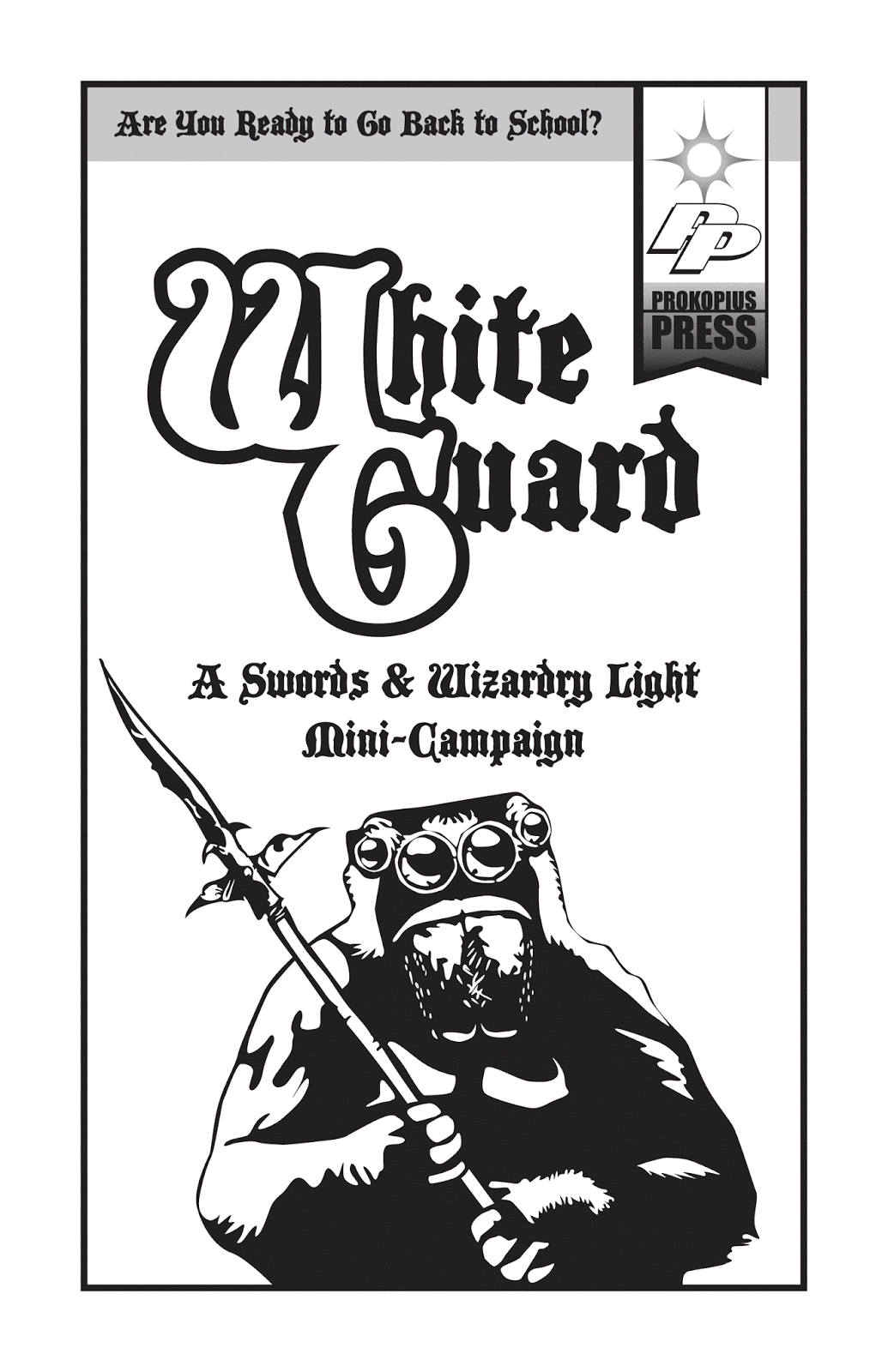
Recently, my eldest has shown interest in running an RPG game. Therefore, I pulled out Erik Tenkar's Swords & Wizardry Light and handed it over because at 4 pages it is a brilliant way to allow a new Referee the ability to get a real handle on all of the rules. After this, we decided on a campaign concept and we put together the following document together. She has successfully run two sessions so far and it has been a lot of fun. Therefore we thought we would share.

White Guard Mini-Campaign

For Swords & Wizardry Light


The file can be found here. Please note, this really hasn't been edited so if you happen to find anything that needs to be fixed I would greatly appreciate if you let me know in the comments. Thanks.

The concept follows the Magic School trope of fantasy literature and allows for PCs to go to magic school and graduate once they get past 3rd level.

Enjoy!

Thursday, October 20, 2016

More 5e Thoughts (And a Gauntlet Thrown)

Over the course of the past several days, I have been trying to typeset a 5e Players Guide to the Lost Colonies in order to reflect some of the ideas I expressed in my last post as well as ideas that are campaign-specific. What a nightmare. I have gotten through what I hope is the messiest part, but I still have a lot of editing and re-organizing to do. This whole experience has cemented the idea that my major complaint about 5e has almost nothing to do with the system.

I will never spend a dime on the core books because they are a hot mess. Seriously, anyone out there who has played a 5e Paladin, you have my sympathy. I took me days to typeset and organize the paladin-as-cleric because, in order to understand the rules for some class features, you have to go to two or three different places in the class description to get a full picture. Even then, a lot of stuff needs several reads in order to interpret the rules.

Now, as an old-school grognard I don’t have any issues with rules that can be interpreted in multiple ways on principle, but 5e presents as such a complicated system that to have rules that are difficult to interpret is not something I appreciate, at least in context of trying to produce an ordered and understandable version of the paladin for my own campaign world.

On the flip side, this experience has demonstrated to me that 5e, at its core, is an extremely simple system. Simply put, it takes the bare bones of a typical d20 system (six ability scores, hit points, armor class, etc.) and strips it all down to the concepts of the Proficiency Bonus and the ideas of Advantage/Disadvantage.

The Proficiency Bonus is a very simple way of expressing that a character is good at something — anything from weapons, to skills, to tools, to saving throws. Advantage/Disadvantage is an extraordinarily elegant way to express bonuses and penalties for virtually any situation in the game.

5e then builds upon this very simple framework a baroque/gothic nightmare of complexity. Whereas I like the idea of using the paladin as a cleric and the warlock as a magic-user, I am less than thrilled about the sheer amount to rules necessary to pull this off. Swords & Wizardry Light (a complete game) will be four pages. That is less than the page count necessary to explain a single class in 5e.

At the heart of all this, however, is a system that I think will make the world of RPGs better. I don’t think I am the man to do it, but there is a 5e-Lite begging to shake off all the excess that WotC have piled onto this system. Indeed, I think the system is elegant enough to pull off just about any genre that you can throw at it.

Here is hoping that someone, someday picks up the gauntlet and produces a 5e-Lite that will make the process of tooling 5e into any genre we want easier than what I am putting myself through now.