Showing posts with label Swords & Wizardry Light. Show all posts

Thursday, October 19, 2017

Zero-Level Characters for SWCL

For those not already aware, Swords & Wizardry Continual Light dropped earlier this week. While I have a few quibbles (like the fact that there are monsters who can surprise on a 1-3 on a d6 and Thieves can backstab surprised opponents but there are no rules for surprise in the combat section), I really like this ruleset. It elegantly boils down D&D to its essence with as few rules as possible and still presents an immensely satisfying game.

I think my favorite part of the entire ruleset is the way it handles Optional Classes like the Ranger and the Monk. They play exactly like one of the four core classes: Fighter, Cleric, Magic-user or Thief, with an extra ability tacked on. The price a player pays for this ability is a slower level progression. Since experience is handled by the number of sessions played, the optional classes simply add an extra session to each level. Brilliant!

What I love the most about the way SWCL handles these Optional Classes is that it provides a very simple way to create world-specific classes that add a lot of color to the campaign without a lot of a lot of mechanics: take one of the four core classes, tack on a special ability and you are good to go!

Thus inspired, I decided to take the rough idea of zero-level characters that I mused about in my last post and applied the mechanical elegance of SWLC to produce a supplement that provides players and referees of SWLC a way to use zero-level characters to bring some life, depth and background to the characters that inhabit their campaigns.

Art by Joyce Maureira

You can download it here.

Monday, September 4, 2017

Star Lite UPDATED

In my last post, I didn't receive much feedback as to how to edit my Star Frontiers + Swords & Wizardry Light Mash-Up, so I am going with the easier of the two routes and going with a system that needs a little more work by the end-user to convert to other systems. Therefore, I give you:

 
You can download a copy here (this link has been updated).

I have also done up a half-sheet Character Sheet for those interested:


It can be downloaded as a .pdf here.

Please consider this post an open thread on thoughts, criticisms, problems, etc.

Enjoy!

UPDATE: As I mentioned in the comments, once you release something into the public, all kinds of mistakes suddenly become visible that weren't before. Thanks to porphyre77 for pointing out a misspelling that was not caught by the spell-check and for suggesting a different font. I normally use the fonts I do in all the stuff I make for myself because not only do I find them pleasing to the eye, but they remind me of two of my greatest literary influences: HPL and CAS; however, I can understand how in this application it might not be the best choice for everyone. Therefore, for those who would prefer a font choice more reminiscent of the 1970s and the roots of our hobby I present to you a second layout with a few changes for space which can be found here.

Monday, August 28, 2017

Star Lite Rough Draft

So, I have settled on a name for my SF + SWL Mash-up: Star Lite. I type-set it and mocked it up on some thick stock paper so that it can stand and double as a Referee Screen:


At this stage, I am proof-reading to make sure this is clean as possible before I send it out into the ether to let folks do what they will with it. I am also at a bit of a cross-roads in terms of how I want to release this. I can proof in one of two directions: make it OGL-friendly or avoid any association with the OGL at all.

In truth, I have been keeping the latter as my default position, following in the footsteps of Kevin Crawford of Stars Without Number fame. There are a couple of phrases I need to edit to make me feel more comfortable doing so, but it will be the easier of the two routes and the one that would be the more complete game.

I am looking to keep this to a four page document so that anyone can do what I have done above with just a tad bit of effort. If I go the OGL route, I will have to lose content in order to make room for the license mumbo-jumbo in really tiny print at the bottom of one of the pages (like SWL). That content would be ship-to-ship combat. The up side to this is that I could edit it to be far more friendly to someone looking to convert over to S&W, SWL, B/X, etc.

Any thoughts, preferences or objections?

Wednesday, August 23, 2017

Insanity Rules for SWL & My Mash-Up

I am in the midst of typesetting my 4-page SF+SWL Mash-Up and realized that I have no real intention for this game to go beyond 3rd level because I don’t have Erik Tenkar’s luxury of saying, “For advancement beyond 3rd level, please refer to the Sword & Wizardry: Complete rules.”

This got me thinking about how to make it possible to have a long-running campaign with SWL without going on to S&W:Complete and by extension how to do the same with my SF+SWL mash-up. In reviewing my monster list, I was reminded of how much influence H.P. Lovecraft has on the way I build RPG worlds, regardless of which system or genre. This, in turn, got me thinking about the insanity rules of Call of Cthulhu and I think I have a fun little means of extending the life of a rules-light RPG campaign that only goes to third level.

I’m Too Old for This Crap!

Delving into the Mythic Underground, going to the edge of the Outer Darkness and fighting the strange monsters that spew forth from these places can and does do damage to anyone’s sanity. Therefore, after each successful adventure, players are required to make a “Sanity Check” for their character:
Roll a d20 and add the character’s level and the number of successive adventures the player has used the character in the current campaign. If the total is ≥ 20, then the character has seen too much and needs to take a break from active adventuring. Roll a d4 (or other die type agreed upon by the player and referee). The result is the number of sessions that character has to sit out before being mentally stable enough to return. The player then creates a new character to use in the next session.
The long-term result is that each player will have a cache of characters that they can play with. Depending on which character is recuperating and what the player feels like, they have the freedom to come to the table with different characters. In turn, this gives the Referee the freedom to plan a longer term campaign that doesn’t have an automatic cut-off date when characters get to 3rd level. Indeed, it can add a bit of spiciness to the table, especially for Referees and Players who don’t mind using a random table of insanities to add to their character’s growing number of quirks.

Monday, August 21, 2017

SF + SWL Mash-Up Part 6

Monsters

What follows are the stat blocs for several monsters. Like SWL, I have 18 creatures with simplified mechanics and descriptions. For those interested I used these public domain alien names and concepts for inspiration for some of the entires.

Brain Lords

Def: 0 HP: 1d6+1 Att: 1d6+1 Mental Blast BAB: +7 Move: 3
Special: Mental Def -4; Telekinesis as per Mind Mage ability
Large, brainy heads with atrophied bodies. They use Mechans as exoskeletons to help them move.

Bug, Giant Glow

Def: -1 HP: 1d6+3 Att: 2d6 bite BAB: +7 Move: 12

A giant glow bug’s light-glands glow phosphorescently and continue to give off light in a 10’ radius for 1d6 days after they are removed.

Crater Men

Def: 0 HP: 2d6+1 Att: 1d6 weapon or claw BAB: +8 Move: 12
Special: Stink Gas
These asteroid dwelling creatures emit a gas attack that, if successful, reduces a victim’s BAB by -2 for 1d6 x 10 minutes.

Demons

Def: -1 HP: 6d6+3 Att: 1d6 weapon or claw BAB: +12 Move: 12
Special: Banish Def: -5; Regenerate 3hp per round.
Creatures of the Outer Darkness. The only way to utterly kill a demon is by dousing them with holy water.

Flesh Eaters

Def: +1 HP: 2d6 Att: 1d6 claw + special BAB: +8 Move: 9
AC: 6[13]
Special: Paralysis Attack; Banish Def: -2; Mental Def: -4

Flesh Eaters Are creatures of the Outer Darkness that eat the flesh of their victims, leaving only skeletal remains. They have a second attack per round that paralyzes a victim for 3d6 rounds if successful. Skeletal remains of their victims will become Fleshless in 1d6 days.

Fleshless

Def: +3 HP: 1d6 Att: 1d6 weapon BAB: +7 Move: 12
Special: Banish Def: 0; Mental Def: -4
Skeletal creatures of the Outer Darkness.

Mechans

Def: +1 HP: 1d6-1 Att: 1d6 weapon BAB: +7 Move: 9

Special: -1 to BAB when not directly controlled by a Brain Lord

Semi-autonomous cyborg servitors of the Brain Lords.

Megaspiders

Def: +1 HP: 2d6+2 Att: 1d6 bite BAB: +8 Move: 18
Special: Webs
Megaspiders may attack using their webs. Victims become stuck. Even those missed can only move at half rate through webbed areas. Megaspider surprise on a roll of 1–5 on a d6.

Mephisians

Def: 0 HP: 4d6+1 Att: 1d6+2 weapon BAB: +9 Move: 9

Special: Banish Def: -3
Devil-like humanoids of the Outer Darkness that like to be overlords of other monsters.

Mooniacs

Def: +1 HP: 1d6 Att: 1d6 weapon BAB: +7 Move: 12
Marauding green humanoids that gather in tribes.

Possessed

Def: +3 HP: 2d6 Att: 1d6 weapon or strike BAB: +8 Move: 6
Special: Banish Def: -1
Innocent humanoids possessed by creatures of the Outer Darkness. They may be freed if rendered unconscious or with a Critical Banish roll.

Sand Rat

Def: +2 HP: 1d6-1 Att: 1d6 bite BAB: +7 Move: 12
Giant vermin about the size of a small dog.

Shadow Beasts

Def: +1 HP: 4d6 Att: 1d6 bite BAB: +10 Move: 18
Special: Banish Def: -3
Large, intelligent beasts from the Outer Darkness sometime used as mounts by other monsters.

Space Dragon

Def: -2 HP: 8d6 Att: 1d6 bite or blast BAB: +14 Move: 6/24 flying
Special: Flight, Sonic Blast
Giant winged beast that are able to use a 30’ r. area effect sonic attack.

Space Witches

Def: +4 HP: 2d6 Att: 1d6 weapon BAB: +8 Move: 12

Special: Charm; Mental Def: -4

These practitioners of the dark arts prefer to avoid combat by Charming their victims (BAB+10). On a critical success, a victim can be forced to do something dramatically out of character.

Stonebacks

Def: 0 HP: 3d6+1 Att: 1d6 weapon or claw BAB: +9 Move: 9
Special: Surprise opponents with 1–3 on 1d6 roll
These carnivorous reptilian humanoids have stone-like scales that allow them to easily hide in any environment.

Utani Ape-men

Def: 0 HP: 2d6 Att: 1d6 weapon or claw BAB: +8 Move: 9
Utani Ape-men are tall humanoids with an ape-like appearance.

Zutharians

Def: +1 HP: 1d3 Att: 1d6-1 weapon BAB: +6 Move: 6
Cowardly, small green humanoids usually enslaved by other monsters.

Sunday, August 20, 2017

SF + SWL Mash-Up Part 5

Characteristics

Before I get to the crux of this particular post, I need to explain my thinking on Characteristics because I won’t be using the traditional six of D&D and its decedents. Due to the fact that there are three categories of Areas of Expertise (AoE) (my proto-skill system) I wanted to condense the original six to three characteristics, each corresponding to an AoE. Thus:
  • STR/CON = Toughness which affects Hit Points, Melee Attacks and the Military AoE.
  • DEX/INT = Acuity which affects Defense, Ranged Attacks and the Hard Science AoE.
  • WIS/CHA = Judgement which affects Banishing, Spell-like Abilities and the Biosocial AoE.
For flavor, players can use descriptors to clarify which of the original six is dominant in each pair. For example, a character’s Acuity could be more intellectual than physical.

Races

In both Star Frontiers and D&D (and its direct descendants), there are four basic races: humans plus three non-human races. Dralasites, Vrusks and Yazirians roughly correspond to Dwarves, Elves and Halflings. While it would be tempting to make simplified versions of the Star Frontier races in the same way SWL does with the traditional D&D races, it severely limits what the game can do. Suddenly, all campaigns are tasked with looking very much like the Star Frontiers universe.

I find this lacking because, while extremely interesting, Drasalites, Vrusks and Yazirians are not archetypal in the way that Dwarves, Elves and Halflings are. As a consequence, I want to offer a set of mechanics that can easily describe a number of different iconic sci-fi aliens rather than three aliens that are described by mechanics.

Humans

At character creation, a human PC gets a +1 that the player can place on any of the three Characteristics. The other two will be ±0. This expresses the great variety of humanity as well as their flexibility.

Militant Aliens

These are aliens that either come from a war-like culture or are physically capable of being excellent warriors. Militant Aliens have a +1 Toughness, ±0 Acuity and -1 Judgement. They also have the special ability of Battle Rage. They may take an action to enter into Battle Rage, which requires a successful Action Roll. If successful, the Militant Alien receives a +2 with Melee Attacks. With a Critical Success, that bonus increases to +4. Militant Aliens may only choose the Warrior Class.

Militant Aliens: Ka D'Argo, Ookla and a Yazirian 

Mentalist Aliens

These are aliens that rely on some kind of mental prowess. Mentalist Aliens have a -1 Toughness, +1 Acuity and ±0 Judgement. They also have the special ability to Detect with a successful Action Roll or a 10 minute preparation time. What exactly the character is capable of detecting is chosen by the player at character creation. For example, Dralasites can Detect Lies. Mentalist Aliens may choose the Mind Mage or Warrior Class.

Mentalist Aliens: a Talosian, Pa'u Zotoh Zhaan and a Dralasite

Merchant Aliens

These are aliens that have a gift for interacting with other cultures and species. Merchant Aliens have a ±0 Toughness , -1 Acuity and +1 Judgement. They also have the special ability to Comprehend Languages (Spoken) with an Action Roll. With a critical success, they can also Comprehend Languages (Witten).  Merchant Aliens may only choose the Warrior Class.

Merchant Aliens: a Neimoidian, Quark the Ferengi and a Vrusk 
Players and Referees are encouraged to re-skin these mechanics any way they wish. As an example, the Comprehend Language ability of the Merchant Alien could be re-skinned as a latent version of telepathy or empathy akin to Ship’s Councilor Troi from STNG.

Friday, August 18, 2017

SF + SWL Mash-Up Part 4

Classes

For those who have been following this series of posts, it is possible to intuit that there will be only three classes: Cleric, Fighter, and Magic-user. For the purposes of making this feel more like a sci-fi RPG, these three classes will be re-skinned and re-named:

Warrior


Adventurers from battlefields from across the galaxy both primitive and technological.

Hit Points: 7hp at 1st lvl, 14 at 2nd lvl and 21 at 3rd lvl.
Basic Action Bonus (BAB): +7 at 1st level, +8 at 2nd level and +9 at 3rd level.
Equipment: Warriors start with any melee weapon and any gun as well as one type of armor and one type of shield.
Special Abilities: Warriors get one attack per level each round.

Crusader


Crusaders are men and women who use their faith to beat back the creatures of the Outer Darkness that now blight the space lanes.

Hit Points: 6hp at 1st lvl, 12hpt at 2nd lvl, 18hp at 3rd lvl
Basic Action Bonus (BAB): +6, +7 at 3rd lvl
Equipment: Crusaders begin the game with either a sonic sword or a sonic pistol as well as one type of armor and one type of shield.
Special Abilities:

Banish: Crusaders have the ability to banish creatures from the Outer Darkness, causing them to flee. When attempting to banish, make an action roll. On a success, all creatures of the targeted type are banished and will flee for 3d6 rounds, or will cower helplessly if they can’t flee. On a critical success, the targeted creatures are destroyed.

Starting at 2nd level, Crusaders may choose one of the following abilities to use on an adventure and may change their choice between adventures:

Cure Wounds: Touch a target and make an action roll. On a success, the target heals 1d6+1 hp.

Detect Evil: Spend 10 minutes in prayer or meditation. For 60 minutes, the Crusader can detect evil creatures, enchantments, intentions, thoughts, or auras at a range of 120 feet.

Spiritual Protection: Spend 10 minutes in prayer or meditation. For the next 2 hours the Crusader has an additional Defense of -2 against all attacks from evil creatures.

At 3rd level, Crusaders may choose two of these abilities.


Mind Mage


Enigmatic students of the arcane who have developed mental powers.

Hit Points: 5 at 1st lvl, 10 at 2nd lvl, and 15 at 3rd lvl
Base Action Bonus: +5
Equipment: Mind Mages begin the game with a laser sword or a laser pistol as well as one type of shield.
Special Abilities:

Mental Powers: Mind Mages are trained in mental powers. At 1st level, a Mind Mage chooses one power off of List A. At 2nd level a Mind Mage chooses a second power off of List A. At 3rd level a Mind Mage chooses a third power from List A and one power from List B. All powers require a successful action roll to use immediately or 10 minutes of careful mental preparation without an action roll.

List A

Allure
Range: 20’ area per level Duration: Instantaneous
When used, all intelligent creatures within range will have a friendly disposition to the Mind Mage.

Metamorphosis
Range: self Duration: 1 hour
The Mind Mage can change their appearance. This change is largely cosmetic, seeming to be up to 1 foot taller or shorter, fatter or thinner; however, the Mind Mage must still look humanoid.

Mental Blast
Range: Line of Sight Duration: Instantaneous
The Mind Mage does 1d6+1 damage. The target gets no defense except for anything that helps against mental attacks. The Mind Mage does not suffer any range penalties.

Screen
Range: Self Duration: 20 minutes
The Mind Mage has an additional -4 Defense vs. ranged attacks and -2 Defense vs. melee attacks.

Telekinesis
Range: 10’ per level Duration: Instantaneous
The Mind Mage may move a 1 pound object 1 foot per level. This may also be used as an attack. On a successful action roll, the target loses their next action.

List B

Chameleon
Range: self Duration: Until removed or an attack is made
The Mind Mage blends into the background and cannot be seen. The Mind Mage cannot be attacked unless an approximate location is known, and then all attacks are made at -4. If the Mind Mage makes an attack, the chameleon effect is ended. Otherwise it lasts until removed by the Mind Mage.

Levitate
Range: self Duration: 1 hour + 10 mins per level
The Mind Mage can move vertically up to 20 feet per round.

Panic
Range: 60’ Duration: 3d6 rounds
All creatures of the targeted type within range are panicked and will flee for the duration, or will cower helplessly if they can’t flee. Creatures of the Outer Darkness are immune to this effect.

Monday, August 14, 2017

SF + SWL Mash-Up Part 3

Crunch

Now that we have established the proto-skill system of AoEs, we need to have a means of determining what happens when Joe or Jane Player can’t quite convince the Referee that their Space Specialization should let them know if a local plant is poisonous.

Over at Delta’s D&D Hotspot you will find one of my favorite formulas for attack rolls:
d20+HD+AC ≥ 20
I want to incorporate the basic gist of this idea. When making any kind of roll involving what RPGs generally call a “skill,” including combat, a character succeeds when the player rolls a d20 adds their bonuses and arrives at a total of 20 or more.

This necessitates determining what a base success looks like. In SWL there are three places where we can start to get an idea of how often a player can expect to succeed: Combat, Turning Undead and Thief Skills.
  • The average AAC of all the monsters in SWL is 13.
  • A 1st level cleric needs a 10+ on 3d6 to Turn a Skeleton, a 13+ to Turn Ghouls & Zombies, a 15+ to Turn Shadows & Wights and a 17+ to Turn a Wraith.
  • A Thief has a 1 in 6 chance for most skills, the exceptions being Hear Noise (3 in 6), Read Languages (4 in 6) and Climb Walls (5 in 6). Demi-human Thieves have some skills at 2 in 6. 
Thus, there is an average 40% chance to hit in combat, and average of 25% chance to Turn all undead and most Thief Skills have a 16.7% chance of success. The average of all of these is approximately 27%. Bump that up a little due to the various other Thief Skills and we are rather close to the 2 in 6 (32%) chance that feels very familiar to those who have played older versions of D&D.

Translating that into a d20 roll means a 14 or a 15 + bonuses to arrive at 20+ in our formula.

This means I have wiggle room to assign variable “Base Action Bonuses” to each class:
  • Fighter +7
  • Cleric +6
  • Magic-user +5
This means that Fighters will be the “skill” class. I justify this because there really isn’t any justification for limiting clerics to blunt weapons or magic-users to staffs and daggers when weapons are described as laser, sonic and conventional as I plan to do. Thus all three classes will be able to use any weapon.

In addition, I am toying with the idea of allowing the spell-casters to use their spells multiple times per day with two different options:
  • To use a spell immediately requires a successful roll.
  • To use a spell that will automatically succeed requires 10 minutes to cast.
Therefore, Fighters get that extra bonus when trying to do the “impossible” stuff.

To sum up, everything in this SWL + SF mash-up will rely on the following formula:
Success = d20 + Base Action Bonus + Situational Bonuses/Penalties ≥ 20.
This also opens the door to this formula:
Critical Success =  d20 + Base Action Bonus + Situational Bonuses/Penalties ≥ 30.

Sunday, August 13, 2017

SF + SWL Mash-Up Part 2

Skills

When it comes to skill systems, I tend to be a curmudgeonly old grognard. I don’t like them. Instead of being inspirational, they are restrictive — they tell players what they cannot do rather than what they can do. Therefore, I prefer having nothing to do with skill systems in games that I run or design. Unfortunately, sci-fi RPGs necessitate some kind of acknowledgement that the worlds they inhabit are heavily dependent upon various skill sets in order to emulate. Thus, if I am going to do a mash-up of SWL + SF I am going to have to come up with a skill system that is inspirational rather than restrictive.

My generic response to skill systems is a concept I call Areas of Expertise (AoE). Rather than being a specific skill, like Knowledge: Nobility, an AoE is a broad category like Society. Rather than telling a player that their character cannot know about the local Nobility in the area they are exploring (you don’t have the specific Knowledge: Nobility skill or you fail your roll if you do), an AoE invites the player to justify why a character should know about the local Nobility. A player with a broad category like “Social” can haggle with the Referee explaining how six degrees of separation allows to him know someone who knows someone or some other creative explanation.

SF actually divides its skill system into three broad categories called Primary Skill Areas: Military, Technological and Biosocial. Each of these are then broken down into more specific skills, some of which are far more specific than others. For example, the Military sub-sets are broken down into specific weapon types whereas one of the Biosocial skills is “Environmental.” Besides the odd mix of specific with broad, I really like this set-up, particularly in the way that (with the odd exception of Military) the system tries to keep it simple by having three skills under each Primary Skill Area.

Therefore, I am going to be borrowing heavily from this set-up, with a few tweaks. Firstly, the Primary Skill Areas will become AoEs and the Skills will becomes Specializations. The idea is this: There will be times when it will become really hard for a player to justify how their AoE is relevant to a particular situation and the Referee will need a roll to see if there is some obscure way that the player’s argument holds water. If the player can then justify that their character’s Specialization is part of the equation, they can get a +1 to the roll. It also gives the player more room for negotiating with the Referee that their character should be able to do a particular task or know a particular piece of information.

The three AoEs will be:
  • Military
  • Hard Science
  • Biosocial
The Military Specializations will be:
  • Ranged Combat (offering a +1 when using ranged weapons)
  • HTH Combat (offering a +1 when in melee)
  • Special Ops (offering a +4 to hit and x2 damage when attacking with surprise)
(These bonuses are up front because the player’s suggestion that they should always hit in combat because of this AoE will always fall short)

The Hard Science Specializations will be:
  • Space
  • Electronics
  • Mechanics
The Biosocial Specializations will be:
  • Environment
  • Medicine
  • Diplomacy

Players choose one AoE and one of its Specializations at character creation. For those worried about Thief Skills, I can see plenty of ways to justify how they would be covered by various Specializations:
  • Find/Remove Traps: Environment, Electronics, Mechanics, Space
  • Open Locks: Electronics, Mechanics
  • Hide in Shadows: Environment, Space
  • Move Silently: Environment, Special Ops
  • Hear Noise: Diplomacy, Space
  • Read Languages: Diplomacy, Electronics
  • Climb Walls: Special Ops, Environment
I am not going to include this particular list in the rules, because I would much prefer to encourage players to make the arguments as to why their character should be able to do them.

Note that these AoEs are available to all classes. Thus, it is possible to have nine different flavors of each class which allows players a tool with which to delve into the background of their character and make something really cool from just a few tidbits of information. It also allows a Referee to either go with the flow and have a hugely diverse universe (as seen in the Star Wars Cantina scene) or to chisel out specific entities within their universe where each AoE specialization would come from (allowing for a much more hard sci-fi approach).

To sum up, this system encourages a lot of creative banter between players and referees (which is something I really enjoy at the table); however, it also provides a backup "skill roll" for those who prefer that style of play or for those who don't like to engage in a lot of negotiations.

Friday, August 11, 2017

SF + SWL Mash-Up Part 1

As I mentioned in my last post, my Gamer ADD has gone into over-drive and I am working on producing a yet-to-be-named mash-up of Star Frontiers (SF) and Swords & Wizardry Light (SWL). The goal with this mash-up is similar to SWL — strip down Swords & Wizardry + Star Frontiers so that a campaign can be played from about 4 pages of rules. Thus, the first thing I need to do is start making a list of things that won’t be in those 4 or so pages of rules.

  • Rolled Characteristics: In SWL, a characteristic either gives a +1 bonus or no bonus at all. Since the implied reason for having rolled characteristics is a reference for ad hoc skill tests, they are not going to be necessary since there will be a proto-skill system imported from SF. All Characteristics will be expressed simply as “0” or “+1.” These will be assigned by the player at character creation.
  • Armor Class: In a world that includes lasers, sonic weapons and rifles, armor is not going to be a huge factor in combat. Since this game will only encompass Levels 1-3, the easiest way to deal with D&D’s weakness for simulating firearms is to create a simple formula where every roll must reach‘20’ with all its bonuses and penalties to succeed.
  • Thieves: Since the Thief is the proto-skill class of D&D and there will be a proto-skill system imported from SF, having a Thief class will be redundant.
  • Elves, Dwarves and Halflings: I will err on the side of SF and simulate the three alien races provided there.
  • Drasalites, Vrusks and Yazirians: The aliens I want to simulate will be inspired by these three races, but will not be these races specifically. I want to use them to create archetypes that one player will be able to call “Drasalite” while allowing another player using the same archetype to call “(Fill in your favorite sci-fi alien here).” This will allow for the game to delve into the space opera, Star Wars cantina scene rather easily while also allowing for a Referee to give a campaign a hard-science fiction feel by being more specific about the archetypes.
  • A Ship-to-ship combat system: This is a bugaboo in sci-fi RPGs for me. As a player, I always found it really frustrating when the party got reduced to one entity in combat and therefore my ability to be creative with my character in order to affect combat virtually disappeared. Even if I were the pilot or the gunner, my actions were pre-defined by the ship. As a referee, I don’t like it because if I were to create situations in space the same way I would in a sand-box campaign, one roll could result in a TPK (the destruction of a ship) rather than the death of one character. Any space combat will be abstracted to the possibility that the party’s ship is damaged, and they need to repair it before they can go anywhere and/or have crash-landed on a hostile planet (like the cover of SF).
  • The traditional six characteristics: This final one isn’t set in stone. SF has eight characteristics grouped into pairs: STR/STA, INT/LOG, PER/LDR. Since SF also has three categories of skills that I plan on emulating, it is going to be awfully tempting to pair up the six D&D traits so that each pair corresponds to a skill set.

Thursday, August 10, 2017

Gamer ADD: Star Frontiers + SWL

Those who are familiar with my blog know that I suffer quite often from Gamer ADD. When I come to a point in a project or a campaign where there is either grueling grunt work (as with my Portown project) or a logical/practical dead end, my mind has a tendency of going off into the woods. Most of the time I can’t help myself because one of the of the aspects of RPGs I love the most is the creative process, both at the table and beyond the table.

Various folks have been blogging RPGaDAY2017 this month. While I am both too busy and not inspired enough by the prompts to bother myself, it did remind me of one of my all-time favorite RPG covers, if not my favorite RPG:


Unfortunately, Star Frontiers never really lived up to the expectations inspired by that cover. It doesn’t do hard science fiction as well as Traveller and doesn’t do space opera as well as Star Wars d6; however, it does invite me to try something that just might drive my creative self a little bit crazy. It has two sets of rules: one called “Basic” and the other called “Expanded.” The Basic rules were about 20 pages but were really only a glorified war game. The idea of a Referee was only introduced in the Expanded Rules.

Given that I have long believed that D&D is actually one of the most successful sci-fi RPGs ever to be published, given that I have really fallen in love with the magnificent simplicity of Swords & Wizardry Light and given that Star Frontiers originally had a simplified version of its rules, my Gamer ADD wants desperately to take Swords & Wizardry Light and marry it with concepts from Star Frontiers to create a version of the game worthy of the cover art.

Colossi of the Empire of a Thousand Suns.

At the height of human space exploration, the Empire of a Thousand Suns came upon the edge of space, beyond which was only darkness. To the peril of all who drew near, all that came out of what would become known as the Outer Darkness were monsters and demons. Thus, the Empire built the Colossi: giant sentinel ships and robots to guard all sentient species from the ravages that emerged from the Darkness.

That age has long past. The Empire is only a shadow of itself, monsters freely roam space and the Colossi float in ruin. Today, adventurers of all stripes dare to explore these hulks at the edge of space: Crusaders of the Holy Sacherdotsi, Mind Mages from the Halls of Ancient Knowledge and Warriors from battlefields both primitive and technological. Some seek fortune and glory, some pine for the treasures of a more venerable age, and some dare to drive the Darkness back from whence it came.

Monday, April 24, 2017

Swords & Wizardry Legion

I got a very special surprise in the mail today. Michael Badolato was kind enough to send me the Swords & Wizardry Legion packet and it is Awesome! This thing is gorgeous and it makes me wish I were 9 years old again so that this could have been my first introduction to roleplaying. It is simple, elegant and just gorgeous to look at. You get two cards for each character class that has everything you need to know on them. It has two copies of S&W Light. It even has a small pad of graph paper. As a big fan of cartography, my favorite part is the map of The Gulf of Akados Region from Frog God Games' Lost Lands on the back of the folder. My Gamer ADD is in overdrive. This little packet is a goldmine of inspiration. Kudos to everyone involved!

I do, however, have one small complaint. Again, as a big fan of cartography, I take huge issue with the scale of the map of The Gulf of Akados Region. It declares that each hex is 50 miles! My first Lost Colonies campaign, which lasted about 3 years, took place largely in one 50 mile hex. This scale is grossly out of proportion.


To give some sense of context, the Gulf of Akados, which takes up about a third of the map, is larger than the Mediterranean Sea. Almost half again bigger. There are several Ruins on this map, giving potential Referees all kinds of opportunity to create dungeons and adventures of their own. Unfortunately, due to the scale of the map most of these ruins are between 150-200 miles away from the nearest town or village noted on the map. Swords & Wizardry movement rules state that a character can hike their base move in miles per day. Given the average burden of a typical 1st level character, that base move is most likely going to be 9. At nine miles per day, a party of adventurers would have to travel between 17 and 23 days in order to get to the ruins marked on this map.

In other words, as is, the map is useless. Fortunately, it is rather easy to erase that ‘0’ after the ‘5’ and reduce the travel time to 2 days and the size of the Gulf of Akados to about half the size of Lake Superior.

Other than that “typo” this is an incredibly cool little package.

Saturday, April 22, 2017

Swords & Wizardry Appreciation Day (Light Edition)

Recently, my eldest has shown interest in running an RPG game. Therefore, I pulled out Erik Tenkar's Swords & Wizardry Light and handed it over because at 4 pages it is a brilliant way to allow a new Referee the ability to get a real handle on all of the rules. After this, we decided on a campaign concept and we put together the following document together. She has successfully run two sessions so far and it has been a lot of fun. Therefore we thought we would share.

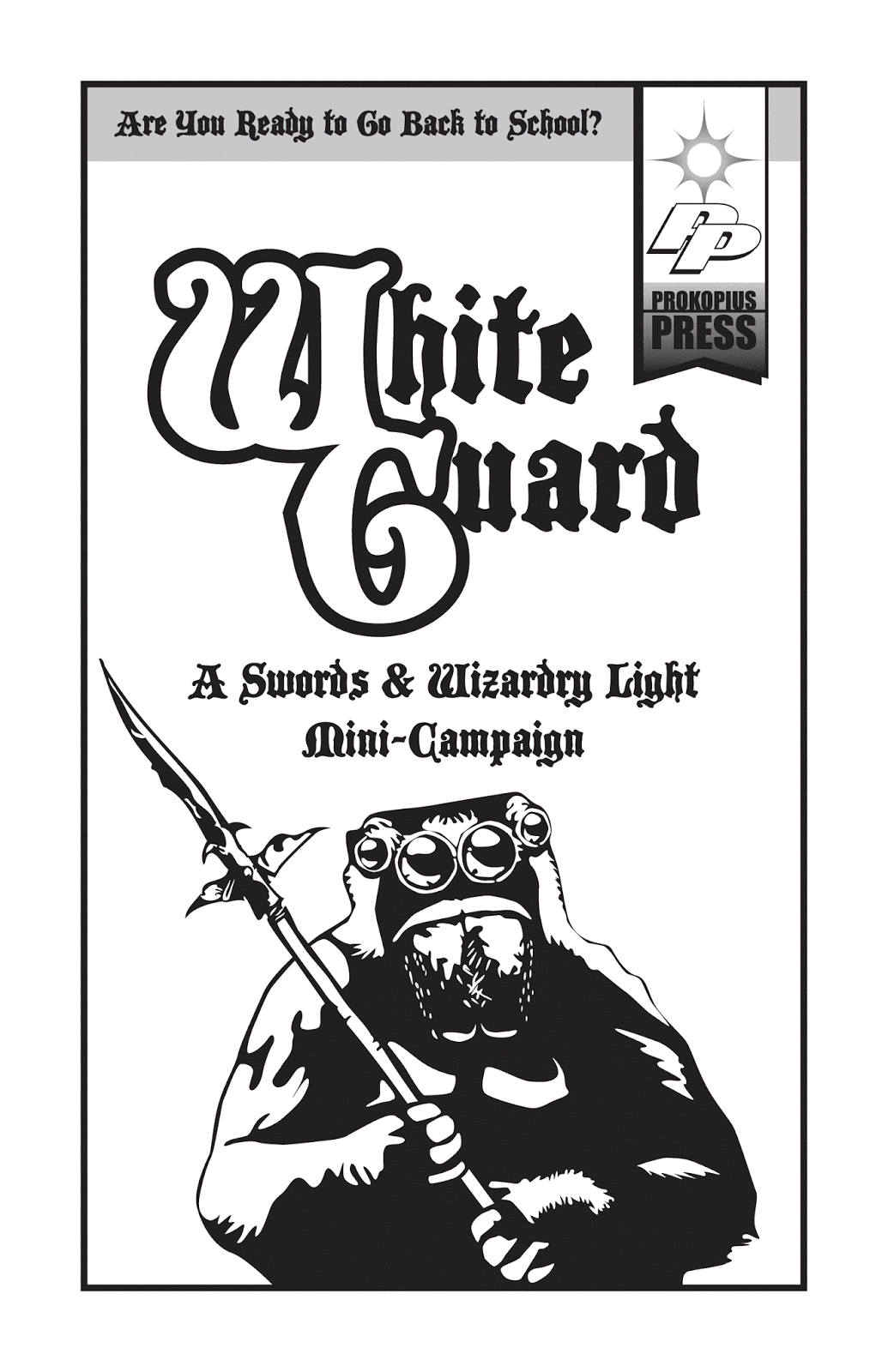
White Guard Mini-Campaign

For Swords & Wizardry Light


The file can be found here. Please note, this really hasn't been edited so if you happen to find anything that needs to be fixed I would greatly appreciate if you let me know in the comments. Thanks.

The concept follows the Magic School trope of fantasy literature and allows for PCs to go to magic school and graduate once they get past 3rd level.

Enjoy!