Monday, November 7, 2011

Lost Colonies Session 45

This last session was primarily about logistics. The party wanted to get back to Headwaters in order to be reunited with Hamlen and Grak in addition to taking care of some unfinished business (mainly, retrieving a dragon's hoard that they had not been able to haul out of the dungeon in the wake of the near TPK when confronting said dragon). It also saw the introduction of several new players (including a father/son combo). So we had to set aside some time to trying to introduce folks to the system and allow them to roll up characters.

The center piece of the evening was a three-way battle for the dragon hoard. A tribe of bugbears had discovered the dragon lair and were in process of claiming it as their own when a bulette showed up looking for a meal (I love random encounter tables). The battle was such that some of the higher level characters could wade into the midst of the melee while the lower level characters were able to be tactically significant by raining down missile fire at areas not currently occupied by party members (never underestimate the value of concentrated missile fire — it can be devastating).

Once the treasure was loaded into several wagons procured to transport the hoard, and subsequently divvied up among the party, the players spent the rest of the evening spending it. As I've said before, I find the house rule attributed to Arneson of 1 gp spent = 1 xp quite useful. Here are several capital investments that occurred during this session:

  • Hamlen contracted workers to start building a dojo-like sword fighting school.
  • Ahkmed began excavation for his underground home.
  • Dn. Goram got some monastics to start on the elvish illuminated text of Scripture.
  • Several party members pooled resources to hire workers to repair the bridge destroyed several sessions ago by a possessed cloud giant.

These last two happened in the environs of the main human city in my campaign, Trisagia. The party set about getting several pieces of equipment unavailable in Headwaters and then hired a ship to take them back to the elf lands. It seems as if they are interested in playing politics…we'll see.

I forget where, but someone in the blogosphere wondered what would happen to a local economy if a party of adventurers started throwing around bunch of gold. Would there be a lot of inflation? Would it destroy the local economy? etc.

If a lot of money were being poured into the same products in the same economic space, this would increase demand and therefore result in a price hike. My players, however, have been careful how they have spent their money. They have spread out their purchases across a broad landscape, both physically and economically.

As a result, they have attracted workers, created jobs and encouraged economic growth. They have started businesses (a cheese factory, a winery and a tavern). They have created new opportunities for NPCs and workers (by continuing to have building projects). The bridge that is being repaired is being fixed in order to restore the flow of trade between Trisagia and Headwaters.

All in all, the only impact my players have had on the economy, that I can justify, is a positive one. Headwaters is growing because of it.

Saturday, November 5, 2011

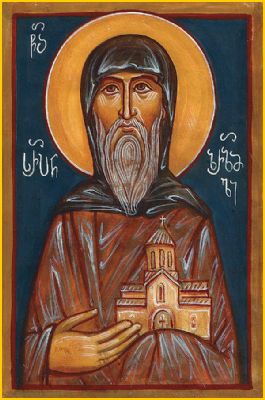
Saintly Saturday: St. Raphael of Brooklyn

Today is one of two recognized feast days for St. Raphael of Brooklyn, one of the most recently recognized Orthodox Christian saints (glorified in 2000). These two feast days are February 27 and the first Saturday of November (which places it shortly prior to Raphael's own patronal feast for the Archangels on November 8).


St. Raphael was born Rafla Hawaweeny in Beirut, Lebanon in 1860 where his parents had fled from Damascus in Syria due to religious persecution. In 1879 he was tonsured a monk. After receiving a theological education at the Theological School at Halki (in Turkey — which, by the way, has been shut down by Turkish authorities since 1971) where he was ordained to the deaconate in 1885. He then went to study at the Theological Academy in Kiev where he was ordained a priest in 1889. He was then invited to New York to become the pastor of the city's Syro-Arab Orthodox Christian community (which would later move to Brooklyn). He arrived in New York in November of 1895.

He would spent the rest of his life traveling the U.S. seeking out Orthodox Arabs to minister to them, and to gather them together. Before his death in 1915 he had established 30 parishes and had gathered together around 25,000 faithful. He was also involved in founding St. Tikhon's Orthodox Monastery (which is also now a seminary). In 1904 he was the first Orthodox Christian bishop ordained in North America.

Although St. Raphael is a fantastic example of the kind of wandering cleric one might expect in a D&D campaign (and even demonstrates how, in extreme situations, priests and bishops will wander far and wide), I am going to indulge in a little Gamer ADD. Given the relative modernity of St. Raphael, he provides a marvelous model for the wandering holy man in a wide range of setting and genre-based games.

Let me preface this by reminding folks that today Orthodox Christianity uses a version of the Divine Liturgy that was redacted by St. John Chrysostom in the 4th century using a version even earlier than that. Despite the radical changes that the world has gone through in the last sixteen centuries, Orthodox Christianity has stayed true to what has been passed down from generation to generation. This is not due to a reticence to change with the times, but rather out of an ability to make that which was passed down relevant to each successive age.

This is my way of pointing out that sixteen centuries from now, the Orthodox Church will still be with us and most likely will still be praying the same words St. John Chrysostom wrote sixteen hundred years ago and that we pray today. Therefore, any genre that hypothesizes a world based on our own ought to have a place for a St. Raphael — a wandering Christian missionary — even if it only ever remains a potentiality.

One of my pet peeves about the sci-fi genre (particularly in the last two decades or so) is that it not only ignores this potentiality, but actively tries to deny it. Despite surviving heresy and schism, Roman persecutions, Persian invasions, Muslim conquests, and Communist depravities, Christianity will somehow disappear in the face of modern science? Really?

It is for this reason that one of my all-time favorites in any medium of sci-fi is Firefly/Serenity. Joss Whedon is honest enough to make Christianity and Christian characters part of his story.


Indeed, Malcom Reynolds is a great simile for the modern American. Despite all his protestations to the contrary, Christianity forms the core of his principles and often explains why he makes the choices that he does.

St. Raphael himself personifies an archetype appropriate for such games as Boot Hill, Deadlands and Weird West. For another example from popular culture, let me highlight my favorite Gene Wilder movie, The Frisco Kid where he plays a rabbi trying to cross the country to minister to the Jewish Community in San Francisco.


This archetype is easily applicable to such hard sci-fi games as Traveller, Thousand Suns and Stars Without Number. Book from Firefly/Serenity is an excellent example.

Even in games that envision a world that destroyed itself (such as Gamma World), Christianity was part of that past and (through the power of the Holy Spirit) could have either survived or be part of a character's quest to recover.

In other words, my love of the cleric class goes far beyond the confines of D&D and its descendants and St. Raphael is my guide.

Friday, November 4, 2011

On Elven Clerics

One of the things that I adore about actually playing (as opposed to just thinking about playing) is that you are forced to consider things that would never occur to you otherwise. Living inside the bubble of intellectual exercise it is easy to be a purist, where your favorite ruleset perfectly meshes with your vision of the campaign world and the way you want the game to be played. Once you give up control and allow the messiness of an actual campaign, however, the intellectual exercise makes less and less sense.

As I mentioned in my last session report on Lost Colonies, some of my players have pooled a considerable amount of money in order to build a church in the elf lands — something that has never been done before. This comes on the tails of the party helping out the elves in dramatic fashion, all the while saying that their problems are better dealt with a dash of faith. A faith, by the way, that would be largely appealing to those elves of the Summer Court.

In the (in)famous verse Gen 1:28, God gives humanity dominion over all of creation:
Be fruitful, and multiply, and replenish the east, and subdue it; and have dominion over the fish of sea, and over the fowl of the air, and over every living thing that moves upon the earth.
In Greek, the word translated as subdue has as its root kyrios, meaning lord. This is a title given to God — thus, God is commanding us to have a relationship with creation as He has. This view is reinforced when one looks at the Hebrew for the word translated as dominion. The literal meaning is to tread in a wine press. In other words, we are to be co-creators with God and we are to offer up our creative efforts to God. It is significant that verb has the visual image of the wine press — creating something that, by offering it to God, becomes the Blood of Christ. This kind of relationship with nature is right up the elves' alley.

Therefore, due entirely to play, am forced to consider something I have never before allowed in any game I have ever played — an elven cleric. Looking at the rules as written (AEC/1ed), elves can advance to 7th level and half-elves to 5th level. Personally, this doesn't make much sense to me. I can understand why an elf would be less likely to advance to higher levels using divine rather than arcane magic, but why are half-elves so much worse? If being a cleric is a human thing, how is it that a half-elf would be less inclined to divine magic than an elf, who is completely alien to humanity?

The AEC is more generous with potential fighter levels than 1ed. Elves can advance to 10th level (as opposed to 7th) and half-elves can go to 12th level (as opposed to 8th). I believe this discrepancy originates in the fact that the AEC operates in a system where race-as-class is an option. Therefore, going the multi-class route needs to be comparable to the race-as-class or there is no point in allowing the multi-class option in the first place.

This begs the question: why shouldn't elven clerics simply be a race-as-class that casts divine magic instead of arcane magic? While I really like this approach (being partial to race-as-class), I am not particularly comfortable with the idea of elves running around like super-paladins (despite the extra XP requirements, it would be awfully tempting to go with an elf over the cleric). It also removes some of the alien-ness of elves.

A more attractive option, taking a cue from Genesis 1:28, is to allow Istinite elves to cast Druid spells. This differentiates them from ordinary elves and maintains that alien-ness that I like to have with my demi-humans (especially since no one else would be casting druid spells).

One aspect of this that I find particularly interesting is that this will likely sour relationships between the Summer and Winter Courts. Whereas the Winter Court is all about cheating death, a Summer Court dominated by Istinite elves would be quite comfortable with death. What had been a rather cordial relationship (because all Summer Court elves knew they would one day be members of the Winter Court) could become downright hostile.

Wednesday, November 2, 2011

Lost Colonies Session 44

This session saw the first major battle of the campaign as the party took part in eradicating the undead horde that they unleashed upon the elf lands. Unfortunately, I am not familiar with any kind of macro-battle system that works to my liking (not that I have had any burning desire or need to look very hard) and my group wasn't very much into the idea of running a large scale battle against the ghouls. What to do?

We began the session with a review of the situation for those who had missed one or more sessions. I then let the players plan, interact with NPCs, answered any questions and provided guidance as to what was available to them in terms of troops, equipment and terrain. The plan that they came up with was actually quite ingenious.

Their objective was to lure the ghouls along some cliffs (a major geological feature of the area) and then pummel them from above using both elven archers and boulder-throwing cloud giants. Ground troops could then encircle to cut off escape and take care of any stragglers.

In such cases, what I try to do in order to make the players feel like they had a role in the larger picture without having to resort to playing out that bigger picture is to remove one or more major pieces of their desired outcome. It is then up to the players to get those pieces back on the board. In this case, their plan relied heavily on the presence of cloud giants. Therefore, the session involved the party making sure that those giants could make it to the battle.

It turned out that the reason that Yellow Face and his charmed ogres and half-giants were able to so easily overrun the castle of the cloud giant king was that there was a traitor inside and that it was grossly undermanned. When the king disappeared, he took his personal guard with him. On top of that, the traitor convinced the queen to send out search parties.

By interviewing Ornak the Half-giant, the party learned that the search party going north was likely wiped out by another tribe of half-giants led by another spell casting Yellow Face. This group was most likely going to arrive at the undermanned castle prior to the undead horde.

The party, therefore, had to defend the castle and find one or more of the remaining search parties in order to be able to have any cloud giants available for the final battle against the ghouls. To my players' credit, they did both with aplomb and careful planning. As a result, I ruled that the battle went off as planned, although Dn. Swibish was certain that their had been around 2000 ghouls when they unleashed the undead horde but he estimated that the battle saw the demise of only about 1800. The party assumed the missing ghouls were due to the efforts of the former Winter King, which he had promised to the Summer Court before mysteriously disappearing.

I have to admit that this whetted my appetite for more larger scale battles — especially since the party is getting up in level and therefore is beginning to think in terms of building strongholds (indeed, the session ended with Dn. Goram and Dn. Swibish pooling their resources to build the first church in the elf lands and to commission an illuminated text of scripture translated into elvish). At some point I am going to want to give the party the opportunity to head up armies and not just a handful of henchman and followers.

Thus, I will end with a series of questions:

Have you ever run a big battle in your campaign? If so, what system did you use and why? How'd it work out?

Monday, October 31, 2011

Meditating on Horror

It is Halloween and I have a confession to make. This is going to sound awfully strange coming from a guy who is such a big HPL fan, but I find supernatural horror really boring. Yep. Boring. As I grow older, the more annoying Halloween gets, because everybody gets all excited about something that I would rather not waste my time on (not to mention the fact that in the Orthodox Christian calendar, All Saints is celebrated the Sunday after Pentecost). Yet, here I am explaining myself:
The Lord asked Cain, 'Why are you angry and downcast? If you are doing right, surely you ought to hold your head high! But if you are not doing right, Sin is crouching at the door hungry to get you. You can still master him.' — Genesis 4:6-7
In the Hebrew, the word translated here as crouching is related to a Chaldean name for a demon that crouches in doorways waiting to devour its prey. Thus, the imagery of the language can be translated thusly:
There is a demon crouched ready to devour you, sin is the means by which you let him in. Despite this, you can still master him.
Sans Christ, in the immediate wake of The Fall, Cain had the power to overcome demons. With Christ and the power of His Cross, demons don't stand a chance. The only way a demon can possess a person or a house is if we let them. Therefore, when it comes to all this supernatural horror stuff, I have a very difficult time suspending my disbelief.

Therefore, it might surprise you that I have a reputation among several of my players of being one of the most successful Referees for bringing horror and terror to the game table. The secret is figuring out who the real monsters are.

The last time I was really scared at the movie theater was when I went to see Silence of the Lambs (which, by the way, demonstrates two truths: 1) I have three kids and have neither the time nor the budget to go see movies in the theater anymore and 2) the overall quality of movies in the last twenty years has so dramatical gone into the tank that Hollywood has utterly failed to make me miss going to the movie theater). Hannibal Lector is one of the truly terrifying movie monsters of all time, because he forces us to realize that we have seen the most horrific monster in the universe and it is us.

The best horror merely holds up a mirror. Whether or not intended, the work of HPL is a marvelous critique of secularism, atheism and scientism* because it holds up a mirror to the terrifying reality of a world without God. This terror and horror has been loosed upon the world every time atheism has been writ large upon a society, any society.

There is a reason why the big bad guys in my campaigns tend to be human. There is a reason why my monsters personify sin. There is a reason why RPGs and not movies are the best medium for telling horror tales — we must confront the horror of our own choices (and kick butt when we make the right ones).

*Scientism is the (false) belief that science is capable of answering questions that it is not designed to do — things more properly answered by philosophy and theology.

Saturday, October 29, 2011

Saintly Saturday: St. Serapion of Zarzma

Today is the feast of St. Serapion of Zarzma, a 10th century saint who is primarily remembered by the Georgian Orthodox Church. He grew up as part of a wealthy family (his father was a Klarjeti aristocrat); however, this did not matter when both of his parents died when he was young. He and his brother were taken in by St. Michael of Parekhi, known as a wonderworker and a teacher of orphans.


St. Serapion became a priest, and, after St. Michael was instructed in a vision to send them, built a monastery with his brother in the village of Zarzma.


Though the life of St. Serapion is fairly simple — he spent his life building and maintaining a monastery — I find inspiration in where he built the monastery.

  • Firstly, there is this really cool map (which I found here):

  • Secondly, the regional name (Klarjeti) and the name of the village and monastery (Zarzma) just sound like they belong in a FRPG campaign world.
  • Finally, take a look at the Georgian (Mkhedruli) alphabet:


Personally, I am a big fan of puzzles, especially codes. When I find that any of my players share the same interest, I will sprinkle my dungeons with treasure maps, riddles and inscriptions written in ancient versions of known languages. Thus, I can write out whatever I want in plain English, substitute each letter with a cool looking symbol/rune/foreign character and then inform the players that they recognize one simple word (like 'the'). They then get to decode the message for themselves. Once a language code is broken, they get to go back to their original find and piece together any new messages they find. This is a great (and fun) way to simulate reading ancient texts. The Georgian (Mkhedruli) alphabet is a perfect candidate for such a use.

I'll end with a couple of questions:

  • Which language would you use the Georgian (Mkhedruli) alphabet to simulate?
  • Are there any other alphabets that you use to simulate FRPG languages in your campaign?

Thursday, October 27, 2011

Monster: Half-Giant

For those of you who are interested, here are the stats I used for the half-giants from the last session of my Lost Colonies campaign.

Half-Giant


The giants were on the earth in those days, and also afterward, when the sons of God came in to the daughters of man and they bore children to them. — Genesis 6:4


Number Appearing: 2d8
% in Lair: 15%
Alignment: Neutral
Armor Class: 4
Move: 9
Hit Dice: 5+5
Attacks: 1d10+3
Special: Surprise on 1-3, backstab
Save: F6
Morale: 9
Hoard Class: VI + VII (individuals); XVIII (in lair)
XP: 660

These desert-dwelling nomads are called half-giants due to their size, but are actually more closely related to goblins (though some will claim giant ancestry and the odd scholar will insist that they are a result of a magical accident). Half-giants are experts at ambush. They surprise on a 1-3 and while attacking from surprise they do double damage.

Wednesday, October 26, 2011

Lost Colonies Session 43

Due mainly to illness, our numbers for this session were small, but we did have a new player at the table. He declared that he wanted to play a Thief as written (rather than my attempt at a sub-class), so I let him arrange his stats. Given the fact that the party was currently in elf lands, I also gave him the option to be an elf or half-elf according to the AEC rules. In order to justify why he was a thief rather than a regular spell-casting elf, he decided to go with the half-elf option and Raine became the newest PC in the party.

Since none of the cleric PCs were available due to the aforementioned illness, the party decided to reign in any grandiose plans, not only because adventuring sans clerics can be deadly, but for the practical reason that, for the time being, the home base needed to be the Summer Court for when the rest of our players are well enough to join in.

Feeling a tad bit guilty over their antics last session, by which they avoided taking responsibility for unleashing an undead horde upon the elf lands, they decided to offer their services to the Summer King as emissaries to the Cloud Giant King, whose castle was within a days travel upon eagle-back and who had a standing treaty with the elves.

When they arrived, however, they found that the King was missing and his castle had been overrun by half-giants and ogres. During their investigations, they learned that the Queen had escaped, but most likely was trapped somewhere inside the castle and that the leader of the half-giants and ogres was called Yellowface.

Most of this information they got from a half-giant named Ornak. Through some really good roleplaying and a clever use of spells, they managed to convince the half-giant to switch sides. With this new ally, and some information gained via a Clairvoyance spell, the party arranged a brilliant ambush of Yellowface (who turned out to be one their old nemeses — those who wear the golden masks). This created enough chaos within the castle to allow them to find and rescue the queen, which is where the session ended.

A few notes about how I ran this session:

This is where I get to admit that I am a minimalist when it comes to preparation. This session is a classic example of why.

At the beginning of the evening, I didn't know whether or not the castle of the Cloud Giant King had been over-run or that half-giants charmed by a mask-wearing magic user were the main culprits or that half-giants were normally desert nomads that minded their own business and were happy to leave well enough alone.

I had in mind both a location (the castle of the Cloud Giant King) and an event (the disappearance of the king and the ransacking of the castle). I knew the party was likely to go the the location, I just didn't know whether or not the event had happened yet.

Due to the needs of the evening (keeping everybody entertained within close proximity to the Summer Court) I decided to have the event occur; however, it was originally meant to be accomplished with a group of evil giants. Such a reality was beyond the ability of the party. Therefore, I changed the intended giant invasion to a group of half-giants and ogres led by a magic-user in order to make the situation on par with the power of the party.

This may sound as if I need to hand in my OSR membership card, but I make a huge distinction between events and locations. Had the party decided to go explore a castle occupied by giants, I would have given them giants, not half-giants and ogres. The difference is based on choice and who makes the choice. An adventure based on location comes out of player choice, so whatever lives there, lives there. Events are my choice, therefore I feel obligated to make sure that such things are mostly about information (feeding player choice). If that information comes via combat, I want to make sure that it is something that will challenge, not overwhelm.

Thus, spurred by the necessity to replace giants with something less overwhelming and the fact that my players like talking to my monsters, half-giants were born. They now wander the deserts in small tribes mostly minding their own business. Had I been anything more than a minimalist in my preparations, half-giant desert nomads would not now be a part of my campaign world.

Monday, October 24, 2011

An Update on St. Nicholas

Back on September 10th, I wrote some of my feelings about the state of affairs at Ground Zero, specifically about a little Greek Orthodox Church that was destroyed a decade ago on 9/11 called St. Nicholas. I just wanted to let everyone to know that things have radically changed in the last month. The Port Authority of New York and the Greek Orthodox Archdiocese of America have finally come to a firm agreement and St. Nicholas finally has a home at Ground Zero. With God's help, the building will begin sometime in the next year or so.

For those of you interested, you can listen to a pod-cast interview with Fr. Mark Arey, the point-man for the Archdiocese for these kinds of things, on the story of St. Nicholas, why this process took so long and how the Archdiocese and the Port Authority finally came to terms here.

Thanks be to God.

Saturday, October 22, 2011

Saintly Saturday: St. Abercius of Hierapolis

Today is the feast of St. Abercius the Wonderworker of Hierapolis and is a remarkable way to end this particular week. He was a 2nd century bishop in the Phrygian city of Hierapolis where the cult of Apollo was not only popular, but the chief patron of the city. While the city was celebrating a festival in honor of their favorite deity, St. Abercius received a revelation where he was instructed to destroy the idols.

That night he snuck into the temple and proceeded to overturn all of the statues therein. As dawn broke and the revelers discovered the saint's work, he boldly declared that all the gods must have become drunk from the quantity of libations offered them and then got into a fight with each other in their drunken confusion.

Enraged at the insult to their gods, a mob began to form in order to take revenge. They were stopped in their tracks by fear, however, when St. Abercius cast out demons from three young men. Upon hearing the Gospel, the crowd and then the city became Christian. St. Abercius reposed in peace near the end of the second century.


I find it remarkable that at the end of a week where I asked the question Is Christianity Compatible With D&D that I get to tell the story of a Christian saint involved in what can only be called a trope of both Sword & Sorcery tales and D&D. The scenario of sneaking into a temple to either steal stuff or do damage plays a significant part in my own formation as an S&S fan and a D&D player.

My introduction to the genre was Lawrence Watt-Evans second installment of his Lords of Dûs series, The Seven Altars of Dûsarra:


The crux of the story has Garth the Overman sneaking into all the temples of the Dark Gods in order to steal whatever is on their altars.

I realize that there is many an REH fan who despises Swarzenegger's Conan the Barbarian (I tentatively place myself among them); however, it was my first "D&D movie" and I still get a kick out of how Conan and company steal the Eye of the Serpent from the Temple of Set.


Speaking of REH, I came late to the creator of Conan. As many before me, I have come to really enjoy his stories. My favorite is The God in the Bowl which sees Conan sneaking into what the locals call Kallian Publico's Temple

Lest we forget, the idea of sneaking into temples are part and parcel to several modules from the early days of the hobby:

  • A1 Slave Pits of the Undercity
  • C1 Hidden Shrine of Tanoachan
  • D2 Shrine of the Kuo-Toa
  • T1-4 The Temple of Elemental Evil
  • WG 4 The Forgotten Temple of Tharizdun

I am sure these are not the last and that I am leaving out others. Needless to say, this just goes to show that even saints have been known to sneak into places to do things we might only expect a D&D PC to do…

Friday, October 21, 2011

A Paladin in Hell


I was inspired by the last few days of discussion and decided to do a little homage to one of my favorite pieces of D&D art, not just in the PH but in the whole history of the game. Of course, you might notice that my version of the paladin is not wearing full plate, but is rather modeled after the Varangian Guard — an elite unit primarily made up of Norseman who served as the personal guard of the Roman Emperor in Constantinople from approximately the 10th-14th century (and who had a chapel in the City dedicated to St. Olaf). This, in part, explains the axe (along with the fact that I just dig fighters who use non-sword weapons).

In addition, according to the cosmology of 1e AD&D, this battle-to-be should be taking place in the Abyss, not in Hell (given that Demogorgon is a demon, not a devil); however, from a Christian perspective, there isn't any distinction between the two. If it matters to you, I suppose you can call this one A Varangian in the Abyss...

Thursday, October 20, 2011

Why the OSR Rocks

When I asked the question Is Christianity Compatible With D&D the other day, I had no idea it would make its way across so much of the OSR. Along the way, however, something quite wonderful happened.

Firstly, religion (and Christianity, in particular) can be a touchy subject. Throughout this ongoing discussion (despite the wide ranging viewpoints and experience of those who voiced their opinion) I never felt as if anyone didn't approach the subject without some amount of respect for the subject or for those who are in the middle of the discussion.

Secondly, James and Stuart (in what I see as an attempt to sum up the discussion) have chimed in to point out that D&D is indeed
a cultural Borg ... that rolled around borrowing from just about every source it encountered.
and this smorgasbord of options includes Christianity. Whether you roll with a heavy dose of theological Christianity (as I do), a Hammer Horror version of Christianity or none whatsoever is entirely up to you. What is important to me, at the end of the day, is the reality that all of these options are not only acceptable but supported by the game.

There was a time in my life, not so long ago, that had I asked the question Is Christianity Compatible With D&D, I very much doubt that such an acknowledgment would have been made. For that I'd like to take a moment to thank all of you and to remind folks what a cool place this corner of the internet happens to be.

Wednesday, October 19, 2011

A Monster Substitution Thought Experiment

Those of you who have read my blog for a while may have noticed that, when doing thought experiments, I like to limit the parameters (sometimes severely). For example, when I posted about finding future/sci fi monsters in D&D I limited myself to LL, Holmes and B/X. This resulted in some thoughts I knew wouldn't have occurred to me had I included the FF, as many commentators urged me to do.

When I was in elementary school, my school district would occasionally have in their budget the ability to bring in an artist in residence to do various projects with each grade level. The one that I remember best (because she had the most impact on me as a person) was a poet. One of the major life lessons I learned from her was that parameters and limitations can actually result in better work and more creativity. My free form poetry sucked, but my couplets and haiku sang. Thus, whenever I do thought experiments, the first thing I do is set limitations and parameters, because it almost always produces better work from yours truly.

I mention this, because there is really no reason for this particular thought experiment, other than it is a parameter that I think is really interesting and cool.  The other day, James over at Grognardia reminded all of us about the 3e SRD, especially all of the monsters listed therein. The post also reminded me that three of my favorite monsters from Homles and Cook are Not in the SRD:

  • Caecilia (can anyone say baby purple worms?)
  • Carrion Crawler (great for scaring the pants off of players)
  • Displacer Beast (one of those monsters that inspires entire adventures)

I am sure that there are many who will gladly point out that, if push comes to shove, all I have to do is rename these wonderful beasts much like Dan Proctor did for LL (Gray Worm, Carcass Scavenger and Phase Tiger for those interested). But what if that wasn't possible? What if I had to use only those monsters in the SRD? What monsters would I use in their place? As I said, a useless (but fun) thought experiment:

  • Frost Worm for Caecilia — I would have to reduce the number of HD (from 14 to 6) but I prefer the cold-based powers of the Frost Worm because it makes the creature more than merely a smaller version of the purple worm.
  • Chuula for the Carrion Crawler — Again, there needs to be a reduction in HD (11 to 3+1); however, the basic concept of the two is very similar — a worm/insect-like creature with paralyzing tentacles. The difference is that the Chuula has a pair of claws that bring in its victim and can do some actual damage as opposed to just paralysis. Thus, it can put even more fear into players.
  • Destrachan for the Displacer Beast — There is less of an HD discrepancy here (8 to 6) but more of a difference between the two concepts — phase displacement vs. sonic powers. If one takes into consideration the enmity with the blink dog, however, the sonic powers make more sense. Why would the blink dog ever develop the ability to blink in order to combat phase displacement (other than they seem to be related/have the same origin)? Blinking in and out in order to avoid sonic attacks, however, does make sense.

What are some of your favorite classic D&D monsters that don't show up in the SRD? What SRD monster would you be willing to substitute for them?

Monday, October 17, 2011

Is Christianity Compatible With D&D?

Is Christianity compatible with D&D? This is a question that has been around since at least the early 80s, if not earlier. Those who regularly read this blog know very well that my own answer to this question is an unreserved Yes; however, it was not always so.

I am old enough to remember the Satanist scare of the eighties, and whether or not you agreed with those attacks (personally, I think they were wildly misplaced and had the opposite effect than their stated goal), they had a marked effect upon how the game is perceived. A perception, by the way, that is pervasive even today.

Starting with 2e, D&D hardwired paganism into its system. Coupled with the poor quality of TSR products thereafter, this was a huge factor in my drifting away from the game. At the time, I didn't know if I would ever be able to play again — despite the new enthusiasm for the game that 3e generated.

Thankfully, the passing of Gary Gygax stirred in me a nostalgic longing that was duplicated in many a gamer, especially of my vintage. Many of us cracked open older editions of D&D to hold onto what the world lost with the passing of Gary. Personally, I found a game not only friendly to a Christian world-view, but one that, in places, can only be described as Christ-centric.

Recently, I ran across this eye-opener while re-reading some of the monster descriptions from the Holmes Basic Edition:
All vampires, regardless of religious background, are affected by the cross which is sovereign against them.
Is there any way to see this statement as non-Christian? I, for one, can't see it.

Christ is the King of kings, sovereign Lord through whom all things were created. He is I AM, Yahweh and Elohim — He is the Most High God. He took on our nature, which was nailed to the Cross — the very place where He became the King of Glory, who has authority over both the living and the dead and through which He saved His creation. Since vampires are creatures that grasp at immortality sans Christ, His symbol of His own victory over death is repellant to them.

This, frankly, is one of the strongest Christian statements I have yet found in any of the various editions of D&D. I wish I had been aware of it back in the 80s because I could have used it to put all those anti-D&D propagandists crying "satanist!" to shame.

Saturday, October 15, 2011

Saintly Saturday: St. Lucian of Antioch

Today is the feast day of St. Lucian (Loukianos in Greek) of Antioch. He was born Samosata. Orphaned at the age of twelve, he became an ascetic in the city of Edessa. In due time, he was ordained as a presbyter (the official title of a priest) and opened a catechetical school in the city of Antioch. Eventually, he was arrested in Nicomedia during the persecutions of the early 4th century. After nine years in prison, he died of hunger and thirst.

One of the more interesting aspects of St. Lucian's life is his continuing influence on biblical scholarship. He did a critical revision of the text of the Septuagint (a Greek translation of the OT done by the Jews of Alexandria three centuries before Christ) by comparing it to the Hebrew. He also did a critical edition of the Greek NT.

In ancient Christendom, there were two schools of interpretation. The one based in Alexandria used a lot of symbolical interpretation. The one based in Antioch (and the one St. Lucian adhered to) insisted on a more literal sense of the biblical text. Therefore, his critical editions emphasized textual accuracy. His edition contributed significantly to what is called the Syrian Recension of the NT which not only was used by such Greek fathers as St. John Chrysostom, but eventually became the basis for the original German Luther Bible.

This brings up the issue of language. As with any post-apocalyptic campaign setting, I tend to emphasize language in my own campaign to the extent that the languages used by those who built all of these ancient ruins and the monsters who currently occupy them are different than the common language of the player characters.

In LL and B/X, demi-humans begin with the ability to speak several languages. One of the interesting consequences of this in my own game is that the demi-humans have become essential for interpreting the languages of monsters who occupy the ruins. To my mind, this does a nice job of re-enforcing the alien-ness of the demi-humans. It suggests that they are closer to monsters because they can converse with them, as opposed to the human characters which do not begin the game with the same kind of linguistic ability.

Another interesting language quirk in my own game derives from the fact that the majority of my players learned the game via 3.5. Therefore, their assumed understanding of languages is based upon this table from the SRD:


While I did resist this assumption at first, I have since basically accepted it. Though I don't necessarily like some of the specifics, I have come to really appreciate the concept of this table quite a bit. It is diverse enough to be expansive and yet concise enough as to be practical. With some simple edits, this table can be easily adapted for just about any campaign.

I'll end with a couple of questions:

  • How important is language to your campaign? Why?
  • How do you use language in your campaign?

Thursday, October 13, 2011

Fighting the Future: A Monster List

One of the themes that I am playing with as I work on my version of the Chateau des Faussesflammes is that of time. I plan on having various levels exist in the distant past, the distant future and, in some cases, both at the same time. One of the easiest ways to dress a level to indicate these various time frames is monsters.

There are multiple choices and themes present in Homes, Moldvay, Cook and LL for monsters of the past. The are plenty of "Lost World" monsters (dinosaurs, neanderthals, saber tooth cats, etc.) as well as ancient Greek monsters (minotaurs, cyclops, medusa etc.). The challenge I am facing is finding monsters to effectively represent the future.

What follows is a preliminary list of monsters from Homes, Moldvay, Cook and LL (those not included in Holmes and Cook will appear in [brackets]) and an explanation as to why they suggest a future timeframe to me:

  • [Ape, Albino] and [Baboon, Higher] — Four words: Plant of the Apes.
  • Black Pudding — I have always felt that black pudding would fit better on an episode of Star Trek rather than as a stand-in for some primordial slime.
  • Blink Dog and Displacer Beast [Phase Tiger] — These two have a definite sci-fi flavor. Their mutual hatred suggests a level of intelligence not necessarily represented in their statistics. I image the displacer beasts to be the equivalent of space-born Nazi war criminals and the blink dogs to be akin to a space-faring version of the Mossad hunting them down. The only question is, are the blink dogs actual agents or are they the pack of hunting dogs used by the agents (which would be some other kind of alien)?
  • Carrion Crawler [Carcass Scavenger] — This tentacled monstrosity has more than a little HPL-inspired flavor. While I do use HPL as inspiration a lot, I usually do so from a sci-fi/futuristic POV rather than a fantasy one.
  • Doppleganger — I despised DS9, but Odo proved the doppleganger is just as appropriate for a sci-fi setting as it is for a fantasy setting (if not moreso).
  • Gelatinous Cube — I have an easier time believing this to be the result of a science experiment gone wrong than the consequence some kind of magical research.
  • Ghoul, [Ghast] — These undead most closely resemble the zombies found in all those zombie apocalypse movies cranked out by Hollywood every couple of years.
  • Golem, Bronze — This could very easily be re-skinned as a robot.
  • Gorgon — Likewise, this could easily pass as some kind of living machine.
  • Men, Berserker — Reavers. Serenity. Nuff Said.
  • [Morlock] — as an homage to the inhabitants of H.G. Wells' dystopian future from The Time Machine, this is one of the few (if not only) D&D monster that is explicitly from the future.
  • Ochre Jelly — Described as a giant amoeba, I can't help but think of the Invisible Monster from the episode of the same name from the first season of Johnny Quest. (This could also be the inspiration for the Invisible Stalker; however, I like Ochre Jellies better)
  • Owl Bear — although described as the result of a magical experiment, this could also easily pass for a mutant from the future or the result of a genetic experiment.
  • Rust Monster — These guys just beg to be seen as biological constructs created to clean up abandoned cities after some kind of future war that levels most, if not all, urban centers.
  • [Statue, Animate (Iron)] — Like the Bronze Golem above, this can easily be re-skinned as a robot.
  • Zombie — While ghouls and ghasts do more accurately depict Hollywood's version of zombies, that doesn't mean I can't also have the D&D version, too.

Tuesday, October 11, 2011

Lost Colonies Session 42

This session started out with a decision by fiat on my part. No one was particularly interested in fighting 2,000+ ghouls, especially since Dn. Goram's player was unable to be with us. I ruled that with the head start the players could get on the oncoming ghoul horde and with the party including one cleric able to turn ghouls automatically and one the could turn on a 3 or more, the party could escape. They boarded the elven sky galley and raced back to the Summer Court.

Assuming that the Winter King had an answer for dealing with the ghoul horde bearing down on the elflands (since he was responsible for creating it in the first place), the party rushed off to the underwater city in order to deliver the Obsidian Hand to the Winter King. They began to question the wisdom of their actions when the Winter King immediately chopped off his own hand in order to replace it with the one the party provided him.

The Winter King's transformation was a painful one, but once complete he seemed to believe that his affliction could no longer affect elven kind — because he claimed no longer to be an elf. He then explained that he needed to inform the elves that he was no longer the Winter King. When informed of the ghoul horde, he quietly acknowledged his part in its creation and vowed to help stop it.

Completely uninterested in getting embroiled in elf politics or in a battle with the ghouls, the party decided to stay underwater and go treasure hunting. So, the rest of the evening was spent doing an unusual dungeon crawl with everything underwater. And the party found treasure. Lots of it.

Two observations:

  1. Phantasmal Force, when used correctly, can be devastating. The party ran into a magic using fishman and his guards. He created the illusion of a gigantic eel that attacked the party. It "killed" Swibish and his dwarven henchman before the party even thought about disbelieving.
  2. I use a house rule on XP for gold attributed to Arneson — I only award the XP once the gold has been spent. When characters come across large treasure troves like this one, it creates an interesting dynamic — how are they going to spend so much money? One answer that my party has come up with is to use the treasure as capital to invest in building projects. Ahkmed has started to build a home. Pawnshee has started a cheese factory and Hamlen had built and staffed a tavern. I have encouraged this because it invests the players in the game world itself, which is then transformed by their economic ventures. These projects only go so far, however. As we wrapped up the evening's fun, the party remembered that they had a map showing where the cloud giant kingdom was. They ended by deciding that they were going to go there and see if the giants had some exotic items that they could purchase for some serious cash. Arneson's house rule has resulted in an adventure I never would have come up with on my own.

Saturday, October 8, 2011

Saintly Saturday: St. Pelagia the Righteous

This Saturday is the feast of St. Pelagia the Righteous. She had been a prominent pagan actress in the city of Antioch (which, in those times, meant that she was pretty much a prostitute). Where others merely saw her physical depravity, St. Nonnus, a bishop, saw her spiritual potential. He was willing to teach her the Gospel and she was baptized and then took up the life of a hermit outside of Jerusalem at the Mount of Olives.

Feigning to be a eunuch, she was well known for her piety and holiness. When she died several years later, her relics gave off the sweet odor of sanctity. Her tomb has been a place of pilgrimage ever since.

When one uses the word pilgrim or pilgrimage, I image one of two images immediately comes to mind for most people — the English settlers of New England or Muslims on their way to Mecca. It might surprise some, then, to learn that pilgrimage has been a part of the Christian experience since antiquity. We know this because of remarkable book called the Itinerarium Egeriae. It is a travel journal written by a woman from Gaul who went on a pilgrimage to the Holy Land in the late fourth century. Her writing is a valuable window into the status of women, Christians and the liturgy of Jerusalem in the 4th century.

What is not so surprising, however, is that pilgrim as a monster listing did not make it from the Monster Manual into the B/X edition of D&D (nor has the dervish from B/X to LL). This in part may very well have to do with the fact that religious pilgrimage is rather alien to the average American of the late 20th and early 21st centuries — despite the wealth of adventure possibilities and role playing opportunities that a random encounter with pilgrims might inspire.

I imagine that one of the greatest stumbling blocks is the actual goal of the pilgrimage itself. To that end, here is a small offering in the form of a few tables to help generate just such a destination:

Main Table (d3)


  1. Relic
  2. Event
  3. Place

Relic Subtable (d3)


  1. Bone
  2. Skull
  3. Piece of Clothing (shoe, belt, cloak, etc.)
  4. Piece of Equipment (weapon, armor, shield, etc.)
  5. Incorrupt Body (where the flesh has not decomposed)
  6. Incorrupt Body Part (a hand, for example)

Event Subtable (d3)


  1. Appearance of a Saint (the Virgin of Guadalupe is a well known example)
  2. Appearance of an Angel
  3. Miracle

Place Subtable (d3)


  1. Tomb
  2. Site of Martyrdom
  3. Home of a saint (cave, monestary cell, etc.)

Thursday, October 6, 2011

The Ecology of Yellow Mold

I have been putting together a level for my version of the Chateau des Faussesflammes, and in process came up with another interesting ecology based upon the monsters that occupy that level. Since folks seem to enjoy my musings on such things, I thought I'd share.

The key organism in this ecology is yellow mold. It is central to two diverse groups — giant ants and troglodytes.

One of those wonderfully tantalizing monster descriptions that set my imagination on fire can be found in LL's entry on giant ants:
They will tend to only have a small amount of treasure around, from past opponents, but in some rare instances giant ants will inexplicably mine precious metals.
I've fiddled with this idea before but have never tried to explain the behavior. Carpenter ants harvest leaves in order to grow fungi that they then use to feed the colony. If some giant ants had a similar behavior there is plenty of potential for explaining this inexplicable mining instinct.

In this particular case, the giant ants harvest the leaves from the yellow musk creeper. This vicious plant has no real defense to protect itself from the giant ants, whose central nervous systems are not developed enough for the creeper to take full advantage of. However, the chemicals that would normally result in a yellow musk zombie do alter the behavior of the giant ants. In addition to the leaves from the creeper, they also begin to mine for precious metals. This, in turn attracts humanoids which can fall victim to the yellow musk creeper.

After harvesting the leaves, giant ants dust them in yellow mold spores. The combination creates a very fertile ground for the growth of yellow mold. The giant ants then feed on the mold, its spore and a liquid that they create by combining the mold with giant ant feces. This liquid is mostly used to feed giant ant pupa, but is also used by the ants to prevent the yellow mold from releasing its spores and protects flesh from the acidic touch of the mold.

Troglodytes are a subterranean sub-species of lizardmen, who all have organs that produce smell to communicate tribal affiliation, willingness to mate, anger, etc. Due to their oft dark environment, this gland came to grow all over the body of the trog, increasing the distance from which these odorous communications could be detected.

What these glands did not do however, was develop the infamous stench that causes humans and demi-humans to save vs. poison or suffer a -2 on attack rolls. This ability is the result of purposely ingesting yellow mold as part of the troglodyte diet. The ingested spores from the yellow mold alter the chemicals produced by the glands, producing a toxic mix for humans and demi-humans.

As a result, troglodytes like to live in proximity to both giant ants and yellow musk creepers. They collect the giant ant liquid to protect themselves from the yellow mold that they harvest for producing their infamous odor.

Tuesday, October 4, 2011

The Bard as a Prestige Class Old School Style

Interesting. Just this morning I went to look at Dragon #56 to remind myself about Jeff Goelz's iteration of the bard in the wake of the interesting discussion that ensued from my post on St. Romanos. In addition, I also reviewed several other versions because I am interested in trying to allow the germ of an idea to flower — allowing the bard to be a prestige class, old-school style.

Though I have always hated the actual application of the 1ed AD&D bard, it is one of the first examples of a prestige class in D&D. I also appreciate the concept — after traveling the world, a bard has accumulated enough stories, tales, songs and information to be able to do all the things a bard does.

Thus, at 4th level a character may choose to become a bard (and this choice must be made at 4th level) — any character. This helps account for such diverse bard-like concepts as St. Romanos, Gandalf, King Henry V as well as the fast-talking, puffy sleeved fop.

In order to gain the abilities of a bard, the character must sacrifice all of the abilities they would have gained for that level from their own class, save hit dice. Thus, fighters would continue to fight as a 3rd level fighter, magic users and clerics would cast spells as at 3rd level, thief skill would remain at 3rd level, etc. Once a character becomes a bard, they advance according to the x.p. requirements of their original class. At each level they may choose to either improve their old class skills or their bard abilities by one level.

I realize that this is unbalanced in that it is much more expensive in x.p. to gain bard abilities for a magic user than a thief. I made this choice for ease of implementation — there need not be any kind of complicated X.P. chart, etc. The differences can be explained by class affinity to the bardic abilities — thieves are more naturally good at being bards than are magic users.

In thinking about how to do a bard (in a way that I'd be interested in playing one), I personally think three abilities are more-or-less universal in everyone's concept of the class:

  • Legend Lore
  • Charm
  • Battlefield Morale Bonus

Legend Lore is the ability to attach a story or piece of history to places and things found while adventuring. I would begin with a simple 1 in 6 chance to know something interesting. This chance goes up by 1 for every level taken in bard abilities.

Charm is potentially the most powerful and therefore abusive ability of the bard. As I see it there are three ways to limit this potential power:

  1. Understand it as a spell and therefore limit the number of uses per day. This could be either a static number (3/day) or a number based on level (1/every three levels).
  2. Limit its potency by allowing two saving throws — one based on the level of the bard (some kind of skill check) and another based on the level/HD of the target (normal save vs. spells). I would start this skill check at 1 in 6. This chance goes up by 1 for every level taken in bard abilities.
  3. Remove the spell effects and tie it to monster reactions. On a successful skill check (again, beginning at 1 in 6, but with the understanding that this can be mitigated through good roleplaying) allows the bard to move a reaction check one or more categories up or down the reaction table.

Personally, I am inclined to choose the second, but include the other options for the purpose of discussion and allowing some flexibility for both Referees and players.

Battlefield Morale Bonus is normally emulated by a simple bonus to various combat rolls. Personally, I never liked this choice. It becomes necessary, however, if this ability is to have a positive effect upon PCs, who never have to check morale. In order to make the mechanism more interesting and unique, I would offer a negative effect — one per combat, a bard can force opposing monsters within 30 feet to make a morale check. This check would suffer a penalty for each subsequent improvement in bard ability. A morale check of '2' always succeeds and monsters with a morale of '12' are unaffected.

Any thoughts?