Tuesday, July 19, 2011

We Are Experiencing a Golden Age

For those of you out there that are still wondering why we need any more retro-clones or other iterations of the original FRPG, take a few moments to look at this.

What Evan has demonstrated with his list of rules is the modularity of the retro-clone. Here is a short list of all the rulesets he has cobbled together for his Nightwick Abbey campaign: LL, S&W, LotFP, AEC, AD&D and RC. We all have the the freedom to cobble together our own rules list from even more sources, if we so choose.

It gets better. Not only do we live in the age of the OGL but Dan Proctor has made his rule sets available as .txt files. Therefore, using the plethora publishing software available to us, we can edit these .txt files to reflect our own house rules.

It gets better. We can also save these house rules as a .pdf to distribute to our players. For those that are really ambitious (and have the cash), we can even to go the trouble of publishing these rules via a POD company and see them as a glorious hard cover.

It gets better. Even games that seem to be outliers like Epées & Sorcellerie have great ideas that can be swiped and written into house rules. For example, if anyone wants to convince a grumpy old grognard like myself to switch to AAC, all you have to do is cite E&S and how it gives players the freedom to use their Dex score for an AC if they don't like their armor's AC.

The real beauty, though, is that if I still want to have DAC in order to take advantage of Delta's Target 20 Algorithm (d20 + level + AC + mods ≥ 20), I can make a table converting Dex scores into DAC equivalents and edit that into my own house rules document:
Dex 18 = AC 1
Dex 17 = AC 2
Dex 16 = AC 3
Dex 15 = AC 4
Dex 14 = AC 5
Dex 13 = AC 6
Dex 12 = AC 7
Dex 11 = AC 8
Dex 10 or lower = AC 9
I reiterate: the more the merrier. Why? The more options we have, the more the game becomes ours — the more golden this golden age becomes.

Monday, July 18, 2011

An Attempt at a Finchian Monster

As far as I am concerned, one of the great monster designers in the OSR is Matt Finch (who is beginning a new monster book!). One thing that makes some of his best monsters so awesome is not the damage they do or how cool they look. Some don't even pose that great of a threat in and of themselves. What makes them so entertaining is that they change battlefield conditions — they force players to deal with a changing environment that affects the way they are able to fight and explore the dungeon/wilderness. Though I have promised myself to imitate this design technique, my output in this direction has been anemic. This is an attempt to change that.

Merovingian Hound


But you, O Lord, do not be far away! O my help, come quickly to my aid! Deliver my soul from the sword, my life from the power of the dog! — Psalm 22:19-20


Number Appearing: 1d6
% in Lair: 80%
Alignment: Chaotic
Armor Class: 5
Move: 12
Hit Dice: 1+1
Attacks: 1d6 + special
Special: see below
Save: F2
Morale: 12
Hoard Class: none
XP: 45

Easily mistaken for some kind of undead creature, Merovingian Hounds are actually a construct, using many of the same techniques used to make golems. They are used by necromancers, vampires and other dark powers as guardians.

Upon a successful attack, a Merovingian Hound will lock its jaws upon its victim and begin emanating a piercing noise somewhere between a whine and a growl. This is will result in an immediate wandering monsters check, with a 50% chance of success. Until the noise is stopped, the party will be subject to this wandering monster check every turn. This noise will continue until the hound lets go of its victim, even in death.

The hound will only let go if its victim is killed, even if the hound itself is reduced to 0hp. These victims will take no further damage, but will have their movement rate cut in half. If anyone attempts to cut the victim free, the victim will take 1d6 damage and must make a save vs. death. If successful, the victim is free of the jaw. If not, the procedure must be done again, doing another 1d6 damage. The only way to force a Merovingian Hound to let go of one of its victims is to pour a vial of holy water on it.

Being a type of golem, Merovingian Hounds are immune to sleep, charm and hold spells as well as fire and cold attacks. Electric attacks will heal them. Further, they may only be hit by silver and magic weapons.

Saturday, July 16, 2011

Saintly Saturday: St. Julia the Virginmartyr of Carthage

One of the saints remembered today is St. Julia the Virginmartyr of Carthage. Born into a Christian family, she was captured by Persians when she was still a girl and sold into slavery. Though her master was a pagan, she served him faithfully and maintained her faith through fasting and prayer. No amount of cajoling by her master could convince her to turn away from Christ.

One day, her master set off to Gaul in order to sell his wares and took St. Julia along. He decided to stop off at the island of Corsica in order to take part in a pagan feast. When the locals found out that St. Julia stayed behind on the ship, they got her master drunk with wine. Once he and his companions were asleep, they stole St. Julia from the ship and crucified her when she refused to denounce Christ.

At her death, an angel appeared to the monks of a nearby monastery. They went, recovered her body and prepared it for a reliquary. Today her relics are at a woman's monastery in Breschia (Italy).

***

Since the island of Corsica is off the coast of France, I feel a little bit justified in some of the work I've done based on the story of St. Julia. I threw together a simple map based off of Corsica:


I've only keyed two things: the monastery and what I've called the "Crash Site." The island is mostly wilderness with very few inhabitants other than the monks. They recently observed a strange fire from the sky crash down upon their island. Since then, they have seen strange things. The river that they use for water has changed color several times. There are mysterious lights that appear from the mountains where the fire fell from the sky. Some of the hermits attached to the monastery have reported seeing strange white-haired ape-like creatures moving through the forest.

The monastery itself is named after a martyr saint. Her death was revealed to the monks by an angel. That angel has been known to reappear in times of tribulation to bring protection, healing and comfort.


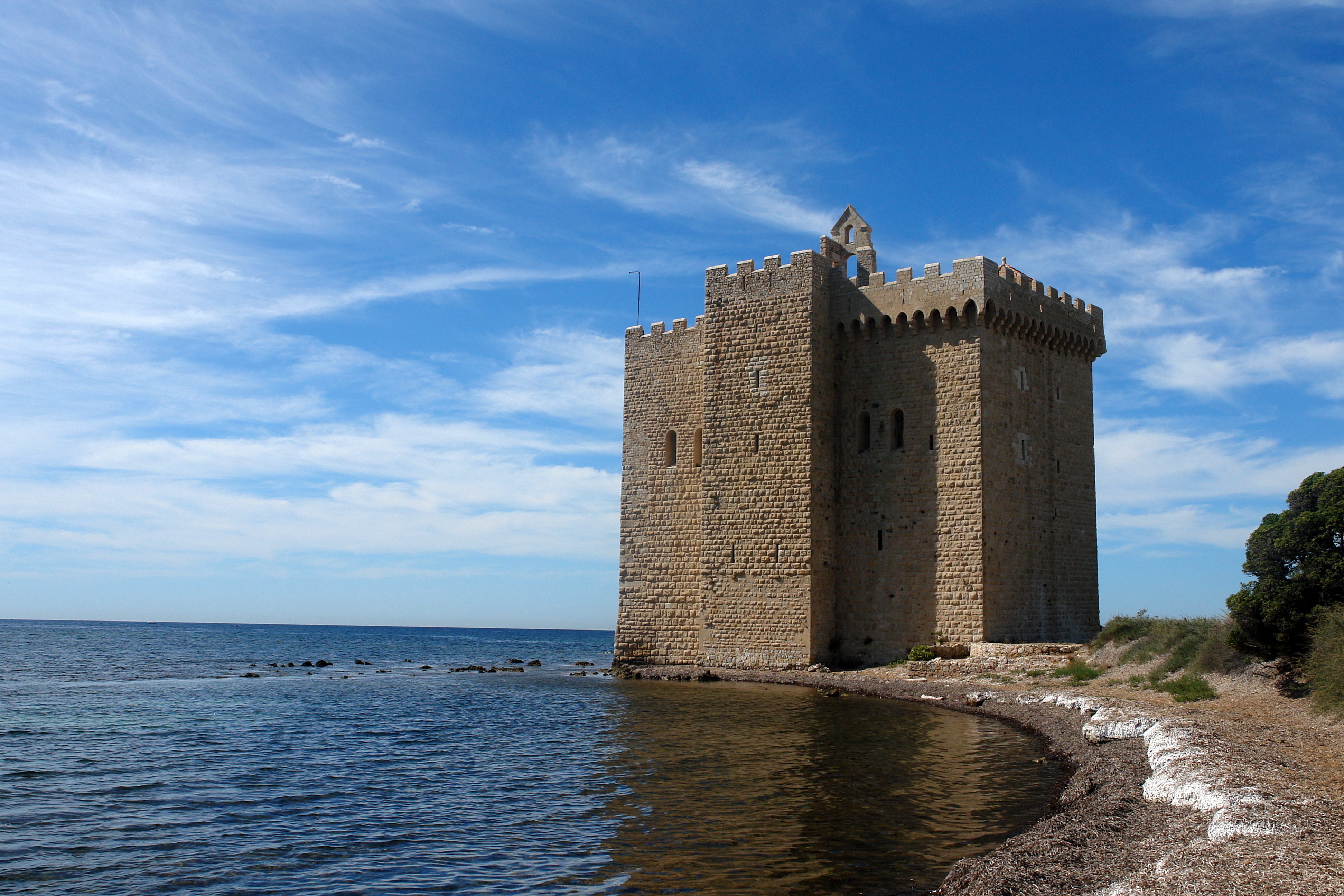
Here are a couple of inspirational photos that might be the basis for and island based monastery:


Although the one above is beautiful and can actually be found in Corsica, I think I prefer the simplicity and practicality of this fortified monastery:

Thursday, July 14, 2011

A Longhaired Ghoul

In light of how many monsters Holmes includes in his Sample Dungeon that do not appear in his Monster section, I decided that I had better start making a few creatures for use in my version of the Chateau des Faussesflammes. For ease of use, I am using my modified version of the LL stat block.

Merovingian Ghoul


If they say, "Come with us, let us lie in wait for blood; let us wantonly ambush the innocent; like Sheol let us swallow them alive and whole, like those who go down to the Pit…" my child, do not follow them in their way — Proverbs 1:11-12;15


Number Appearing: 1d4
% in Lair: 20%
Alignment: Chaotic
Armor Class: 4
Move: 9
Hit Dice: 2 (turn as 3 HD)
Attacks: by weapon
Special: see below
Save: F2
Morale: 12
Hoard Class: XXI
XP: 47

These vile creatures are sometimes mistaken for vampires, due to their habit of drinking the blood of their victims; however, they are merely the undead soldiers of the Black Queen. From a distance, they appear as normal fighting-men — dressed in armor bearing the Black Queen's heraldic crown and armed with a variety of weapons (the Two-Handed Sword is most common). From up close, however, their near featureless faces and blood red eyes can be seen beneath long locks of hair.

There is only one way to permanently kill a Merovingian Ghoul: cut short its hair. Otherwise, 2d6 turns after being reduced to 0hp, it will reanimate with full hp and then relentlessly hunt down and seek revenge against the one who delivered the felling blow. When on such a hunt, the burning hate within them results in supernatural strength. All attacks and damage are made at +2.

Although they need not make morale checks, when fighting in groups, they are known to retreat when one or more of them have been "killed," taking their "dead" with them so that they might hunt with supernatural strength once their comrades have reanimated.

As undead, they are unaffected by the spells charm person, sleep, or hold person.

Wednesday, July 13, 2011

Holmes & Cook: Stocking a Dungeon

Holmes famously wrote this piece of advice:
As a guideline, it should take a group of players from 6 to 12 adventures before any of their characters are able to gain sufficient experience to attain second level.
If we add up all of the available XP in the Sample Dungeon in Holmes by totaling all of the treasure and non-wandering monsters found in encounter areas, we arrive at a number somewhere around 5500 (some treasure and encounters are variable), with approximately 4600 of that coming from treasure.

When describing wandering monsters and advising on what numbers to use, Holmes says this:
First level adventurers encountering monsters typically found on the first level of a dungeon should be faced with roughly equal numbers, i.e. a party of three would encounter 2-6 orcs, 3-12 giant rots, etc.
Intriguingly, the numbers Holmes uses for his example Wandering Monster Table fall into this given range for a party of three! This is important because the number of monsters found in the encounter areas of the Sample Dungeon roughly fall into this range as well (for example, 4 pirates or 2d4 giant rats). In other words, the expected party size for the Sample Dungeon is approximately three PCs.

The Sample Dungeon, however, has enough available XP to allow at least some of those hypothetical PCs to get to second level. This means that, on average, about four new rooms are going to be explored per expedition into the dungeon (if you accept that it will take 6 expeditions by a party of three to explore the whole dungeon and therefore earn enough XP for many in the party to gain second level).

Whether or not you or I think that this is a realistic ratio is irrelevant (for now), because the reason I am doing all of this geeky math is to arrive at an XP per room ratio based on Holmes' Sample Dungeon. I am interested in trying to find a baseline for how much treasure a Holmesian dungeon has for the purposes of stocking my own version of the Chateau des Faussesflammes. Whereas Holmes does an excellent job of following his own advice for the number of encounter areas and encounter strength, he doesn't really give much advice for placing treasure, other than point to the random treasure tables.

There is only one problem with that. Take a look at the list of monsters he has stocked his Sample Dungeon with:

  • Skeletons*
  • Fighter, 2nd level
  • Magic-user, 4th level
  • Giant Rats*
  • "Enormous" Spider (6HD!)
  • Giant Crab
  • Pirates
  • Skeleton (with 7hp, meaning it is at least 1HD rather than the normal 1/2HD)
  • Octopus
  • Giant Snake
  • Ghouls*
  • Ape

Only those marked with an asterisk are listed in the Monster section. [Note: I am operating with the version of the rules I own, which is an early edition.]

I take two things out of this:

  1. Holmes seems to be encouraging DMs to make up their own monsters.
  2. I have to do all this crazy math in order to figure out what an appropriate amount of treasure is.

To that end, I have two approaches:

  1. Gold pieces per room: This works out be be approximately 100gp per character. (Of course this is a ratio and the actual treasure will not be found in every room — especially since a third of all rooms are specifically empty.)
  2. Gold pieces per HD of monster: This works out to be about 150gp per HD. (Likewise, not every monster will have treasure.)

I am currently working on a dungeon level with about 38 rooms and approximately 65HD worth of monsters (using the example Wandering Monster table, which assumes a party of three). Using the first method, I arrive at 11,400gp (38 rooms x 100gp x 3 characters). Using the second method, I get 9,750gp (65HD x 150 gp).

This produces a nice range, and provides me with a reasonable "stingy" number as well as a reasonable "generous" number that falls within the range of XP per room of Holmes' Sample Dungeon.

Tuesday, July 12, 2011

Merovingian Role Call

So, being a bit of a history geek, I have been doing some light research on the Merovingian Kings of France. Therein I found some wonderfully evocative stories, both real and legendary. I did so with the intention of adding weight and depth to the characters of The Court of the Crimson King, which are central themes for my version of the Chateau des Faussesflammes. Here are some of the results:

Crimson King

There is an intriguing legend about Merovich, the founder of the Merovingian Dynasty. It seems that his mother was raped by a fiendish monster known as the Quinotaur (which literally means five-horned). One of the consequences of this heritage is that Merovich is the first vampire. Both of these stories fit very nicely with the title Crimson King.

Black Queen

Brunhilde was a Visigoth princess and an Arian who converted to the Catholic faith when she married Sigebert I of Austrasia. Though she was hailed as a stalwart Catholic by such luminaries as St. Gregory of Tours, she eventually earned a reputation for avarice and cruelty and stood at the center of several conflicts over succession. I need a lamia to haunt the environs of the Chateau, and Brunhilde fits the bill quite nicely as someone tempted by power — especially the fiendish kind that spawned the Crimson King.


The Purple Piper

St. Gregory of Tours is part of the Marovingian line. Therefore, he was a royal who gave up nobility in order to take up the cloth and preach the Gospel. Since purple is a royal color, he fits the role of the Purple Piper (someone who leads in unexpected ways) quite nicely.

The Pilgrim

It was through the faith of St. Coltilda that the Merovingians became Christian. She, therefore, makes a good Pilgrim (using its original meaning of a person who journeys to a sacred place for religious reasons).

The Gardener

King Clovis I was the first Christian Merovingian king. There is a legendary story about his decision to embrace Christ: he was granted the vision of an angel giving him a flower. The fleur-de-lis has been the heraldic symbol of France ever since. Given this horticultural symbolism, I thought he might make a good Gardener.

The Pattern Juggler

The Merovingians actually had several kings ruling over various sections of there territory. Despite this, they collectively were considered one political unit — much like the Roman Empire when it was under multiple emperors. As one might expect, this led to a lot of internal conflict (as exemplified by Brunhilde). This suggests a singular figure who suffers from multiple personalities, many of whom are in direct conflict with other personalities. The Pattern Juggler would have a love/hate relationship with the Black Queen.

The Yellow Jester

King Childeric was the last of the Merovingian kings. He was also a puppet. The real rulers were the founders of the Carolingian dynasty, who prior to their ascension to the thrown were Mayors of the Palace. Yellow suggests sickness, decline and the setting sun. Since the Yellow Jester smiles as the puppets dance, I think the puppet Childeric fills the role quite nicely.

The Fire Witch

I did not find any historic correlation for the Fire Witch; however, I quite like to think that she had something to do with the summoning of the Quinotaur, of which the broken bells play a part…


For the purposes of having a fantasy version of each, here are the versions of all these names I plan on using:
  • Merovich = Merovic
  • Brunehilde = Brunehaut
  • Gregory = Gregor
  • Clotilda = Iotilda
  • Clovis = Chlodovic
  • Childeric = Kildervic

Sunday, July 10, 2011

Fun with Vertical Geomorphs

Back in April, Jeff Rients threw down a challenge to all the geomorph artists of the OSR to make a vertical style of geomorph for the purposes of creating cross-sections of dungeons. A few months on, and there are now a plethora of "vertical geomorphs" available. As I move forward in working on my own version of the Chateau des Faussesflammes, it occurs to me that using this new OSR resource will be a huge boon.

The Chateau and the Court of the Crimson King have a demi-planar existence that makes it appear as if several different times and places co-exist in the same place. On certain days and certain times, it might be possible to find whole sections of dungeon that are not accessible at other days and times. A fantastic way to simulate this easily is with vertical geomorphs. Using several produced by Dyson Logos, here is the basic layout for an ongoing Chateau-megadungeon:


Since this is generated entirely out of vertical geomorphs, it will be an easy thing to substitute other geomorphs in one or more sections to produce dungeon levels that co-exist in the same space but are only accessible at certain times. Thus, there will be an entire class of treasure maps (which I plan to generously seed all over the dungeon) that will map out time rather than space.

As an aside, there are two things I really like about this particular cross-section:
  • At first glance, the dungeon is really very small. Despite there being multiple entrances to multiple parts of the megadungeon, most are secret. This gives me the ability to peek player curiosity about the rest of the dungeon through treasure maps.
  • I also like the fact that there is a section of the megadungeon (keyed areas 28-31) where going up results in finding a more dangerous area of the dungeon.

Saturday, July 9, 2011

Saintly Saturday: Icon of the Mother of God of Cyprus

The first Sunday of Great Lent in the Orthodox Church is called The Triumph of Orthodoxy. On this day, the Orthodox Church celebrates the restoration of the icons to the Churches after Iconoclasm. [For those interested, I have written about this in another Saintly Saturday post]. In the liturgical texts of the following week, according to the Greek textual tradition, there is a story about an icon of the Theotokos (the Virgin Mary) in Cyprus. The style of this icon depicts the Theotokos sitting on a thrown with the Christ child on her lap with angels on either side. Today marks one of the days that this icon is commemorated.


According to the Greek Synaxarion, this icon adorned the gates of a Church dedicated to the Theotokos. A certain Arab was passing by and he decided to demonstrate his disdain and hatred of Christianity. So, he shot an arrow into the icon. The arrow struck the Virgin's knee, which immediately began to bleed. Overcome by fear, the Arab tried to flee for his home, but dropped dead before he got there.

This is not a unique phenomenon. Bleeding icons can be found all over the world. In fact, I have seen one myself. It reinforces the theological understanding of icons — through the grace of the Holy Spirit, icons manifest the personal presence of Christ and His saints.


***

Bleeding Icons


These rare objects were once normal religious icons — simply paint on wood — positioned by the faithful in a place where the saint depicted might be a guardian. Many were at one time on gates, doors or over some kind of entrance. The story usually unfolds that during an attack, one of the invaders strikes the icon with a weapon as if to attack the person depicted in the icon. It then starts to bleed and the invaders run away in fear.

A Bleeding Icon has the ability to affect one of the following types of monsters:
1 Berserkers
2 Brigands
3 Bugbears
4 Dwarves (including Gnomes & Grey Dwarves)
5 Elves (including Drow)
6 Gnolls
7-8 Goblins
9-10 Hobgoblins
11 Kobolds
12 Lizardfolk
13 Locathahs
14 Morlocks
15-16 Orcs
17 Ogres
18 Pirates
19 Sahuagin
20 Troglodytes
The character wielding the Bleeding Icon has the ability to Turn this type of monster as a cleric of the same level Turns Undead. A result of 'D' on the Turn table indicates that the target dies of fright.

Thursday, July 7, 2011

Serendipity

I cannot claim to be a gear- or petrol-head in any way shape or form. Nonetheless, Top Gear is probably my favorite TV show on today. I find it fascinating, hysterical and wildly entertaining in a way very little produced for TV can. I have thus gleefully been spending down time watching past seasons on Netflix. I mention this because when the Stig is driving various cars that I'll probably never see let alone lay my hands on, they make a habit of mentioning what he is listening to on the car stereo. Each season has its own theme. One such theme is Prog Rock.

I was born too late in order to experience Prog Rock in its prime; however, that doesn't mean it didn't loom large in the musical landscape of my youth — especially the background noise of my formative RPG years. In a fit of nostalgia, I got online and watched a documentary about British Prog Rock by the BBC. Therein I encountered a band and a song that had somehow escaped my notice all of these years. Here are the lyrics of The Court of the Crimson King by King Crimson:

The rusted chains of prison moons
Are shattered by the sun.
I walk a road, horizons change
The tournament's begun.
The purple piper plays his tune,
The choir softly sing;
Three lullabies in an ancient tongue,
For the court of the crimson king.

The keeper of the city keys
Puts shutters on the dreams.
I wait outside the pilgrim's door
With insufficient schemes.
The black queen chants
the funeral march,
The cracked brass bells will ring;
To summon back the fire witch
To the court of the crimson king.

The gardener plants an evergreen
Whilst trampling on a flower.
I chase the wind of a prism ship
To taste the sweet and sour.
The pattern juggler lifts his hand;
The orchestra begin.
As slowly turns the grinding wheel
In the court of the crimson king.

On soft gray mornings widows cry
The wise men share a joke;
I run to grasp divining signs
To satisfy the hoax.
The yellow jester does not play
But gently pulls the strings
And smiles as the puppets dance
In the court of the crimson king.

Given that my now months-long thought experiment with the Holmes Basic Edition originated with the question of what would my version of D&D look like if I only had Holmes and Cook available, it occurs to me that I also ought to include some hypothetical sources of inspiration (I have already begun to do this with CAS and Averoigne). Given that most of my RPG friends and I listened to various parts of the Prog Rock scene, I think it entirely appropriate to use The Court of the Crimson King as a lyrical source for my own version of the Chateau des Faussesflammes.

As I look at the lyrics, I see four different ways this song could be the foundation of a really interesting megadungeon campaign:

  • Note the line "Three lullabies in an ancient tongue." When juxtaposed with the summoning of a fire witch, it paints a picture of a Classical Civilization within the Holmesian cultural landscape — pagan and seeking out the powerful arcane knowledge of the ancients. This provides a solid timeline and cultural background for the Chateau.
  • There are eight distinct characters that are named within the text. If the lyrics of the song are understood to be a cryptic description of the megadungeon, each of these characters, then, can be the inspiration or theme for one or more levels within the megadungeon:
  1. The Purple Piper
  2. The Crimson King
  3. The Pilgrim
  4. The Black Queen
  5. The Fire Witch
  6. The Gardener
  7. The Pattern Juggler
  8. The Yellow Jester
  • There are two subtitles for the song: The Return of the Firewitch and The Dance of the Puppets. Both suggest potential events waiting to be triggered (at the ringing of the cracked bell?) by foolish groups of adventurers.
  • Finally, there is also an implied mystery: who is the narrator? He, too, can inspire an entire dungeon level where knowing his true identity can be the key to finding a great treasure and/or the key to survival.
I am sure there will be those who will point out that Peter Sinfield coined the name of the band (and therefore the song) as a synonym for Beezlebub, the prince of demons. Therefore, there might be some question as to whether or not this song is appropriate as a source of inspiration for a Christian-themed campaign. Personally, I have no problem with demons being a part of my FRPGs — as long as they fill their proper role of adversary and monster. Besides, if the Crimson King is somehow affiliated with the prince of demons, then the identity of the Narrator has even more import.

Wednesday, July 6, 2011

Rethinking Charisma and Wisdom

This is the time of year that the Orthodox Church is reading St. Paul's Letter to the Romans. I mention this, because I've been pouring over the original Greek and ran into this word: χάρισμα. Those of us who have spent any time in the hobby will immediately recognize its English progeny: charisma. What we won't recognize, however, is its meaning. Whereas we see charisma being related to attractiveness, charm and leadership qualities, χάρισμα means a gift freely given.

This got me thinking about characteristics and what they mean. In OD&D there is a kind of nice symmetry with the six characteristics. Three are prime requisites corresponding to the three base classes and which affect XP acquisition. The other three have a mechanic related (directly or indirectly) to combat. Constitution affects Hit Points, Dexterity affects missile combat and Charisma affects the number of henchmen one can bring to bear and how loyal they are.

The introduction of the Thief class disrupts this symmetry. If there is one thing about the Holmes edition that really irks me, it is that the prime requisite for Thieves has two mechanical bonuses (XP and missile fire) while every other class only gets one (XP).

As I see it, there are two ways to fix this:

  1. Do what was done in later editions of the game — give more mechanical bonuses to the other three prime requisites. There are two consequences to this approach (neither of which I am fond of). Intelligence gets short shrift in combat. Outside of extra languages, more spells, and/or skill bonuses Intelligence never really gets to shine once swords are drawn. Charisma becomes a dump stat. As characters gain more and more mechanical benefits for high ability scores, they become more and more robust. Therefore, the need to have henchmen in order to survive (especially at lower levels) disappears.
  2. The other option is to use χάρισμα as a jumping off point to redefine the ability scores in order to maintain the prime requisite's primary function as XP modifier.

The root word of χάρισμα is χάρις (charis) which is often translated as grace. In Paul, it is most often encountered is its plural form χαρίσματα (charismata) or gifts. The implication is that God freely pours out His grace upon us, and this manifests itself as gifts — preaching, teaching, etc. Given that the source of the Cleric's abilities —spells and turning — are granted by a divine power (God), it seems to me that Charisma is a better fit for a prime requisite than Wisdom for the Cleric.

Though Wisdom literally means the quality of being wise, that is not how it is used mechanically in later editions of the game. Rather, it is used to grant bonuses to saves vs. spells and to awareness-type skills. This mechanical expression more closely resembles an Orthodox Christian theological notion called the nous.

The word nous is difficult to translate. The best way I have found is the idea of receptive intelligence. When we have "aha!" moments, or instantaneous sparks of inspiration that is the nous in action. In other words, it is that part of us that is spiritually and physically aware of our surroundings. It receives information and processes it in a way that our reason cannot. Given that one of the primary functions of the Thief us to be aware of their surroundings, Wisdom (ironically) can become the prime requisite of Thieves, if it is understood to be the nous. In order to avoid the mental dissonance of criminal activity and being wise, I might be tempted to rename the ability Awareness.

Therefore, we now have four prime requisites: Strength, Intelligence, Charisma and Awareness. They all have the primary mechanical function of affecting XP; however, in order to do this Charisma must be stripped of the henchman mechanics. Either that, or the mechanic can be spread across all of the prime requisites.

I come to this from the perspective that when we think of great leaders, we will most often find people who have great skill in their chosen field. Alexander the Great was a great military mind. Pope John Paul II was a great theological mind. Bill Belichick, while not being very charismatic, certainly has a great football mind. Thus, when it comes to attracting and keeping hirelings, having a high prime requisite can represent that great mind found in the likes of Alexander the Great, Pope John Paul II and Bill Belichek.

One could go further and say that each prime requisite affects the loyalty of its given class. Thus, a magic user with a high Intelligence would have better loyalty from magic user hirelings than fighting-men. The reverse would be true of a fighting-man with high strength.

Therefore, the highest prime requisite score would determine the max number of hirelings total that can be hired. Strength would determine the highest number of fighting-men and their loyalty. Intelligence would would determine the highest number of magic users and their loyalty. Charisma would determine the highest number of clerics and their loyalty. Awareness would determine the highest number of Thieves and their loyalty.

The end result of this retooling of characteristics is a return to the symmetry of OD&D, where all prime requisites grant the same bonus to every class and where Dexterity and Constitution grant the same combat bonuses to every class.

Tuesday, July 5, 2011

Dave's Mapper

I just wanted to let folks know that I contacted Dave of Dave's Mapper and he was kind enough to include my Holmesian geomorphs into his ever expanding and very cool resource. Go check it out. Here are a couple of examples, the first using just using my own geomorphs, and the second one using a combo of mine with those of Risus Monkey. Enjoy:


Monday, July 4, 2011

More Holmesian Geomorphs: Caverns, Odd Shapes and 45° Angles

Here are the last two "sheets" of geomorphs I plan to do for the time being. Every dungeon needs caverns and every old-school dungeon needs odd shaped rooms and at least a few 45° angles. Enjoy:


Happy Independence Day!

As someone who is very much interested in history and as someone who is very interested in examining texts, I hope you'll indulge me as I spend some time on this 4th of July doing something that I wish more would do — reading and examining the document whose signing we are celebrating today:
When, in the course of human events, it becomes necessary for one people to dissolve the political bands which have connected them with another, and to assume among the powers of the earth, the separate and equal station to which the laws of nature and of nature's God entitle them, a decent respect to the opinions of mankind requires that they should declare the causes which impel them to the separation.
This is an 18th century way of saying that you don't just start a revolution without explaining why.
We hold these truths to be self-evident, that all men are created equal, that they are endowed by their Creator with certain unalienable rights, that among these are life, liberty and the pursuit of happiness.
The Founding Fathers are setting forth their presuppositions — those things that they all see as true and fundamental. If one is honest, these truths are only self-evident from a Christian world view. God is the source of life. God is ultimately free, therefore, being made in His image and likeness we are free and have free will. True equality can only be accomplished in Christ, who shares our humanity and loves us all — despite all the obvious inequality that exists between us. The Pursuit of Happiness is probably the most misunderstood. It does not equal hedonism, rather the ability to use one's time, resources and skills to pursue a vocation that one wants. Wrapped up into this is the idea that this vocation will not only benefit the individual, but the family, the community and humanity as a whole. This has a striking resemblance to St. Paul's image of the Church as the Body of Christ.
That to secure these rights, governments are instituted among men, deriving their just powers from the consent of the governed.
We get the government we deserve.
That whenever any form of government becomes destructive to these ends, it is the right of the people to alter or to abolish it, and to institute new government, laying its foundation on such principles and organizing its powers in such form, as to them shall seem most likely to effect their safety and happiness.
Note again that sticky word happiness — here it means to ability to affect the overall well-being of society and humanity.
Prudence, indeed, will dictate that governments long established should not be changed for light and transient causes; and accordingly all experience hath shown that mankind are more disposed to suffer, while evils are sufferable, than to right themselves by abolishing the forms to which they are accustomed.
This is a passage I really find quite interesting. The Founding Fathers only did this reluctantly. They were willing to suffer evil as British citizens and would have rather remained within the confines of the British Empire — those forms which they were accustomed. It is also an admonishment to all those who would start a revolution — don't do it unless you can demonstrably prove that the evil suffered under the current government is truly insufferable.
But when a long train of abuses and usurpations, pursuing invariably the same object evinces a design to reduce them under absolute despotism, it is their right, it is their duty, to throw off such government, and to provide new guards for their future security.
The word I find interesting here is duty. If government is evil — if it actively and consistently denies the image and likeness of God in its citizens — we have an obligation to make sure that the government changes.
Such has been the patient sufferance of these colonies; and such is now the necessity which constrains them to alter their former systems of government. The history of the present King of Great Britain is a history of repeated injuries and usurpations, all having in direct object the establishment of an absolute tyranny over these states. To prove this, let facts be submitted to a candid world.
This begins the longest section of the Declaration of Independence where the Founding Fathers set out to prove that the British Crown has indeed committed insufferable evil. They list over 25 abuses of King George III. We always remember unfair taxation, but there are worse. For example:
He has constrained our fellow Citizens taken Captive on the high Seas to bear Arms against their Country, to become the executioners of their friends and Brethren, or to fall themselves by their Hands.
For brevity, I won't quote them here but I encourage all to read them through.
We, therefore, the representatives of the United States of America, in General Congress, assembled, appealing to the Supreme Judge of the world for the rectitude of our intentions, do, in the name, and by the authority of the good people of these colonies, solemnly publish and declare, that these united colonies are, and of right ought to be free and independent states;that they are absolved from all allegiance to the British Crown, and that all political connection between them and the state of Great Britain, is and ought to be totally dissolved;
This is the declarative statement. Having set out their argument that given self-evident truths and that the government of Britain has abused its citizens in the colonies, it is right and just that the U.S. declare its independence and set up its own form of government. Note the phrase "appealing to the Supreme Judge of the world." This is a title given to Christ. This again demonstrates the assumed Christian world-view that is the foundation of this document.
and that as free and independent states, they have full power to levy war, conclude peace, contract alliances, establish commerce, and to do all other acts and things which independent states may of right do.
This is an interesting historical reality that we don't appreciate in the post-Civil War era. Note that the Founding Fathers understood at this time that the Thirteen Colonies were thirteen separate states all with the independent power to declare war, etc. Prior to the Civil War we referred to ourselves as These United States, not The United States.
And for the support of this declaration, with a firm reliance on the protection of Divine Providence, we mutually pledge to each other our lives, our fortunes and our sacred honor.
Note how this statement paints a relational image of the Cross. They rely upon God through the protection of Divine Providence, indicating a vertical relationship with God. They pledge to each other — indicating a horizontal relationship with their fellow human beings. The result of this pledge was sacrifice. Many of the men who signed the Declaration did indeed give to their new country their lives, their fortunes and their sacred honor. They picked up their cross so that those who followed might know freedom and liberty. In other words, they lived out the words of Christ — He who willingly went to the Cross for our salvation:
If anyone would come after me, he must deny himself and take up his cross and follow me.
May we all follow.

Sunday, July 3, 2011

More Holmesian Geomorphs: The Great Chasm

Another of my favorite dungeon design tropes is The Pit, seen here in the Sample Cross Section found in Holmes:


The idea is to give an adventuring party easy access to lower levels without having to trudge through all those levels in between. My favorite iteration of this is what I like to call The Great Chasm. In essence, it is a giant crack in the earth that cannot be crossed without aid — such as a bridge or a spell. What I really like about this iteration is the image of looking down (or up) and seeing various bridges below (and/or above) connecting different parts of different levels. Thus, I wanted some geomorphs that would allow me the ability to have The Great Chasm be a part of my version of the Chateau des Faussesflammes. Using these, I'll be able to include it on several dungeon levels. Enjoy:

Saturday, July 2, 2011

Saintly Saturday: St. Juvenal

Today is the Feast of St. Juvenal, who was originally a mining engineer in Russia; however, when his wife died in 1791, he became a monk at a monastery in St. Petersburg. After three years, he was sent to Alaska. Yes. Alaska. We tend to forget that the Russians discovered Alaska in 1741 and had a permanent settlement on Kodiak Island by 1784.

St. Juvenal was an enthusiastic missionary and was very successful with the Yupik, especially the Chugach. Due in large part to his work, to this day Alaska has a larger Orthodox Christian population per capita than any other state in the U.S.

In 1796 he was martyred near the mouth of the Kuskokwim by a hunting party. No one is certain why St. Juvenal was murdered, but the natives later told St. Innocent of Alaska that St. Juvenal did not defend himself nor did he try to run away. Rather, he begged his murderers to repent. After beating him severely, they left him for dead. He got up and started to follow them, again, begging them to repent. They beat him again, sure that they killed him. But again, St. Juvenal came to his feet and cried out to them to repent. This repeated itself several times. Finally, the hunting party hacked the saint into pieces. Thus, he became the first Orthodox martyr on American soil.

Years ago, I worked with a woman who grew up in Alaska. She wrote and drew an indie comic book that I once owned but have long since misplaced during all the moves I have made over the years. The story took place in a fantasy world inspired by the mythology of the Inuit peoples of Alaska that she grew up surrounded by. [For those of you who are interested, I cannot pull the name of the book out of my mind, nor did a Google search refresh my memory. Sorry.]

I remember thinking at the time, that Alaska is an untapped resource of inspiration for those of us who play FRPGs. Reading up on St. Juvenal only reinforced this idea. It has all the markers of a classic sandbox. There is a vast, unexplored wilderness at the edge of an empire. There is a type of Keep on the Borderland at Kodiak Island where adventurers go out and encounter natives both friendly and hostile while trying to make the wilderness safe for civilization.

To boot, Inuit mythology has just as many cool monsters to harass our stalwart adventures as anything in our hobby. For example:

  • Nennorluk — a sea monster of gigantic proportions with white fur on its back, ears as large as tents and capable of swallowing people whole.
  • Mahaha — long-clawed cold demons.
  • Taqriaqsuit — shadow people who live in a parallel dimension.
  • Qallupilluk — sea-dwelling child snatchers.
  • Inupasugjuk — giants of the frozen north.
  • Tuniit — the original inhabitants of the land who might not be too bright, but are very strong.


If that isn't enough to whet your appetite, check out this fantastic site.

Unfortunately, I do not have the time, nor the players to justify working on such a campaign at the moment, but this is definitely one of those pseudo-historical campaigns I've always wanted to do. For those so inclined, here are a couple of beautiful maps to get you started:


Friday, July 1, 2011

More Holmesian Geomorphs: Tombs and Rivers

Here is another set. HPL mentions that there are crypts underneath the Chateau des Faussesflammes, so I need some geomorphs that double as catacombs. One of the tropes of dungeon exploration that I truly love is the underground river. Therefore, I supplied myself with several geomorphs that can connect to make one or more of them. Enjoy:

Thursday, June 30, 2011

Holmesian Geomorphs

Yesterday, I mentioned that I would not be using geomorphs for creating my version of the Chateau des Faussesflammes. This is a decision I am not at all fond of, not only because of the ease with which one can make dungeons with geomorphs, but also because of the nature of The Dungeon as suggested in Holmes. If The Dungeon is a constantly shifting semi-intelligent NPC in the campaign, geomorphs are the easiest way I know of to represent it. If I proceeded with normal dungeon maps, shifting and changing bits and pieces would mean having to re-do these maps every time I want to make a change. Ultimately, this choice would discourage making changes and The Dungeon would have less impact on the game.

Geomorphs, on the other hand, would allow 100 x 100 sections to be easily removed, added or changed. It would even be easy to randomize the changes. For example, there could be a standard 1 in 6 chance for every geomorph explored by the characters to change in-between dungeon-delves.

Therefore, I bit the bullet and started making up some of my own geomorphs using the 100 x 100 template; however, note that there are "open" sections on the edges. When connected, these "open" edges allow for some truly colossal room sizes. Enjoy:

Wednesday, June 29, 2011

Holmes & Cook: Dungeon Design

I have been busying myself with the prospect of creating a dungeon in homage to the Chateau des Faussesflammes, one of the ruined castles mentioned by CAS in his stories of Averoigne. Being in a Holmesian kind of mood, I have been trying to tackle this particular project by reverse engineering the Sample Dungeon in the Holmes Edition. In some of my initial forays into the project, I have found an interesting curiosity.

As a life-long hobbyist, I cannot remember a time more exciting than the period we are living through right now. We have a plethora of resources at our finger tips that demonstrate an amazing amount of creative output. Being a bit of a map-geek, one such resource that I have taken particular joy in is the rebirth of the geomorph. I was fully planning on taking advantage of this revival for the purposes of creating maps for my version of the Chateau; however, go on over to Dave's Mapper and compare the (marvelous) results that you get there with the Sample Dungeon from Holmes:


The average room size in the Sample Dungeon is 60 x 60, which easily takes up more than half the space on the popular 100 x 100 geomorph used by the good folks who draw them for Dave's Mapper. The largest rooms in the Sample Dungeon wouldn't even fit on a single geomorph. Even more interesting is that the Keyed rooms are on average almost twice as big as the Empty (E) rooms (75 x 65 compared to 35 x 35).

This got me thinking about the necessity of designing a dungeon with such large rooms and, in particular, encounter areas. I think this largely has to do with the way combat works in Holmes. Missile (and Magic) combat is largely distinct from Melee combat. Once Melee combat is engaged, Missile (and Magic) combat effectively ends, due to the fact that missile fire and spells have a chance of hitting the wrong target.

Given this style of combat, movement and closing into melee and/or maneuvering to avoid melee becomes a vital element of the game. If combat were confined to small spaces (such as the majority of the rooms found in 100 x 100 geomorphs) this ability to move would be severely limited. Most combats would engage in melee almost immediately, reducing the usefulness and effectiveness of characters interested in using bows and spells. Therefore, Holmes provides encounter areas with plenty of room to maneuver.

Besides offering more evidence that the Dungeon is an ever-changing underground spawning new rooms, passageways and even monsters, the size of Empty rooms also implies an attempt by Holmes to make them dangerous.

The only monsters a party of adventurers would encounter in an Empty room are Wondering Monsters, which are meant to be a major part of the Holmesian dungeon-delving experience. Outside of evidence of an ever-changing semi-intelligent dungeon, they seem rather innocuous. Their significantly smaller size, however, limits any combat that does happen within them. Like the rooms on a typical 100 x 100 geomorph, the smaller Empty rooms limit tactical choice in combat. They are therefore a more dangerous place to encounter wandering monsters than a normal encounter area.

The long and the short — I (unfortunately) won't be using geomorphs to do my version of the Chateau des Fammesflammes because Holmesian dungeons need significantly larger rooms than we modern gamers are used to. I shall also be endeavoring to have my dungeon create a sense of claustrophobia with players despite these larger room sizes. Hopefully, they will come to fear the smaller Empty rooms, where wandering monster encounters are truly dangerous.

Sunday, June 26, 2011

There Is an Adventure in Here Somewhere

My youngest daughter absolutely loves the concert DVD A Winter's Night — Sting at the Durham Cathedral doing winter and Christmas-themed music. If she hears the opening of Three Ships, she'll drop whatever she is doing and come running. I mention this, because as a result of her enthusiasm, I have had the opportunity to become very familiar with many of the songs. One of my favorites is this rendition of The Burning Babe:


The lyrics of the song come from the poem by the Jesuit Robert Southwell:

As I in hoary winter's night stood shivering in the snow,
Surprised I was with sudden heat which made my heart to glow;
And lifting up a fearful eye to view what fire was near,
A pretty babe all burning bright did in the air appear;
Who, scorchëd with excessive heat, such floods of tears did shed
As though his floods should quench his flames which with his tears were fed.
Alas, quoth he, but newly born in fiery heats I fry,
Yet none approach to warm their hearts or feel my fire but I!
My faultless breast the furnace is, the fuel wounding thorns,
Love is the fire, and sighs the smoke, the ashes shame and scorns;
The fuel justice layeth on, and mercy blows the coals,
The metal in this furnace wrought are men's defilëd souls,
For which, as now on fire I am to work them to their good,
So will I melt into a bath to wash them in my blood.
With this he vanished out of sight and swiftly shrunk away,
And straight I callëd unto mind that it was Christmas day. 
Given my recent interest in an Averoigne-like campaign setting, this poem just feels right — like it somehow should be a part of the fabric of the campaign. There has to be an adventure in here somewhere — what dangerous direction could the visage of a burning babe lead a band of adventurers?

Saturday, June 25, 2011

Saintly Saturday: Apodosis of the Nativity of St. John the Baptist

Today is the Aπόδοσις (Apodosis), or Leave-taking of the Nativity of St. John the Baptist. The actual feast occurred yesterday, but when it comes to a lot of the bigger feasts in the Christian calendar, Orthodox Christians don't celebrate for just one day. Depending upon the feast, these celebrations can last anywhere from 2 to 40 days. The last of these days is the leave-taking of a feast, where much of the original service of the feast is repeated.

Most of the feats that have an apodosis are either major feasts of the Lord, like Christmas and Pascha (Easter), or of the Virgin Mary, like the Annunciation or the Nativity of the Theotokos. There are, however, a few feasts that fall outside of these that do have an apodosis. Besides of the Nativity of St. John the Baptist, they include the feasts of St. Demetrius, Sts. Peter and Paul and the Beheading of St. John the Baptist.

I highlight this for a pair of reasons:
  • In a fantasy setting, especially one that is analogous to the medieval world, a festival is going to go on for several days and the last day of the feast is going to be as big as the first.
  • Though he is a hugely popular saint today, St. Demetrius was at one time only known around the environs of Thessaloniki. Therefore, feasts need not necessarily be about huge, over-arching theologies or events (though they may be implied).
To that end, I give you a couple of random tables to help produce a feast with a little more color than your average harvest festival:

Event Commemorated


1. Conception of...
2. Nativity of...
3. Death of...
4. Rites of Passage of…
5. Arrival/Appearance of…
6. Victory of…
7. Discovery/Recovery
  1. Relics of…
  2. Skull of…
  3. Sword of…
  4. Armor of…
  5. Shield of…
  6. Weapon of…
8. Miracle
  1. Healing by…
  2. Vision seen by…
  3. Supernatural Event seen by...
  4. Raising from the Dead by...
  5. Protection from a Natural Event (earthquake, flood etc.) by...
  6. Protection from an Invading Army by…

Person Commemorated


1. Local Saint/Hero
2. Local Ruler
3. Regional Saint/Hero
4. Regional Ruler
5. A People/Nation/Progenitor
6. Obscure/Unknown Saint/Hero
7. Enemy
8. Mother of…(roll again, ignoring a roll of 8)

Length of the Feast


1. 2 days
2. 1d4+1 days
3. 1d6+1 days
4. 2d6 days
5. 2d10 days
6. 4d10 days

For example, a roll of 7 on the Event Commemorated table results in "Discovery/Recovery." This is followed by rolling a d6 to find out what is discovered or recovered. A roll of 2 indicates the "Skull of..." To find out whose skull, roll on the Person Commemorated table. A roll of 8 indicates the "Mother of..." In order to find out whose mother, another roll is made, ignoring any result of 8. A roll of 3 indicates a "Regional Saint/Hero." To find out how long the feast is, a roll of 5 on the Length of the Feast table indicates 2d10 days, which results in one week of celebrations.

Thus, the feast generated would be The Discovery of the Skull of the Mother of a Regional Saint which lasts a full seven days. That sounds a lot more interesting than "harvest festival," doesn't it?