Showing posts with label Clark Ashton Smith. Show all posts

Wednesday, August 3, 2011

A Map of Averoigne

Here is the map I've been fiddling around with. Those of you who are acquainted with the works of Clark Ashton Smith will note that I have changed most of the place names. This, of course, is done on purpose. While I am quite inspired by Smith's work (obviously), I have little desire to traipse about the original version of Averoigne. Whether or not I like it, whether or not it is existentially true, I feel restricted by trying to stay true to someone else's creation. As I have noted before, running any RPG requires letting go of creative control. The truly rewarding part of play is the surprise of letting players do their thing. 

In order to permit myself the freedom to let go and just allow play to naturally develop as the creativity of various people affect the campaign world, I mentally need to divorce a world from its source material. Changing the name of Ximes to Ximera is a small and easy way to do this. This version of Averoigne stops being Smith's and becomes mine. In doing an homage, rather than a simulation, I have complete creative control and therefore the freedom to completely let go of that control. With a simulation, I never can get over the fact that though I play at having complete control, this world doesn't entirely belong to me.

Intriguingly, James over at Grognardia today tries to make the case that it is possible to play around in another's creation. The example he gives is a Judge's Guild module (The Nightmare Maze of Jigrésh) created for EPT. He argues that its relative banality proves that it is possible to run a campaign in Tékumel without getting bogged down in the minutia of Barker's creation.

I don't doubt that this is true. The number of successful Greyhawk campaigns through the years demonstrate its inherent truth. Despite the relative ease we all have with understanding the assumed culture of Greyhawk vs. the complexity of Tékumel they are both someone else's creation

I, for one, however, prefer the freedom of doing an homage rather than a simulation.

Thursday, July 21, 2011

On Being Seelie

Any time one decides to set an FRPG in an pseudo-historical setting, such as Averoigne, one must deal with elves, dwarves, halflings, etc. A choice must be made: to have demi-humans or not. If they are included, they must be explained — especially if the pseudo-historical setting is Christian because the salvation of Christ is intrinsically tied to His incarnation as a human.

I have long been a fan of demi-humans. When I first began to play with the Holmes edition all those years ago my first character was an elf and my best friend's was a dwarf. Though my friends and I gravitated towards human characters as we grew older, I have always enjoyed the sense of whimsy and mystery they can bring into a game (they also can transform a "hopeless" character into something dangerous as the halfling Pawnchee has demonstrated in my Lost Colonies campaign). Therefore, I am not particularly interested in "punting" the issue of demi-humans by not including them in my version of Averoigne.

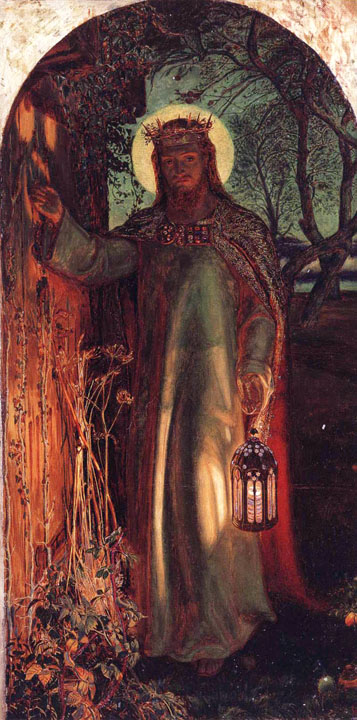
This brings me to the word seelie. With the world of FRPGs we associate this word strongly with fey creatures and their two rival courts who may or may not be benevolent toward humans. If we look at the etymology of the word, however, we find three very interesting meanings: happy, lucky and blessed. I am particularly interested in that last word, especially given this depiction of Christ by the Pre-Raphaelite William Hunt:


I defy anyone to deny that this doesn't have at least a passing resemblance to how Tolkien describes his high elves.

The word unseelie, therefore, means unholy. There are two primary examples of unholy beings that frequent the forests of Averoigne: vampires and lycanthropes. These two can be seen as men who have actively denied God's image and likeness within themselves. Vampires have chosen to seek immortality sans God and lycanthropes (literally wolf-men) have denied their own free-will to make moral choices — they give themselves over to being beasts and beings of pure instinct.

This suggests that the fey, rather than being faeries, elves, dwarves, goblins, etc. are actually bodiless powers (aka angels and demons) who either bless or corrupt normal human beings who then become elves, dwarves, goblins, etc. I imagine that the normal trajectory would look something like this:

  • A child is "touched" and begins to display outward signs of being an elf, dwarf or halfling.
  • This child would then never quite fit into normal human society. Society may even fear the child.
  • The child would then have three options: embrace their gift (and possibly get ostracized), hide their gift in order to fit in (the origin of half-elves?) or reject it.
  • Those that embraced their gift but are ostracized are tempted by unseelie fey to take revenge. Those that give in are twisted (the origin of orcs, etc.)
  • Those that reject their gift will also be tempted by the unseelie fey to do whatever it takes to get rid of their gift. These will also be twisted.
  • Subsequently, those that are twisted have two options: repent or no.
  • Those that refuse to repent become monsters.

The one wrench in this whole set-up is the elf, who is able to cast arcane magic. Given that arcane magic is naturally corruptive (especially when not done in conjunction with divine magic and/or the church), the origin of the elven "gift" is most likely not seelie. Quite possibly, the reason people fear the "touched" is due to the very reason that most, if not all, elves are unseelie from the outset…

Sunday, June 26, 2011

There Is an Adventure in Here Somewhere

My youngest daughter absolutely loves the concert DVD A Winter's Night — Sting at the Durham Cathedral doing winter and Christmas-themed music. If she hears the opening of Three Ships, she'll drop whatever she is doing and come running. I mention this, because as a result of her enthusiasm, I have had the opportunity to become very familiar with many of the songs. One of my favorites is this rendition of The Burning Babe:


The lyrics of the song come from the poem by the Jesuit Robert Southwell:

As I in hoary winter's night stood shivering in the snow,
Surprised I was with sudden heat which made my heart to glow;
And lifting up a fearful eye to view what fire was near,
A pretty babe all burning bright did in the air appear;
Who, scorchëd with excessive heat, such floods of tears did shed
As though his floods should quench his flames which with his tears were fed.
Alas, quoth he, but newly born in fiery heats I fry,
Yet none approach to warm their hearts or feel my fire but I!
My faultless breast the furnace is, the fuel wounding thorns,
Love is the fire, and sighs the smoke, the ashes shame and scorns;
The fuel justice layeth on, and mercy blows the coals,
The metal in this furnace wrought are men's defilëd souls,
For which, as now on fire I am to work them to their good,
So will I melt into a bath to wash them in my blood.
With this he vanished out of sight and swiftly shrunk away,
And straight I callëd unto mind that it was Christmas day. 
Given my recent interest in an Averoigne-like campaign setting, this poem just feels right — like it somehow should be a part of the fabric of the campaign. There has to be an adventure in here somewhere — what dangerous direction could the visage of a burning babe lead a band of adventurers?

Wednesday, June 22, 2011

Monastic Orders

In the wake of the creative onslaught that assaulted my brain after reading The Beast of Averoigne by CAS, I have been brushing up on Western monasticism in order to be able to piece together an appropriate ecclesial structure for a campaign set in a fantasy version of southern France. In order to do this, one actually has to start in the east.

Christianity has from the very beginning had a monastic character. Though he was certainly not the first monk, St. Anthony is considered the grandfather of Christian monasticism. He was a hermit of the Egyptian desert in the late 3rd century and early 4th. His life was record by St. Athansius the Great. This was translated into several languages and became an extremely popular book. It inspired an entire generation (and continues to inspire, I might add).

With the advent of Christianity not only being tolerated by the Roman Empire, but being the preferred religion of emperors, the first great era of martyrdom came to a close. Facing a world where there was no possibility of following in the footsteps of the great Christian heroes into martyrdom and inspired by the Life of St. Anthony, an entire generation went into the desert.

There, two basic styles of monasticism developed: cenobitic (communal) and eremitic (hermit-like). St. Basil the Great is seen in Orthodoxy as a founding monastic legislator, whose rules are still used by Orthodox monks today. St. Benedict, using St. Basil's rules as a model, wrote his own Rule which became the model for Western monasticism.

During the period of approx. A.D. 1100-1350 there were at least three orders within France that could be used as inspiration for a fantasy setting:

  • Benedictines: (mentioned in The Beast of Averoigne), also known as black monks (because of their black/dark robes) who are followers of the Rule of St. Benedict. It is a cenobitic order.
  • Cistercians: also known as white monks (because of their undyed robes). They also follow the Rule of St. Benedict, which they attempt to follow in exactness. They emphasize field-work and are famous for their agriculture (they introduced a lot of agricultural technology to Europe) and as horse breeders. The only income they accepted was from this field-work (no gifts, no tithes, etc.). It is a cenobitic order. The Knights Templar were Cistercians.
  • Carthusians: also known as charterhouse monks. This is the most austere of the orders. They shaved their heads, wore horse hair shirts and took a vow of silence. They lived as hermits, gathered together only for services and ate together only on Sundays. It is an eremitic order. In more modern times, they made famous a green liquor known as chartreuse, from which the pale green color gets its name.

For the purposes of using these three orders to inspire monastic orders for a fantasy world, I am going to adopt the names black monks, white monks and green monks. These primarily refer to the color of the robes that they wear.

One of the basic credos of the Rule of Benedict is the simple phrase Pray and Work. White monks emphasize work, being excellent farmers and horse breeders. They live in communities in rural and wilderness environments. Green monks emphasize prayer. They are famous for their elixirs (derived from the same plants that they use to dye their robes) and live primarily as hermits in the wilderness. Black monks seek to find a balance between work and prayer. They tend to live in communities in or near urban centers.

Besides their robes, the three orders can also be distinguished by their form of tonsure. White monks wear the classic "bald spot" tonsure we all associate with medieval monastics. Green monks shave their heads. Black monks do not cut their hair or beards at all. Therefore, they are also sometimes known as Nazirites (see Numbers 6:5). [This latter style has two sources of inspiration. Orthodox monks normally do not cut their hair nor shave and the Merovingian Kings of France were known as the "long-haired kings" because not only did they wear their hair long, but if their hair were cut, they would be unworthy of ruling.]

In addition to monks, each order would have two sub-orders: Canons and Swords. Canons are those ordained priests who have taken monastic vows. Interestingly, the Eastern Orthodox practice of allowing marriage prior to ordination was still in use in Western Christendom at this time, though frowned upon. I like the idea that cleric characters don't necessarily have to start out as ordained clergy, but would have to be ordained in order to receive 3rd level spells or higher — thus marriage is a possibility for those inclined. Swords are the military arm of the order. These would be the Knights Templar or the Hospitallers of this fantasy world.

To summarize:

Black Monks

Cenobitic order whose abbeys are primarily in or near urban centers. They seek to find a balance between prayer and work. Known for their black/dark robes and their uncut hair and beards. Also known as Nazirites.

Black Canons

Ordained priests who have taken a monastic vow with the Black Monks.

Black Swords

The military arm of the order. They have served extensively in the East, explaining the heavy eastern influence on the order.

White Monks

Cenobitic order who emphasize field-work. They are especially gifted farmers and horse breeders. Known for their undyed robes and their "bald spot" tonsures. Their abbeys are primarily in rural or wilderness areas.

White Canons

Ordained priests who have taken a monastic vow with the White Monks.

White Swords

The military arm of the order. While they also have served in the east, they have had more influence in the West. There are rumors of corruption, hidden treasures and even sorcery among its members.

Green Monks

Eremitic order who primarily live in the wilderness. Emphasizing prayer, they are known for their green robes, which are dyed with the same plants that they use to make their green elixirs. They shave their heads and take various vows of silence.

Green Canons

Ordained priests who have taken a monastic vow with the Green Monks.

Green Swords

The military arm of the order. The smallest of the three military orders, these soldiers are famous for their unarmed fighting techniques.

Monday, June 20, 2011

Holmes and Clark Ashton Smith

Over the weekend, I have been very much distracted by Mr. Clark Ashton Smith. I am not unfamiliar with his writings, even though I only discovered him as an adult; however, to date, I have mainly read his Zothique Cycle of stories. While I certainly enjoy his prose and would gladly read them again and again rather than what has passed for science fiction/fantasy over the last couple of decades, his stories have never really fired up my imagination. Until now. This weekend was the first time I ever ventured into Averoigne.

[Before anyone starts questioning by old-school cred, I was a player when my friends and I ran X2 Castle Amber and we never got to Averoigne during the campaign. Thus, I never had occasion to see the bibliography that Moldvay provided.]

Smith's The Beast of Averoigne caught me by complete surprise. There are stories that really excite and entertain. There are those that inspire. This one sent explosions of creativity bursting through my brain.

First of all, I love the groundedness of the story. I felt comfortable in the world — as if I were somehow familiar with it despite the fact I had never before read anything about it.

Secondly, I love the implication that the Beast itself is extraterrestrial. This leaves all kinds of room for whatever monstrosities one wants to inflict upon a campaign world (gonzo or no).

Finally, as someone who has not only spent quite a bit of time with Holmes, but extrapolating an assumed world from those rules, I have to ask: Is there a better example of a literary world for playing Holmes in than Smith's Averoigne? Personally, I can't think of any.

It hits so many of the notes I have found coming out of the Holmes edition:

  • It implies a Christian civilization at the edge of the wilderness.
  • Although tolerated, arcane magic is frowned upon as being pagan and corrupting.
  • There are Inquisitors that monitor and arrest wizards who do not use their magic to benefit the citizens of Averoigne.
  • The corruption of arcane magic dates to before the advent of Christianity, and runs deep.
  • There are powerful magic items which date from these ancient times.
  • There are plenty of ruins and abandoned chateaus (and therefore, potential dungeons) available for exploring.
  • I could go on…

From a purely (and geeky) historical point of view, the southern part of France (which is approximately where Averoigne would be) is a fascinating model for any campaign — especially if one chooses A.D. 1100-1350 or so. Pope Clement V refused to move to Rome. As a result, the papal court moved to France. A total of seven popes reigned from the Papal palace in Avignon. In addition, two antipopes used Avignon as their headquarters. This juicy history is chuck full of possibilities for all kinds of campaigns.

I also have in my possession an hagiography written by St. Gregory of Tours. In it he details the lives of several Gaulic saints from the 5th-6th centuries. Though this is well outside the time frame of an Averoigne-based campaign, it does lay the foundation for the beginnings of Christianity in the campaign world. These saints can be the background noise that defines the Christian civilization.

Finally, with the campaign world being so firmly grounded in a real-world location and time-frame, the clothes, armor, weapons, names, etc of characters can be clearly delineated. There are plenty of books available that can help define what it is a character can expect to be able to own and what they might look like.

I love it when a story starts me down a path like this…I just hope these seeds can someday come to fruition.