Showing posts with label orcs. Show all posts

Tuesday, July 28, 2020

The Importance of Evil

I think I agree about the ‘creation by evil’. But you are more free with the word ‘creation’ than I am. Treebeard does not say that the Dark Lord ‘created’ Trolls and Orcs. He says he ‘made’ them in counterfeit of certain creatures pre-existing. There is, to me, a wide gulf between the two statements, so wide that Treebeard’s statement could (in my world) have possibly been true. It is not true actually of the Orcs – who are fundamentally a race of ‘rational incarnate’ creatures, though horribly corrupted, if no more so than many Men to be met today. — J.R.R. Tolkien Letter No. 153
Implied in this quote about orcs is a cultural critique of modern man divorced from God. The “rational incarnate” creature is one that has replaced God with reason, and having done so has rid the world of Good and Evil. Fundamentally, this is why I have a real problem with WotC and its new approach to orcs.

Evil, like cold, is an absence of something. In the case of cold, it is an absence of heat. In the case of evil, it is the absence of good. In a Biblical context, God is the source of all goodness, because Christ Himself tells us:
“Why do you call me good? No one is good except God alone.” —Mark 10:18 
Thus, when humanity elevates rationality to the point that it thinks God is no longer necessary, a biblical critique would argue that the society built on that foundation is evil. From a practical point of view, good and evil cease to make any sense.

To go back to the heat/cold analogy, imagine that we have lived our entire lives near the arctic circle and have never seen a world without ice and snow. In such circumstances, it is impossible to describe what it might be like to live in the Sahara, because we have never experienced that kind of dry heat in our lives. In the same way, if we live a life without good, we have no reference with which to understand evil.

The consequence of such a world-view is catastrophic on many levels. The first half of the 20th century saw the rise of what Tolkien might call rational incarnate societies. They murdered others and their own in the tens of millions. Absence any concept of good, rationality justified mass murder. The level I am concerned with today, however, is in the realm of stories…specifically about how we construct them in context of an RPG.

The most universal and archetypal stories that have cultural significance and last through the ages are those that at some level pit good versus evil. In my lifetime, Star Wars played with these archetypes brilliantly. Homer, Beowulf, Gilgamesh, the Bhagavad Gita, King Arthur, Shakespeare, etc. all meditate on Good versus Evil. Good yarns have good characters who have complex and interesting motivations inspired by the classic conflict of good and evil.

In context of RPGs, especially classic versions of D&D, character motivation becomes a central feature of the game. Every player has to wrestle with why their character does what they do. Every player has to wrestle with what has the most value. This is particularly true when XP isn’t exclusively given for combat. In older versions of the game where 1xp=1gp, and a goblin was worth 5 xp, getting the 500gp treasure guarded by the goblins became an exercise in weighing values. In campaigns where 1xp=1gp spent, gaining a level became an exercise of literally putting your money where your mouth is, and then living with the consequences.

In this context, orcs are the personification of the absence of good. Whether physical manifestations of sin, spawn of the fallen world, or a humanity that has turned its back on God, orcs allow us to have a reference point for what is good. Without them, every character is an orc. They may look like a human, gnome, or elf, but without the reference point of evil, everyone may as well be an orc.

In a world where everything is an orc, good stories become impossible. Archetypes disappear, because the only character motivation left is selfishness. Without evil, why do anything? When selfishness is the motivation for everyone, everything become normative. Killing millions becomes rational.

Telling stories and playing RPGs become boring and pointless.

So, for me, having a world where orcs are evil is essential for not only understanding the game, but being able to actually play it.

Friday, July 24, 2020

Orcs of My Greyhawk Campaign

Given the fact that the etymology of the word orc includes such definitions as hell-devil, evil spirit, and underworld corpse (literally, the corpses of Orcus), I (unlike WotC) have no problem calling the orcs in my version of Greyhawk evil. In fact, I have always been attracted to the idea of using Gygax’s suggestions for orc and hobgoblin tribe names to represent various different types of orcs in one of my campaigns. Thus, I am going to take several human(oid) monsters and re-skin them (with a few minor adjustments) as different types of orcs.

For the sake of practicality, every orc tribe is primarily made up of orcs by-the-book:  HD 1; AC 6; Atk 1 by weapon; Move 9; Special: -1 penalty on attack rolls in sunlight. Also for practicality, all of the following variations of orc can be found in any tribe; however, these variations are more likely to be found in certain tribes, described below.

The Skull Smashers are a haven for the Swift Orcs, for which I am going to use the stats of a goblin but up the move from 9 to 12. Thus, they survive by outmaneuvering their bigger cousins and by gathering in large enough numbers.

The Rotting Eye Orcs have figured out a way to overcome their weakness in sunlight. Their strongest warriors are infected with a magical disease that rots out their eyes and increases the other senses. One of the side-effects of this process is a lust for violence that results in a battle-frenzy. Frenzied Orcs use the same stats as berserkers.

The Slow Killers get their name, not just from their talent for torture, but from the fact that they can take their time to move either at night or day because Dusk Orcs do not suffer from the sunlight penalty of normal orcs. The Dusk Orc uses the same stats as a gnoll.

The Flesh Renders get their name from the claw-like hands of Talon Orcs. Like Dusk Orcs, Talon Orcs have no penalty in sunlight; however, they prefer to engage in unarmed combat in order to take advantage of their claws. They use the same stats as an ogrillon.

The Death Moon Orcs have a reputation of being silent killers. This is due to their heavy use of Ghost Walker Orcs, who are surprisingly nimble and quiet on their feet. They use the same stats as bugbears.


The Dripping Blade Orcs are widely feared for their reliance on Rivener Orcs. These huge orcs are strong enough to cut normal troops in half with their large blades. Rivener Orcs use the same stats as ogres.

The Leprous Hand Orcs are notorious for their use of undead. This is made possible by their heavy use of Necromancer Orcs who are able to summon skeleton warriors to bolster the ranks of the Leprous Hand. Necromancer Orcs use the same stats as a Tusken Ogre; however, instead of Mirror Image, they are able to cast Monster Summoning I (skeletons only).

The Flayers are literally feared because they are led into battle by Flagellant Orcs, who use blood magic and self mutilation to cast the spell Fear. They use the same stats as a Tusken Ogre; however, instead of Mirror Image, they are able to cast the aforementioned Fear spell.

The most powerful orcs, the Priests of Orcus, are normally only found within the Vile Rune Orcs, who are fanatic followers of the Prince of the Undead. The Priests of Orcus use the same stats as an Ogre Mage; however, instead of having the ability to shape-shift, they have the ability to cast Monster Summoning II (zombies and skeletons only).

Finally, the Long Spears is a mercenary company made up of orcs, half-orcs, and humans. Normally, their leader types are half-orc and they instill a level of discipline in their troops that make them very dangerous on the battle field. Normal troops of the Long Spears use the same stats as hobgoblins, but also gain the Special Ability that as long as they fight in formation, any damage done to one is distributed among all the Long Spears in the formation. For example, if a PC is fighting four Long Spears in formation and does 8 damage, instead of one Long Spear taking all 8, each of the four in formation will take 2 damage each.

Thursday, July 21, 2011

On Being Seelie

Any time one decides to set an FRPG in an pseudo-historical setting, such as Averoigne, one must deal with elves, dwarves, halflings, etc. A choice must be made: to have demi-humans or not. If they are included, they must be explained — especially if the pseudo-historical setting is Christian because the salvation of Christ is intrinsically tied to His incarnation as a human.

I have long been a fan of demi-humans. When I first began to play with the Holmes edition all those years ago my first character was an elf and my best friend's was a dwarf. Though my friends and I gravitated towards human characters as we grew older, I have always enjoyed the sense of whimsy and mystery they can bring into a game (they also can transform a "hopeless" character into something dangerous as the halfling Pawnchee has demonstrated in my Lost Colonies campaign). Therefore, I am not particularly interested in "punting" the issue of demi-humans by not including them in my version of Averoigne.

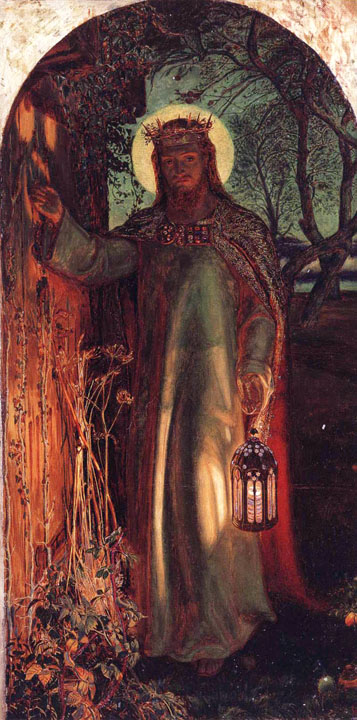
This brings me to the word seelie. With the world of FRPGs we associate this word strongly with fey creatures and their two rival courts who may or may not be benevolent toward humans. If we look at the etymology of the word, however, we find three very interesting meanings: happy, lucky and blessed. I am particularly interested in that last word, especially given this depiction of Christ by the Pre-Raphaelite William Hunt:


I defy anyone to deny that this doesn't have at least a passing resemblance to how Tolkien describes his high elves.

The word unseelie, therefore, means unholy. There are two primary examples of unholy beings that frequent the forests of Averoigne: vampires and lycanthropes. These two can be seen as men who have actively denied God's image and likeness within themselves. Vampires have chosen to seek immortality sans God and lycanthropes (literally wolf-men) have denied their own free-will to make moral choices — they give themselves over to being beasts and beings of pure instinct.

This suggests that the fey, rather than being faeries, elves, dwarves, goblins, etc. are actually bodiless powers (aka angels and demons) who either bless or corrupt normal human beings who then become elves, dwarves, goblins, etc. I imagine that the normal trajectory would look something like this:

  • A child is "touched" and begins to display outward signs of being an elf, dwarf or halfling.
  • This child would then never quite fit into normal human society. Society may even fear the child.
  • The child would then have three options: embrace their gift (and possibly get ostracized), hide their gift in order to fit in (the origin of half-elves?) or reject it.
  • Those that embraced their gift but are ostracized are tempted by unseelie fey to take revenge. Those that give in are twisted (the origin of orcs, etc.)
  • Those that reject their gift will also be tempted by the unseelie fey to do whatever it takes to get rid of their gift. These will also be twisted.
  • Subsequently, those that are twisted have two options: repent or no.
  • Those that refuse to repent become monsters.

The one wrench in this whole set-up is the elf, who is able to cast arcane magic. Given that arcane magic is naturally corruptive (especially when not done in conjunction with divine magic and/or the church), the origin of the elven "gift" is most likely not seelie. Quite possibly, the reason people fear the "touched" is due to the very reason that most, if not all, elves are unseelie from the outset…

Saturday, March 12, 2011

Meditating on Orcs

In response to James' call to create a buzz about orcs across the old school blogosphere, let me begin with my absolute favorite depiction of "orcs" in print or film:


Yep, those are the "goons" from Disney's Sleeping Beauty. I don't know what it is, but whenever I watch this classic with my kids, every time I see these guys run across the screen, I am transported back to my very first experiences with D&D and my attempts at making heads or tails out of the Holmes edition. In short, these guys make me want to play. I can't say that about pig-faced orcs, green-faced orks that cry "Waaagh!" or (especially) Pete Jackson's full body-suit orcs.

The inspiring thing about the Sleeping Beauty orcs is their deliciously deviant diversity. Yes, the guys are kinda cute, but there is a dangerousness about them that I just can't get enough of.

In terms of D&D, my own version of orcs are distinct from the goblinoid races and are a byproduct of a world where magic interacts with sin. There are several ways that orcs can be produced:
  • They can be manufactured by either evil magic-users, powerful half-orc champions or any other number of likely candidates for general of an orc army.
  • There is an evil that wanders across my world called the Blight Demon. It feeds off of negative emotions — anger, greed, gluttony, etc. One of the byproducts of a "feeding" is the creation of Blight Spawn. These include such oddities as owlbears, perytons and orcs. The Blight Demon allows the sin of its victims to become physically manifest. This is one of the reasons for the wide diversity among orcs.
  • Finally, through repeated debauchery and heinous behavior, people can slowly transform over time into orcs.
In other words, these are true monsters.