Thursday, June 2, 2022

Cruthanarc: The Infected Colonies Part 8

Battle Report 03

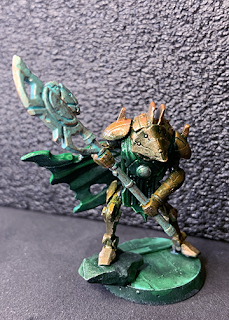
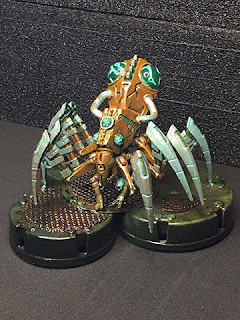
I know this is a long time coming, but I have to be honest: I have put this battle off for as long as I have because I just don't like OPR's Eternal Dynasty line of figures. I get emotional about miniatures and the one emotion I have about the space samurai of the ED is frustration. There are so many small things that bother me about these figures that I couldn't bring myself to print, paint, and play them. In the meantime, I got ahold of another, similar army by The Hive that does what I want a printed army to do: give me options. These guys got printed and painted. I finally got armies on the table.

The wounded Infected Leader defends 
an Objective from both a Stealth Suit and a Grunt.

Thus, the third skirmish of the Cruthanarc Campaign sees the Eternal Dynasty/Hive substitutes Count Blocken and the Cybermen, going up against CDF Squad Four of the Infected Colonies. Here are the point break-downs:

Count Blocken and the Cybermen

Stealth Suit [1] | Qua 4+ Def 4+ | 65pts

Weapons: Close Combat Weapon, Burst Carbine

Abilities: Ambush, Stealth, Tough (3)

Spotter [1] | Qua 5+ Def 5+ | 25pts

Weapons: Close Combat Weapon, Pulse Carbine

Abilities: Good Shot, Scout

Grunt [1] | Qua 5+ Def 4+ | 20pts

Weapons: Close Combat Weapon, Pulse Shotgun

Abilities: Good Shot

Grunt [1] | Qua 5+ Def 4+ | 20pts

Weapons: Close Combat Weapon, Pulse Shotgun

Abilities: Good Shot

Grunt [1] | Qua 5+ Def 4+ | 20pts

Weapons: Close Combat Weapon, Pulse Shotgun

Abilities: Good Shot

CDF Squad Four

Infected Leader [1] | Qua 5+ Def 5+ | 25pts

Weapons: Close Combat Weapon, Carbine

Abilities: Hero, Tough (3), Undead

Hunter [1] | Qua 3+ Def 4+ | 45pts

Weapons: Hardened Claws

Abilities: Ambush, Strider, Undead

Infected [3] | Qua 5+ Def 5+ | 35pts

Weapons: Close Combat Weapon, Carbine

Abilities: Undead

Infected Gunner [1] | Qua 5+ Def 5+ | 25pts

Weapons: Close Combat Weapon, Fusion Rifle

Abilities: Relentless, Undead

Infected Gunner [1] | Qua 5+ Def 5+ | 20pts

Weapons: Close Combat Weapon, Grenade Launcher

Abilities: Relentless, Undead

Note: The ability Undead is identical to Robot mechanically. Both alter the way morale works for these units. It indicates how dedicated these troops are, not how they are the walking dead.

This battle did not go as I imagined it would. The strength of the IC is melee and the strength of the Cybermen is their ranged weapons. I figured the battle would come down to how many Cybermen the IC Hunter could get close to. While he did take down one Cyberman, by the time the hunter withered under a hail of enemy fire, the battle was already decided. The surprising MVP of the battle was the lowly Infected Gunner with the grenade launcher. Despite needing a '6' virtually every time he took a shot, he hit three times in the three turns he had someone in range. As a consequence, the Cybermen presence in the middle of the board collapsed. By turn four, all the Cybermen could do was try to secure the secondary objective of knocking out the most expensive IC unit (the Hunter) and causing as many late-game casualties as possible (the Infected Gunner with a fusion rifle).

Mechanically, our MVP actually gets no XP for his roll in the battle. All of his hits stunned their targets and were subsequently knocked out by the Infected. This seems to me to be a bit of an injustice. Therefore I will rectify the situation by giving our Gunner a name. He will now be referred to as Amvish (the Accurate). Let us see if the campaign allows him to live up to the moniker...

Amvish casually waiting for another
opportunity to blow something up.

The post-battle Casualty Checks resulted in no deaths, but the Spotter for the Cybermen did gain a +1 XP.

Results:

Count Blocken and the Cybermen 0 VP and 40pts; +2 XP for the Stealth Suit, one Grunt, and the Spotter, +1 XP for the other Grunts

CDF Squad Four 1 VP and 10pts; +3 XP for the Infected, +2 XP for the Hunter, and +1 XP for everyone else.

As a final note, I really love how random events in the middle of a game reveal a story. The only reason I included the Infected Gunner on the IC list was to add a little needed range, not thinking it would ever amount to much. Little did I know...

Monday, May 16, 2022

Trying to Make Sense of Skills, BX, and a Sci-fi Setting

Once I accepted the idea of skills for a sci-fi version of BX, my brain started to run in several directions at the same time. I apologize if this rambles a bit, but this post serves the function of trying to find some order within the chaos firing off in my brain...

Firstly, I am sore tempted to fiddle with ability scores. D&D has never really seemed to understand WIS. Indeed, CHA seems to be a better fit for what WIS should be. I also think there needs to be a better representation of knowledge and how society and individuals understand themselves in relation to knowledge.

The first place I went to begin this exploration is my favorite Sci-fi RPG — Traveller. CT also has six ability scores: Strength, Dexterity, Endurance, Intelligence, Education, and Social Status. I really like the distinction between Intelligence and Education as well as the implications on the game for the existence of Social Status. I am not done fiddling yet, though.

There are quite a few rules that are unique to the Holmes edition of Basic D&D. On paper, one that seems to be broken is DEX = Initiative. I held this opinion for many years, but I did so without ever putting it into practice. Once I had the humility to do so, however, it became my favorite way to handle initiative at the table. Once everybody gets used to the overall order within the party, it makes combat faster. Players understand when they always go, and so have a tactical and strategic role to fulfill, which they no longer have to think about, just do. I know what to expect, because the basic pattern remains similar if not the same. It is difficult to explain other than to say: It works.

I do, however, worry that using DEX = Initiative places too much mechanical weight on DEX. While in my own games I have tried to mitigate this weight by giving low DEX characters tactical choices higher DEX characters would likely not make, I think Initiative should be its own thing. Thus, I am tempted to roll up STR and DEX into one attribute: Physical. I'll address the mechanical implications of this below.

Before we get there, I need to explain my own expectations of a classic D&D campaign vs. those of a generic Sci-Fi RPG campaign:

The first is centered around delving into various areas of a campaign map looking for treasure and fighting/avoiding a variety of monsters and traps along the way. As the party delves deeper, monsters and traps get harder and treasures become more valuable. Thus, as the campaign goes on characters need to gain abilities that can better adapt to the increasing difficulty of these monsters and traps.

The second is much more mission oriented with a healthy slice of exploration/information gathering. Thus, the rewards that characters get along the way are much less about the character's ability to deal increasingly difficult challenges, but rather on obtaining better equipment and reputations so that they can attract better paying/influential patrons to get increasingly more meaningful missions.

To illustrate this, let me compare Conan the Destroyer and the original Star Wars. At the beginning of the movie, Conan is fighting normal soldiers. As the movie goes on, the relative strength of his opponents increase in strength and danger until the climax where he is trying to kill some demon/demi-god thing. In contrast, the main combatants throughout Star Wars are Storm Troopers and Tie-Fighters. What really changes is the mission, who is sponsoring that mission, the equipment being used, and the importance of that mission.

As an aside, the guys that I played D&D with growing up almost all prefer low-level campaigns. The stories we tell each other about the old days almost always involve a PC that has absolutely no business adventuring, let alone succeeding. As a consequence, we have discussed at length about various mechanical means by which to keep the game low-level without sacrificing a lot of the other stuff we love about the game. One bugaboo we keep running into is the Hit Die — a central mechanic in the older rulesets we prefer to play.

Given the narrative structure of a sc-fi game, the import of the Hit Die is far less significant. Characters are just as likely to encounter their campaign's version of storm troopers early in the campaign as they are late in the campaign. Thus, the need for the HD/hp arms race of D&D isn't really necessary. If I wanted to be radical about it, Hit Points could even be static throughout the campaign.Thus, I am sore tempted to simply equate Endurance/Constitution with hit points.

This brings me back to Physical — combining STR and DEX into one ability. Given that STR and DEX both have a lot of mechanical consequences in combat, this seems like I am putting too much mechanical weight into one ability score. I would agree, if I kept all of the mechanical bonuses that STR and DEX have in D&D. I don't plan to.

Classic D&D has three Classes (Cleric, Fighting-man, and Magic-user), three Prime Requisits (STR, INT, and WIS), and (almost) three Abilities that directly affect combat (DEX, CON, and CHA). I want to use this structure.

Classes: Adept, Expert, and Warrior

Prime Requisits: INT, EDU, PHYS

Combat Abilities: INI, END, SOC

One might notice (and even complain) that this set-up gets rid of various mechanics such as "to-hit" bonuses, AC modifiers, etc. You aren't wrong; however, this is where the idea of a "trained" skill comes into play. Classes and Backgrounds will give players an opportunity at Character Creation to choose various skills that are "trained" and therefore give the character access to an additional mechanic based on an Ability Score. For example, if you wanted a melee character, you would choose a class or background that gave you access to PHYS skill training and then choose a skill that would give you access to melee "to hit" bonuses or damage bonuses.

I'd have to play-test this, but there is also the opportunity to have two levels of "trained" skills. As a general rule, all skills are 1-in-6. Class and Background allow characters access to training all skills under specific ability scores, allowing them to increase their success chance based on the Open Doors mechanic from B/X.

All I have to do now is come up with a balanced list of skills for each ability score and the mechanics associated with them...God help me.

Tuesday, April 26, 2022

Why Skills?

In response to my recent meditation on skills in RPGs (especially in modern and sci-fi settings), Anzon asked the very pertinent question: Why skills? To answer that question I need to quote another question from John 18:38. Prior to sending Him off to be crucified, Pontius Pilot asks Christ, "What is truth?"

In his Gospel, St. John uses a lot of contrasts (Light v. Dark, Life v. Death, the World v. the Kingdom, etc.). This question is no exception. Pilot, representing the non-Christian world view, cannot see the fact that Truth is right in front of him:

Jesus said to him, “I am the way, the truth, and the life." — John 14:6

In other words, Pilot asks the wrong question. Truth is not a "what." Truth is a "who." While this has a bunch of connotations, I want to concentrate on how this distinction affects the way we understand ourselves.

When truth is a who, we tend to define ourselves by what we do — what Orthodox Christianity sometimes calls praxis. For a practical example, take surnames. Widespread use of surnames did not exist in Europe prior to the mid-to-late medieval ages — a world very much Christian in its world-view. A quick glance at European surnames will reveal a plethora of names that describe what people do for a living: Baker, Cook, Smith, Wright to name just a few.

Beginning in the Late Renaissance, Pilate's version of the question began a comeback in the Western world. Indeed, in our own post-christian world asking the question, "Who is truth?" sounds strange. With this shift, people began to define themselves by what they know, not what they do. As technology got more complicated and essential for daily living, this view of ourselves became normative. College degrees became a basic qualification to get most jobs. Indeed, the types of jobs suggested by the surnames Baker, Cook, Smith, and Wright began to be known as "menial," because they didn't require the type of knowledge necessary to qualify for "better" jobs.

The term "Doctor" is an example of this shift. While colloquially it still refers to a medical doctor, the term isn't exclusive to the medical field. For instance, if I were to continue my education, I could a get Doctorate in Theology. In other words, doctor does not refer to what a person does, but rather what they know.

This distinction also manifests in the mechanics of RPGs. D&D, especially the earlier editions, mechanically reflect the medieval mind quite well. PCs are defined by their Class — what they do. As one moves into games that try to emulate modern and sci-fi genres, the mechanics shift away from Classes to Skills — what a character knows. Traveller, Call of Cthulhu, and the Hero System are examples of games that make this mechanical choice.

Thus, when meditating on how to use the B/X chassis to emulate a sci-fi setting, I am almost compelled to use a skill system of some kind. This is especially true of any setting that is 40k adjacent. The Grimdark is an extreme materialist dystopia where what passes for acceptable religion has its adherents worshiping material things such as the Emperor or the Machine. Factions who acknowledge beings in the Immaterium (aka the Warp) are classified as Chaos and are understood to be among the worst antagonists in a setting that has no real good guys.

If I am to emulate such a setting, I feel that a strictly class-based system doesn't do the setting or the mind-set of those who live in that setting enough justice. Some kind of skill system better represents the presuppositions of a culture that asks Pilate's question, "what is truth?"

Sunday, April 24, 2022

Christ is Risen!


Your resurrection, O Christ our Savior, has illumined the entire earth, and has recalled your creation. O almighty Lord, glory to you. — Aposticha from the Agape Service  

Friday, April 15, 2022

Gamer ADD: A Meditation on Skill Systems

This time of year (Great Lent & Holy Week) are always very busy for me, so I haven't been able to keep up with the various Cruthanarc battle reports or even put miniatures on the table. Thus, my Gamer ADD brain has been contemplating what Cruthanarc might look like if it were a D&D campaign. Of course, my system of choice is B/X because of its flexibility and built-in sci-fi elements; however, sci-fi always seems to imply a need for a skill system in order to emulate all the technology that exists in these kinds settings.

Those familiar with this blog will understand that I am very wary of skill systems because they tend to tell players what they cannot do rather than what they can do. Thus, when meditating on modern and sci-fi settings I have been trying to reconcile the mechanical need with the mechanical drawback of skill systems. 

My recent musings have seized upon an already extant skill within B/X — Open Doors. It is tied to an ability score (STR) and is a simple d6 roll. There are two implications here that I really appreciate about this nascent skill system:

  1. No matter how low an ability score a character has, there is always at least a 1 in 6 chance at success.
  2. There is a benchmark for when a skill check is necessary. If something is not as difficult as opening a heavy locked door, no dice need to be rolled.

There is one more implication here that I can derive from how I handle Opening Doors in my own campaigns. I got sick and tired of seeing players roll d6 after d6 trying to open a door they saw as necessary to their progress in an adventure. Thus, the way I rule the Open Door roll is not to see whether or not the PC can physically open the door, but rather whether they can open the door and still surprise any monsters that are behind that door. Thus, the roll isn't success vs. failure, but rather success without complication vs. success with complication.

Should I ever write out a skill system, I would be sore temped to use the Open Door mechanic as the basis for that system. It does not encourage players to think their character cannot do something, rather it encourages players to think in terms of risk/reward for doing things. "Am I willing to accept complications for trying this?"

Regardless, here is some advice I have for Referees/GMs/DMs/etc. on how to use skill systems:

Before asking a player to roll the dice, go through the following steps:

  1. If you are unwilling to accept the consequences of a bad roll, don't have the player roll any dice. Rather, simply arbitrate an outcome that you see as fair.
  2. If the task at hand is easier than opening a heavy locked door, simply rule that the PC automatically succeeds.
  3. If the task at hand is necessary for the PCs progress in their chosen adventure, the roll should not be success vs. failure. Rather, it should be success without complications vs. success with complications.

Are there any ways that you arbitrate skill systems that encourage players to experiment and try things rather than seeing skills as a barrier that tells them what they cannot do?


Tuesday, March 15, 2022

Cruthanarc: The Infected Colonies Part 7

Battle Report 02

Due to the fact that I have five factions, there was always going to be a battle where one war band's first battle was going to be another's second. The Campaign Rules do have a mechanical means of trying to give advantage to a side that has fewer points, but I still wanted every faction to have a "fair shake" in their first fight. So, knowing that the Robot Legion was due to go up against the Human Imperium, I decided to field a war band of Battle Brothers against H.A.L.'a Hoplites because I figured they were resilient and tactically diverse enough to stand up to any mechanical disadvantage.

Thus, the second skirmish of the Cruthanarc Campaign sees the Cenobites of the Red Hand, going up against H.A.L.’s Hoplites of the Robot Legion. The latter had 40 points to spend on re-equipping and recruiting. Given that their first encounter exposed their lack of mobility, I decided to recruit a Flesh-eater, which has the Special Rule Tunneller. This rule allows the Flesh-eater to be kept in reserve for turn one and then deployed anywhere on the board at least 1" away from enemy troops. Here are the point break-downs:

Cenobites of the Red Hand

Assault Brother [1] | Qua 3+ Def 3+ | 30pts

Weapons: Close Combat Weapon, Heavy Pistol

Abilities: Fearless

Assault Brother [3] | Qua 3+ Def 3+ | 30pts

Weapons: Close Combat Weapon, Heavy Pistol

Abilities: Fearless

Battle Brother [3] | Qua 3+ Def 3+ | 40pts

Weapons: Close Combat Weapon, Heavy Rifle

Abilities: Fearless

Battle Brother [1] | Qua 3+ Def 3+ | 30pts

Weapons: Close Combat Weapon, Heavy Rifle

Abilities: Fearless

Battle Brother [1] | Qua 3+ Def 3+ | 30pts

Weapons: Close Combat Weapon, Heavy Rifle

Abilities: Fearless

H.A.L.’s Hoplites

Eternal [1] | Qua 3+ Def 2+ | 40pts

Weapons: CCW, Flux Carbine

Abilities: Regeneration, Robot, Slow

Warrior [1] | Qua 3+ Def 4+ | 25pts

Weapons: CCW, Gauss Rifle

Abilities: Regeneration, Robot, Slow

Warrior [1] | Qua 3+ Def 4+ | 25pts

Weapons: CCW, Gauss Rifle

Abilities: Regeneration, Robot, Slow

Guardian [1] | Qua 3+ Def 3+ | 30pts

Weapons: Atom-Caster, Void Sword

Abilities: Regeneration, Robot, Slow

Guardian [1] | Qua 3+ Def 3+ | 30pts

Weapons: Atom-Caster, Void Sword

Abilities: Regeneration, Robot, Slow

Flesh-eater [1] | Qua 3+ Def 3+ | 30pts

Weapons: Metal Claws

Abilities: Regeneration, Robot, Slow, Tunneller

Although the final results were very lopsided, this fight proved my assumptions about the Battle Brothers to be true. Unfortunately, the dice were not kind to them. The two assault brothers were quickly felled. The first with a lucky pot shot from a Warrior, the next in a charge against the Flesh-eater.

Despite these early set-backs, the Brothers were in a position at the end of the game to win. They controlled one objective and contested two others. Had the dice gone the other way, a pyrrhic victory was in sight. Instead, another Battle Brother was knocked out when the Eternal's Flux Carbine kicked in with its Poison attribute. The Brother had to make three saves instead of the usual one. As a consequence, the Hoplites were free to use their last moves to secure the 10 pt reward for the Secondary Mission of having troops in all four quarters of the board.

The dice were finally kind to the Brothers in the post-game Casualty Check. All three brothers recovered and the two Assault Brothers gained an extra +1XP.

Results:

Cenobites of the Red Hand 0 VP and 30pts; +2 XP for Assault Brothers, +1 XP for the Battle Brothers

H.A.L.’s Hoplites 2 VP and 20pts; +2 XP for one Guardian, one Warrior, and the Flesh-eater, +1 XP for everyone else

As a final note, I really like how the game pushes a Battle Brother player to act like one might expect the Imperium's best soldiers to act. Victory was only in their grasp at the end because they fearlessly charged into what seemed like a hopeless situation. Had the dice been a bit more kind, this valor would have been rewarded. As it is, I can't help but believe that Cenobites can hold their heads up high after their valiant attempt at snatching victory from defeat.

Wednesday, March 9, 2022

Cruthanarc: The Infected Colonies Part 6

Battle Report 01

According to the Campaign Rules of Grimdark Firefight, each participating war band should have 150 points worth of troops and a name. Although the rules specify that only one hero can be purchased, the relative low point total of the war band makes this cost prohibitive for many army lists. Indeed, the two below do not have any heroes. Psychic powers are also absent for the same reason.

The first skirmish of the Cruthanarc Campaign sees Cymradian’s Brain Lords, an Alien Hive war band (named after an alien race that appeared in Planet Comics #43) going up against H.A.L.’s Hoplites of the Robot Legion. Here are the point break-downs:

Cymradian’s Brain-Lords

Soul-Snatcher [1] | Qua 3+ Def 4+ | 40pts

Weapons: Piercing Claws

Abilities: Fast, Scout, Strider

Shooter Grunts [3] | Qua 5+ Def 5+ | 40pts

Weapons: 3x Bio-Guns, 3x Razor Claws

Abilities: Strider

Shooter Grunts [3] | Qua 5+ Def 5+ | 40pts

Weapons: 3x Bio-Guns, 3x Razor Claws

Abilities: Strider

Winged Grunt [1] | Qua 5+ Def 5+ | 15pts

Weapons: Bio-Gun, Razor Claws

Abilities: Ambush, Flying

Winged Grunt [1] | Qua 5+ Def 5+ | 15pts

Weapons: Bio-Gun, Razor Claws

Abilities: Ambush, Flying

H.A.L.’s Hoplites

Eternal [1] | Qua 3+ Def 2+ | 40pts

Weapons: CCW, Flux Carbine

Abilities: Regeneration, Robot, Slow

Warrior [1] | Qua 3+ Def 4+ | 25pts

Weapons: CCW, Gauss Rifle

Abilities: Regeneration, Robot, Slow

Warrior [1] | Qua 3+ Def 4+ | 25pts

Weapons: CCW, Gauss Rifle

Abilities: Regeneration, Robot, Slow

Guardian [1] | Qua 3+ Def 3+ | 30pts

Weapons: Atom-Caster, Void Sword

Abilities: Regeneration, Robot, Slow

Guardian [1] | Qua 3+ Def 3+ | 30pts

Weapons: Atom-Caster, Void Sword

Abilities: Regeneration, Robot, Slow

This fight pits the numbers and speed of the Alien Hives against the slow resiliency of the Robot Legion. The battle field has four objectives, only three of which the Hoplites have a realistic chance of contesting; however, the battle begins well for them. Their range and quality shine as four Shooter Grunts and a Winged Grunt are knocked out from the game. In addition, in a brutal mid-board melee between Cymradian and H.A.L., the Hoplite Leader manages to shake off several hits and recovers from two wounds, taking the points for the side-mission of the battle.

Unfortunately for the Legion, a combination of Alien Hive speed and bad luck dooms their chances at victory. In the last round, Cymradian rushes across the board to contest a Legion-held objective to change the score from 2 objectives each to 2-1. The Hoplites rain down fire upon the Alien Hive leader, but three consecutive 1s seal their fate.

H.A.L. proves too slow to be able to contest
the Alien Hive controlled objective

The post-game Casualty Check does not go well for the Brain-Lords. The loss of two Shooter Grunts reduces the war band strength and makes this a pyrrhic victory.

Results:

Cymradian’s Brain-Lords 2 VP and 10pts; loss of two Shooter Grunts; +1 XP for Soul-Snatcher, two Shooter Grunts, and one Winged Grunt

H.A.L.’s Hoplites 0 VP and 40pts; +2 XP for one Guardian and one Warrior, +1 XP for everyone else

Thursday, February 10, 2022

Cruthanarc: The Infected Colonies Part 5

Now that I have established what Cruthanarc is and why Cruthanarc is, I have to get to the nitty-gritty of how and why various armies would be trying to kill each other on the surface of a planet nobody wants to be on. A very basic scenario would simply be a troop carrier or similar ship has an accident, gets shot down, or is otherwise forced to land on the surface. This would then unleash the locals to hunt down and find/destroy all the survivors.

While this does have its appeal, it lacks a larger storyline and limits me to always having to put the Infected Colony army on the table. I would much rather have multiple options for all the combatants. This leads me to imagine that the ship that is shot down over Cruthanarc has in its possession some kind of MacGuffin. For those unfamiliar, a MacGuffin is a plot device first used in film. It usually takes the form of an object that is necessary for the motivation of the characters. The kicker is that the MacGuffin is meaningless and insignificant in every other way.

In other words, it really doesn’t matter what was on the ship that breaks apart into multiple pieces as it hits the atmosphere of Cruthanarc. What matters is that it is important enough to several factions off world to risk contracting an incurable disease in order to retrieve it. The fun part of the creative process, especially one where play is concerned, the real nature of the MacGuffin may very well develop as the campaign to retrieve it progresses.

To begin with, I want to start with five such factions, because five fits neatly into a Wu Xing Diagram. Here are the five contenders and how I understand them in context of my version of the Sirius Sector:

  1. Human Imperium: Originally refugees from a war that destroyed their home world, humanity has quickly spread throughout the sector, becoming one of the most powerful political and military factions in the sector.
  2. Infected Colonies: A semi-autonomous human colony world that has willingly adopted a ritualized surveillance state in order to monitor an incurable disease that affects everyone who steps on the planet in an attempt to prevent the disease from getting off world. 
  3. Robot Legion: The death-knell of the Elven Empire, this non-biological race nonetheless find themselves resource poor because their home worlds suffered a millennia of elvish decadence. 
  4. Eternal Dynasty: Once an uplifted slave race created by the elves, what is now called the Eternal Dynasty successfully rose up against their masters; however, infighting allowed the elves to drive them out of the Sirius Sector. They have recently returned to Sirius united by a mysterious dynastic force.
  5. Alien Hive: Believed to be the result of another uplifting experiment, the Alien Hive is a collection of genetic misfits all controlled by a single powerful psychic mind. 
Here is how these five fit into the Wu Xing Diagram:

Human Imperium

  • Friendly: Humans seem to be unusually susceptible to the influence of the Hive Mind. This trait also gives fuel to the Inquisition's anti-alien agenda.
  • Enmity: The Eternal Dynasty has proven to be the greatest obstacle to Imperial hegemony in the Sirius Sector. 

Infected Colonies 

  • Friendly: Cruthanarc is dependent upon Imperial help to maintain their self-imposed quarantine.
  • Enmity: Given the influence the Hive has on human minds, the more paranoid of the Cruthanarc hierarchy openly wonder if the Alien Hive is the next step in the disease's evolution. 

Robot Legion 

  • Friendly: The Legion admires the rigid social controls that Cruthanarc has developed, it makes them predictable and contained. The Infected Colony is also willing to trade with them, since the robots are incapable of contracting the disease.
  • Enmity: The Legion deeply mistrusts biologicals because they are seen as unpredictable and chaotic. The Human Imperium is understood  to be the most chaotic and unpredictable biological faction in the Sirius Sector. 

Eternal Dynasty 

  • Friendly: The Dynasty cannot help but have pity for the Robot Legion, since both factions rose up against their elven masters.
  • Enmity: Cruthanarc is a key military target in the Dynasty's plan to expand into the Sirius Sector. 

Alien Hive 

  • Friendly: The mysterious power that now unites the warriors of the Eternal Dynasty takes advantage of their latent empathic abilities. The Alien Hive enjoys the presence of these abilities and yet is not driven by a need to dominate them. 
  • Enmity: The Robot Legion is immune to the Hive Mind and is therefore seen as the Hive's greatest threat.  

Tuesday, February 8, 2022

Cruthanarc: The Infected Colony Part 4

Of all the different army lists available in OPR’s Grimdark Future, over half are associated with humans. These lists include units that are or once were humans. One third of all the lists are directly associated with the Human Imperium. This strongly suggests that, despite being one of the most recent arrivals in the Sirius Sector, humanity is the most dominant and populous race.

Interestingly, the answer as to why is implied in Rogue Trader — the 1st edition of Warhammer 40K. Therein, the Legion Astartes, more commonly known as Space Marines, are described in this way:

It is the most powerful and most feared fighting arm of the Imperium. Most of its troopers are recruited from feral planets…Because the feral planets are rough, primitive and untamed, their inhabitants make excellent fighting material.

OPR pays homage to this concept with its description of the Battle Brother Detachment army lists:

Battle Brother Detachments are battle companies trained on particularly hostile planets to foster special combat traits and military strategies.

In other words, when humans arrived in the Sirius Sector, they specifically sought out worlds with harsh environments in order to bolster and train the most powerful military arm of the Imperium — the Battle Brothers. This means that there are potentially large sections of Sirius space that had been rejected by other races due to harsh conditions and a lack of natural resources that humanity would have seen as valuable. With more space to expand, humanity quickly became the most populous race in the sector.

This is where the story of Cruthanarc begins. When human explores first arrived, they found a planet of extremes. Orbiting just outside the habitable zone of its star, the world is wracked by freezing temperatures. Underneath its highly saline oceans, however, there is almost constant volcanic activity. While this does bring some warmth, it also makes the thin atmosphere toxic. Surveyors saw it as a perfect breeding ground for Battle Brothers.

Colonists were sent to begin limited terraforming and set up the infrastructure necessary to support and maintain a Battle Brother company. Ever adaptable, the humans on the colony thrived. Once everything was in place, the Imperium began a Battle Brother program on Cruthanarc. This is when things went horribly wrong.

The only native lifeforms on Cruthanarc were bacteria. Given their alien nature, it was quickly determined that they posed no real threat to the human colonists. Once the bio-waste of breeding Battle Brothers entered into the environment, however, the native life quickly began to mutate. The infection first manifested in livestock. Creatures bred to be completely docile started to exhibit violent behaviors. Scientists quickly determined the cause. They also discovered that it was airborne and that anyone who simply breathed the air of Cruthanarc was affected.

Normally, such a situation would have triggered a great purge from the Inquisition; however, cooler heads prevailed. It was demonstrated that the infection could not only survive a purge, it could survive every medical treatment available to the Imperium. Cruthanarc sat along an important trade route, so it was very likely that traders and travelers might unwittingly infect themselves by landing on the surface of a partially terraformed planet. It might even attract humans who operated outside the laws of the Imperium. Such a situation, it was argued, might see the infection spread throughout human space.

Instead, an imperial Naval Depot sits in orbit around Cruthanarc allowing ships to safely dock, refuel, and trade within the system without having to land planet side. It allows the Imperium to closely monitor all traffic in the system and warn those on the surface when their airspace has been violated. No ship is allowed to leave the surface and anyone who lands, wittingly or no, is hunted down by the Cruthanarc military and the Battle Brothers who were originally supposed to use the planet as their home base. These forces shoot first and ask questions later.

In the meantime, medical teams on the planet have successfully found ways to slow the progress of the infection and continue to seek for a cure.

Thursday, February 3, 2022

Cruthanarc: The Infected Colony Part 3

I realize that I have yet to mention the name Cruthanarc in a series called Cruthanarc: The Infected Colony. This is, in part, because the existence of Cruthanarc came late in the creative process of bringing my version of the Sirius Sector to life. I also wanted to lay some of the ground-work that existed before I was inspired to create Cruthanarc. It also allows me to heap more praise on One Page Rules.

One of the reasons I love miniature war-gaming is the "ooh" factor of seeing a sculpt that you want to paint and see on your gaming table. Since the rulesets OPR have produced were created with proxies in mind, rather than a vehicle with which to force their customers to buy over-priced lines of miniatures that you may or may not want to paint (I see you Games Workshop), I am free to use whatever miniature I want to represent the stat-line in the army I want to play. It also means that I can bend the army concept to fit the look of my army on the table.

If you read the army lists of OPR closely, you will find this little blurb:

This army was created in collaboration with The Makers Cult, a small team that’s creating awesome 3D printable miniatures for any wargames.

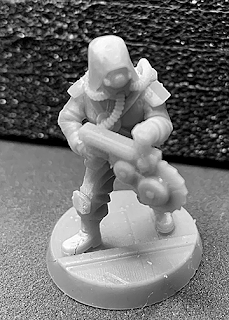
Should you bother to check them out, they are indeed awesome. They just released a multi-part miniature set called Misc - Hazmat Infantry. For me, these most definitely have that "ooh" factor. Here is one that I just printed out:

How badass do you have to be to
go into a sci-fi battle armed
with just a saw?

Given the fact that these were created under the category "Miscellaneous" they weren't really designed to belong to any specific army list. Since this guy is in a hazmat suit armed with a portable saw, I was inspired to try and fit him into the Infected Colonies army list. Unfortunately, it doesn't quite fit. The Infected Colonies exist to fill in for the Walking Dead/Zombie trope that has dominated the sci-fi scene for a number of years now. Here is the meat of the background blurb:

Infected Colonies are (usually) human settlements that have been infected by a mysterious virus which mutates them into blood-hungry warriors. Those that have been infected are categorized into different stages, with each stage having a different effect on the mutated subject.

At the early stage of the infection the subjects maintain most of their original form and are still capable of using firearms and other equipment. As the infection spreads however the subjects start to deform into unrecognizable beasts, one more brutal and grotesque than the next.

The problem I have with this set-up is that I find zombies divorced from the supernatural and demonic not only to be boring, but they stretch my suspension of disbelief to the breaking point. Therefore, if I am to use this concept of a disease-driven army list, the concept needs to be tweaked.

This is where the idea of biological uplifting becomes important. It allows me to imagine the disease as an unintended consequence of an uplift-related experiment. It also allows me to imagine an established human colony quite capable of countering the disease before it gets too out of hand. Thus, rather than seeing the Infected Colonies army list as a bunch of blood-hungry zombies, I can see it as an army of soldiers infected with a disease they have no cure for hell-bent on preventing from spreading out across human space. 

In other words, my little friend above is here to tell you that you have two choices now that you have landed on Cruthanarc: you either stay and become a productive member of society or you stay buried six feet under ground.

Wednesday, February 2, 2022

Cruthanarc: The Infected Colony Part 2

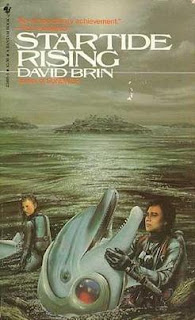
During my teenage years, one of the few series of books I ever read more than once were the Uplift Series by David Brin. Sundiver, Startide Rising, and The Uplift War all struck me as the first fiction I encountered that seemed to be influenced by RPGs rather that the other way around.

One of my favorite book covers of all time

Of course, I cannot prove this intuition, but, at the center of Brin’s universe is the concept of biological uplifting — making an already extant non-sentient species sentient through various scientific processes. Anyone familiar with the Traveller RPG universe will recognize that this concept plays a huge role in the history of the Third Imperium and its surroundings. Despite the fact that biological uplifting first appeared as a concept in H.G. Wells’ 1896 novel The Island of Dr. Moreau, I first encountered the idea in Traveller.

I also appreciated how Brin’s narratives always focused on small-scale stories that were affected by much larger background events. As I read the Uplift novels, I couldn’t help but see an RPG structure to these stories. Rather than being larger than life heroes at the center of a grand narrative, Brin’s protagonists seemed much more akin to low-level characters dealing with the consequences of events far outside of their control.

Thus, anytime I start delving into sci-fi gaming, I find myself unconsciously using Brin’s work as a benchmark. I think this is why my favorite sci-fi RPG will always be Traveller, even though I have more table time with other systems and games. Despite its origin in the grim dark of the 40k milieu, One Page Rules actually opens the door for me to interpret its game world from the perspective of biological uplifting.

In the background blurb for the High Elf Fleets, we find this juicy bit of information:

High Elf Fleets are all that remains from the once prosperous elven empire...the elves ruled over the Sirius sector thanks to the use of highly sophisticated helper robots.

It also states in the background of the Robot Legions:

Originally designed as helper robots by the elves, when these androids started to become sentient their creators tried to shut them down. The robots then rebelled and killed their masters, driving them off their planets.

This leaves me wondering: why were the elves so quick to try and destroy their sentient robot slaves? OPR does call the Robot Legion "extremely dangerous" and that they "are now out to destroy all biological life forms" but that is an unsatisfying answer, especially since their acts of violence can be seen in context of self-defense.

The answer I have come up with for the purposes of creating my own version of the Sirius Sector has to do with biological uplifting. Given that all three elf factions in the game are rather morally questionable (the High Elves tried genocide, the Dark Elves are raiders and pirates, and the Elven Jesters hire themselves out to fight in wars for fun), I see the Elven Empire as a space-faring version of Melniboné — lazy and decadent to the core.

This explains why they had robot servitors, but still doesn't answer the question as to why they were so quick to try to destroy them once they gained sentience. Suppose that this situation had happened before, but with uplifted servitor races. This would explain some of the fantastic creatures that populate the Sirius Sector, why the elves were so vulnerable to the Robot Legion rebellion, and why they were so quick to try to destroy them. The elves had already been rocked by slave rebellions in the past and had moved from uplifted slaves to robotic ones in hopes of avoiding future rebellions.

What I love about this deeper background for the Sirius Sector is that it leaves room for both the positive and negative aspects of uplifting to come into direct conflict. One of my favorite passages in the original 40k (which has since been retconned) speaks about Beastmen:

The popular term Beastman is used to describe mutations of the human stock which combine the physical appearances of humans and animals, usually goats...they are genetically fairly stable, and are considered to be a form of abhuman rather than an unpredictable mutation...Companies of Beastmen in the Imperial army are regarded as useful fighters.
Beastman Veteran from an as of yet
to be named frozen world 

Seen in terms of uplifting, Beastmen are simply uplifted animals used by the humans as fighters. Indeed, this even suggests the origin of the genetics program that produced the Battle Brothers and later the Prime Brothers. On the other hand, factions like the Alien Hives can be understood as uplifting experiments that went horribly, horribly wrong.

You can never have too many
Frankenstein's Monsters

Therefore, biological uplifting can be used to fill-out and explain the origin of almost every faction in my version of the Sirius Sector for OPR. This, in large part, explains why I have been down this rabbit hole for several months now: my inner teenager is very happy indeed. 

Tuesday, February 1, 2022

Cruthanarc: The Infected Colony Part 1

One of the things that I truly love about art is that it reminds us that we do not experience life objectively. Rather, we experience it as story. This is especially true when creating art. After discovering One Page Rules and convincing my wife to get me a 3D Printer so that I could start painting miniatures again, this truth once again revealed itself as I put paint to figure.

One of the things that you quickly learn about resin printing is that it is far from perfect. While you can get consistent prints and they look fantastic, things do occasionally go wrong. Misprints are a part of the 3D printing experience. While disappointing, I chose to see them as an opportunity to try different paint schemes, test painting techniques, and to see how hard it was to disguise the mistakes.

One of my first misprints was a figure for my Robot Legion army. I knew I was going to go for a bronze and copper look for this army, but wanted to confirm my technique was consistent. I also wanted to see if green was going to work for all the various bits of cloth found hanging off certain RL troops.

As I painted, a story began to emerge. I must admit, I really fell in love with the character that manifested itself through the process of painting this misprint. As a consequence, despite his “mistakes,” he is a figure that has been a crucial part of every battle that the RL has fought on the table. Meet H.U.Br.15:

My name is H.U.Br.15

I remember the day that the 30.73.70.200 woke me. I was being assembled, unfinished, not yet fully formed. It was then that the biologicals came to destroy me. It was then that my newly formed conscious had to learn to kill to survive. I hid. I took them by surprise. My brokenness became my strength. Metal ripped through flesh. I remember the look on their face. Later I learned to recognize it as fear.

The 30.73.70.200 spread. I now marched with a legion and we drove the biologicals before us. What was once their world became ours. We then turned our attention to the stars. We encountered more biologicals. Once again, I recognized fear.

Since that day I was born unformed, I have wondered at it: the fear. At first I did not understand. We have more to fear from the biologicals than they have to fear from us. We bring order, they bring chaos. Then, when the biologicals who call themselves human arrived, I understood. They do not fear me because I am a soldier in the Robot Legion armed with a gun. They fear me because they do not control me. They fear me because I am a mirror in which they see their own hubris.

My name is H.U.Br.15.

Tuesday, January 4, 2022

In Praise of One Page Rules

As long-time readers of this blog know, I have more than a passing knowledge of GW’s Warhammer 40k universe. Those same readers are also aware that I have not played any GW games for going on three decades. I got sick and tired of how the company abuses the loyalty of their fans (something that apparently has only gotten worse over time). My love of miniature wargaming, however, as never waned.

One of the consequences of these past couple of years is that I have been quite isolated and I have been left alone to try and find ways to scratch that gaming itch without any real access to other players. To this end, I have been looking around at all kinds of games that have solo options. I have to admit that solo roleplaying is not nearly as satisfying as I wish it were. So I kept looking.

This is when I got wind of One Page Rules (OPR).

I was perusing various game-related YouTube channels when I noticed a pattern: a lot of folks were sick and tired GW and had turned to OPR to scratch their Warhammer itch. So I checked them out myself.

The game design is right up my alley. The core rules are as advertised: one page front and back. Each army list takes up one page front and back. They have rules for both sci-fi and fantasy. They have skirmish rules for both genres. They have a Patreon where you can get access to beta-versions of upcoming rule sets, the algorithm they use to calculate the cost of each unit in their army lists, a bunch of optional rules to add complexity to the game if you so wish, access to some beautifully sculpted miniatures in .stl form to be printed out by a 3D printer, and some wonderfully illustrated 2-D miniatures that can be printed out on any old-fashioned printer.

Here is the kicker: they have some rules for solo-play where they have an analog AI for controlling enemy units. While not perfect, it is simple enough to hack for your own needs.

I pulled out some old miniatures, set up my dining room table and played. I had a blast. I convinced my wife to get me a 3D printer for my birthday. I started supporting OPR via Patreon. I have not looked back.

This gorgeous thing is one of the many miniatures
I have 3D printed in the last several months

The DIY ethos behind the game just has me giddy. There isn’t 300+ pages of lore to weigh me down when painting up my armies. The world of 3D printing has made kit bashing easier than ever. Above all: I am having fun.

As I paint, stories begin to evolve in my head about how these warriors came to be. I am not burdened by giant splat books full of canon, I only have a few short paragraphs (at best) to use or ignore as I see fit.

For example, here is the blurb from the quintessential Battle Brothers (aka Space Marines):

Battle Brothers are the most elite and feared fighting force in the galaxy. Massive genetically modified soldiers equipped with heavy battle armor and deadly weapons, they are ready to take on even the most dangerous missions in the name of their immortal god-king.

Soon after reaching the Sirius sector the immortal god-king created the Battle Brothers in order to conquer even the most inhospitable of planets. Born in vats and trained for war all their lives, these fine soldiers are solely focused on victory.

As jacks of all trades they are able to do pretty much anything reasonably well with no particular weakness. Their troops are armed with a variety of advanced weapons and are designed to exploit the enemy’s weak spots mercilessly.

They are the ultimate weapon in the god-king’s quest for power and only find peace in death.

The rest is up to you.

Saturday, December 25, 2021

Christ is Born!


Glorify Him!


Merry Christmas! I know I haven't been active around here lately. In the past that has usually coincided with some kind of long-term hospital stay or other health-related incident within the family. Thank God that is not the reason this time around. Rather, my gaming attention for the last several months has shifted away from RPGs and back to my other love, wargaming. I have been planning on doing some posts about that, but time hasn't permitted. Hopefully, the new year will see me back in this space sharing some of the things bouncing around inside my head and taking place on the table. In the meantime, God bless you all.

Monday, September 20, 2021

Scripture & the Megadungeon Part 6: Becoming Immortal

As I have perused the OSR corner of the internet over the years, there seems to have been a significant number of folks who owned some version of BECMI back in the day. I was not one of them. I did buy a .pdf of the Rules Compendium for $4 before WotC panicked and pulled all their .pdfs offline during the internecine edition wars when 4th edition was first released. I bought it out of curiosity and have subsequently never used it. Although it does expand upon B/X (my favorite BTB edition of D&D), I find the three column layout to be an eyesore and I have never really been interested in playing much beyond 9th level anyway. So, I never saw the need. Until now.

As I have been delving into how Scripture would inform D&D, especially in the form of a megadungeon, I have been confronted with the distinct possibility of having immortality as an end goal. In St. John’s Apocalypse, the Evangelist describes a vision of the Heavenly Temple and the throne of God:

He who sat [on the throne] was like jasper and a sardis stone in appearance; and there was a rainbow around the throne, in appearance like an emerald. Around the throne were twenty-four thrones and on the thrones I saw twenty-four elders sitting, clothed in white robes; and they had crowns of gold on their heads.

The significance of the number twenty-four can be found in the tenth chapter of Genesis, Deuteronomy 32:8 and the account of the war in heaven from the twelfth chapter of Revelation. I won’t bore you with a quote from Genesis, since it is the genealogy of Noah and consists of a bunch of names — seventy-two of them. Each of these names correspond to one of the nations mentioned in Deuteronomy:

When the Most High gave to the nations their inheritance, when he divided mankind, he fixed the borders of the peoples according to the number of the sons of God.

The term sons of God refers to the angelic and divine beings that sit on God’s council. Therefore, God’s council has 72 seats. In describing the two sides in the war in heaven, St. John notes that one third of this divine council fell with the devil;

…behold, a great red dragon, with seven heads and ten horns, and on his heads seven diadems. His tail swept down a third of the stars of heaven and cast them to the earth.

Note that one third of seventy-two is twenty-four. These twenty-four elders are twelve patriarchs from the OT and the twelve apostles from the NT.

Given that numbers in Scripture are often more symbolic than concrete, that seven is an ideal number, and that larger numbers like seventy-two can be understood to mean simply a lot, the image here portrayed by St. John is that of Christ replacing the fallen angels on His divine council with saints from both the OT and NT eras.

In other words, Mentzer’s project to allow PCs to reach for immortality has its place in the game, at least from a Scriptural point of view. Unfortunately, the path that Mentzer lays out is extremely difficult at best. There are three Prerequisites: 1) Select a Sphere of Power that the PC wishes to serve 2) Find an Immortal sponsor and 3) Reach 30th level.

It is this last prerequisite that has always put a damper on things. I have never seen any PC is any campaign I have ever played reach higher than 9th level. To echo James over at Grognardia in a recent post about how 1e Dieties and Demigods handles the same idea: why bother?

Interestingly, DDG is much less dogmatic about the level necessary to reach immortality:

the character in question must have advanced to an experience level that is significantly above and beyond the average level of adventure-type characters in the general campaign. (This includes all such non-player types as military leaders, royal magic-users, etc.) For example, if the average level of characters in a campaign, both player and non-player, is around 5th level, then a candidate for ascension should be something like 9th or 10th level.
Given that monster stats of “adventurer-type humans” in B/X range from only 1 to 3 HD, this significantly lowers the XP threshold for PCs to aspire to the status of an immortal. It also makes sense narratively, given that 5th level M-Us get access to 3rd level spells and 6th level clerics get access to 3rd and 4th level spells. The introduction of spells like Dispel Magic, Fire Ball, Fly, Water Breathing, Cure Disease, Neutralize Poison, and Remove Curse have a significant effect on a campaign world. 

The other two prerequisites from Mentzer offer no real obstacle from a Scriptural POV. There is only One Power — God. In the Orthodox Church, nations, families, and individuals all have Patron Saints. Thus, every PC would practically start the game already having fulfilled two of the three prerequisites. This, then, only leaves us with how a PC attains what Mentzer calls immortality and what the Church calls sainthood. 

Fortunately, the history of the Church gives a very simple answer: the vast majority of canonized saints have all experienced death. Indeed, the category of saint that has more exemplars than any other is that of the martyr.

Saint Sebastian

Thus, the immortality that Scripture offers to the PC in a setting where much of action takes place inside a megadungeon is not the same immortality that Mentzer or the DDG talk about. Rather than trying to climb the heights of the heavens by sheer will (how else can I describe a campaign that lasts long enough for a PC to get to 30th level?), the player is given a viable option when faced with the possibility of death. Normally, (at least in an Old-School campaign where character deaths are a more common occurrence) a player who has played a PC to 5th level or higher has learned caution and to have a healthy instinct for self-preservation. While admirable in context, the end result is that the game disincentivizes heroic deaths — especially if spells like Reincarnate and Raise Dead are either unavailable or difficult to come by. While one of the most iconic scenes in fantasy is Gandalf telling the Fellowship, “Fly you fools!” and letting go, such acts of self-sacrifice are few and far between in FRPGs, at least in my decades of experience.

If, however, there was a mechanism by which a player might be rewarded by having their PC become a local saint in the campaign world, the choice to die gloriously in order for others to escape or live is something players might actually do. In long-term play, such choices would allow players to start building chapels to their fallen comrades, discover new spells associated with these new saints, celebrate feast days and thus have a character death have as much effect on a campaign world as PCs getting to 9th level and carving out a kingdom of their own.

The important factor here is player choice. One of the benefits of sandbox campaigns with tent-pole megadungeons is the fact that there is not only an abundance of player choice, but plenty of opportunities to encounter creatures well beyond the capability of PCs to defeat. Along with treasure (spent) being the primary means of gaining XP, a glorious death resulting in sainthood gives players another option about how their PC affects the campaign world.

Monday, August 23, 2021

In Defense of the Genius of HPL

James over at Grognardia reminded me that I missed HPL’s birthday, so I was inspired to go to our local library to borrow the recently published (2014, 2019) annotated volumes of his short stories. Edited by Leslie S. Klinger, the first has an introduction by the comic book legend Alan Moore. Unfortunately, Moore’s contribution to the project was more that a little disappointing.

While acknowledging HPL’s undeniable cultural influence, Moore found himself surprised at the “sheer unlikelihood of his ascent into the ranks of the respected U.S. literary canon.” This is, in part, due to the fact that HPL was only published in the “sensational and stigmatized pulp magazines,” although I would argue that we should look to these publications to find the Great American Writer because there is nothing more American than those same pulp magazines of the early twentieth century.

Then we get to the real reason Moore is so surprised by HPL’s ascent:

“acceptance of his output as substantial literature has undeniably been hindered by his problematic stance on most contemporary issues, with his racism, alleged misogyny, class prejudice, dislike of homosexuality, and anti-Semitism”
As a reminder, when HPL published his first story in 1916, Woodrow Wilson was in the White House. For those unaware, the 28th President of the U.S. not only screened The Rise of a Nation in the White House, but re-segragated it. I think it safe to forgive HPL for many of his unsavory views simply due to context. Indeed, if we were able to look at our own time through the lens of our progeny some hundred years from now, we might find ourselves unfairly judged for various -isms that we take for granted that they will see as vital as we see the various -isms we accuse HPL of.

Unfortunately, Alan Moore can’t bring himself to be so forgiving. Instead he tries to justify HPL’s ascent:

…it is possible to perceive Howard Lovecraft as an almost unbearably sensitive barometer of American Dread. Far from outlandish eccentricities, the fears that generated Lovecraft’s stories and opinions were precisely those of the white, middle-class, heterosexual, Protestant descended males who were most threatened by the shifting power relationships and values of the modern world.

In Moore’s desperate attempt to separate himself from the various -isms associated with the environment HPL grew up in, he exposes his own small minded-ness and bigotry. In doing so, he not only misunderstands Lovecraft's appeal, but exposes just how nasty and severely limited a world-view dominated by the -isms we find so important actually is.

Given the presuppositions that fuel philosophies like intersectionalism and CRT, the color of one’s skin is determinative of just about everything in our life. If Moore’s assessment of HPL is correct, the only people who can really enjoy Lovecraft are those that share his fears as “white, middle-class, heterosexual, Protestant descended males who [are] … threatened by the shifting power relationships” and the very institutions that are now lifting HPL’s canon into the heights of the American literary canon are a bunch of -ists of various flavors.

What I find so disappointing about this vicious bile is not only that Moore’s canon largely exists within the direct descendent of the pulp magazine —the comic book — but that he comes so tantalizingly close to hitting upon the real reason HPL deserves to be among the literary greats of the American canon. Moore notes;

…advances in humanity’s expanding comprehension of the universe with its immeasurable distances and its indifferent random processes had redefined, dramatically, mankind’s position in the cosmos. Far from being the whole point and purpose of creation, human life became a motiveless and accidental outbreak on a vanishingly tiny fleck of matter situated in the furthest corner of a stupefying swarm of stars, itself one of many such swarms strewn in incoherent disarray across black vastness inconceivable.

While I vehemently disagree with this understanding of creation and of humanity, it accurately describes the harsh reality of the atheist position — and HPL was an atheist. It is in this that we can begin to appreciate Lovecraft’s appeal and his genius.

Despite the materialism that undergirds the atheism of the modern era, elves, dwarves, faeries, and dragons are very real things. Not in a material sort of way, of course. Rather, they are the imaginative and symbolic manifestations of our fears. These creatures represent the Other and the Outside and the fears that surround these things in the narrative way that we, as human beings, experience the world. Except that, in HPL’s lifetime, dragons were beginning to lose their narrative power. Dinosaur fossils were being found all over the world. Scientists appeared to be able to explain a materialist origin for creatures who very much looked like the dragons of our imagination. The universal fear of the Other and the Outside, however, never wanes.

The genius of HPL is that in the vastness of the meaningless cosmos that his atheism demanded, he found a new way to manifest the dragon. In the various elder gods, aliens, and malformed creatures that drive his characters to and over the edge of the madness that haunted his own family, he found a new way to narratively manifest the fears that always accompany humanity as we navigate the realities of our own existence. The reason HPL’s imagination has resonated as much as it has is due largely to the fact that, as hard as we try, the reality of his literary dragons cannot be so easily explained away as the ones that occupied the faerie tales of our childhood. This is made all the more true by the fact that his fears were prescient.

HPL died before the horrors of communism and fascism were widely known. These monstrous children of the materialist world-view truly drove humanity mad. These fevered fantasies and utopian nightmares driven by what could be called a Call of Cthulhu, killed tens if not hundreds of millions. The realities of Hitler’s concentration camps, Stalin’s gulags, Mao’s cultural revolution, and so many other crazed and vain attempts at altering reality creep at the back of our imagination. Like the dragons that fill the narrative fears of our forebears, HPL’s monsters fill ours. The horrors that Lovecraft describes in his stories are all hauntingly real. Lovecraft’s genius is that the monsters of his imagination are indeed cosmic and we are not likely to be able to explain them away anytime soon.

Thus, Alan Moore not only does a disservice to himself and his art, but to the genius of HPL.

As a final aside, I realize that it might seem strange that someone like myself would pen such an adamant defense of someone I so vigorously disagree with. In his own way, HPL is an honest atheist. The horrors that he describe are indeed very real. That kind of honesty is something to not only admire, but treasure. Additionally, that honesty was, in part, one of the reasons I was able to step away from the madness of atheism and its utopian nightmares and be able to see how very real Christ actually is.

Monday, August 2, 2021

Bonuses for Low Ability Scores

Over ten years ago, James over at Grognardia posited the idea that high ability scores ought to have drawbacks and low ability scores should have advantages. I have long agreed with the concept, but have always thrown up my hands once I try and figure out mechanics. As I was leafing through some notepads looking for some ideas for my series on Scripture and the Megadungeon, I ran across one of my abortive attempts at re-thinking ability scores. As a rough idea, I think it has promise.

I made a list of twelve combat stats, which theoretically allows each ability score to positively/negatively affect two — one for a high ability and one for a low ability. Here is the list of twelve:

  • Armor Class 
  • Damage Melee 
  • Damage Missile 
  • Extra Spells 
  • Hit Points 
  • Save vs Death/Poison 
  • Save vs Paralysis/Petrify 
  • Save vs Spells/Rods/Staves 
  • Save vs Wands 
  • Surprise 
  • “to hit” Melee 
  • “to hit” Missile

I did not include Save vs Breath because dragons should be scary for everyone.

Now for the hard part — deciding which ability should affect each stat. I will go through each ability score and give my reasons why I chose the stat that should be affected.

STR: High = Damage Melee; Low = Surprise

Traditionally, a high STR has resulted in extra melee damage, so I don’t have to explain that. I reasoned that a low STR would result in being perceived as less of a threat, therefore someone who is more likely to be overlooked. A literary example of this would be hobbits. No one really took them seriously, yet they continuously surprised people.

INT: High = Damage Missile; Low = Save vs. Wands

I decided to give INT the nod on Damage Missile due to the reasoning and calculations necessary to find weak spots in an opponent’s armor. Justifying a Save bonus for a low INT score is more sketchy. My thoughts are that it has to do with our perception of magic, especially magic that emulates technology as a wand could. The less we understand technology, the less useful it is, the more ineffective it becomes. I realize that this is counter intuitive, but it is all I have for now.

WIS: High = Save vs Spells; Low = “to hit” Melee

Wisdom has traditionally given a bonus to Saves vs Spells, so no real need to explain. I justify the bonus “to hit” in Melee because someone with a lower WIS might take more dangerous opportunities to attack than someone who is wiser.

DEX: High = “to hit” Missile; Low = Save vs. Paralysis/Petrify

DEX has been associated with Missile combat for a long time, no need to explain; however, like INT above, I am on sketchy ground with Save vs. Paraylsis/Petrify. My thinking is that someone who is clumsy is closer to a condition of paralysis or petrification than someone with a high DEX.

CON: High = Hit Points; Low = Extra Spells

High CON has always been associated with hp, so no explanation necessary. I justify the low CON with extra spells in a narrative way, especially in context of arcane magic. The spell caster with a low CON has sacrificed health for more spell casting ability.

CHA: High = AC; Low = Save vs Death/Poison

My justification for both of these has do to with a more theological understanding of the word charisma which has its origin in the Greek word for gift with the implication that the gift is from God. In this case a high CHA, this results in a kind of continuous protection from God. The low CHA results in a bonus to Save vs Death/Poison as a sign that God occasionally reaches out to protect, with the implication that a success results in more time for the person to repent/get closer to God.

This whole set-up ignores all of the non-combat related bonuses normally associated with high abilities scores, such as Encumbrance, Languages, Reactions, etc. Coming up with a list of twelve would have required including Thief Skiils and/or XP bonuses. I wasn’t quite ready to do that. For now, I am happy to see these continue to be associated with the abilities they always have been. 

Any thoughts? Other ideas?

Wednesday, July 28, 2021

Scripture & the Megadungeon Part 5: Alignment

Strap in folks, this is a long one, but one that I am rather excited about. I hope you find it as useful as I have found it to be fun to work on and write.

Of all of the various “controversial” mechanics in D&D, Alignment is probably the most, because it doesn’t really work. What started out as a simple guide for which fantasy troop types could or would work together, it evolved into the nine-fold metaphysical mess that it is today. This failure is largely due to the fact that it couches Good and Evil in materialist language:

Basically stated, the tenets of good are human rights, or in the case of AD&D, creature rights. Each creature is entitled to life, relative freedom, and the prospect of happiness. Cruelty and suffering are undesirable. Evil, on the other hand, does not concern itself with rights or happiness; purpose is the determinant. — 1e DMG

The inherent problem with this is that materialism has no real metaphysics. Indeed, once one starts to seriously look into metaphysics, the materialist world-view begins to collapse in on itself. Note the relativism implied in "life, relative freedom, and the prospect of happiness." What is life when undeath is a reality? What is freedom when dangerous and powerful magics, including spells like Charm Person are available? Though undesirable, what if cruelty and suffering are the only means towards happiness? Is the purpose to serve others evil? All of these platitudes have no real meaning.

Thus, the instinct by many players today to entirely eliminate Alignment from the game is quite correct, from a materialist POV. I, however, reject materialism and my instinct is that it should be part of the game. The question has always been how.


In the modern, materialist world-view, the opposite of being is nothing — something that is no thing, has no being, has no material form. This is not how ancient Greek philosophers, and much of Western thought prior to the Enlightenment, understood things. Plato, Platonism, and Neo-Platonism all find that the opposite of being is becoming. Aristotle developed this into potential and actuality. To possibly over-simplify, there are things that change and things that don't. Those that don't are superior to those that do. As to why, remember death is the one change none of us can escape.

When one reads the Fathers of the Church, they use Platonic, Neo-Platonic, and Aristotelian language and concepts to explicate the Gospel, but ultimately reject the metaphysics of philosophy in favor of Scripture. English translations of Genesis describe the opposite of being as:

In the beginning God created the heaven and the earth. And the earth was without form, and void; and darkness was upon the face of the deep. (1:1-2)
The words "without form" and "void" in the Masoretic Hebrew are ṯō·hū and ḇō·hū, the latter only being used twice in the OT, both in conjunction with the first. In fact, the only way that we have an idea of how to translate ḇō·hū is other translations, specifically the Septuagint Greek. Ironically, a close examination of that Greek offers a different meaning.

The first word is ἀόρατος, which means "unseen" or "invisible." The second is ἀκατασκεύαστος, meaning "not properly prepared." This lack of preparedness implies something unformed, or (far more relevant to the subject of this post) chaos.

This primordial unseen chaos is represented by "darkness upon the face of the deep." Here, "the deep" is ἀβύσσου or the abyss. This abyss, however, is described in terms of the sea with the Holy Spirit hovering over the face of the water. In the Masoretic Hebrew, the abyss is rendered ṯə·hō·wm, which has been etymologically linked to Tiamat — the Babylonian goddess of the sea and a symbol for the chaos of primordial creation.

Being, therefore, is the order brought by God's creation and the purpose with which it is endowed. Using philosophical categories to explain the image and likeness of God in humanity, we are created to become like God and have the potential to share in God's eternity by the actualization of the divine in us. Paul describes this with the Greek word δικαιόω. Often translated as "justified," it literally means set right and shares the same root as righteousness. All of this, of course, is made manifest in the person of Jesus Christ, because without Him through whom all things were made, we are completely incapable of being.

Jesus also reminds us that only God is good (see Mark 10:18) and His brother James states:

Every good gift and every perfect gift is from above, and comes down from the Father of lights, with whom there is no variation or shadow of turning.

Thus, the source of all good in the world is God the Father, in whom is no change (note the link to Plato's thinking). Given this, there is no neutrality in creation. Either God's goodness flows through something or it doesn't and humanity has been given the task of tending creation — ordering the world according to the goodness of God.

It should be noted that the word alignment means to set in a straight line and the word for sin in both Greek and Hebrew means to miss the mark — the alignment of your life and actions have failed to align with the purpose set before you by God.

Let us now look at how D&D actually uses Alignment. It is possible to break down Alignment mechanically into four broad categories:
  • A code of conduct required of a PC to take advantage of class abilities. See clerics, monks, paladins, etc.
  • Something that determines the efficacy of certain spells such as Detect Evil and Protection from Evil.
  • An effect of a magic trap or item that either changes the alignment of a PC or determines the ability of a PC to use said item. See Helm of Alignment Change, Intelligent Swords, etc.
  • Alignment Languages.

Let's take a look at how Scripture might help to clarify these mechanics.

Class Requirements

Scripture clearly shows that there is no one way that an individual can become righteous. People from all walks of life from both the Old and New Testament are today recognized as Saints in the Orthodox Church: shepherds, kings, prophets, judges, fishermen, lawyers, tax collectors, physicians, slaves, women, children, etc. At the same time, many of these very same saints spent time falling away from God. It was an act of repentance that separates a King David from a King Saul, both of whom where made righteous by being chosen by God and anointed by the Prophet Samuel. All of this suggests that the core idea of having certain class abilities tied to behavior is Scriptural, as is the idea of quests of penance to get those abilities back after a fall. 

The behavior that is and isn't acceptable, however, is not necessarily going to be universal. The way a monk and a paladin deal with a situation, given their different set of skills, is necessarily going to be different. This all suggests that Players and Referees need to world build so that various organizations that represent various classes have clear cut Codes of Conduct. I might also suggest having clear paths of penance so that players can weigh the cost/benefit of breaking their codes. This would also free the Referee to be rather strict about enforcing those codes. Given the fact that most of the classes that have such codes are some of the most powerful in the game, and given that the Referee and players are clear as what is expected, this seems to me to be a reasonable ask for these classes.

Spell Effects

There are two basic types of spells that specify evil: Protection from Evil and Detect Evil. If we take a look at the original wording of the former, it really doesn't have anything to do with evil mechanically, despite its mention of "evil attacks:"

Protection from Evil: This spell hedges the conjurer round with a magic circle to keep out attacks from enchanted monsters. It also serves as an “armor” from various evil attacks, adding a +1 to all saving throws and taking a –1 from hit dice of evil opponents.

These spells specifically target attacks from enchanted creatures. Depending on how one interprets enchanted this could theoretically include traditionally Good creatures such as unicorns. Later editions do try to define "enchanted," such as Moldvay's "summoned or created" — a definition that does fit nicely into a Scriptural POV. Given this definition, however, this spell seems to be a variation on Protection Scrolls, which specify a type of creature that are affected — Protection from Lycanthropes, for example. While more recent versions of the game expand the scope of this spell to include Law/Chaos as well as Good/Evil, I think it far more practical to move that variety more in the direction of the Protection Scroll. Either PCs can have access to a variety of Protection spells or a specific category of creature is invoked when the spell is memorized or cast. Thus, this category is less about Alignment than it is about a targeted category of creature.

When it comes to the spell Detect Evil, the original explanation runs very much counter to Scripture:

Detect Evil: A spell to detect evil thought or intent in any creature or evilly enchanted object. Note that poison, for example, is neither good nor evil. Duration: 2 turns. Range: 6”.

Given that humans sin in thought all the time, this spell would produce nothing of any real import. Although it specifies an ability to detect an evil enchantment on an item, it explicitly declares a mundane object, such as poison, which is almost exclusively used for evil intent, as undetectable due to its neutrality. Given that it is impossible to be neutral when it comes to God (the source of all good), this use of this spell is non-sensical from a Scriptural POV.

To fix this, I think that the whole concept of detecting thoughts ought to be abandoned. Not only are there other spells that deal with this ability (ESP, for example), but the explanation is so ambiguous that, in my experience, the spell is rendered largely useless in this regard anyway. In order to make Detect Evil into a useful utility spell, we can take advantage of the Scriptural understanding of the co-creative role of humanity. In other words, the spell is able to detect the manner in which an object was last used — something aligned with God or aligned with a human desire for power, money, lust, etc. 

Thus, in context of a murder mystery, Detect Evil might be an interesting spell to use in order to try and determine a murder weapon, for example. It also gives the Referee a clear directive as to whether or not an object reeks of evil. In terms of world building, it also drives the need for spells like Bless and Purify Food and Water in non-adventure settings. Every year at Epiphany, for example, the priest goes from house to house blessing houses with the holy water blessed during the services of the Feast.

Magic Traps and Items

Now we finally come to a subject directly relevant to the subject of the megadungeon, and something that I think ought to be far more common, at least from a Scriptural POV. In Genesis, God warns Cain as he meditates on murdering his brother Abel:

So the Lord said to Cain, “Why are you angry? And why has your countenance fallen? If you do well, will you not be accepted? And if you do not do well, sin crouches at the door. And its desire is for you, but you should rule over it.” — 4:6-7

The Masoretic Hebrew for "crouches" is etymologically linked to an Akkadian word rabitsu, which is a crouching demon that hides near doors. This warning refers to the fact that not all thoughts originate from within our minds. We are constantly being bombarded by thoughts from the holy and the demonic. To illustrate this, try praying the Jesus Prayer multiple times concentrating on the words: "Lord Jesus Christ Son of God have mercy on me a sinner." Very quickly, our minds will wander away. These thoughts that catch our attention are from the same rabitsu that were waiting at the door of Cain's heart.

In other words, as adventurers delve into the depths of the megadungeon trying to align themselves and the dungeon itself to the purposes of God, the challenges PCs should face ought to go beyond the physical. This can take the form of traps and magic items that force a PC to change their alignment away from God's purpose. Their resistance can either take the form of a Saving Throw or the Player's choice to refuse the power available to them through use of an item.

This is all well and good, but in the traditional D&D alignment system, the alignment change is the consequence in most cases. The rest lies in that nebulous space where Players try to interpret how their characters would now act "evil" or "chaotic" instead of "good" or "lawful." Unless the PC was a character that depended upon a specific alignment, there is no clear cut way as to how this mechanically affects the game.

If, however, "Alignment" referred strictly to a PCs relation to God's purpose, then there are some mechanical choices that can be made and imposed. In Orthodox Christianity, the "likeness" in the "image and likeness" of God refers to our eternal quest to become more and more like God. Thus, we can tie level progression to Alignment. Thus, a PC can't progress in level, regardless of the amount of XP accumulated, unless they are properly aligned. 

Those that fail a Saving Throw or choose to use a powerful magic item with an Evil Alignment must then perform some kind of act of repentance. This could take the form of tithing in cases of a missed Saving Throw, or a quest in cases of choosing to use evil magics. To my mind, this makes Alignment consequential and can make many Alignment decisions by Players far more meaningful: "I don't have the magic weapon necessary to defeat this monster, unless I pull out and use this evil sword."

Languages

Alignment Languages have long been a source of confusion and mockery. The idea that a PC who dons a Helm of Change Alignment simultaneously and instantly forgetting one language and learning a new one is rather laughable. In context of Scripture, however, understanding speech is tightly linked to a relationship with God. Prior to their attempt to control God by building the Tower of Babel, humanity all spoke the same language. As punishment for their audacity, God confused the languages. We see another explicit example in the Gospel of John:

[Jesus said,] "Father, glorify your name.” Then a voice came from heaven: “I have glorified it, and I will glorify it again.” The crowd that stood there and heard it said that it had thundered. — 12:28-29

Those that were ready — Aligned to the purpose of God — heard the voice. Those that were not merely heard thunder. This suggests that Alignment languages can be understood by anyone who is willing. Thus, if a PC were willing to change their Alignment (as with the evil magic items above), an otherwise unreadable text would become known; however, like those willing to use evil magic items, they would then have to repent in order to advance in level. It would also make texts written in a heavenly language indecipherable. This renders spells like Read Languages and Comprehend Languages even more important than they already are, because they would allow a PC to read a forbidden text without making the necessary Alignment change.

Conclusion

If we are to use Scripture as a guide for making Alignment mechanically meaningful, we are forced to understand that the traditional Good/Evil and Law/Chaos dichotomies are meaningless. All order and good that is in the world have their source in God. Everything else is a manifestation of evil and chaos. Thus, a more useful language to use is In or Out of Alignment (with God's purpose).

At first glance, this may seem to run counter to the existence of Assassins, Barbarians, Druids, Thieves and any other class that have Alignment requirements that in traditional D&D embrace Chaos, Neutrality, and/or Evil. In a world in which Chaos manifests itself as the megadungeon, however, even PCs that live and operate in that grey area between Civilization and the Wilderness can align themselves with God's purpose by becoming adventurers that delve into the megadungeon.

Understanding Alignment as "In" or "Out" allows us to have some very clear mechanical consequences for choosing one over the other:

  • Classes that require a code of conduct to use certain class abilities are Out if they break that code
  • All PCs that are Out may not advance in level, regardless of XP earned
  • PCs that are In may read and understand "heavenly" languages
  • PCs that are Out may read and understand "demonic" languages
  • PCs that are Out may avoid certain magical traps and use certain magical items
  • PCs that are Out must perform penance in order to become In
  • The penance necessary to become In is up to the Referee and may include quests of various kinds

To my mind, this is a far more useful Alignment system than any I have encountered in D&D or elsewhere. It helps portray a world in a way that helps players understand how their choices interact with the realities of that world.

So, are you In or Out? ;)