Showing posts with label megadungeon. Show all posts

Saturday, March 9, 2024

Arneson’s version of Challenge Rating

One of the more fascinating bits of information to be gleaned from Tonisborg is a section which reveals Arneson’s methodology of stocking dungeons. For those of us who have used Moldvay as our go-to guide for creating dungeons, we might expect an Arneson dungeon to have monsters in about one third of all rooms. If you are exploring dungeon levels 3-6, this is exactly what you would find; however, only 1-in-6 rooms on dungeon levels 1 and 2 have monsters and half of the rooms on dungeon levels of 7+ are occupied.

Each room that has monsters is assigned what are called “Protection Points” — a randomly determined amount of hit points that are used to “buy” monsters with. As described in Tonisborg, the number of Protection Points are based on an average party size of 4 to 5 PCs. Unfortunately, I found the table provided to be a bit confusing, but was able to take the concept and the described math to provide a very simple metric for determining the number Arneson’s Protection Points:

(1d6+1)(Dungeon Level) per PC*

*This assumes that that HD are based on a d6. This die would shift depending upon what the standard HD is according to the edition used.

Thus, if I were stocking the second level of my dungeon, I would be rolling 2d6+2 Protection Points for each PC in the party. So, if my party had 3 PCs the total number of Protection Points would be 6d6+6.

Additionally, Arneson had a “one sixth principle of monster variation.” On top of the dice rolled above, an extra d6 is rolled. Should that d6 result in a ‘6,’ there is a 50/50 chance that the number of points are halved or doubled.

Thus, in the example above, an average roll would result in 27hp; this would be halved to 14 hp or doubled to 54 hp with a ‘6’ on the variation die.

I have yet to try this method at the table, but in principle it does several things: 

1) It clearly sets up the expected danger of each dungeon level while allowing for some encounters to be surprisingly easy or hard. 

2) It despenses with the need to roll for the number of monsters encountered or for hit points. Both are simply assigned based on the number of Protectin Points avaible. In a way, it frees up the Referee to more exactly tailor their dungeon.

For example, our room on the second level has 27 Protection Points. This can be a typical encounter of 2HD monsters like 3 gnolls with 9 hp each. Or, it could be a bit more ridiculous with 27 goblins with 1 hp each. Or it could be a bit more chellenging with a single 5HD creature like a griffin with 27 hp. 

3) It allows for a kind of short hand when designing/stocking a dungeon. I can simple indicate the number of protection points each occupied room has and assign these points to monsters on the fly depending on whim, need, or random roll. It gives me the freedom to adjust some of the difficulty of a room by increasing or decreasing the number of potential attacks. For example, if I wanted to buy gnolls with my 27 Protection Points and my party needed a bit more of a challenge, I can increase the number of gnolls to 9 with 3 hp each; however, the overall deadliness of nine gnolls is somewhat mitigated by the fact that each will die from average hit from a PC.

This is an idea that seems far more practical than Challenge Levels and their equivalants in the modern game. It will also be something I will have to experiment with to see how it actually plays. Nonetheless, fascinating stuff!


Monday, September 20, 2021

Scripture & the Megadungeon Part 6: Becoming Immortal

As I have perused the OSR corner of the internet over the years, there seems to have been a significant number of folks who owned some version of BECMI back in the day. I was not one of them. I did buy a .pdf of the Rules Compendium for $4 before WotC panicked and pulled all their .pdfs offline during the internecine edition wars when 4th edition was first released. I bought it out of curiosity and have subsequently never used it. Although it does expand upon B/X (my favorite BTB edition of D&D), I find the three column layout to be an eyesore and I have never really been interested in playing much beyond 9th level anyway. So, I never saw the need. Until now.

As I have been delving into how Scripture would inform D&D, especially in the form of a megadungeon, I have been confronted with the distinct possibility of having immortality as an end goal. In St. John’s Apocalypse, the Evangelist describes a vision of the Heavenly Temple and the throne of God:

He who sat [on the throne] was like jasper and a sardis stone in appearance; and there was a rainbow around the throne, in appearance like an emerald. Around the throne were twenty-four thrones and on the thrones I saw twenty-four elders sitting, clothed in white robes; and they had crowns of gold on their heads.

The significance of the number twenty-four can be found in the tenth chapter of Genesis, Deuteronomy 32:8 and the account of the war in heaven from the twelfth chapter of Revelation. I won’t bore you with a quote from Genesis, since it is the genealogy of Noah and consists of a bunch of names — seventy-two of them. Each of these names correspond to one of the nations mentioned in Deuteronomy:

When the Most High gave to the nations their inheritance, when he divided mankind, he fixed the borders of the peoples according to the number of the sons of God.

The term sons of God refers to the angelic and divine beings that sit on God’s council. Therefore, God’s council has 72 seats. In describing the two sides in the war in heaven, St. John notes that one third of this divine council fell with the devil;

…behold, a great red dragon, with seven heads and ten horns, and on his heads seven diadems. His tail swept down a third of the stars of heaven and cast them to the earth.

Note that one third of seventy-two is twenty-four. These twenty-four elders are twelve patriarchs from the OT and the twelve apostles from the NT.

Given that numbers in Scripture are often more symbolic than concrete, that seven is an ideal number, and that larger numbers like seventy-two can be understood to mean simply a lot, the image here portrayed by St. John is that of Christ replacing the fallen angels on His divine council with saints from both the OT and NT eras.

In other words, Mentzer’s project to allow PCs to reach for immortality has its place in the game, at least from a Scriptural point of view. Unfortunately, the path that Mentzer lays out is extremely difficult at best. There are three Prerequisites: 1) Select a Sphere of Power that the PC wishes to serve 2) Find an Immortal sponsor and 3) Reach 30th level.

It is this last prerequisite that has always put a damper on things. I have never seen any PC is any campaign I have ever played reach higher than 9th level. To echo James over at Grognardia in a recent post about how 1e Dieties and Demigods handles the same idea: why bother?

Interestingly, DDG is much less dogmatic about the level necessary to reach immortality:

the character in question must have advanced to an experience level that is significantly above and beyond the average level of adventure-type characters in the general campaign. (This includes all such non-player types as military leaders, royal magic-users, etc.) For example, if the average level of characters in a campaign, both player and non-player, is around 5th level, then a candidate for ascension should be something like 9th or 10th level.
Given that monster stats of “adventurer-type humans” in B/X range from only 1 to 3 HD, this significantly lowers the XP threshold for PCs to aspire to the status of an immortal. It also makes sense narratively, given that 5th level M-Us get access to 3rd level spells and 6th level clerics get access to 3rd and 4th level spells. The introduction of spells like Dispel Magic, Fire Ball, Fly, Water Breathing, Cure Disease, Neutralize Poison, and Remove Curse have a significant effect on a campaign world. 

The other two prerequisites from Mentzer offer no real obstacle from a Scriptural POV. There is only One Power — God. In the Orthodox Church, nations, families, and individuals all have Patron Saints. Thus, every PC would practically start the game already having fulfilled two of the three prerequisites. This, then, only leaves us with how a PC attains what Mentzer calls immortality and what the Church calls sainthood. 

Fortunately, the history of the Church gives a very simple answer: the vast majority of canonized saints have all experienced death. Indeed, the category of saint that has more exemplars than any other is that of the martyr.

Saint Sebastian

Thus, the immortality that Scripture offers to the PC in a setting where much of action takes place inside a megadungeon is not the same immortality that Mentzer or the DDG talk about. Rather than trying to climb the heights of the heavens by sheer will (how else can I describe a campaign that lasts long enough for a PC to get to 30th level?), the player is given a viable option when faced with the possibility of death. Normally, (at least in an Old-School campaign where character deaths are a more common occurrence) a player who has played a PC to 5th level or higher has learned caution and to have a healthy instinct for self-preservation. While admirable in context, the end result is that the game disincentivizes heroic deaths — especially if spells like Reincarnate and Raise Dead are either unavailable or difficult to come by. While one of the most iconic scenes in fantasy is Gandalf telling the Fellowship, “Fly you fools!” and letting go, such acts of self-sacrifice are few and far between in FRPGs, at least in my decades of experience.

If, however, there was a mechanism by which a player might be rewarded by having their PC become a local saint in the campaign world, the choice to die gloriously in order for others to escape or live is something players might actually do. In long-term play, such choices would allow players to start building chapels to their fallen comrades, discover new spells associated with these new saints, celebrate feast days and thus have a character death have as much effect on a campaign world as PCs getting to 9th level and carving out a kingdom of their own.

The important factor here is player choice. One of the benefits of sandbox campaigns with tent-pole megadungeons is the fact that there is not only an abundance of player choice, but plenty of opportunities to encounter creatures well beyond the capability of PCs to defeat. Along with treasure (spent) being the primary means of gaining XP, a glorious death resulting in sainthood gives players another option about how their PC affects the campaign world.

Tuesday, July 20, 2021

Scripture & the Megadungeon Part 4: Factions

One of my favorite published megadungeons is Rappan Athuk published by Necromancer/Frog God Games. With all of its various entrances it is a sandbox campaign unto itself. Nonetheless, I still have quibbles. For example, while it is organized, it is not organized for use at the table and without a lot of preparation on my part makes for an awkward and slow gaming session with lots and lots and lots of page turning. For the purposes of this series, however, my biggest misgiving is this quote from the 2012 S&W edition:

Oh, and yes, Level 15 is still just intended for the Referee to read—Orcus is still supposed to be unbeatable.

This is, in part, due to the fact that Orcus is literally the logo of Necromancer games and they don’t want to produce a product where the symbol of their company gets killed. From a Scriptural POV, however, Orcus is doomed and Rappan Athuk will be conquered.

To make this case, let us first go to Genesis Chapter 18:

And the Lord appeared to [Abraham] by the oaks of Mamre, as he sat at the door of his tent in the heat of the day. He lifted up his eyes and looked, and behold, three men were standing in front of him. (v. 1-2)

The oaks of Mamre were a pagan place of worship. The word for "standing" in verse 2 has a military connotation, coming from a word meaning "station" in Hebrew and "marshaling troops" in Greek. In other words, God is claiming this worship place as His own.

This is possible because, unlike other gods who are tied to a specific place, God's throne is mobile:

And the Ancient of Days was seated; His garment was white as snow, and the hair of His head was like pure wool. His throne was a fiery flame, its wheels a burning fire — Daniel 7:9
In the previous verse, the thrones of God's council are set up. We get a description of one of these thrones when Elijah is taken up into heaven. These thrones are chariots:
Behold, there appeared a chariot of fire, and horses of fire, and parted them both asunder; and Elijah went up by a whirlwind into heaven. — 4 Kings (2 Kings) 2:11

At the time of Moses, the primary place where God set his throne was in the tabernacle (a tent), which Moses made according to God's command:

See that you make everything according to the pattern that was shown you on the mountain. — Exodus 25:40

With the incarnation, the tabernacle became humanity itself:

καὶ ὁ λόγος σὰρξ ἐγένετο καὶ ἐσκήνωσεν ἐν ἡμῖν (And the Word became flesh and dwelt among us) — John 1:14

Note that in the Greek, the word translated as "dwelt" is ἐσκήνωσεν, which literally means to tabernacle. Thus, the place of God's throne — the tabernacle — is baptized humanity and through this humanity, all of creation. This includes megadungeons.

This does not suggest, however, that the megadungeon will be conquered long or even at all before the Second Coming. Note that Solomon, the builder of the Temple and the wisest of all men:

went after Ashtoreth the goddess of the Sidonians, and after Milcom the abomination of the Ammonites. So Solomon did evil in the sight of the Lord. 3 Kings (1 Kings) 11:5-6

Indeed, his son Rahoboam refused to listen to the advice of his elders and the Kingdom of Israel was split into the Northern and Southern Kingdoms. Eventually, both would succumb to foreign invaders because they failed to stay faithful to God.

This suggests that while Orcus and his ilk can be killed, there is always someone in the wings ready to take his place. In his portrayal of Morgoth, Sauron, and Saruman, Tolkien illustrates this very well. It also gives us a very different understanding of factions within the megadungeon.

Christ tells us (in reference to being accused to working for Baalzebul):

If a kingdom is divided against itself, that kingdom cannot stand. — Mark 3:24
Thus, all the monsters within a megadungeon are on the same side. That doesn't mean, however, that various subordinates aren't gunning for a higher position within the team. Remember, Baal is a usurper and is doomed to have the same done to him. Thus, it could very well be in the best interest for one of those subordinates to make a little deal with PCs to have them do the dirty work of cleaning out a level or two before moving in and taking over.

Hence, from a Scriptural POV, Gygax and Mentzer got it wrong when they had Zuggtmoy bound in the depths of the Temple of Elemental Evil. Zuggtmoy should have made some kind of deal with the various forces of Good that participated in the "great slaughter" of the Temple, killing off Loth or some other demon she needed out of the way so that she could re-establish it once the various rulers who made the deal had passed away. Another option is that it was Iuz who made the deal to get rid of Zuggtmoy.

In other words, the fight versus Chaos will never end until such time that Christ comes again because men are weak in the face of evil and there will always be another evil ready to step in when Orcus eats dirt.

Thursday, July 15, 2021

Scripture & the Megadungeon Part 3: Meditating on Those Who Hate the Light

Probably my all-time favorite illustration of a goblin

The most iconic adversaries for a party of adventurers exploring the first levels of a megadungeon are kobolds, goblins, and orcs. While D&D has always differentiated these as three different types of creatures, an examination of etymology and Tolkien suggest that they are three different names for the same type of creature. The word kobold is a German form of the Latin gobalus both of which come from the Greek κόβαλος. In turn, Tolkien himself suggested that orc and goblin are two different names for the same creature (having used goblin in earlier works for what would later be called orcs).

If one looks at the meaning of κόβαλος and orcneas (a plural of orc used in Beowulf), there is a suggestion that kobolds, goblins, and orcs are all human.

A κόβαλος was an impudent rogue and the adjective κόβαλα had the connotation of knavish trickery. Later it was associated with goblins invoked by rogues. Orcneas is often translated as evil spirit and literally means underworld corpse. It could be argued, then, that kobolds, goblins, and orcs are all varieties of humans who have willingly aligned themselves with Baalzebub, Asmodeus, etc. and have either been transformed or are possessed by demonic powers.

This understanding of these creatures is actually hinted at in the 1e MM:

Orcs dwell in places where sun-light is dim or non-existent, for they hate the light.

This mirrors John’s use of the Light/Dark motif is his Gospel:

And this is the judgment: the light has come into the world, and people loved the darkness rather than the light because their works were evil. — 3:19

Intriguingly, the word translated here as judgement is κρίσις, the root of the English word crisis. While the Greek does have a connotation of trial and judgement, it can also mean decision or choice.

The reasons behind this choice can be gleaned from the polemics of Ezekiel 28 where the King of Tyre is condemned to the pit (v. 8) and is turned to ashes on the earth (v. 18) because he claimed, “I am a god, I sit in the seat of the gods” (v. 2). While it could be claimed that this is directed at an earthly king, the Lament over the King of Tyre in verses 12-19 call him a guardian cherub who was placed on the holy mountain (v. 14, 16). In other words, the King of Tyre is seen as a Baal.

In the Baal Cycle, Baal kills Prince Yam-Nahar and takes his throne as the King of the Gods. Yet, despite (or more accurately because of) his victory, Baal fears Mot, the personification of death:

But take care, divine servants: Do not get too close to Divine Mot, lest he take you like a lamb in his mouth, like a kid, you be crushed in the chasm of his throat. The Divine Lamp, Shapsh, is red; the heavens are weak in the hands of the Beloved, Divine Mot. From across a thousand acres, a myriad of hectares, at the feet of Mot bow down and fall, you shall prostrate yourselves and honor him.

Despite the apparent victory and enthronement of Baal, he has no real power because even he cannot approach the land of the dead without being consumed. He killed in order to gain the throne, which means someone else could do the same to him. Like other hero myths from around the world, the Baal Cycle sees Baal forced to go into the underworld (Mot kills him) and then returning with knowledge that allows him to subjugate death.

Thus, at the heart of the Baal Cycle and the other pagan myths that follow the same pattern, is a desire to overcome death using one’s own power — without God. The polemic found in Ezekiel 28 proclaims the folly of this endeavor and warns:

[you will be] thrust down into the pit, and you shall die the death of the slain in the heart of the seas. (v. 8)
Thus, from a Scriptural view, kobolds, goblins and orcs could be seen as what remain of those who align themselves with Baal and attempt to cheat death. What remains of them are underworld corpses, possessed of evil spirits trying to steal from humanity what once was theirs before they turned their back on the Light and embraced Darkness. It is their former humanity, and the temptation for other humans to cheat death without God, that see them occupying those levels of the megadungeon closest to the surface.

Tuesday, July 13, 2021

Scripture & the Megadungeon Part 2: The Destroyer

The name Asmodeus does not appear in the NT or in the Masoretic text of the OT; however, it does show up in the Septuagint OT in the Book of Tobit:
Sarah, daughter of Raguel...was married to seven husbands, but before they could be with her as a wife, Asmodeus, the evil demon, killed them.
According to the Orthodox Study Bible, the name Ἀσμοδαῖος means "the destroyer" and links this with the description of "the thief" as Christ claims the title of Good Shepherd in the Gospel of John:
The thief comes only to steal and kill and destroy; I have come that they may have life, and have it abudantly. I am the good shepherd.—10:10
The name Ashmedai appears in the Talmud and has been linked to the Zoroastrian demon of wrath, Aeshma of the Bloody Mace.

Though later Medieval writers would link these names to lust and even the title Prince of Lust, the Book of Tobit does not attribute any special status besides "evil demon" to the name Asmodeus. This bears little resemblance to Gygax's entry on Asmodeus in the 1e MM, with the possible exception of his glowing rod of pure ruby, which might be a play on the bloody mace of Aeshma.

To fully understand the portrayal of Asmodeus in the Book of Tobit in context of the megadungeon, I must first highlight one the main ways Orthodox Christianity is different from both Catholicism and Protestantism. Orthodoxy has always insisted that there is a distinction between the Essence and Energies of God. The word ἐνέργεια (energy) is often translated in English as work, but in many cases is better understood as activity. The activities of God are made manifest in the three persons of God — we experience the energies, or activities, of God personally. 

There is, however, an essential aspect of God which we can never know and which the Fathers of the Church use apophatic language to describe — ineffable, inconceivable, invisible, incomprehensible, etc. This distinction can be illustrated with the 33rd chapter of Exodus where:

The Lord used to speak to Moses face to face, as a man speaks to his friend. — 33:11

Yet, when Moses, seven verses later, asks to see God's glory, the Lord responds:

You cannot see my face, for man shall not see me and live. — 33:20

These two events are difficult to reconcile unless we acknowledge the Essence/Energy Distinction. Moses is able to encounter the Lord face to face in His energies/activities/person; however, when Moses asks to see the Lord's essence (His glory), the face of God becomes something no man can survive.

For the purposes of this post, however, the most important consequence of the Essence/Energy Distinction is that all the activities of God — Creation, Truth, Life, Love, Hope, Mercy, Forgiveness, Long-suffering, Magnanimity, etc. — are God Himself:

Jesus said to him, “I am the way, and the truth, and the life. — John 14:6

Death is introduced into creation when Adam eats the fruit of the Tree of the Knowledge Good and Evil because he introduces a separation between humanity and Life itself — the energies of God.

This separation also exists in all the fallen angels, also known as demons. They have no access to the energies/activities of God. This is illustrated in the Book of Tobit with Asmodeus. He kills Sarah's husbands before they can consummate the marriage, thus cutting off the co-creative power of the marriage bed. All Asmodeus has power to do is "to steal and kill and destroy."

This all paints a very different picture from the Gygaxian Naturalism found in the 1e MM. Gygax's description of an orc lair would not, and arguably could not, exist:

Orc lairs are underground 75% of the time, in an above ground village 25% of the time. There will always be the following additional orcs when the encounter is in the creatures' lair: a chief and 5-30 bodyguards (AC4) 13-16 hit points, attack as monsters with 3 hit dice and do 2-8 hit points damage), females equal to 50% of the number of males, young equal to 100% of the males.
Pig-faced orcs, along with other hybrid creatures like gnolls, harpies, owlbears, satyrs, etc. are mere manifestations of Chaos "stealing" their appearance from other creatures and are incapable of producing their own offspring.

Asmodeus as depicted in Collin de Plancy's Dictionnaire Infernal.
Notice how he is a hybrid.

Thus, the megadungeon is a manifestation of the fallen nature of Baalzebub, Asmodeus, etc. Whatever order exists within has been stolen from humanity — ancients destroyed by the introduction of the demonic into their cultures. As one goes deeper into the dungeon, this order begins to break down until there is nothing left but the Chaos embodied by caves and caverns.

Another implication is that one of the primary characteristics of the megadungeon is the undead. Having no ability to create life, Chaos must depend upon the bodies of the dead to provide vehicles for their abortive and monstrous attempts at the creative act.

Finally, this also speaks to something early D&D instinctively got right: randomness. Wandering monsters, randomly generated dungeon levels, random treasure, etc. all speak to the Scriptural understanding of the megadungeon far better than Gygaxian Naturalism. In some sense, the only things that should make sense inside a megadungeon are:

  1. Order is something stolen from Law 
  2. Chaos is randomness 
  3. The lower a party goes, the less order and more randomness there are

In this sense, Holmes got it right: he has Wandering Monsters as important features of dungeon exploration along with traps, doors, secret doors, and surprises.

Please note that I am a fan of Gygaxian Naturalism and take great pleasure in creating various ecosystems within a dungeon complex. As fun as creating a dungeon that "makes sense" and is "realistic" can be, it misses the opportunity to have Chaos, Randomness, and Theft the very things that "make sense" of a megadungeon. Besides, what better way can we simulate that "Oh Crap!" moment of the Balrog in the depths of Khazad-dûm?

Tuesday, July 6, 2021

Scripture & the Megadungeon Part 1: Lord of the Flies

As you might recall from my last post, the name Baal is a generic title for a local pagan god which can be translated as “lord.” This name actually makes an appearance in the 1e MM:

Lord of the Flies
The sixth and seventh planes of Hell, Malbolge and Maladomini respectively, are ruled by Baalzebul, “Lord of the Flies” (“lies”?) He is an arch-devil of great power, second only to Asmodeus. Malbolge is a black stone plane, filled with stinking vapors, smokes, fire pits, and huge caves and caverns. Maladomini is similar, but there will be found the moated castles of the malebranche and the great fortress of Baalzebul.
As used in the NT, Baalzebul is called the ἄρχων of the demons:
Now when the Pharisees heard it they said, “It is only by Baalzebul, the ruler of demons, that this man casts out demons.” — Matthew 12:24

Some English translations will render this as “prince” rather than “ruler,” but the word ἄρχων is the root for the English prefix arch- as in archduke and archenemy. Thus, it suggests a primacy not found in the word “prince.” In other words, this is a title for Satan: 

Knowing their thoughts, he said to them, “Every kingdom divided against itself is laid waste, and no city or house divided against itself will stand; and if Satan casts out Satan, he is divided against himself; how then will his kingdom stand?”— Matthew 12:25-26

Thus, Gygax gets it wrong when he labels Baalzebul as the second most powerful devil behind Asmodeus (which we will get to later in this series). He also gets the meaning of the name wrong (though he is, in spirit, correct in labelling him as the Lord of Lies).

Baal-zebul can roughly be translated as “high lord Baal” which, is in turn, a rough duplicate of Most High God (ὁ θεὸς ὁ ὕψιστος). Given that, according to the Baal Cycle, it is Yam-Nahar that is made king of the gods by El and not Baal, this title is the title of a usurper. This is where the name "Lord of the Flies" comes from.

The OT writer of 4 Kings (2 Kings) could not bring themselves to call Baalzebul by his proper name:

Now Ahaziah ... lay sick; so he sent messengers, telling them, “Go, inquire of Baal-zebub, the god of Ekron, whether I shall recover from this sickness.” — 4 Kings (2 Kings) 1:2

Baal-zebub is a term of mockery better understood as "lord of the place of flies" — a pile of dung. Anyone claiming that Jews and Christians aren't allowed to name-call hasn't read Scripture (or the Fathers, who could throw down with the best of them). This role of usurper is confirmed in Isaiah:

How you are fallen from heaven, O Day Star, son of Dawn! How you are cut down to the ground, you who laid the nations low! You said in your heart, ‘I will ascend to heaven; above the stars of God I will set my throne on high; I will sit on the mount of assembly in the far north; I will ascend above the heights of the clouds, I will make myself like the Most High.’ But you are brought down to Sheol, to the depths of the Pit. — 14:12-15
This is where Gygax’s description of Baalzebul’s domain is strikingly accurate. Making good use of the prefix mal- (from the Latin male, meaning badly), Gygax calls the sixth plane of hell Malbolge (bölge in Turkish means region), the seventh Maladomini (where domini imitates the Latin for domain) and the various moated castles under Baalzebul’s control malebranche (branche in German referring to branch, as in a part of a business).

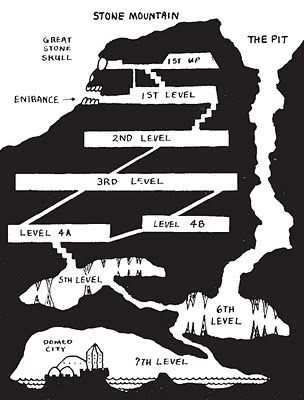
Ezekiel informs us that Baalzebul was cast down to the earth (28:17), and in the cosmology of the OT has Sheol under the earth. Therefore, it is safe to depict the realm of the Lord of the Flies as the megadungeon suggested in Holmes:

Note that the 6th level can be reached via The Pit  and the 7th has a moated castle

Thus, the Megadungeon, from a Christian POV, is the personification of Chaos (another way to express Baalzebul’s domain) sinking its stinking claws into God’s domain. It is the adventurer’s job, therefore, to beat it back down into the depths of Sheol.

Friday, September 11, 2020

Towards a Holmesian Dungeon

What follows is not anything particularly new. Many of these ideas have been present within the hobby and explored throughout the years I have been maintaining this blog. My interest here is codifying what I consider to be the characteristics of a dungeon that can truly be called Holmesian — by which I mean a dungeon that puts into practice what the Holmes Basic Edition presents as Dungeon. It has been a quest of mine to find and/or create such a dungeon. This is intended to help both me and anyone else who shares this particular quixotic quest. 

My introduction to the hobby of RPGs was the Holmes Basic Edition. While it did excite my imagination and was the gateway for me to spend years of my life playing various RPGs, I never really played the game as Homes presented it until Gary Gygax’s death. In the wake of this great loss to the hobby, I returned to the pages of Holmes to revisit my youth. What I found inside that blue cover was eye opening. Not only was it as inspiring as I found it back in the late seventies, but it presented a kind of dungeon design philosophy that I have only seen put into practice in part over the many years I have played the game. 

In other words, what might be called a “Holmesian Dungeon” doesn’t introduce us to any really radical new ideas about what a dungeon is (it has been around since 1977, after all). Rather, it combines extant ideas about dungeon design in a distinct way. This uniqueness teases us with a dungeon adventure experience that, though filled familiar tropes, is, at its core, something that I really haven’t ever seen in all my years of playing. 

What I seek to do here is delineate what I believe are the explicit and implicit characteristics of what I call a Holmesian Dungeon with the aim of creating a template for such an adventure to be created.

Explicit

Large Rooms 

The Example Dungeon in the Homes Basic Edition provides for several large rooms with at least one dimension of 80 to 100 feet or more. 


At first brush, one might not place much import on such a design feature, but a close reading of Holmes reveals that it is a deliberate choice. Melee movement in Holmes is slower than any other edition: an unencumbered character in Leather Armor moves 20 feet per round. Thus, larger rooms allow for encounter distances that make moving into melee a tactical choice. This is especially important for magic and missile weapons:

A magic-user must concentrate on his spell, so he cannot cast a spell and walk or run at the same time, and he certainly cannot cast a spell while engaged in combat.
Once the party is engaged in melee, arrows cannot be fired into the fight because of the probability of hitting friendly characters.

In other words, designing a dungeon with large rooms specifically allows party members to take advantage of both the magic and missile phases of the game and to choose how long these phases are in effect by determining when the party engages in the melee phase of combat. It also allows the Referee to create encounters where it is the PCs who must figure out a way to close the gap in order to avoid the magic and missile phases. 

Doors are Stuck or Locked 

Holmes states that doors are usually closed and often stuck or locked. Opening doors is an important part of the game. It affords an opportunity to surprise monsters beyond the door, but also involves a risk of ruining that surprise. Brute strength can always open a door; however, failure means alerting any monsters that are behind the door. Thieves afford the party a means of opening doors where failure is silent. Magic-users can use a valuable spell slot for a Knock spell which guarantees a silent open door. Additionally:

Doors opened will usually shut automatically unless spiked or wedged open. Doors open automatically far monsters, however, unless held or spiked shut.

Every door in a Holmesian Dungeon is a consequential tactical choice. 

I should note, that in practice, I have found that failing to open a door with brute force shouldn’t result in the door remaining shut, it simply means that the door has been opened in such a way that surprise is impossible. Having players roll again and again just to open a door is tedious and ruins the flow of exploring the dungeon. 

Traps as Non-lethal Time Wasters 

Unlike Moldvay, whose trap examples include poison gas with a Save vs. Poison or die, a ceiling block that does 1d10 damage if a Save vs. Turn to Stone is failed, and a pendulum blade that does 1d8 damage, Holmes understands that traps normally do not serve the purpose of causing damage to members of an adventuring party:

Traps should not be of the "Zap! You're dead!" variety but those which a character might avoid or overcome with some quick thinking and a little luck. Falling into a relatively shallow pit would do damage only on a roll of 5 or 6 (1-6 hit points at most) but will delay the party while they get the trapped character out. Hidden rooms, movable walls, teleportation devices, illusion rooms, dead ends, etc., make interesting variations.

Traps play the role of time waters. While some might pose an actual physical threat to player characters, they can be worked around given enough time. Along with trying to open doors, players must make the choice as to whether or not the time wasted on a trap is worth it. This choice becomes meaningful when one considers the real danger of a Holmesian Dungeon. 

Wandering Monsters are the Real Danger 

Holmes states that a Wandering Monster check should be made every three turns. Thus, everything that takes time in a dungeon brings with it the threat that monsters will come and investigate what the characters are doing. Given that Holmes specifies that a Wandering Monster on the First Level of a Dungeon might come from the Second or Third Level indicates that these Wandering Monster Encounters are not meant to be balanced or even winnable situations for the players. Dropping treasure in order to have the movement rate fast enough to run away can become a necessity. Larger rooms also allow for tactical retreat to be a realistic possibility. Implicit in this Holmesian reality is that a Dungeon Level can never truly be cleared…but more on that below. 

Empty Rooms 

Of the twenty-two rooms keyed in the Sample Dungeon of the Holmes Basic Edition, eight are labelled as Empty. Like the locked doors and time-wasting traps, these serve the specific function of forcing characters to make tactical choices as to whether or not spending time in a room that may or may not have a secret door or hidden treasure is worth it. Of course, there is a danger that game-play with become monotonous and boring as players encounter empty room after empty room. This is where the Implicit characteristics of a Holmesian Dungeon become important. 

Implicit 

The Three Eras 

(Empty Rooms are Not Really Empty) 

One of the curiosities of the Holmes Basic Edition can be found in its presentation of Magical Scrolls. Besides those that have a Protection Spell, scrolls are only usable by Magic-users. Additionally, there are scrolls that have spells that mimic the special effects of Magical Rings, Potions, and Wands. Implicit in this presentation of Scrolls are at least two different eras: 

  • The Present Era, in which Divine Magic is something new enough that scrolls cannot be found within the Dungeon. 
  • The Ancient Era, which knew powerful spells which now only exist on scrolls buried within the Dungeon. 
  • Since the difference between these two is so stark, there probably is also a Quondam Era between the two in which the ancient arcane magics are lost. 

Thus, an empty room need not simply be empty, but can tell a story about a bygone era through the materials used to construct it, the mundane items left behind, and the art and architecture of those who once lived there. This information adds to the weight of the players’ tactical choice of whether a room is worth exploring. 

Powerful Magics Lie Within 

Spells once existed where creatures like dragons and giants could be controlled. Thus, the magics available to those who came before are far beyond what player characters might ever be able to accomplish. Thus, a Holmesian Dungeon itself would reflect this reality — magic was once far more powerful than it is in the present. 

The Dungeon is Malleable 

The primary way this reality manifests itself is through malleability.In its most basic form, this malleability is demonstrated by the ever-present threat of Wandering Monsters. There is, however, an implication that this malleability affects the physical nature of the Dungeon itself. Over time, the dungeon changes to adapt to the new realities of the adventurers that explore it. 

The Dungeon itself is an NPC 

In other words, the Dungeon itself acts as a semi-intelligent, malevolent creature that continually offers up the lure of powerful magic and treasure in order to entice adventurers of all stripes, hoping to lead the to their potential deaths. It is never too challenging, else why would just anyone venture into its depths? No, it offers just enough to make things interesting; however, those ever present Wandering Monsters are there to devour the unsuspecting.

Question: Is there a published Adventure Module out there that ticks all of these boxes? I do not know of one.

Sunday, September 6, 2020

Saintly Saturday: The Miracle of Archangel Michael at Colossae

…on Sunday 

It has been quite awhile since I did a Saintly Saturday, where I look to the Feasts of various Saints as an inspiration for RPG world-building and adventure. In my last post, I noted how James Maliszewski of Grognardia fame published a post about a map I drew for him about a decade ago. The map is of a ruined monastery that once guarded the world from foul aberrations of Chaos that bubble forth from the crags of Urheim. 

It occurred to me that the The Feast of the Miracle of the Archangel Michael at Colossae, celebrated on September 6th, tells a tale that could have been an inspiration for someone running a campaign around the concept of The Monastery of St. Gaxyg-at-Urheim. 


In what is now southwestern Turkey, there was a region called Phrygia and a city called Hierapolis. 

Roman Amphitheater at Hierapolis

Not far from the city was a church dedicated to the Archangel Michael. It was built by a pagan who had a vision of the Archangel directing him to have his mute daughter drink from a spring. After partaking, she gained her speech. He converted and had the church built over the spring.

The region had once been dominated by a pagan cult dedicated to some kind of serpent god. According to a 5th-7th century account of the Miracle at Colossae, Sts. John the Evangelist, Philip the Apostle, and Mariamne, Philip’s sister:

Slew the viper with prayer, as with a spear, putting it to death through the power of Christ.

The Tomb of St. Philip at Hierapolis

It should also be noted that there was a pagan underwater spring called the Plutonium. It emitted poisonous gas and was thought to be an entrance into Hades. 

Plutonium: Enter at Your Own Risk

About ninety years after the church was built, a boy called Archippos traveled to the Plutonium. Repelled by the gas, he went to the spring at the church and decided to dedicate his entire life to Christ. This was a pattern that repeated itself enough that the local pagans decided to destroy the church. For ten days, they worked to divert two rivers in order to wash away the church and the spring that was attracting so many to Christ. Archippos remained in the church praying fervently for the protection of God. Just as the pagans released their dam to unleash the rivers, the Archangel appeared and drove a staff into the ground, causing an earthquake that opened a chasm down which the waters flowed. 

Waterfalls at Honaz

The pagans ran and the locals changed the name of the place from Colossae to Chonae, which means “plunging.” Today the city is called Honaz. In subsequent years, the area was ravaged by Persian invasion, multiple earthquakes, and civil war. The ruins of Hieropolis are a tourist spot where people bathe in baths and springs to this day. 

Thermal Springs near Hierapolis
This story has everything for the beginnings of a megadungeon-centered campaign:

  • A snake cult 
  • The tomb of a saint that fought the snake cult
  • A ruined church/monastery
  • A chasm with a waterfall
  • Magical pools
  • An entrance into the underworld
  • An earthquake revealing parts unknown underground
  • A miracle describing the local geography
  • Invasions and civil wars of civilizations past
I think the lovely part of all this is that implied in this story are multiple entrances into the dungeon where the snake cult  still harbors hatred for the civilizations of humanity that rejected it. How cool is this?

Tuesday, April 10, 2018

SWCL Adventure Module: The Burnt Village of the Restless Dead

I have slowly been working on my own version of The Temple of Elemental Evil for use with SWCL. Rather than releasing it all at once, I have created the moniker Adventure Tools. This allows me to release each finished section as its own adventure that can be modularly added on to any campaign or any megadungeon. The first release can be found here.

This release is a bit unusual in that it is a surface encounter area that leads to a dungeon rather than a part of the dungeon itself. I will be interested to see if and how this gets used.


As is normal for me, this comes with the disclaimer that I am a hobbyist and have edited this as best as I am able, but there will be mistakes. Please consider the comment section a thread for any typos etc. that you catch. Thank you!

The module can be found here.

Tuesday, February 6, 2018

SWCL Adventure Module: The Hermit Caves

I've been slowly grinding away at my own version of The Temple of Elemental Evil, and I have finished the first section: The Hermit Caves. As I mentioned in a previous post, I am releasing this SWCL megadungeon piecemeal. In this way, I can get the parts of this project I've finished out more quickly (as opposed to waiting until the whole project is done), but I also get to experiment with the design goal of flexibility. This module can be run as-is, easily attached to an existing dungeon or be used in conjunction with my other MyToEE adventures.


As per usual, this comes with the disclaimer that I am a hobbyist and have edited this as best as I am able, but there will be mistakes. Please consider the comment section a thread for any typos etc. that you catch. Thank you!

The file can be found here.

Sunday, December 3, 2017

It's Re-Imagination Time!

As those who have followed this blog over the years are probably aware, my favorite TSR module of all time is T1:The Village of Hommlet. There really is no contest. It is one of the very few TSR modules I have actually ran as a Referee and it is the only one I have ran multiple times. I have even re-skinned it on numerous occasions. Headwaters in my Lost Colony Campaign started life as the map from T1.

It should come as no surprise, then, that I was sore disappointed when T1-4: The Temple of Elemental Evil finally made its way to publication. While I have used the surface temple map as an entrance to other dungeons, I have never actually bothered to run it outside of a failed attempt at a solo campaign from some summer when I was in college and was desperate for some gaming.

Therefore, it has been the TSR module I have most wanted to re-imagine a la Slave Pits of Abhoth are to A1: Slave Pits of the Undercity and The Caves of Cormakir are to B2: The Keep on the Borderland. I have drawn maps, re-skinned Druids as elemental monsters and fiddled with the idea for years. Unfortunately, nothing has ever really inspired me to go beyond tinkering.

While I have been working on my various alternate versions of SWCL, I have been trying to wrack my brains as to what kind of adventure I could write up to support SWCL since it has set up permanent residency in my gamer heart and mind. It occurred to me that I could write up a mega-dungeon based on maps I’ve done in the past and ran in my Lost Colonies Campaign (with mixed results, thus justifying the re-write). It also occurred to me that these maps could be the foundation of my version of ToEE. Once I had that thought, ideas just started flowing.

The first big idea, the one where this will most obviously be a re-imagining, is to ditch the 4-part European elemental system and replace it with the 5-part Asian system. In terms of gaming, it offers a lot of world-building and factional goodness that the 4-part system lacks. For example, each element has two “opposites,” one element it likes to work with and another that likes to work with that element. Therefore, there is a given structure to motivations and factional disputes that is really easy to re-skin for use in an RPG.

There are also a bunch of associations that are made with each element that are not necessarily obvious at first glance, but not only make some sense but suggest a much richer elemental creature catalog than that suggested by a 4-part elemental structure. For example, here are how the animal associations are described:
Wood = Scaly
Fire = Feathers
Earth = Human
Metal = Fur
Water = Shelled
Given that we are talking about a corruption of nature, this gives me the ability to assign two different archetypal creatures to each element: one is ideal and the other is corrupt:
Wood = Dragonborn/Troglodyte
Fire = Kenku/Dire Corby
Earth = Human/Humanoid
Metal = Ratling/Wererat
Water = Crabmen/Spiders and Driders
Once you start skinning these creatures in elemental clothes and add in other related creatures this very quickly becomes a fertile ground for all kinds of ideas.

Finally, there is one really punny idea that really started this ball rolling and one that as an Old Grognard I cannot resist: Hermit Crabmen.

Tuesday, June 27, 2017

A Holmes Inspired Megadungeon: Under Portown

Ever since I started down the path of trying to combine Holmes and Cook, I have been trying to create a megadungeon that would tick off all the boxes I see suggested in a Holmes-style game. To a certain extent, I have accomplished much of what I wanted with my version of the Chateau des Faussesflammes, but the result has been, well, really complex.

As my Gamer ADD has recently returned to Holmes, I have been working on taking some of the ideas I put into practice with the Chateau, but in a much simpler format in order to flesh out the Sample Dungeon found in Holmes. 

Here is the basic concept: The dungeon beneath Portown is part of the Mythic Underground. Therefore, it is an NPC unto itself. One of the great dangers of the Mythic Underground is that as an environment, it is hostile to adventurers (as is evidenced by the fact that doors easily open for monsters, but PCs must use Thief Skills, spells or Strength). One way that hostility can express itself is by actually changing.

Under Portown, there are six elements of the dungeon that do not change. One is the entrance and there are five special areas which all play a major part in the backstory of the dungeon itself. I've drawn these up here:

The idea here is that the spaces around these six elements can change on a whim. For my part, I am imagining various factions vying for control of the dungeon. Each faction controls a different version of the dungeon. As each faction's power waxes and wanes, the Mythic Underground exposes different versions of itself to the surface world.

Thus, I can take a piece of tracing paper and draw out different "levels" and place them over my six static elements. Here is a version where I took pieces and parts of the Sample Dungeon of Holmes:

Alternately, I can do this electronically. I purposely used geomorphs to create the five main elements of the dungeon so that it would be possible to create something in Dave's Mapper to drop my main elements into with little effort on my part:

The result is an ever-changing megadungeon with an unlimited number of rooms; however, PCs will always have anchor points of familiarity if they can find those unchanging elements of each version of the dungeon. If they can figure out part of the mechanism of when the dungeon changes, they can also begin to have some control over which version of the dungeon they explore.

Tuesday, May 16, 2017

Reconsidering a Holmesian Dungeon

As someone who regularly suffers from Gamer ADD, I am occasionally reminded about how many projects I have left fallow over the years. One such reminder came  yesterday when Rob Conley of Bat in the Attic Games posted a set of S&W compatible rules  as a prelude for a project he is working on. In contemplating all the various things I have not managed to finish, the one I am most disappointed with is my version of Averoigne and its megadungeon, the Chateau des Faussesflammes. One of the reasons for this was that I ran into a problem of how to stock and handle what I envisioned as a dynamic and constantly changing dungeon.

As I have mentioned many times before, historically, I am actually more of a war gamer than a role-player. Recently, I have spent more time at the gaming table playing board games than RPGs. As a consequence, I was inspired to look at my version of the Chateau as if it were a board game rather than an RPG dungeon. What I came up with is a rather intriguing idea and I wanted to see if it was scalable.

Here is my thinking: the mega-dungeon in Holmes strongly suggests the Mythic Underground that many bloggers over the years have described when re-reading older versions of D&D; however, as I mentioned in this post on Holmes on Traps, the biggest danger in this Holmesian Mythic Underground is wandering monsters. My conundrum for years has been how to marry the best ideas of classic dungeons that have factions with the Mythic Underground with the dynamism of a dungeon whose main threat is wandering monsters. My answer was to make all the monsters a kind of wandering monster by turning the dungeon into a kind of board game for the Referee.

Let's begin with a really big dungeon. This is from Dyson Logos and he calls it The Deep Halls:

I haven't counted carefully, but I estimate that this beauty has about 150 rooms. According to older iterations of the game, approximately one third of these rooms will have monster encounters or 50.

In order to make this work like a board game I need to have it look like a board game, so I added a hex-grid:

This grid provides almost 200 spaces. The idea here is to place tokens on this board that represent monster encounters. They exist on a grid so that they can move during the adventure from one hex to the next, with each hex being about 30 feet per side and thus easily moved through by just about every monster that might inhabit a dungeon. In order to give myself enough room to maneuver these tokens, I arbitrarily decided to place one token in about every four hexes:

This provides 45 monster encounters. This is close enough to the traditional 50 to leave it at that, or one could have five set-piece encounters that exist in specific rooms that never move. Now, here is where things get interesting. Forty-five divides nicely by 3 giving us the ability to divide the monster encounters into three different factions:

When stocking a dungeon this way, one really doesn't have to stock the dungeon at all. Sure, you have to make notes about room characteristics and various kinds of traps, but there really is no need to place any monsters at all (again, unless you are married to the idea of set-piece encounters and then you only have to do up to five). What you do need is three lists of 15 monster encounters representing the three factions and a wandering monster list.

So here is how it works:

Every time a wandering monster check is triggered (either by a loud noise like combat or simply time spent in the dungeon), roll your favorite type of die to check if a wander monster shows up. For the purposes of this example, let us use a d6:

  • On a '1' move one blue token one hex.
  • On a '2' move one red toke one hex.
  • On a '3' move one green token one hex.
  • On a '6' a wandering monster rolled up on the WMT appears in the hex the players are currently in.

Alternatively, a 1-3 indicates how many tokens to move one hex. Regardless, which token to move and where is entirely up to the whim of the Referee. For example, in the middle of the second row there are a blue and green token in the same room. I would most likely move those closer to each other at the first opportunity.

This leads us to one of the more interesting facets of this idea: when two tokens of different factions end up in the same hex, they get to fight. This leads to a noise encounter that the PCs get to investigate or ignore at their leisure. In the meantime, one your tokens comes off the board and you make a note about bodies being strewn about the floor.

Here is the part I personally like best: when the PCs enter a hex with a token or tokens, they get to have a monster encounter. At this point one of the 15 monster encounters can be randomly assigned to that token. In other words, every monster encounter is as much a surprise for you as it is for your players. If the players prevail, that encounter is marked off the list and the token is removed.

Once the players have wrecked havoc,  you have a very tangible and tactile way to restock the dungeon: place new tokens according to the way the dungeon currently looks. New factions can suddenly make their move to gain territory or one faction can bolster their territory as they have been left unscathed by the activity of your PCs. Or whatever.

While this may seem to be a bit of a headache at the table, I don't believe it to be overly complicated and it incentivizes wandering monster checks, something I know I am guilty of not doing enough (partly because nothing happens most of the time). Using this idea, something happens most of the time, even if the PCs are unawares.

What really attracts me to this idea, however, is the level of danger that gets placed on every wandering monster check. Not only could a monster get spawned from the WMT, but one of the regular monster encounters of the dungeon could come investigating the noise being made by the fighter trying to open that locked door.

Tuesday, November 22, 2016

Re-Imagining the Megadungeon (Monster Manual II Part 10)

One of the interesting things that happens when I go about any kind of thought experiment, is that it has a tendency of bleeding out into other facets of the game that I wasn’t necessarily interested in or intent on fiddling with. So, as my thoughts drifted towards what a B2 adventure module might look like if MMII dominated the monster section of a Moldvay Basic Edition of D&D, my brain took a stroll right past the traditional TSR adventure module and started thinking about a megadungeon.

Normally, the themes found in the MMII lend themselves quite nicely to the idea of a megadungeon, or least a multi-level dungeon. This set-up allows for each section of the dungeon to have its own feel, its own monsters and its own environment. Thus, play isn’t bogged down by a bunch of X by X rooms that all look the same and have monsters scattered about with no apparent rhyme or reason. On the contrary, it adds an element of discovery and excitement as players try to figure out what makes each section of the dungeon tick.

Unfortunately, my brain would not allow itself to be contained by a mere dungeon. Or a megadungeon, for that matter. Take a look at the three themes that can be gleaned from the monsters of the MMII that might show up in a Basic Edition: Fey, Lost World, Elemental.

  • The fey normally hang out in the forest, as in outside.
  • Creatures from a Lost World, like walking plants and dinosaurs, don’t do a lot of dungeon delving. They, too, mainly hang outside.
  • Elementals can be found in a dungeon, but have always struck me as something that is better suited to an environment where all the elements can excel, not just the earthy ones. That means, they kinda want to hang outside.

This got me thinking about one of my favorite ideas from a module I have never played nor ever really plan on playing: D1 Descent into the Depths of the Earth. Contained therein is a hex map with various tunnels that a party can travel and explore. On that hex map are fixed encounter areas. Thus, while it is a dungeon crawl, it also feels kinda like an outdoor hex crawl. Given that the monsters I have available with an MMII monster section of a Basic Edition, why couldn’t I then have a hex crawl that felt like a dungeon crawl?

The end result was something I’m calling the Valley of Chaos:
The white circle in the southeast corner labeled ‘1’ is the party’s home base. All the white squares are encounter areas with a small structure/dungeon/tower/cave network with 5-25 rooms. There are three distinct areas in and around the valley. The floor of the valley itself is the stomping ground of the fey. The forested areas above the valley have a Lost World atmosphere. The desert, volcano and lake of fire all are home to elemental creatures. The further away from home base the party wanders, the more challenging the going gets.

Note that like any good dungeon, there are multiple access points for parties to enter into the “dungeon.” There are established paths and river ways for the party to follow. Each branch ultimately leads to an encounter area. There are also things to be found off the beaten track. There is even a river way that encourages Referees/GMs/DMs to expand on so that a party can go off on higher level adventures.

All-in-all there are four 6-mile hexes with 23 encounter areas with approximately 200-300 rooms to explore. All of this is dressed up in several distinct environments, each with its own character and set of wandering monsters. All that is needed now is a back story to explain why all the monsters live there and why the valley looks and behaves like it does.

For me, one of the most exciting aspects of this set-up is that it realistically allows for dungeon factions to play a huge role in the adventure. As much as I love the feel and the play of dungeon factions, I have to suspend my disbelief every time I employ them because if such factions were in such close proximity to each other, why isn’t the dungeon a complete war zone with everybody dead? There are ways around this, I am aware, but it does take that extra step to make it work. In this case, the factions have enough space between them that raiding parties actually make sense.

Thus, here I have what feels like a tent-pole megadungeon that looks like a hex crawl and I think could be the beginning of something magical.

Saturday, May 9, 2015

Saintly Saturday: The Prophet Isaiah

Today is the Feast of the Prophet Isaiah. The book attributed to him is one of the longest in Scripture at 66 chapters and over 25,000 words. Given how much life is demanding my time these days, I am not going to spend a lot of that time on that text. Rather, I will focus on the historical context and share some of the extra-biblical stories attributed to Isaiah.

The prophet was of royal lineage. He was the nephew King Amaziah of Judah (796-767 B.C.). His name means “The salvation of God.” He married a prophetess and had a son named Jashub. He prophesied during the reigns of Uzziah, Joatham, Ahaz, Hezekiah and Manasseh. This places him in a very turbulent time.

After the reign of King Solomon, the kingdom was torn in two. Sometimes the two are referred to as the Northern Kingdom and Southern Kingdom. They are also called Israel and Judah. During Isaiah’s lifetime, the Assyrians were busy conquering kingdoms all over the area, including the Northern Kingdom. Isaiah criticized both kings and the people for turning away from God and declared that the various military defeats suffered by Judah were a consequence of this disobedience.

Isaiah influenced Hezekiah to turn back to God and re-instate the liturgical practices specified in the Law. When Assyria came before the gates of Jerusalem, they were turned back through the prayers of Hezekiah and Isaiah.

Isaiah was killed by King Manasseh. Though not specifically named, his execution is mentioned in Hebrews 11:37 where a prophet is said to have been sawn in two. According to tradition this was Isaiah and it was a wooden saw.


Another interesting attribution to Isaiah is the Pool of Siloam. During a siege, Jerusalem’s water supply was becoming exhausted. Isaiah prayed and water started to flow from beneath Mount Sion. It is the same pool in which Christ has the blind man wash his eyes in order to restore his sight (John 9).

The Pool of Siloam had an interesting liturgical role during the Festival of Tents during the Temple era. There would be a procession from the Temple to the pool where water was drawn using a golden pitcher. This water was then processed back to the Temple with the sound of the shophar (trumpet) and around the altar while the Hallel (Psalms 113-118) were chanted. The men would wave fruits, palms, myrtle and willow to various verses in the Psalms. The water would then be offered along with the drink offering made at the altar.

In context of FRPGs, this is an excellent example of the kinds of little details that make exploring a dungeon really interesting. As I have noted before,  I like to have three basic eras that a dungeon exists through: Ancient, Old and Present.

In this case, we can understand the Ancient source of the Pool to be Isaiah’s prayer during the siege. The Old era would be the temple worship and the Present as the ruins of Jerusalem after its destruction in A.D. 70.

These kinds of detail really give a dungeon a sense of place and history. Personally, discovering these details while my PCs explore dungeons or revealing them to players as they explore are some of my favorite moments while playing RPGs.

Saturday, January 31, 2015

Saintly Saturday: St. Brigid of Kildare

While today is the feast of Sts. Cyrus and John the Unmercenary Healers, I am not really going to blog much about them. I do love them and have a great affinity towards Alexandria, where they were martyred; however, in terms of RPGs the only thing that I can think of to write about is the fact that one of the reasons the original cleric, which was in part modeled after Christianity, has spells like Cure Lights Wounds, Neutralize Poison and Cure Disease is likely because of these saints and those like them.

While potentially interesting, I have found myself drawn to St. Brigid of Kildare this week. Though her feast isn’t until tomorrow, her life has me itching to start drawing maps.

St. Brigid was born around A.D. 450, the daughter of a slave and her master. She was baptized by St. Patrick, Enlightener of Ireland and they were life-long friends. Due to her generosity to the poor, her father found her to be too expensive to keep as a slave and was set free. Afterwards, she was the founder of women’s cenobitic monasticism in Ireland and is considered to be one of the patron saints of Ireland along with St. Patrick.

The monastery that she established was on a piece of land given to her by the King of Leinster and called Cill Dara (now known as Kildare). Translated, the name means “church of the oak.” It was in the midst of an oak forest and was built from oaken timber.

There are a lot of stories from the various hagiographies of St. Brigid, but one of my favorites is of the blind nun Dara. One evening, the two sat and talked. Losing track of time, they found that their conversation had lasted the whole night and it was dawn. St. Brigid was astonished at the beauty of the morning light on the dew of the flowers in the field in front of her and longed for Dara to be able to see it all. Praying to God, she made the sign of the cross and Dara could see. Although she did find the morning scene to be quite beautiful, she asked St. Brigid to pray for her blindness to return, explaining, “for when the world is visible to the eyes, then God is seen less clearly by the soul.” St. Brigid prayed, and Dara was blind once again.

Interestingly, St. Brigid herself had only one eye because she plucked the one out in defiance of a suitor who was enamored with her beauty. She died in A.D. 523.


The RPG part of my brain has been gleefully chewing on the name “Cill Dara” and the story of Dara the blind nun all week. The fruit of that endeavor is an adventure locale akin to the Monastery of the Unsleeping Ones.

The Monastery of the Oak is literally a giant oak tree with a door in it. At one time, it was inhabited and cared for by an entire community of blind nuns. What is not generally known is that the oak actually sits atop a rift in time/space which allows all kinds of nasty things to come crawling into the world. It is also not widely known that the nuns actually lived inside the oak.

When a normal adventuring party opens the door of the giant oak tree, they will see a set of stairs going down. These lead to a section of your favorite megadungeon teeming with all kinds of monster badness. If, however, any member of the party is blind, blindfolded or otherwise cannot use their eyes to see, there are no stairs down, but rather a gate leading into the main grounds of a monastery which can only be “seen” by those who cannot use their eyes.

If the monastery is successfully entered and those who enter it begin to pray, the tear in time/space is closed. Thus, anyone entering the oak sans blindness or a blindfold would simply see the empty shell of an oak trunk. How and why the blind nuns no longer pray 24/7 to keep the tear closed is part of the mystery a party might stumble upon while exploring the dungeon and the monastery.

Saturday, July 6, 2013

Saintly Saturday: St. Sisoës the Great

Today is the feast of Sisoës the Great, a monastic saint of the fourth century. He began his ascetic trials at the monastery Nitria, just outside of Alexandria, Egypt. After the death of St. Antony the Great, St. Sisoës went out into the desert to live in the same cave that Antony died in. He lived a life emphasizing humility, as is evidenced by the story of his death.

As his brother monks gathered around his death bed, the face of St. Sisoës began to shine as if the sun. When prompted, he began to describe the coming of St. Antony, then the Prophets and then the Apostles. He then began to speak. When his brothers asked who he was speaking to, the saint explained that the angels had come for his soul and he was begging for more time to repent.

The monks tried to argue that he had no need of repentance, but the saint replied, “I do not think that I have even begun to repent.”

The light of his countenance then became unbearable as he explained the the Lord was coming. Then there was a great flash of light, the air was filled with a sweet fragrance and then (as the Orthodox Church likes to say) St. Sisoës fell asleep in the Lord.

As inspiring as this story is, I want to talk about this icon:


It is called The Astonishment of Sisoës the Great and depicts the saint at the tomb of Alexander the Great.

During the fourth century, Emperor Theodosius began to issue a series of decrees outlawing the worship of pagan gods. At this time, Bishop Theophilus of Alexandria obtained the legal authority over a pagan temple (some accounts have Dionysus, others Mithraeum), which he intended to renovate into a Church. When secret caverns beneath the temple were discovered, this caused a major conflict between the pagans and Christians. The pagans were forced to retreat into the Serapeum, the main pagan temple, taking Christians as hostages. Though many Christians were tortured and thrown into pits used for blood sacrifice, Theophilus asked for leniency from the Emperor; however, he did ask that all pagan images be destroyed. As a result, the Serapeum was demolished by a combination of Roman soldiers and monks. It is at this time that the remains of Alexander the Great disappeared from the historical record.

St. Sisoës was a contemporary of these events, thus, despite a lack of any written record, what is depicted in the icon is probably an actual occurrence.

The inscription on the icon reads thusly:
Sisoës, the great ascetic, before the tomb of Alexander, King of the Greeks, who was once covered in glory. Astonished, he mourns for the vicissitudes of time and the transience of glory, and tearfully declaims thus:

“The mere sight of you, tomb, dismays me and causes my heart to shed tears, as I contemplate the debt we, all men, owe. How can I possibly stand it? Oh, death! Who can evade you?”
In other words, it doesn’t matter if you are one of the greatest kings in the history of the world, or if you have conquered all the world, or gathered riches from all the world: in the end death makes us all a pile of bones.

An interesting note about the Serapeum: it is named for the Ptolemaic pagan god Serapis. He was named the protector of Alexandria and was a syncretic combination of Osiris and Apis. This was done so that these local gods could be accepted by the Greeks, who ruled Egypt after Alexander until Egypt fell to Rome. I find it fascinating how politics helped create a pagan cult which became the center of pagan worship in Alexandria.

Besides exposing me as a history geek, this story has an interesting twist on factions within a dungeon — faction can be outside the dungeon fighting each other for the right to explore/protect/go in. Thus, the PCs have to negotiate with various parties to get into the dungeon, and may find that the control of the dungeon entrance has changed when they return to the surface (giving the DM/Ref/LL/Judge plenty of opportunity to have fun with the players).

Saturday, May 4, 2013

Saintly Saturday: Holy Saturday

Today is Holy Saturday according to the Orthodox Calendar. We Orthodox Christians do a funny thing this week. We are so eager to celebrate Pascha (aka Easter) that we turn the clock ahead 12 hours this week. All the morning services happen the night before and all the evening services happen in the morning. Thus, we actually celebrate the Vesperal Liturgy of the Resurrection this morning and will celebrate the morning Divine Liturgy tonight at midnight.

As a result, this hymn was sung this morning:
Today, Hades groans and cries out, "My authority has been destroyed. I took One who died, as though He were mortal, but I am powerless to contain Him. Along with Him I lose all those, over whom I had ruled. I had held the dead from all ages, but behold, He raises them all." Glory to Your Cross and Your Resurrection, O Lord!
I have meditated before on the idea that Christ turns the classic hero story on its head. Normally, the hero descends into the Mythic Underground in order to gain something lost or something that they need in order to defeat whatever nemesis they happen to need to get rid of. As can be seen by this hymn, Christ goes into Hades (aka Sheol aka the Mythic Underground) to conquer it.

Thus, the classic trope of the megadungeon that is always restocking itself, morphing and reacting to the PCs as they delve deeper into its bowels also gets turned on its ear. It occurred to me that a previous post might give an interesting answer as to how to reconcile the Christ-as-hero story with the classic D&D megadungeon.

Awhile ago, I blogged about something I called The Gnomic Highway, which I equated to the idea of a kind of faerie road that could shorten the distance between two given points, but which would also be far more dangerous than a normal road. Subsequently, I came across the idea of the gnomic will which suggests a deliberate choice away from a path that results in the fulfillment of one’s being.

Thus, in a Christian context, it would be possible for PCs to defeat a megadungeon — that once cleared or once a particular goal has been met, that megadungeon ceases to exist in the normal sense; however, one can still find it on the Gnomic Highway — where one can deliberately choose to enter into the Mythic Underground and all its subsequent dangers even though it has ceased to exist as a normal part of the world.