Showing posts with label Warhammer 40K. Show all posts

Tuesday, January 4, 2022

In Praise of One Page Rules

As long-time readers of this blog know, I have more than a passing knowledge of GW’s Warhammer 40k universe. Those same readers are also aware that I have not played any GW games for going on three decades. I got sick and tired of how the company abuses the loyalty of their fans (something that apparently has only gotten worse over time). My love of miniature wargaming, however, as never waned.

One of the consequences of these past couple of years is that I have been quite isolated and I have been left alone to try and find ways to scratch that gaming itch without any real access to other players. To this end, I have been looking around at all kinds of games that have solo options. I have to admit that solo roleplaying is not nearly as satisfying as I wish it were. So I kept looking.

This is when I got wind of One Page Rules (OPR).

I was perusing various game-related YouTube channels when I noticed a pattern: a lot of folks were sick and tired GW and had turned to OPR to scratch their Warhammer itch. So I checked them out myself.

The game design is right up my alley. The core rules are as advertised: one page front and back. Each army list takes up one page front and back. They have rules for both sci-fi and fantasy. They have skirmish rules for both genres. They have a Patreon where you can get access to beta-versions of upcoming rule sets, the algorithm they use to calculate the cost of each unit in their army lists, a bunch of optional rules to add complexity to the game if you so wish, access to some beautifully sculpted miniatures in .stl form to be printed out by a 3D printer, and some wonderfully illustrated 2-D miniatures that can be printed out on any old-fashioned printer.

Here is the kicker: they have some rules for solo-play where they have an analog AI for controlling enemy units. While not perfect, it is simple enough to hack for your own needs.

I pulled out some old miniatures, set up my dining room table and played. I had a blast. I convinced my wife to get me a 3D printer for my birthday. I started supporting OPR via Patreon. I have not looked back.
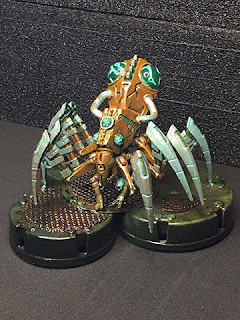
This gorgeous thing is one of the many miniatures
I have 3D printed in the last several months

The DIY ethos behind the game just has me giddy. There isn’t 300+ pages of lore to weigh me down when painting up my armies. The world of 3D printing has made kit bashing easier than ever. Above all: I am having fun.

As I paint, stories begin to evolve in my head about how these warriors came to be. I am not burdened by giant splat books full of canon, I only have a few short paragraphs (at best) to use or ignore as I see fit.

For example, here is the blurb from the quintessential Battle Brothers (aka Space Marines):

Battle Brothers are the most elite and feared fighting force in the galaxy. Massive genetically modified soldiers equipped with heavy battle armor and deadly weapons, they are ready to take on even the most dangerous missions in the name of their immortal god-king.

Soon after reaching the Sirius sector the immortal god-king created the Battle Brothers in order to conquer even the most inhospitable of planets. Born in vats and trained for war all their lives, these fine soldiers are solely focused on victory.

As jacks of all trades they are able to do pretty much anything reasonably well with no particular weakness. Their troops are armed with a variety of advanced weapons and are designed to exploit the enemy’s weak spots mercilessly.

They are the ultimate weapon in the god-king’s quest for power and only find peace in death.

The rest is up to you.

Wednesday, October 24, 2012

WH40K Campaign: Space Port Map

One of the entrances into B.R.7 is the space port. This is one area in which geomorphs are not going to be very helpful, so I decided to create a generic sci-fi space terminal that can be attached to any kind of hive city, space station or other variation of sci-fi goodness. I'd like to give a shout out to Paratime Design whose sci-fi maps have not only been used in my own campaigns, but inspired this:

Enjoy.

Friday, October 19, 2012

WH40K Campaign: Space Orks

One of the most prevalent group of creatures that inhabit B.R.7 are the orks left over from the failed invasion of Black Reach. Thus, I need to convert several of the ideas about WH40K orks into stats I can use at the table.

There are three things I have to note about the way I am going about this conversion:

  1. There are going to be discrepancies between my interpretation of certain types of oddboyz and WH40K canon for the purpose of having a working set of statistics.
  2. For the moment, I have no conversion for Madboyz. I have three possible ways to go: 1) Use the psionic rules of Stars Without Number and determine the number of disciplines and powers by the number of orks in the area 2) Use various Mental Mutations from Mutant Future placed in a table to determine which is available on a particular round and modified by the number of orks in the area 3) Use various psionic powers from Realms of Crawling Chaos, again using a random table modified by the number of orks in the area. The first is most likely to be the most effective, whereas the latter two are a bit more fun (with MF being more gonzo than RCC). I just haven’t made up my mind yet.
  3. I am going to use a modified S&W stat block. There are a couple of reasons for this. First and foremost, I have come to find that it is the easiest to both prepare and use and the table. It has just about everything I need to know about the monster. On most occasions, I would quibble with myself over this statement because normally I insist on things like % in lair and Hoard Class/Teasure Type. These two stats, however, are not going to be necessary. There is not going to be a whole lot of wilderness exploration where orks are involved and traditional D&D/LL treasure is not going to be a major part of the campaign. HD = Hit Dice; AC = Armor Class; Att = Attack & Damage; ST = Saving Throw; Sp = Special Abilities; MV = Movement; Al = Alignment; Mor = Morale

Space Orks


No one can control the wind and stop it from blowing, no one can control the day of death. From war there is no escape, no more can wickedness save the person who commits it. — Ecclesiastes 8:8

Space Orks are a genetically engineered race whose sole purpose is war. Who engineered them and for what purpose is lost to the mists of time. Presently, they are a plague upon imperial space. Mostly, they fight amongst themselves; however, warbosses of great prowess and power are able to organize large groups of orks into what is known as a WAAAGH! that conquer entire worlds, spreading destruction and chaos as they go.

One of the more interesting aspects of space orks is that their technology does not function for any other race. Indeed, their technological prowess is genetically engineered into them — they have no real knowledge of how or why it works. Rather, their is a latent psionic power that exists within groups of orks that through their belief that the technology will work, it does. Outside of this psychic field, it doesn’t.

One of the side-effects of this reality (besides the inability of adventuring parties of looting space orks for their technology) is that in within the remnant ork warbands inside of B.R.7, this psychic belief is waning and the technology starts to malfunction. A minimum of five space orks are required for their tech to work without a glitch. For every ork less than five, there is a 25% chance that their tech will malfunction when it is used. Thus, if there is only one ork, all the the tech ceases to function at all.

Space Orks

HD 2
AC 6
Att 1d8 (pistol) or 1d8 (sword/axe)
ST 16
Sp Burst Fire (+2 to hit w/pistol), Flank (+1 damage in HTH)
MV 90’
Al Chaotic
Mor 8
Also known as Orkboyz, these form the vast majority of any ork mob or WAAAGH! They are cruel creatures who have no word for diplomacy and solve every problem by fighting. They are normally armed with “Shootas” (the equivalent of a semi-auto pistol) and a “Choppa” (a sword or an axe). In missile combat, orks can use burst fire to get a +2 to hit. In HTH, if they are able to flank an opponent, they get +1 to all damage.

Oddboyz

These are orks with special skills not found in the typical ork trooper. These include Mekboyz, Painboyz, Runtherdz, Gretchin, Wildboyz, Snotlings, Nobs and Madboyz.

Mekboyz

HD 3
AC 2
Att 2d6 (thermal pistol) or 2d6 (power claw)
ST 15
Sp Life Support
MV 90’
Al Chaotic
Mor 9
Mekboyz are orks with the genetic encoding to create advanced technology. In combat, they wear powersuits that allow them to survive in hostile environments, to wield the otherwise dangerous to use thermal pistol and the strength to use a power claw.

Painboyz

HD 2
AC 6
Att 1d8 (pistol) or 3d6 (poison)
ST 16
Sp Cause Frenzy, Poison
MV 90’
Al Chaotic
Mor 8
Painboyz are what pass for field medics in ork mobs. In combat, they carry spiked gauntlets attached to canisters filled with what passes for ork medicine. When used against non-orks, it functions as a poison doing 3d6 damage (save for half). When used on an ork, it sends them into a frenzy. They gain +1 to hit and damage and are able to ignore death until they are at -10 hp.

Runtherdz

HD 3
AC 5
Att 1d6 (whip) or Special (Snotling Gun)
ST 15
Sp Snotling Swarm, Raise Morale
MV 90’
Al Chaotic
Mor 9
Runtherdz are those orks that are capable of corralling and controlling the smaller members of the ork mobs — the Gretchin and the Snotlings. When Getchin and Snotlings are within 60’ of a Runtherdz, they use the morale of the Runtherdz rather than their own.

Runtherdz sometimes use a specialized weapon called the Snotling Gun. It fires up to three Snotling Swarms (see below).

Gretchin

HD 1
AC 7
Att 1d6 (pistol) or 1d6 (knife)
ST 17
Sp none
MV 120’
Al Chaotic
Mor 6
Gretchin are either space ork young, or a smaller variety of ork. They are generally used as cannon fodder and the driven into combat by Runtherdz.

Snotling Swarm

HD 8
AC 7
Att Swarm 1d6
ST 9
Sp Swarm
MV 90’
Al Chaotic
Mor 10
Snotlings are the smallest of the ork-kin, and are generally seen as the most useless. Individually they have little courage and little combat prowess; however, orks have found that when sent en masse through a warp tunnel from a Snotling Gun, they go temporarily insane and start biting and clawing anything they come in contact with. Such a swarm will automatically do 1d6 damage to anyone in a 10’ square.

Wildboyz

HD 3
AC 7
Att 2d6 (great sword/axe)
ST 15
Sp Berserk Rage
MV 90’
Al Chaotic
Mor 10
Wildboyz are feral orks that have not yet exhibited the ability to build or maintain technology. In combat, they only wield primitive HTH weapons, but are able to induce in themselves a berserk rage which gives them a +1 to hit and damage in HTH and they are able to ignore death until they are at -10hp. If a wildboy is treated by a painboy, the effects are cumulative.

Nobs

HD 6
AC 2
Att 2d6+2 (mag pistol) or 2d6 (great sword/axe)
ST 11
Sp Morale Boost
MV 90’
Al Chaotic
Mor 12
Nobs are the “nobility” of the ork mob. They are some of the biggest and strongest of their kind, able to inspire their fellow orks to greater feats of chaos and destruction. All orks involved in a battle where a Nob is present increase their morale by 2.

Friday, September 21, 2012

WH40K Campaign: Mapping B.R.7 Part 3

As I have admitted before, one of my least favorite parts of this hobby is actually keying a dungeon or adventure. When it comes to actually being at the table, I much prefer working off of simple notes and a bunch of random tables. It helps me be creative and it makes my time at the table far more enjoyable — I get to be surprised by my own creation.

As such, the most challenging aspect of mapping B.R.7 is going to be keying this potentially massive megadungeon. One of the ways that I improvise at the table is coming up with themes for various sections of a dungeon — based upon either the architecture, inhabitants or both. In thinking in terms of a hive city, one basic theme will be city zoning.

I took a brief look at the zoning laws of New York City this week and determined that they have three basic zones: Residential, Commercial and Industrial. Each of these has three subcategories based on population. This can be extrapolated into nine zones:
  • Poor Residential (high population)
  • Middle-Class Residential (medium population)
  • Upper-Class Residential (low population)
  • Warehouse/Storage-Commercial (low population)
  • Office Space Commercial (medium population)
  • Retail Commercial (high population)
  • Heavy Industry (low population)
  • Medium Industry (medium Population)
  • Light Industry (high population)
To this list I would also include Military (since there is such a huge emphasis on war in the WH40K universe). Thus, for every section of map I make, I can roll on a table to determine the basic zoning (and thus the theme) of the area:

01-03   Poor Residential (PR)
04-05   Heavy Industry (HI)
06-08   Warehouse/Storage (WS)
09-10   Medium Industry (MI)
11-12   Light Industry (LI)
13-13   Military (M)
14-15   Middle-Class Residential (MR)
16-17   Retail (R)
18-19   Offices (O)
20- 20  High-Class Residential (HR)

This roll can be modified in the following ways:

  • Apply a -2 when a neighboring zone is either PR or HI.
  • Apply a -1 when a neighboring zone is either WS or MI.
  • Apply a +1 when a neighboring zone is either MR or R.
  • Apply a +2 when a neighboring zone is either O or HR.
From there, I intend to pull out the yellow pages, in order to make several tables to determine what each room in a zone actually contains. For example, a table for an R zone might include:

  • Restaurant
  • Clothing
  • Electronics
  • Grocer
  • Office Supply
  • Luxury Items

Then I can roll to see what condition the room is in:
1    Heavily Damaged (nothing of value)
2-3 Lightly Damaged (some items of value)
4-5 Looted (in good condition but no items of value)
6    Untouched
This will give me a lot of information to improvise with. From there, it is only a matter of putting together several wandering monster tables to reflect territories held by various factions.

Thursday, September 20, 2012

WH40K Campaign: Mapping B.R.7 Part 2

As much as I love geomorphs, I must admit that due to the limitations of the form, maps made from them can be a bit blocky. One of the most popular posts in the entire history of this blog took a bunch of Dyson Logos maps drawn on 3x5 cards and stitched them together. The result was a beautifully organic looking dungeon.

In turn, I started to produce some 3x5 “geomorphs” which resulted in some more beautifully organic dungeons — the kind that we might expect (and do) find in the real world. Though (to my knowledge) my challenge to other artists out there to produce a library of 3x5 geomorphs has yet to be answered, it did power my own (ongoing) attempt to create my own version of the Slave Pits of the Undercity.

However, as Kobold of Waystar Highport points out:
I would imagine that many parts, or subsections, of a Hive would be duplicated or of "standard" design. So, one could map a couple of floors of a residential block in some detail and then decide that the design repeats, both horizontally and vertically over the extent of the Residential subsection.
Indeed, there are many aspects of any modern city that are standardized.

In other words, a megadungeon based on a WH40K hive city is a perfect application for the good, old-fashioned geomorphic map with its blocky, standardized feel. Indeed, if one wanted to limit oneself to a set of a dozen or more for an entire section of the city, not only would it not feel wrong, but would become a realistic feature.

Thus, one aspect of mapping B.R.7 is going to be a very heavy dose of geomorphic madness. In part, this is why I have happily supported Dave Millar’s recent fundraising drive — to give myself a number of geomorphs that have the feel I am looking for in a hive city. The beauty of Dave’s Mapper is that it makes maps very quickly, and given my own experience with graphic design, I can pound out a bunch of maps in short order to accommodate play.

If and when players push off a map, I can always do my own version of the “Greyhawk Construction Company” in the form of a collapsed hallway. How and why are these passageways cleared later? All part of the adventure…

Here is a quick example of what kind of maps I can produce in a short period of time using Dave’s Mapper:


Monday, September 17, 2012

WH40K Campaign: Mapping B.R.7 Part 1

B.R.7 is the working name of the hive city-as-megadungeon for my WH40K campaign. Last night I started to do an intellectual exercise with some math, which demonstrates why having a hive city as a megadungeon is both an unending source of adventure as well as a mapping nightmare.

I have been using Manhattan as a reference in this intellectual exercise because it is both a finite space — an island about the size I might imagine a floating city — and it is one of the most densely populated areas in the world (about 70,000 people per sq. mile) — which suits the image of “hive city” very nicely.

The island is approximately 23 sq. miles and has a population around 1.5 million people (probably a little low, I know, but for easy math purposes 1.5 is a lot easier to deal with than 1.602). In order to fulfill the notion of a hive city, there needs to be, at minimum, 1 billion people. Thus, at least seven seven hundred Manhattans have to be stacked on top of each other in order to approximate a hive city environment. Ignoring for a moment that the island is covered in towering skyscrapers and multi-level apartment buildings, seven seven hundred Manhattans would have around 161 16,100 sq. miles.

Herein is the beauty and the horror of the hive city megadungeon. If one considers that (as far as I can tell) AEG’s World’s Largest Dungeon covers about one third of one square mile, mapping a hive city would require at minimum 483 48,300 world’s largest dungeons. This, of course ignores the fact that Manhattan has an average story height that might approach 20-30.

As much as I love maps and making maps, the idea of mapping 5000+ 500,000+ different versions the World’s Largest Dungeon is not something I want to do (or can do). This means that I must severely reduce access to the hive city itself. This way, I can reduce the amount of actual mapping that needs to be done and allow for expansion as I need or want it. In order to do this, I have in mind the cover of GDW’s Journal of the Traveller’s Aid Society #15:


The giant skyscrapers represent the mega-cities of the high population world Azun in my favorite part of Third Imperium space: The Solomani Rim. (Since I am having a hard time finding my copy of this, I am having to go on memory) Azun is xenophobic. Each of the cities is self-contained and even communication between mega-cities is limited. Thus, access to each mega-city is extremely limited.

While this scenario works, Black Reach is not xenophobic; however, it does have a Thick Atmosphere and an Immiscible Biosphere. Thus, each hive city can have a controlled environment that seals itself off from the environment outside. This set-up would allow for a limited number of access points into the city and make my job much easier from the outset.

Here is a (tentative) list of possible access points:

  • Exhaust Port — while controlled, the city’s environment is still dependent upon the extant atmosphere. An exhaust port would lead into an air filtration system. These, in turn, would lead to air ducts and maintenance hatches. One or more may have survived the crash.
  • Space Port — each hive city would need a means to import and export resources. While probably badly damaged from the ork invasion, this still should result in some kind of access into the city.
  • Engines — damaged from the fighting (and the cause of the city’s descent), these would almost certainly grant access; however, this may be the most dangerous because it would also be the main access point for native life forms.
  • The Gardens — the upper most level of the city is dedicated to agriculture. Some if the plexiglass-like roof has been damaged, allowing access.
  • The Frigate — during the battle that resulted in the city’s descent resulted in a frigate crashing into the side of the city. It is still there and has damage to its exterior, allowing access to the frigate itself, and possibly to the city beyond.

Sunday, September 9, 2012

WH40K Campaign: Abhumans

When I conceived of this WH40K campaign, I mentioned that I would allow abhumans (ogryns and beastmen, for example) as characters. The mechanism by which this could happen is the replicant class from Section 9 of Mutant Future. To that end, I need to define exactly what “mutations” various abhumans have. In addition to the standard ogryn and beastmen, I have also included an abhuman type of my own making to give the Black Reach Sector its own bit of abhuman flavor.

The following table will be used for all abhuman advancement:
Lvl 1: HD 1d8; XP 0; AB 1
Lvl 2: HD 2d8; XP 3,000; AB 1
Lvl 3: HD 3d8; XP 6,000; AB 1
Lvl 4: HD 4d8; XP 12,000; AB 3
Lvl 5: HD 5d8; XP 24,000; AB 3
Lvl 6: HD 6d8; XP 48,000; AB 3
Lvl 7: HD 7d8; XP 96,000; AB 5
Lvl 8: HD 8d8; XP 192,000; AB 5
Lvl 9: HD 9d8; XP 492,000; AB 5
Lvl 10: HD 9d8+2; XP 892,000; AB 7
All abhumans save as warriors of the same level.

Ogryns

Ogryns are described as big, brutish, physically powerful and tough. They are often used by the Imperial Guard as close quarter and shock troops.

Mutations:

Gigantism: Ogryns stall about 3 meters tall. As a result they gain a +1 on damage in HTH combat.
Increased Physical Attribute: Roll (or choose):
1-3 Strength: starting at 3rd level, the ogryn can summon great bursts of strength. Once a day, the ogryn does an additional 3d6 damage in HTH combat. The number of times per day goes up one for every additional 2 levels (thus, at 7th level it can be done 3 times per day).
4-6 Constitution: The ogryn receives an additional hit point per level and a +2 to all saves vs. poison.

Beastmen

These abhumans combine features of both human and animal. Despite their bestial nature, however, they do conform to the genetic standard of what qualifies as an abhuman. In the past, they were used as assault troops by the Imperial Guard, but this practice has been quietly abandoned over fears that beastmen are more prone to fall prey to the temptations of Chaos (despite little evidence that normal humans are any less so).

Mutations:

Aberrant Form: Beastmen normally have horns, which they can use in HTH combat doing 1d6 damage.
Natural Armor: Beastmen are also covered in hide, which give them a natural AC bonus of +3.

Darkmen

These near albino abhumans hail from the feral planet Night in the Black Reach Sector. Once a mining colony, the surface of the planet along with its atmosphere was blasted to ruin in a conflict long forgotten by its inhabitants. The isolated remnant population has managed to adapt and survive far beneath the surface of the planet in honeycombed cave complexes with a society largely based on war. Locally, the Imperial Guard in the Black Reach Sector have recruited Darkmen as special forces.

Mutations:

Ecolocation: Often living in pitch dark, Darkmen have adapted echolocation as means to see. Though they cannot make out fine details, they can make out shapes even incomplete darkness. This adaptation can also be used to increase combat prowess — Darkmen who are able to use their echolocation gain a +2 to hit in combat.
Combat Empathy: This is a low-grade psychic power that allows Darkmen to see what their opponents are about to do in combat before they do it. As a result they gain +1 to hit and +1 to damage in combat. This damage bonus increases by 1 at both 3rd and 5th level.

Thursday, September 6, 2012

WH40K Campaign: Black Reach

As folks who have read this blog for awhile know, I am a big fan of random tables. When used correctly, they can be a catalyst for some seriously cool creativity. Thus, I am very pleased with the way Stars Without Number handles system and planet creation.

A system consists of a 8x10 hex map on which are randomly placed 20+1d10 worlds (well, mostly random — the rules stipulate that you can choose where to place the last 10 or so in order to make sure worlds have access to other worlds in a way that you want). Each world has several characteristics reminiscent of Traveller: Atmosphere, Temperature, Biosphere, Population, Tech Level and Tags. There are two big differences, however. Biosphere refers to how the native life relates to humanity and Tags are a plethora of descriptors that give depth and flavor to the world itself. The rules suggest two for each planet. Further, the descriptions of these Tags come with what are called Complications — what amount to campaign and adventure seeds.

Thus, I gleefully filled out a hex sheet with planets in order to flesh out the Black Reach Sector. The results were challenging — just the way I like them. The dice came up with three hive worlds which could be a stand-in for my version of the sector capital. However, one had a low tech level and another had the tag Xenophiles — hardly appropriate for a world that had just been decimated by an alien (ork) invasion.

This left me with only one candidate: Thick Atmosphere, Warm Temperature, Immiscible Biosphere, Population in the Billions (of course), a TL of 4 (which is Imperial normal), and has the Tags Floating Cities and Tomb World.

This implies that when colonists first arrived at Black Reach, they found an environment that was completely hostile to human beings — the atmosphere was too thick and the local flora and fauna were too toxic for human consumption. Their answer was to build a floating colony suspended in the upper (and therefore thinner) atmosphere where they could create their own (separate) ecosystem. This solution proved to be so wildly successful that the original floating colony grew to be one of many hive cities flying above a planet surface no human would think to set foot upon. As a result, no one realizes that Black Reach is actually a tomb world, where Necrons patiently await for a food source to awaken them from their slumber (and in turn, the Necrons have failed to awaken because the potential smorgasbord of all those hive cities are miles beyond their reach).

All of this also strongly suggests the reason why adventurers are needed on Black Reach. During the fighting of the ork invasion, the mechanism that kept one of the hive cities afloat was heavily damaged. As a result, the city descended onto the surface of the planet somewhat in tact.

Various factions from around the sector have become aware of one of several things that were in the hive city when it crashed to the surface. They are now in great need of expendable resources to descend onto the surface to recover these valuables (can anyone say tent pole megadungeon?)

The upside of this setup is manifold:

  • I can justify a remnant ork population holed up in the hive city.
  • Native flora and fauna can not only be found throughout, but be as wild, alien, surprising and toxic as I want them to be.
  • Resource management becomes critical. The only food available is the food you bring in — even eating foodstuff found inside the city can run the risk of contamination. Filter masks are necessary to avoid having the air become toxic over time. Making sure the ride back home is secure becomes a real concern.
  • The thick atmosphere justifies a constant fog of war — literally. Regardless of light source, line of sight is going to be severely limited.
  • Has the hive city landed near a Necron tomb? Is there enough food that some have arisen from their slumber? If so, will an adventuring party inadvertently give them access to a transport to the billions who live above?
  • Regardless of whether or not an adventuring party ever takes advantage of the Letter of Marque to go world hopping around the sector, this hive city, its denizens and the riches it holds will always be there to fall back on when a party wants a good, creepy and possibly rewarding adventure.

Tuesday, August 28, 2012

Gamer ADD: WH40K Campaign

Grrr… this is what happens when I don't get to play as regularly as I want.

So, despite the fact that life continues to happen (severely limiting the time I have to dedicate this sort of thing) two comments from my last couple of posts have fired my imagination in a way that is extremely difficult for me to ignore (Gamer ADD — an affliction even the best of us suffer from).

Anthony said of this post:
This sounds like a lot of fun, giving space for all sorts of adventures and, if the chests were lost years ago, historical detective work. In fact, this campaign would also work with "modern" games, such as Call of Cthulhu. I'd be very tempted to add "competitors," say after the 2nd or 3rd chest was recovered, to give the party a sense that Bad Things would happen, if the relics were to fall into the wrong hands.
TheMetal1 said of this post:
And...so...What are you waiting for?!! Get this campaign rolling and run it online through Google+ or on a Virtual Table Top like FGII!
Anthony made me realize that the campaign idea I had laid out with lost relics could very easily be applied to the WH40K campaign that TheMetal1 has so enthusiastically demanded that I do. Unfortunately, my gaming budget does not have any room for a $30 .pdf of a rule system I am not even sure I would want to play; however, Sine Nomine’s Stars Without Number has a free edition. Since it is based on a system I am very familiar with (old school D&D) it means that not only will it be easy for me to run such a game, but it is flexible enough to easily accommodate the various peculiarities of the 40K universe.

I occasionally can’t sleep and over the weekend I spent some time perusing the Warhammer 40000 wiki and found myself a planet that could serve very well as a basis for a campaign: Black Reach. There are several reasons why I find this local to be ideal (many of which fall into the category of classic D&D campaign tropes):

  • The system lies in the Ultima Segmentum, which is on the imperial frontier.
  • A bunch of races can be found in the Ultima Segmentum (both friendly and antagonistic). Eldar, Tau, Tyranids, Orcs and Chaos are explicitly named, and there is plenty of room to include Abhumans, Dark Eldar, Necrons and Squats as well as all sorts of unexplained xenoforms.
  • Black Reach is a Hive World — it has giant multi-level cities capable of supporting a population in the billions. It also means that it is the equivalent of a giant megadungeon.
  • Black Reach was also recently decimated by a recent invasion of orcs — the entire northern hemisphere was left in ruin.
  • Despite the fact that the Ultramarines beat back the invading orc horde, (given a little change in tense) there are still pockets of orcs that need to be eliminated by the local population (i.e. adventuring parties).
  • There is a precedent for Space Marine chapters to have relics. The Ultramarines, in particular, have quite a few.
  • The thing that I like best about Black Reach, however, is that all the information I can find about it is this paragraph:
Black Reach is the Imperial Hive World in the Ultima Segmentum fought over by the Ultramarines 2nd Company under Captain Cato Sicarius and the Goff Clan Orks under the Warlord Zanzag following the invasion of Black Reach in 855.M41 by WAAAGH! Zanzag. As an Imperial Hive World, Black Reach's massive hive cities are home to billions of Imperial citizens. Much of the planet's population was slain during WAAAGH! Zanzag, and the northern continent of the world was completely ruined by the intensity of the fighting. After the defeat of Zanzag by the Imperial forces, Black Reach's inhabitants still had to take back the rest of their world from the pockets of surviving Greenskins.
    Other than this, there is no canon that I have to worry about. It doesn’t even appear on any of the maps I have found of the WH40K universe. Given that there are a million planets within Imperial space, that means I have the freedom to create the entire sector of space in which Black Reach is found.
The initial adventure will hold out a carrot to the party — a Letter of Marque, which gives them the freedom and authority to go anywhere within the Black Reach Sector. This will give them a bunch of planets to explore, and provide a reasonable limit on their activities to make life easier for me.

In addition, since Stars Without Number is based on older editions of D&D, I can easily import various classes from D&D and its clones. I expect to have the following:

  • Dwarves as a stand-in for Squats.
  • Halflings as a stand-in for Ratlings.
  • A modified version of Elf (combining Psychic and Warrior) as a stand-in for Eldar.
  • The Replicant class as detailed in Section 9 of Mutant Future as a stand-in for Abhumans (like Beastmen and Ogryns).
  • The Cleric class to represent the prophets of the 41st century Christians, whose turning ability will work against both Chaos and the Necrons.

Friday, August 24, 2012

Meditating on Warhammer 40K

Conrad Klinch of Joy and Forgetfulness asked the following question of me:
One of the most popular wargames, Warhammer 40K, makes heavy use of Christian imagery, but warps it rather spectacularly. Do you have any thoughts on that?
Let me preface my answer with a bit of personal background. I had largely stopped playing RPGs in the late 80s and thus most of my gaming budget (both temporal and monetary) was spent playing miniature wargames. In the early 90s I did play quite a lot within the 40K universe (particularly the 2nd Edition of the Spacemarine Epic ruleset). So, I have more than a passing familiarity with the universe; however, I stopped paying attention to GW products around fifteen years ago because I got sick and tired of the constant rule changes, the ever more expensive rule sets and the pricing of figures based on game ability rather than the amount of metal. Thus, if there has been any major changes in the mythology of the universe since then, I am unaware.


Secondarily, I would also say this about symbology: there is very little in Christianity that doesn’t originate in other cultures. One of the central feasts of the Orthodox Church in summer is the Transfiguration — when Jesus shows his divinity to Peter, James and John on Mt. Tabor. The important part of this event is that this happened through Christ’s humanity. This demonstrates that created matter (our humanity in this case) can be transformed through divine grace. One of the primary purposes of the Orthodox Church is facilitating this transformation, not just in ourselves but the very culture that surrounds us. Thus, pagan symbols and celebrations have been “baptized” and transformed into Christian symbols and holidays.

A classic example is the Cross. In pagan Roman culture, it was a symbol of Roman power and the violent and awful death that awaited anyone who dared defy that power. Through Christ, this symbol has been transformed from an instrument of torture and oppression into a symbol of resurrection, salvation and eternal life.

Thus, one is likely to find Christian symbols within other contexts and cultures used in radically different ways. So, that the 40K universe has symbology similar to Christianity, but has a cosmology that is radically different is no real surprise. For my part, I would view it as my role to transform this symbology and the culture around it into its proper form — Christianity.

Thematically, the 40K universe is not much different than any number of human empires that had at their core a cult of personality. The Roman Empire, for example, had an emperor cult in much the same way that 40K does. Indeed, this cult of personality is a reason that there are fascistic and socialist overtones in the way the 40K universe is depicted.


If I were ever to play within the 40K universe again, it would likely be via Rogue Trader, which would allow me to introduce players to the underground Christian Church which has survived (through the grace of the Holy Spirit) alive and well into the 41st millenium. I would couple this with the revelation that the Emperor is one of the primary sources of Chaos in the universe (it helps consolidate his power by giving him an excuse to “protect” so many worlds with his iron fist and constant sweeps of his Inquisitors). Thus, players would be afforded an opportunity to take the symbols of the 40K universe and transform them — give them meaning by restoring them to their proper orientation towards God.