Showing posts with label races. Show all posts

Thursday, December 31, 2020

Half-Ogre/Ogre Race-as-Class for B/X

In a wonderfully weird way to end 2020, this post exists because the cleric in my solo campaign just got polymorphed into an ogre when setting off a magical trap...

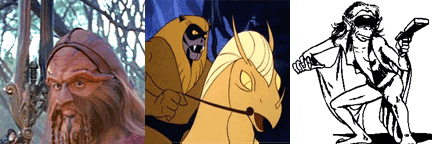
Half-ogre PC by  Timothy Truman


Requirements: STR 9, CON 9

Prime Requisite: STR

Hit Dice: 1d10

Maximum Level: 10

Armor: Any appropriate for size, plus shields

Weapons: Any

Languages: Alignment, Common, Goblin, Orc

Combat Progression: as a Fighter

Saves: as a Fighter

XP Progression: as a Fighter

Ogre Strength: +2 to Attack and Damage in Melee Combat

Stronghold: An Ogre may start building a stronghold at 2nd level

Weaknesses: -2 on all Reaction Rolls; -2 to hit Small Creatures (like Halflings and Dwarves)

After Reaching 9th Level: An Ogre will be recognized by humanoid populations as a Warlord and the Ogre will attract humanoid followers from far and wide. Ogres may only hire humanoid mercenaries. Specialists and retainers may be of any race.

Here's to better polymorphs and transformations in 2021.

Have a happy and blessed New Year.

Monday, April 27, 2020

Halfling as Half-Dwarf Race-as-Class

Halflings (Half-Dwarves)

Requirements: DEX 9, CON 9
Prime Requisite: STR and DEX
Hit Dice: d6
Maximum Level: 12

Hill Dwarves (sometimes known as Gnomes) have a reputation for being reclusive, but are in many ways more gregarious than their Mountain-dwelling cousins. This, in combination with their relative proximity with Humans, has resulted in not a few unions between Hill Dwarves and Humans of smaller stature. The result of these pairings is a Half-Dwarf, more commonly known as a Halfling.

Like their Human progenitors, Halflings have a wide range of appearances, though they are rarely able to grow a beard of any significant length. They usually average from about 3 to 4 feet and weigh in at 60 to 100 pounds. Due to this short height, Halflings cannot use two-handed weapons or longbows. However, they can use any other weapon or armor. They must have at least 13 in one or the other prime requisite in order to get the +5% to experience. They must also have a STR and DEX of 13 to get the +10% bonus.

Due to their unusual background, they are used to existing on the fringes of both human and dwarven society. At character creation, a player chooses three Thief abilities that the Halfling character can use. Additionally, Halflings have an uncanny ability to disappear into their surroundings. Using any kind of cover, they hide on a 1-4 on a d6. They also have keen coordination which gives them a +1 to hit with missile weapons.

Halflings use the same saving throws as Dwarves, sharing the hardiness of that side of their ancestry. They also fight as a Dwarf. Further, a Halfling character will speak the common tongue, dwarvish, halfling, gnomish, goblin, and kobold.

Reaching 9th Level: When a Halfling reaches level 9, he has the option of creating a stronghold, which can be either above or below ground. The stronghold will attract Dwarves and Halflings from far and wide. A Halfling ruler is able to hire Dwarven and Halfling soldiers or mercenaries, but may only hire members of other races for other tasks, such as human alchemists or elves for spell casting.

Level Progression
1…0
2…1900
3…3800
4…7600
5…15,200
6…30,400
7…60,000
8…120,000
9…250,000
10…380,000
11…510,000
12…640,000

Sunday, April 26, 2020

On Gnomes and Halflings

So, over at B/X Blackrazor, JB has an excellent post on Gnomes, doing an historical dive into the origins of the race in search of why they can be illusionists. I, ironically, I have been doing a very similar deep dive into rulesets about gnomes, but for a radically different reason. Whereas JB is working on revamping the Illusionist class using the various iterations from the pre-1ePHB era of the game, I was doing my deep dive because of a curious mention of halflings in Advanced Labyrinth Lord.

For a bit of background, as a joke, I challenged by eldest to run a game of D&D where all the PCs were gnomes. The joke became somewhat serious when she demanded that I provide her with an edition of the game to use to create the campaign. When she settled on Advance Labyrinth Lord, I was forced to read to those rules to create a character.

Therein, I found this quote:
Their habitations often overlap with halflings, and these two races are typically very friendly, if not familial, to each other.
I don’t ever remember that word “familial” being used to describe the relationship between halflings and gnomes, so I started digging.

Lately, I have been finding myself actually trying to play Holmes Basic D&D (putting into practice all of the stuff I wrote about Holmes over the years). I have to admit, having never actually played the game in my youth, I am finding it to be quite a pleasure to use as I get older. One of the conclusions I made about gnomes, given the way Holmes treats them, is that they are (as JB concludes) a variation (or twisting) of dwarves — specifically, a Chaotic Good version.

Given this Holmesian background where I conclude that the languages of Gnomes, Kobolds, and Goblins are all dialects of Dwarvish, I find it fascinating that Gnomes in the MM1 and Gnome PCs in the 1ePHB are able to speak the language of halflings. It should also be noted that in the Racial Preference Table from the 1ePHB Gnomes have goodwill toward Halflings. The only other race to get such treatment are dwarves.

Thus, while Advanced Labyrinth Lord’s use of the word “familial” is not found in the original material, it is, nonetheless, not unwarranted. It also has my brain going in (what I consider to be ) a really exciting direction.

I must note that despite my use of Bilbo Baggins as a literary inspiration for my understanding of Thieves, and my love for Jeff Dee’s cover of T1: The Village of Hommlet, I am not a fan of Tolkien, Hobbits, or halflings.

Conceptually (as a race inspired by Hobbits), halflings just don’t fit in D&D except as a curiosity or a group if interesting NPCs. However, this word “familial” has me re-thinking the halfling’s place among the PC races.

What if “familial” implied the “half” part of the name “halfling” didn’t refer to their size, but rather to their parentage? In a game world where half-elves and half-orcs make regular appearances, why are there no half-dwarves? Unless, of course, they have always been there in the form of the halfling (which sounds better than “half-dwarf” and is something the dwarf kin probably would use anyway).

If one begins with the assumptions that gnomes are smaller, skinnier dwarves and that gnomes live closer to humans and other races than regular dwarves do, and that halflings have similar saving throw bonuses to dwarves, it is not a huge leap to imagine that halflings are to result of some relationships between the odd gnome and human here and there.

Such an understanding of a halfling makes much more sense to me, and explains that cover of T1 a whole lot better than Tolkien ever did.

Tuesday, June 4, 2019

Races of the Land of the Ten Clans

I not only want the Land of the Ten Clans to be Asian-flavored fantasy, but I also want it to be human-centric. Therefore, there will none of the standard D&D non-human flavors of demi-humans such as elves, dwarves or halflings. I do, however, want there to be distinct differences between the various human factions. Therefore, rather than using the standard human racial traits, I propose the following:

Humans in the Land of the Ten Clans

  • +1 on two Ability Scores of your choice
  • Proficiency in one Skill of your choice
  • Subrace

Human Subraces in the Land of the Ten Clans

Beongae (Lightning)
  • +1 Str
  • Advantage on Athletic checks when swimming; auto succeed on DC10 or less
  • Double Con when determining how long you can hold your breath
  • Languages: Common and Beongaego
Doku (Poison)
  • +1 Int
  • Ability to write in a Cipher that requires magic or a DC of (your Int + Proficiency Bonus) to read. It is possible to teach allies to read your cipher without a check.
  • Languages: Common, Dokugo plus 3 additional Languages of your choice
Gweilo (Outsider)
  • Gain 3 proficiencies in any combination of skills or tools of your choice
  • Languages: Common and Gweilogo
Huo (Fire)
  • +1 Con
  • Base Move is 35 feet
  • Advantage on Con Saves vs. Exhaustion
  • Languages: Common and Huogo
Korudo (Cold)
  • +1 to an Ability of Choice
  • Gain Saving Throw Proficiency with that Ability
  • Languages: Common and Korudogo
Suan (Acid)
  • +1 Wis
  • You can read lips. As long as you can see a person's lips, you can get a good idea of what that person is saying (though not exact without actually hearing the person) 
  • +5 on passive Wisdom (Perception) and passive Int (Investigation) scores
  • Languages: Common and Suango

This set-up also allows me to change what are considered to be Standard Languages in the Land of the Ten Clans. Here is the list, where the Script from more traditional D&D languages is indicated in parenthesis:
Common (Draconic)
Beongaego (Elvish)
Dokugo (Draconic)
Hengeyokai (Elvish)
Gweilogo (Celestial)
Huogo (Draconic)
Korudogo (Dwarvish)
Oni (Infernal)
Suango (Draconic)
Note: I do plan to allow PCs to be Hengeyokai, but rather than a separate race, they will be represented by a Background.

Friday, October 27, 2017

Half-Elves for SWCL

One of the ideas from 0e that I truly find fascinating is the idea that elves can adventure as fighters and magic-users, they must do so one class at a time. Unlike later editions of the game, they don’t get to be armor-clad spell caster. This idea re-surfaced in the retro-clones Swords & Wizardry White Box and Labyrinth Lord Original Edition Characters, but not in main version of those games. SWCL splits the difference in the fact that elves only get to be one class: fighters, magic-users or thieves.

When it comes to demi-human races, my favorites are the half-breeds: half-orcs and half-elves. Something about the cultural, social and personal complications that these races imply has always fascinated me. Therefore, in order to get my 0e elf fix with SWCL, I propose the introduction of a new optional race: the half-elf.

The half-elf adventures as either a human or an elf. Each persona has its own class and its own racial abilities. The player chooses which persona to play at the beginning of each session. For example, a half-elf could adventure as a human cleric in one persona and an elven magic-user in the other.

Like all other characters, the half-elf can get a total of six level gains and each of these level gains requires the same number of adventures as other classes; however, the half-elf can gain a maximum of three levels in each of their two classes. Thus, the half-elf cleric/magic-user in our example above can only advance to be a 4th level human cleric and a 4th level elven magic-user.

Like the 0e elf, all class restrictions apply when adventuring in certain classes. Thus, when adventuring as a magic-user, the half-elf cannot wear any armor.

Sunday, August 20, 2017

SF + SWL Mash-Up Part 5

Characteristics

Before I get to the crux of this particular post, I need to explain my thinking on Characteristics because I won’t be using the traditional six of D&D and its decedents. Due to the fact that there are three categories of Areas of Expertise (AoE) (my proto-skill system) I wanted to condense the original six to three characteristics, each corresponding to an AoE. Thus:
  • STR/CON = Toughness which affects Hit Points, Melee Attacks and the Military AoE.
  • DEX/INT = Acuity which affects Defense, Ranged Attacks and the Hard Science AoE.
  • WIS/CHA = Judgement which affects Banishing, Spell-like Abilities and the Biosocial AoE.
For flavor, players can use descriptors to clarify which of the original six is dominant in each pair. For example, a character’s Acuity could be more intellectual than physical.

Races

In both Star Frontiers and D&D (and its direct descendants), there are four basic races: humans plus three non-human races. Dralasites, Vrusks and Yazirians roughly correspond to Dwarves, Elves and Halflings. While it would be tempting to make simplified versions of the Star Frontier races in the same way SWL does with the traditional D&D races, it severely limits what the game can do. Suddenly, all campaigns are tasked with looking very much like the Star Frontiers universe.

I find this lacking because, while extremely interesting, Drasalites, Vrusks and Yazirians are not archetypal in the way that Dwarves, Elves and Halflings are. As a consequence, I want to offer a set of mechanics that can easily describe a number of different iconic sci-fi aliens rather than three aliens that are described by mechanics.

Humans

At character creation, a human PC gets a +1 that the player can place on any of the three Characteristics. The other two will be ±0. This expresses the great variety of humanity as well as their flexibility.

Militant Aliens

These are aliens that either come from a war-like culture or are physically capable of being excellent warriors. Militant Aliens have a +1 Toughness, ±0 Acuity and -1 Judgement. They also have the special ability of Battle Rage. They may take an action to enter into Battle Rage, which requires a successful Action Roll. If successful, the Militant Alien receives a +2 with Melee Attacks. With a Critical Success, that bonus increases to +4. Militant Aliens may only choose the Warrior Class.

Militant Aliens: Ka D'Argo, Ookla and a Yazirian 

Mentalist Aliens

These are aliens that rely on some kind of mental prowess. Mentalist Aliens have a -1 Toughness, +1 Acuity and ±0 Judgement. They also have the special ability to Detect with a successful Action Roll or a 10 minute preparation time. What exactly the character is capable of detecting is chosen by the player at character creation. For example, Dralasites can Detect Lies. Mentalist Aliens may choose the Mind Mage or Warrior Class.

Mentalist Aliens: a Talosian, Pa'u Zotoh Zhaan and a Dralasite

Merchant Aliens

These are aliens that have a gift for interacting with other cultures and species. Merchant Aliens have a ±0 Toughness , -1 Acuity and +1 Judgement. They also have the special ability to Comprehend Languages (Spoken) with an Action Roll. With a critical success, they can also Comprehend Languages (Witten).  Merchant Aliens may only choose the Warrior Class.

Merchant Aliens: a Neimoidian, Quark the Ferengi and a Vrusk 
Players and Referees are encouraged to re-skin these mechanics any way they wish. As an example, the Comprehend Language ability of the Merchant Alien could be re-skinned as a latent version of telepathy or empathy akin to Ship’s Councilor Troi from STNG.