Showing posts with label languages. Show all posts

Monday, September 23, 2019

Alignment Languages, the Scarlet Brotherhood, and Flutes

JB of B/X Blackrazor has been meditating how to go “Advanced” from his usual B/X D&Ding. As seems always necessary in such endeavors is the long, hard struggle with Alignment.

I myself have waxed poetic about the subject many, many times.

The thing that interested me about JB’s post has almost nothing to do with JB’s near abandonment of the system. D&D has several mechanics that depend upon Alignment and therefore one must deal with those mechanics on some level if any major changes are to be made with Alignment (like getting rid of it entirely). One such mechanic in AD&D is the much maligned Alignment Languages.

Back when I got into blogging, one of the bigger blogs was James Maliszewski’s Grognardia. At the time he was trying to wrestle with OD&D as written using the axiom that the rules were always right and therefore he needed to find a way to make them work. The results were often surprising and fun. It is a principle that I enjoy applying to various editions of the game for that very reason — I often come up with ideas that wouldn’t exist otherwise.

With that in mind, here is what Gygax has to say about Alignment Languages on pg. 24 of the DMG:
Alignment language is a handy game tool which is not unjustifiable in real terms. Thieves did employ a special cant. Secret organizations and societies did and do have certain recognition signs, signals, and recognition phrases — possibly special languages (of limited extent) as well. Consider also the medieval Catholic Church which used Latin as a common recognition and communication base to cut across national boundaries. In AD&D. alignment languages are the special set of signs, signals, gestures, and words which intelligent creatures use to inform other intelligent creatures of the same alignment of their fellowship and common ethos. Alignment languages are NEVER flaunted in public. They are not used as salutations or interrogatives if the speaker is uncertain of the alignment of those addressed. Furthermore, alignment languages are of limited vocabulary and deal with the ethos of the alignment in general, so lengthy discussion of varying subjects cannot be conducted in such tongues.

This largely harkens back to the 0e version of Alignment, where it was about which side of the larger conflict are you willing to fight with rather than a code of behavior. It also introduces the idea of secret(ive) societies that use various means of communication that those outside their clique cannot understand.

Which brings me to my favorite love/hate political entity within the Greyhawk campaign world. I love the idea of a bunch of racist monks working in secret to further their political agenda, but I hated the idea of there being a country on the map called The Scarlet Brotherhood. I always wished that they were a secretive society that were the real power behind several different throwns and were always looking out for a way to whisper sweet nothings into the ears of the rich and powerful.

Here is an organization that would definitely have something akin to an Alignment Language as Gygax describes. There is even an historical template on which to build this vision of both the Scarlet Brotherhood and Alignment Languages: the Fuke monks.

As I noted in my last post, many Shoguns took advantage of the Fuke monk’s anonymity and mobility to create spy networks. One simple way to identify oneself, in an Alignment Language kinda way, would be the music a monk would play on their flute.

This also suggests why characters lose the use of an Alignment Language once their alignment changes. Secret symbols and signs are in constant flux in order to keep them secret. Think about pitching symbols in baseball or sideline play signals in football. The form is almost always the same, but their meaning is in constant flux because other teams are constantly trying to steal signals. Once a character leaves and organization, they lose the ability to update the current meaning of the signals being given or to recognize if a signal is being given at all.

The exciting thing about the idea of Alignment Languages is the world-building implications: secret societies abound in a political climate that is cutthroat and in constant flux. That sounds like a really fun atmosphere to throw a bunch of Player Characters at.

Tuesday, June 4, 2019

Races of the Land of the Ten Clans

I not only want the Land of the Ten Clans to be Asian-flavored fantasy, but I also want it to be human-centric. Therefore, there will none of the standard D&D non-human flavors of demi-humans such as elves, dwarves or halflings. I do, however, want there to be distinct differences between the various human factions. Therefore, rather than using the standard human racial traits, I propose the following:

Humans in the Land of the Ten Clans

  • +1 on two Ability Scores of your choice
  • Proficiency in one Skill of your choice
  • Subrace

Human Subraces in the Land of the Ten Clans

Beongae (Lightning)
  • +1 Str
  • Advantage on Athletic checks when swimming; auto succeed on DC10 or less
  • Double Con when determining how long you can hold your breath
  • Languages: Common and Beongaego
Doku (Poison)
  • +1 Int
  • Ability to write in a Cipher that requires magic or a DC of (your Int + Proficiency Bonus) to read. It is possible to teach allies to read your cipher without a check.
  • Languages: Common, Dokugo plus 3 additional Languages of your choice
Gweilo (Outsider)
  • Gain 3 proficiencies in any combination of skills or tools of your choice
  • Languages: Common and Gweilogo
Huo (Fire)
  • +1 Con
  • Base Move is 35 feet
  • Advantage on Con Saves vs. Exhaustion
  • Languages: Common and Huogo
Korudo (Cold)
  • +1 to an Ability of Choice
  • Gain Saving Throw Proficiency with that Ability
  • Languages: Common and Korudogo
Suan (Acid)
  • +1 Wis
  • You can read lips. As long as you can see a person's lips, you can get a good idea of what that person is saying (though not exact without actually hearing the person) 
  • +5 on passive Wisdom (Perception) and passive Int (Investigation) scores
  • Languages: Common and Suango

This set-up also allows me to change what are considered to be Standard Languages in the Land of the Ten Clans. Here is the list, where the Script from more traditional D&D languages is indicated in parenthesis:
Common (Draconic)
Beongaego (Elvish)
Dokugo (Draconic)
Hengeyokai (Elvish)
Gweilogo (Celestial)
Huogo (Draconic)
Korudogo (Dwarvish)
Oni (Infernal)
Suango (Draconic)
Note: I do plan to allow PCs to be Hengeyokai, but rather than a separate race, they will be represented by a Background.

Saturday, February 17, 2018

Saintly Saturday: St. Theodore the Recruit

This year, in the Orthodox Church, an unusual occurrence happens. We get to celebrate The Great Martyr St. Theodore the Recruit (sometimes rendered “Soldier”) two Saturdays in a row. February 17th is the Feast of St. Theodore and we also always celebrate him on the first Saturday of Lent (of which I write about here) which falls on February 24th this year.

St. Theodore was a soldier in the Pontine district of Asia Minor (northeast Turkey along the Black Sea). When his commander ordered him to sacrifice to idols, he refused. The saint was given several days to reconsider, during which time he set fire to a temple dedicated to Cybele, “the mother of the gods.” For this he was tortured and sentence to burn to death. He boldly stepped into the fire, and though he gave up his sprint, his flesh was not burned.


There is another St. Theodore who is also a Great Martyr and who also is a soldier. Thus, each is given a different moniker to differentiate the two. Today’s Theodore is called “the Recruit” and the other is called “the Commander” because of the different ranks they held as soldiers.

There is a bit of confusion, however, when it comes to the moniker “The Recruit.” In the Greek it is “Tyronos” which comes from the Latin “tiro” meaning “recruit.” In Greek, when one reads the Feast of the Day, the name of the saint of always in genitive — the 17th is the feast of  Theodore the Recruit. Therefore, the “the” in “the Recruit” is also in genitive. Since “tyronos” is Latin, not Greek, is sometimes mistakenly understood to be a place: St. Theodore ofTyronos. Of course, there is no such place (at least that I or Google Maps are aware of). There is, however, the city of Tyre in modern-day Lebanon. In the genitive is is rendered in Greek “Tyrou” — close enough that might the two might be conflated.

This is a reminder that names and language are important tools in our tool belt as RPGers, designers and players. It also puts a nice spin on a troptastic campaign idea:

There are plenty of examples of folks out there that have posited re-skinning the Lost Caverns of Tsojcanth, The Tomb of Horrors and other classic modules as the end-goal of a campaign-long quest (especially if the said dungeon holds within it a critical magic artifact that several different factions want to get their hands on).

Imagine if there existed a map or a legend or a song that was believed to be the key to finding said quest-ending dungeon. Here is where language becomes very important: as with St. Theodore’s moniker having multiple meanings depending upon grammar and language, this map/legend/song would have a different meaning depending upon which language thought to be its origin.

Thus, depending upon whether or not the party has access to Dwarfish, Elvish, Orcish, etc. the map/legend/song points in a very different direction.

Saturday, April 6, 2013

Saintly Saturday: St. Methodius Archbishop of Moravia

Today is the feast of St. Methodius, Equal to the Apostles and Archbishop of Moravia, Enlightener of the Slavs. This ninth century saint was born into an illustrious family in Thessaloniki along with his younger brother Constantine (who would become known as St. Cyril). Early in his life, he served as a soldier in a Slavic speaking region dependent upon the Byzantine Empire. This is where he most likely learned to speak Slavonic. After serving for about 10 years, he received a monastic tonsure and retired to a monastery at Mt. Olympus, where he was joined by his brother Cyril.

These two brothers, however, were soon summoned to become missionaries to the Slavic peoples, due, in large part, to the knowledge St. Methodius had of their language and culture. The two brothers would go on to translate the Gospel, Epistles, Psalter, and collected services, into the Slavic tongue using an alphabet they devised based upon what knowledge they had of the Slavic written language. This alphabet is known as Glagolitic. Their disciples would later refine the alphabet and it would become known as Cyrillic (after St. Cyril) and is still the alphabet used in the national languages of Belarus, Bosnia and Herzegovina, Bulgaria, Kazakhstan, Kyrgyzstan, Macedonia, Mongolia, Montenegro, Russia, Serbia, Tajikistan and Ukraine.

St. Methodius would outlive his brother, who died in Rome while the two defended their use of Slavonic to the bishop of Rome. The two had come into conflict with German bishops who insisted that there were only three holy languages: Greek, Hebrew and Latin. Sts. Cyril and Methodius would say:
You only recognize three languages in which God may be glorified. But David sang, ‘Praise the Lord, all nations, praise the Lord all peoples (Ps 116/117:1).’ And the Gospel of St Matthew (28:18) says, ‘Go and teach all nations....’
St. Methodius would spend the rest of his life in conflict with German bishops over this and other issues. He died on this day in A.D. 885.


Thus, these two saints stand as champions of preaching the Gospel in the language of the people. Anyone who insists upon a particular language or particular translation (in the case of English) stand in contradiction to these two great saints. Thus, I am sore tempted to play with language.

What follows is a language I have dubbed VOX, which is Latin for utterance which happens to be the meaning of the root of Glagolitic. I have taken various characters from several versions of early Slavonic and assigned them to various sounds in English. Thus, it can be used to write out code for the purpose of having cool looking props at an RPG table:


For example, a Protection from Evil scroll might be labelled thusly:


In addition, I have devised a way to use the VOX alphabet to duplicate something akin to the Greek numeric system:


Besides the normal treasure map or riddle that would look cool using VOX, I also think it might be fun to introduce new spells using VOX. When a player finds a scroll, hand them the spell and its mechanics in VOX. Personally, I would find such a spell a whole lot more precious because I would have earned it.

Tuesday, December 18, 2012

Languages of Averoigne

As I have admitted in the past, one of things that I have really come to appreciate from the 3.5 SRD is the way that it handles languages. It lists both a standard group of languages (Common, Ork, Elvish, etc.) and the alphabet that it uses. This way not only is there a common group upon which to understand how language is used across different campaigns, but how different languages are related (and thus reveal cultural realities about the world). This format, of course, is easily adaptable and customizable for different campaigns.

I mention this, because one of the fallow projects that I am most interested in finishing is my work with my own version of Averoigne. I have found that using the SRD understanding of language to be very useful both in terms of harking back to a Holmesian understanding of humanoids and for the purposes of building a rich cultural background. Here is a table with the SRD languages/alphabets in brackets followed by the languages they represent within my version of Averoigne:
[Celestial] Greek
[Common] Latin — Salic, Church Latin
[Draconic] Norn
[Dwarven] German — Dwarven, Gnomish, Goblin, Kobold
[Elvish] Celtic — Occitan, Elvish, Orc, Hobgoblin, Gnoll
[Infernal] Gothic
I made Celestial the equivalent of Greek, because that is the language of both the Gospel and the Christian Empire, which now only exists in its original form in the East. Rome has fallen and the Christian peoples of the West are now trying to pick up the pieces.

Common, therefore, is the various forms of Latin. Salic is a fantasy version of proto-French spoken by the Salians (which is the original tribal name for what would be become the Franks). They represent those outsiders in Averoigne whose answer to the fall of Rome is to create a new Holy Roman Empire based in Salia (which lies somewhere northwest of Averoigne). Church Latin is a more archaic version of the Common tongue.

Draconic is represented by Norn, another real world language found in Scotland; however, I am playing with double meaning of the word because it evokes the Norns of Norse Mythology. It thus has a pagan feel and represents a guiding force behind the pagan Rome of old (I am also thinking here of the woman riding a dragon in Revelation 17).

Dwarven is represented by German because (as fey touched demi-humans who have rejected the image and likeness within themselves) it is one of the main language groups spoken by pagans outside the Roman Empire. Gnomish, Goblin and Kobold are different dialects.

Elvish is represented by Celtic because it is the other major culture/language of pagans outside the Roman Empire. Occitan is another (dying) real world language, which can be found in Southern France in the very region Averoigne is a fantasy analog of. In the real world, it is a Romance Language (derived from Latin); however, I wanted it to represent more of a cultural clash between the Averni (the native people of Averoigne) and the Salians. They yearn for the old Romes (both Christian and pagan). It also nicely sets up a conflict within the Averni themselves over which pieces of Rome they are trying to pick up. Thus, Occitan, Orc, Hobgoblin and Gnoll are all dialects of Elvish.

Infernal is represented by Gothic, because Christian Rome was sacked by Visigoths and a fantasy version of the Visigoths can easily be seen as a stand-in for the infernal forces found in the Chaotic (Demonic) Wilderness.

Saturday, October 6, 2012

Saintly Saturday: St. Thomas

Today is the feast of St. Thomas the Apostle. Of the Twelve, St. Thomas may very well be my personal favorite. While he is most popularly known by the moniker “Doubting Thomas,” I believe this is a bit unfair. While he does declare that he would not believe in the resurrection before he put his hand in the mark of nails and in the Lord’s side, note his words upon seeing the resurrected Christ:
My Lord and my God! — John 20:28
This is not only a tremendous statement of faith, but St. Thomas is the only person in any of the four Gospel accounts to explicitly call Christ God.

This faith also led Thomas to go to similar extremes as St. Paul to preach the Gospel. According to tradition, he founded churches in Palestine, Mesopotamia, Parthia, Ethiopia and India. It was in the latter where he was martyred in the city of Meliapur when he was pierced by five spears.

Today, there is still a Christian presence on the southwest coast of India in the state of Kerala. Therein is enough inspiration for an entire campaign far removed from a lot of our normal FRPG tropes.


The region of Kerala provides a fantastic geography, quite similar to that found in the classic Known World map of the Expert Edition. It is a plain surrounded by mountains with a couple valleys that connect it to the rest of the world. There is an ancient paleolithic culture that has left ruins. There is religious diversity — predominately Hindu with sizable Islamic and Christian minorities. With the hagiography of St. Thomas, there is also a tie-in for five major relics — the spears that martyred the saint.

Possibly the most attractive aspect of this camping setting, however, is the fact that Kerala is the home to Kalaripayattu — a native martial art style. It comes in a variety of flavors and there is even a version practiced by Christians. In other words, not only is there is a perfectly legitimate reason for monks and other martial artists to be a base character class, but entire factions within the campaign world can be built around a particular style.

Another intriguing aspect of this setting is the weapons associated with both Kalaripayattu and the region. Some are typical D&D weapons:

  • Val = Sword
  • Shareervadi = Staff
  • Kuntham = Spear
  • Gada = Mace
  • Churika = Short Sword
  • Kattari = Dagger

However, there are a couple of atypical weapons:

  • Maduvu = deer-horn dagger
  • Otta = curved stick
  • Kuruvadi = short stick
  • Urumi = flexible sword

It is this last that most intrigues me, and would beg for variable weapon damage so that it could do less damage than a normal sword, but be able to ignore shields.

Finally, it would give an excuse for using this alphabet:


It is called Malayalam for those who are interested. Beautiful, isn’t it?

Saturday, January 28, 2012

Saintly Saturday: St. Ephrem the Syrian

Today is the feast of St. Ephrem the Syrian. He was born in Nisibis about the year A.D. 306. In his youth he was a disciple of St. James, Bishop of Nisibis who was one of the Fathers of the First Ecumenical Council. Around A.D. 363 he was forced to flee his home in the wake of the death of Julian the Apostate. When the pagan emperor died fighting the Persians, they were able to conquer Nisibis. St. Ephrem settled in Edessa where he flowered as a poet and a hymnographer.

At the time, a form of Gnosticism preached by Bardaisan was very popular in Edessa. Much of this popularity was due to Bardaisan’s skill with hymns, which became very fashionable. St. Ephrem set about writing a multitude of hymns with correct Christian dogma to combat the gnosticism of Bardaisan. Interestingly, they were meant to be sung by women. His writing became so popular that it was translated into Greek from the original Syriac.

Eventually he came to be known as The Harp of the Holy Spirit. His prayers and hymns influenced later hymnographers and are still used today. The most readily recognizable prayer for Orthodox Christians is the following, because it is a central prayer in our Lenten services:
O Lord and Master of my life!

Take from me the spirit of sloth,
faint-heartedness, lust of power, and idle talk.

But give rather the spirit of chastity,
humility, patience, and love to Thy servant.

Yea, Lord and King! Grant me to see my own errors
and not to judge my brother,
for Thou art blessed unto ages of ages. Amen.

There are two things that suggest themselves to me through St. Ephraim:

  1. Firstly, he wrote in Syriac. This might surprise some, but Syriac is a very important language in Christianity, particularly in the East. In fact, it is arguable that it is as, if not more, influential than Latin. I mention this, because one of the things that has emerged from my Lost Colonies campaign is the relative importance of Goblin. Besides Common, there is no other language that has had a greater impact on the campaign — something not lost on my players. Intellectually, I might be tempted to have Elvish or (to borrow from the 3e era) Celestial, Draconic or even Abyssal a centrally important language. These (at least to me) are the fantasy equivalents of Greek and Latin. The importance of Syriac in Christianity, however, suggests that we can throw a curveball in our campaign worlds where languages like Goblin can be just as, if not more, important.
  2. Secondly, St. Ephrem, being a hymnographer, brings up that old bug-a-boo the bard. Roger of Roles, Rules & Rolls has a very nice iteration of the bard as a hireling. This has me thinking. The influence of St. Ephrem was not in his singing or his performance. Rather, it was from other people learning and singing his hymns. To put it in another context, drinking songs and school fight songs do not depend upon their performance, but rather in the very strong emotions that they give those who know and participate in singing them (however badly). This suggests that mechanical effects normally associated with bards need not actually need a bard to be present. Rather, players can attempt to get their exploits popularized by song. Base price can be 50-100gp with a base chance of success derived from Charisma. Extra cash can be spent to increase the chance of success. That success represents the tune, the song and the exploit becoming popularized enough that anyone singing/reciting it will induce an emotional response. Mechanically, this can be played out as simple battle cries such as Remember the Alamo! or Spoon! When appropriate, the Referee can make something like a Morale Check for the party. If successful, the battle cry based upon the successful song can give the party a +1 to hit, AC or damage for the battle. Of course, this is entirely dependent upon the whim of the Referee — but this prevents such things from being overused or abused.

Saturday, October 29, 2011

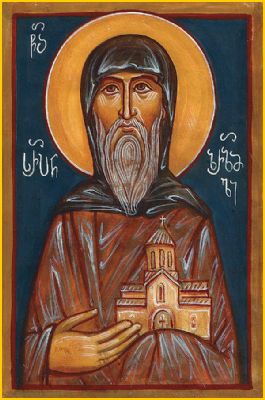
Saintly Saturday: St. Serapion of Zarzma

Today is the feast of St. Serapion of Zarzma, a 10th century saint who is primarily remembered by the Georgian Orthodox Church. He grew up as part of a wealthy family (his father was a Klarjeti aristocrat); however, this did not matter when both of his parents died when he was young. He and his brother were taken in by St. Michael of Parekhi, known as a wonderworker and a teacher of orphans.


St. Serapion became a priest, and, after St. Michael was instructed in a vision to send them, built a monastery with his brother in the village of Zarzma.


Though the life of St. Serapion is fairly simple — he spent his life building and maintaining a monastery — I find inspiration in where he built the monastery.

  • Firstly, there is this really cool map (which I found here):

  • Secondly, the regional name (Klarjeti) and the name of the village and monastery (Zarzma) just sound like they belong in a FRPG campaign world.
  • Finally, take a look at the Georgian (Mkhedruli) alphabet:


Personally, I am a big fan of puzzles, especially codes. When I find that any of my players share the same interest, I will sprinkle my dungeons with treasure maps, riddles and inscriptions written in ancient versions of known languages. Thus, I can write out whatever I want in plain English, substitute each letter with a cool looking symbol/rune/foreign character and then inform the players that they recognize one simple word (like 'the'). They then get to decode the message for themselves. Once a language code is broken, they get to go back to their original find and piece together any new messages they find. This is a great (and fun) way to simulate reading ancient texts. The Georgian (Mkhedruli) alphabet is a perfect candidate for such a use.

I'll end with a couple of questions:

  • Which language would you use the Georgian (Mkhedruli) alphabet to simulate?
  • Are there any other alphabets that you use to simulate FRPG languages in your campaign?

Saturday, October 15, 2011

Saintly Saturday: St. Lucian of Antioch

Today is the feast day of St. Lucian (Loukianos in Greek) of Antioch. He was born Samosata. Orphaned at the age of twelve, he became an ascetic in the city of Edessa. In due time, he was ordained as a presbyter (the official title of a priest) and opened a catechetical school in the city of Antioch. Eventually, he was arrested in Nicomedia during the persecutions of the early 4th century. After nine years in prison, he died of hunger and thirst.

One of the more interesting aspects of St. Lucian's life is his continuing influence on biblical scholarship. He did a critical revision of the text of the Septuagint (a Greek translation of the OT done by the Jews of Alexandria three centuries before Christ) by comparing it to the Hebrew. He also did a critical edition of the Greek NT.

In ancient Christendom, there were two schools of interpretation. The one based in Alexandria used a lot of symbolical interpretation. The one based in Antioch (and the one St. Lucian adhered to) insisted on a more literal sense of the biblical text. Therefore, his critical editions emphasized textual accuracy. His edition contributed significantly to what is called the Syrian Recension of the NT which not only was used by such Greek fathers as St. John Chrysostom, but eventually became the basis for the original German Luther Bible.

This brings up the issue of language. As with any post-apocalyptic campaign setting, I tend to emphasize language in my own campaign to the extent that the languages used by those who built all of these ancient ruins and the monsters who currently occupy them are different than the common language of the player characters.

In LL and B/X, demi-humans begin with the ability to speak several languages. One of the interesting consequences of this in my own game is that the demi-humans have become essential for interpreting the languages of monsters who occupy the ruins. To my mind, this does a nice job of re-enforcing the alien-ness of the demi-humans. It suggests that they are closer to monsters because they can converse with them, as opposed to the human characters which do not begin the game with the same kind of linguistic ability.

Another interesting language quirk in my own game derives from the fact that the majority of my players learned the game via 3.5. Therefore, their assumed understanding of languages is based upon this table from the SRD:


While I did resist this assumption at first, I have since basically accepted it. Though I don't necessarily like some of the specifics, I have come to really appreciate the concept of this table quite a bit. It is diverse enough to be expansive and yet concise enough as to be practical. With some simple edits, this table can be easily adapted for just about any campaign.

I'll end with a couple of questions:

  • How important is language to your campaign? Why?
  • How do you use language in your campaign?