Wednesday, November 29, 2017

Gene Wars (SWCL)

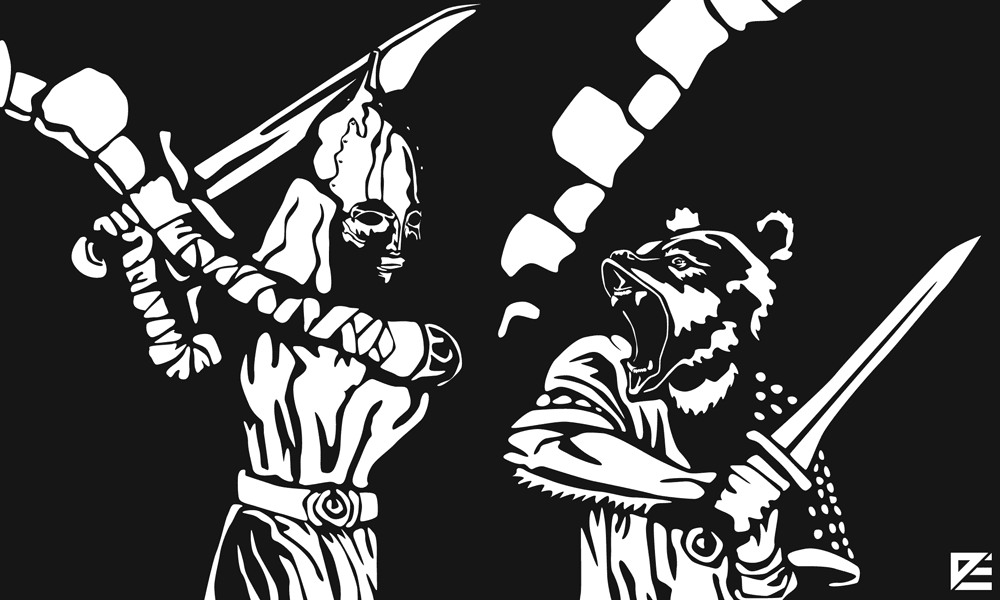
For those wondering where I have been the last couple of weeks, I have been fighting with Gene Wars, my third installment of Swords and Wizardy Continual Light alternate versions. And I do mean fighting. I went through three editorial choices on this puppy before it finally relented and I could stop thinking about it. Whenever I started to actually write something for the blog, an idea for Gene Wars would intrude and off I was trying to make the thing leave me alone.

At any rate, I present to you Gene Wars:


You can find it here.

As per usual, I am pretty sure there are errors throughout. If you are so inclined, please leave comments below of any you happen across. Thank you!

Saturday, November 11, 2017

Saintly Saturday: St. Menas of Egypt

Today is the Feast of St. Menas of Egypt. His moniker comes from his birthplace and his martyrium. His life, however, took place mostly in Phrygia (central Turkey). During the reign of Diocletian, he not only distinguished himself as a soldier, but embraced the monastic life of a Christian. When orders came to persecute Christians, he renounced his rank and withdrew to the mountains. This took place in the city of Cotyaion (modern day Kütahya).

Once, when he was passing through the city, a pagan festival was going on. St. Menas loudly condemned the fete as impious. The prefect Pyrrhus had him arrested and, when the saint refused to take up his military rank as a bribe to denounce Christ, had St. Menas tortured.

As normally happens with martyrs, he endured many vile and cruel tortures through strength given him by God. When none of these worked, Pyrrhus was forced to have the saint beheaded. This is significant, because beheading is a citizen’s death. The crime Christians were accused of was treachery. Therefore, they didn’t deserve a citizen’s death. Over and over again, however, Christians were beheaded. Thus, the very state that was persecuting and killing Christians was declaring that the crime they were accusing Christians of was false.

After his death, Christians gathered up his relics, hid them and later moved them to Alexandria, Egypt. There, his relics became famous due to the number of miracles worked through them. His martyium became a place of pilgrimage. Evidence shows that these journeys came from all over the world, even from as far away as Ireland. To this day, he is still invoked as a healer, a protector from demons and as a finder of lost objects.


The idea of people in the ancient world traveling thousands of miles to visit a relic suggests a very interesting FRPG adventure set-up or even a campaign. There are plenty of examples of saints not allowing their relics to be moved and plenty of saints whose relics are incorrupt (thus suggesting that they cannot be destroyed). Thus, in a FRPG campaign world there could be a well known saint whose relics lie deep within (insert your favorite humanoid/monster race here) territory. The area once belonged to Civilization, but when it was overrun by monsters, the saint refused to leave and the monsters could not destroy the relics.

Today, there is still demand among the faithful to go on pilgrimage despite the dangers. Thus, an adventure could be written around the idea of a prince or other important person afflicted with a magical disease that they believe can only be cured by visiting the saint’s relics. The adventurers are hired to help with the expedition. Enterprising characters (especially clerics) could then spend a campaign rooting out the monsters so that the relics become the centerpiece of their Stronghold.

Friday, November 10, 2017

Advanced Edition SWCL + Mutants

As I was meditating on an “Advanced” version of SWCL and looking through some of my old gaming notes, it occurred to me that Goblinoid Games produced Mutant Future before it produced Advanced Edition Companion for LL. I also noted that I have endeavored a couple of times to create a Thundarr the Barbarian-esque take on D&D. Therefore, the beginning of idea began forming in my head: what if “Advanced” SWCL was a mash-up of stuff from SWCL, the stuff I’ve done with MMII and FF as well as elements from a Mutant Future/Gamma World-type setting?

Here is how I would do it:

Rather than the classic trope of a nuclear holocaust leading to the kinds of mutations one expects out of MF/GW, I would steer in the direction of Star Trek II: The Wrath of Khan. In other words, the thing that destroys civilization as we know it isn’t a nuclear conflagration, but rather the attempt to avoid such an event through genetic manipulation to create the perfect soldier. Thus, the end of the world comes with a "Gene War" rather than a nuclear one.

This scenario justifies the existence of elves, dwarves, halflings, beastmen and even mutants. All of these are attempts at super soldiers. It even justifies all kinds of cosmetic weirdness in human characters. What to play a blue-skinned warrior with a pink mohawk? Sure. Chalk it up to instability in the over-manufactured human genome.

An intro might look something like this:

Sometime in the future, the human race embarks on a journey to transform themselves by playing with their own genetic makeup. This coincided with the expansion of humanity into space. Inevitably, war happened. What the exact reason for fighting or who fought who is lost to time. In fact, no one rally even knows if they are over or still ongoing. Due to the genetic quest to find the perfect soldier, the conflicts that arose came to be known as the Gene Wars.

The planet that is now know as Ur is the site of a major space battle took place during the Gene Wars. Scores of damaged ships crash landed on Ur, bringing with them humanity, technology, and a menagerie of genetically engineered monsters. The space battle look place generations ago, and its significance is lost on all those who have descended from the survivors. However, the crash sites remain and there are still technologies and treasures of a much more advanced society still riddling the landscape.

Ur is now a planet of many races and monsters. Individuals from each generation rise up to brave the wilderness to find treasures and monsters at crash sites of the spaceships damaged from that long-forgotten battle.

I already have a collection of monsters I would deem MF/GW-worthy organized into three broad categories: Machine, Mutant and Alien. I would need to stat up some more classes/races: Mutants, Clones and Purebred Humans.

Thus, the final project in all this would include:

  • Humans
  • Dwarves
  • Elves
  • Halflings
  • MMII Elves
  • MMII Dwarves
  • Mongrelmen
  • Ursani
  • Tengi
  • Tabaxi
  • Mutants
  • Clones
  • Purebred Humans

In addition, it would contain all the monsters from SWCL, Swords & Shapeshifters, Fiends & Falchions as well as 30 more that fit in the MF/GW mold.

I can even imagine future/alien technology being described in terms of extant magic items from SWCL. For example:

Plasma Gun: Functions as a Magic Wand (Magic Missile usable 3 x a day); however, rather than being limited to the Magic-user class, it is usable by anyone but requires a Save to activate. 
Grenades: Function as a Scroll, but (again) usable by anyone but requires a Save to activate. Thus, you could have a Stun Grenade (Hold Person spell).

Or, should I just do up another Alternate Version of SWCL that just encompasses MF/GW and let folks mix and match as they wish?

Thursday, November 9, 2017

Advanced Edition SWCL

One of my favorite (if not the favorite) retro-clones is Labyrinth Lord. As I have said on many occasions, the reason I like it so much is its modularity. Goblinoid Games has produced a whole line of compatible titles from different genres so that you can port into your game whatever ideas, races, classes, magic, items, etc. you want. In terms of playing AD&D, Labyrinth Lord Advanced Edition Companion is my favorite version because it gets rid of all the fiddly stuff I don’t like about 1e and smooths out the corners with all the stuff I love about B/X.

I have been busy of late making alternate versions of SWCL and I thought it would be fun to do an Advanced Edition treatment to the rules. The questions becomes, what exactly is missing from SWCL that would justify an “Advanced Edition?” Here are a few ideas:

  • Gnomes
  • Half-Elves
  • Half-Orcs
  • Illusionists
  • “Gygaxian” Monsters
  • Artifact/Relic-like Magic Items
  • Ability Inflation

In terms of the missing races, I want to take advantage of Moldvay’s description of Gnomes:
Gnomes are a human-like race related to dwarves
Sounds a bit like a half-dwarf. Thus, all the missing races can be understood to be half-bloods. As such, they can be any class just like their human parent; however, they don’t get the full-blown the racial abilities of their non-human parent. Rather, they get to advance in one of the Optional Classes without having to put in an extra adventure every level to advance. The Optional Classes would be as follows:

  • Half-Elf: Ranger
  • Half-Orc: Assassin
  • Gnome (Half-Dwarf): Illusionist

Speaking of the Illusionist Optional Class, we need to make one:
Illusionists function exactly as Thieves, except they can cast a limited number of Magic-user spells as if they were a magic-user of one level lower. The spells Illusionists can cast are as follows:
1st Level: Charm Person, Detect Magic, Light
2nd Level: Illusion, Invisibility
3rd Level: Dispel Magic, Summon (Illusory) Monster
By “Gygaxian” Monsters, I mean those monsters that suggest a monster ecology. For example, Hobgoblins can speak the language of carnivorous apes and these creatures can be found in Hobgoblin lairs. Therefore, the plan is to find 10 or so monsters that can interact with the monsters provided in SWCL to create more "Gygaxian" monster ecologies.

The Magic Items in SWCL are wonderfully simple and generic. The Magic Items of AD&D are often quite specific. For example: Sword +1 Flame Tongue +2 vs. regenerating creatures, +3 vs. cold-using or avian creatures, +4 vs. undead. What I am suggesting is that rather than introduce Hand of Vecna-level magical artifacts to the game, add some of those wonderfully specific magic items found in the 1e DMG as one-of-a-kind magic items worthy of going on a quest for.

Finally, for me, one of the most iconic aspects of AD&D (and one of its most ridiculous features) was exceptional Strength: all those fighters running around with 18/xx Strength. I have no real desire to go there; however, something must be done to encourage and reward players for being human, otherwise there are no human rangers, assassins, illusionists, etc. Thus, the Optional Rule that humans get to switch out their lowest stat with a 15 will become standard.

Tuesday, November 7, 2017

Fiends & Falchions (SWCL)

Well, my latest alternate version of Swords & Wizardry Continual Light is finished, but this one feels different. It is SWCL. It is D&D stripped down to its essentials. Yet, it isn't.

I'll be interested to hear folk's impressions as they read this. Again, I really haven't done much to the nuts and bolts of SWCL, so I am curious if this reads any different for you.

As per usual, I have done my best to edit out typos and errors, but I am sure there are several riddled throughout that have gotten past these efforts. Please also consider this a thread for pointing out these errors. Thank you.

In the meantime, I hope everyone enjoys! You can find the link here.

Sunday, November 5, 2017

FF Monsters and SWCL Part 2

Back when I first started looking into the FF seriously, I made the observation that the number of monster entries per page was significantly lower than the MMI. I chalked it up to the growing complexity of D&D and its inevitable crawl towards the rules-heavy editions to come. I also admitted that, despite being my favorite of all the early monster collections, there were a number of monsters I’d never used specifically because of the verbose entires and all the little fiddly bits associated with these creatures.

Now that I am actually converting a selection of FF creatures to SWCL, I find myself struggling to keep the texts describing several of these monsters short. Of course, by “short” I mean the one sentence descriptions that characterize so many of the creatures in SWCL. For example:
Zombie
AC: 8[11] HD: 2 Attacks: +2, slam (1d6) Move: 6 Special: Undead
Shambling corpses who crave the blood and brains of the living.
Compare that to a similar HD undead creature that I’ve endeavored to convert from the FF:
Huecuva
AC: 2[17] HD: 2
Attacks: +2, claw (1d4) Move: 6
Special: Undead; Immune to Normal Weapons; Disease; Spellcasting; Vulnerable to Silver
Robed, worm-eaten walking corpses can cast Illusion on themselves three times a day to appear to be normal. When hit, victims must make a Save or get a diseased that prevents all magical healing until the victim receives a Cure Condition spell. Huecuva take +1 damage from silver weapons.
Note that I have seriously trimmed this down from its original and even from its simplified version in the S&W edition of Tome of Horrors Complete.

To put this more concretely, SWCL averages 6 monster entries per page. When I put together Swords & Shapeshifters, I managed to get 7 monster entries per page. I am guesstimating that I’ll be around 4 entires per page when I am done typesetting my FF version of SWCL.

It's fascinating that, despite my efforts at finding the simplest way to present these monsters, I am finding myself following in the footsteps of Don Turnbull and company. I am writing verbose monster descriptions and I am beginning to understand why.

The monsters that inhabit both SWCL and MMI are largely creatures that pervade our cultural consciousness. Even if someone who doesn’t play D&D or has never read Tolkien will still have an idea of what an orc is. Certainly the word “zombie” needs little to no description at all.

In contrast, the FF is full of creatures that the average person may have never heard of before. Huecuva certainly falls into this category. Whereas I can assume most people will be able to fill in the blanks when it comes to goblins, orcs and zombies, I can’t when it comes to creatures like the huecuva, volt and even the somewhat familiar flind.

In retrospect, this may be what has so powerfully drawn me towards the FF: there are very little cultural preconceptions about the creatures found in its pages. Therefore, I am more free to expect more of what I want from them than I ever could from an orc.

Saturday, November 4, 2017

Saintly Saturday: St. Joannicius the Great

Today is the Feast of Joannicius the Great. He was born in A.D. 752 in Bithynia (in modern-day Turkey) to faithful but very poor parents. Their only wealth was some cattle, which Joanicius would tend, often using it as a means of prayer and using the Sign of the Cross to ward away both beast and thief.

When emperor Leo IV came to power in A.D. 775, he instituted a draft and Joannicius was chosen from his village to serve. He did so with bravery and earned the respect of his fellow soldiers. He was rewarded more than once by both his commanders and the emperor himself for striking fear into the hearts of his enemy. He served in the military for six years, but he knew that the life of a soldier was not his calling.

When he was able to leave the imperial army he wanted to become a hermit, but at the direction of a spiritual elder, he spent a couple of years in a monastery to learn the monastic life. He then went into the wilderness to finally become a hermit. He spent time with other monastics saints, became known as a miracle worker and finally retired to Antidiev monastery were he died at the age of 94 in A.D. 846.


From the perspective of RPGs, I find the life of St. Joannicius fascinating because it demonstrates how grounded in reality the character creation system of Classic Traveller is, one of my favorite subsystems of any RPG in existence. Though he is famous for being a hermit, along the way he was, for lack of a better term, a cattle rancher, a soldier and a monk. If he were an RPG character, his character creation process would have gone through a couple of careers, garnered a wide variety of skills prior to becoming an adventurer (a hermit wandering the Wilderness).

The closest to this idea that I have ever seen in FRPGs is Warhammer Fantasy Roleplaying Game; however, the career changes happen as part of character advancement, not as a precursor to becoming an adventurer. A close second is the 0-level character concept that I first encountered in Goodman Games modules like DCC35A: Halls of the Minotaur. Neither of these, though, scratch the itch for a Classic Traveller-esque mini-game of character creation.

In the ACKS Players Companion there might just be a foundation upon which to build one for B/X. Therein is a section called Custom Classes which reverse engineered all the B/X classes to come up with a system to build campaign-specific classes with all variety of possibilities. A character gets a total of 4 points to spend on Hit Point Value, Fighting Value, Thieving Value, Divine Value and Arcane Value. Certain aspects of these can be traded in for special abilities which can further be expanded if they are delayed across levels.

Using these concepts, it might just be possible to create a series of tables to, like Classic Traveller, create a fantasy character, their life prior to becoming adventurer and the skills/abilities that they picked up along the way.

This is where I must disappoint. I don’t have the time or energy to put something like this together at the moment; however, I am going to bookmark this idea and come back to it at some point. Or, maybe someone else can have a go…

Friday, November 3, 2017

FF Monsters and SWCL

I am in process of converting a bunch of FF monsters to SWCL and it is actually kind of a fascinating process, assuming that one can only use the FF as a source (which I am). Besides the various systemic differences (which, to be honest, are really just figuring out ways to trim down the mechanics to their most elegant simplicity) I am facing three larger issues:

  1. Non-OGL monsters. One of the most iconic monsters of the FF (the Githyanki) and one of my favorite (and criminally under-utilized) monsters (the Slaad) are non-OGL and therefore have to be re-imagined in ways that feel familiar but, for legal reasons, are different.
  2. References to creature outside the FF. The best example of this is the Flind. These are a special type of Gnoll, which don’t exist within the confines of the FF. To a lesser extent, this is also an issue with the Githyanki because their lore so heavily relies upon the Mind-Flayer, which not only doesn’t exist within the confines of the FF, but are also non-OGL.
  3. There are about 160 monster entries in the FF. Due to the scope of SWCL, that number needs to be trimmed to about 30 and those 30 need to present something that resembles a cohesive science-fantasy world-view.

The first is actually probably the easiest of the three to solve because I have already treaded these waters before. I have a collection of monsters I used when I wrote The Caves of Cormikir, which was my version of B2:The Keep on the Borderlands that conceptually would have been part of the Basic D&D boxed set had the FF been the source of all the monsters. I also have my own version of the Githyanki that I have used for years in my Lost Colonies campaign.

Nonetheless, I still have to cut out the creature references from sources outside of the FF. There are two main ways I plan to do that:

In the case of the Flind, being described as hyena-men gives me leeway to create an entire class of monsters called “Beastmen” of which the Flind is a type. This then gives me the freedom to re-skin virtually all the of various humanoid monsters as some variation of the “beastman type.” Bullywugs become frogmen. Kuo-Toa become fishmen. Grimlocks become molemen, etc. This also allows me to re-skin Flinds, Ogrillons and Lizard Kings as exceptional types that exist within all variations of beastmen.

The second main strategy is to re-write the narrative behind the Githyanki (Sons of Cyn). Rather than their ancient conflict being with the Illithid, that conflict will be with the Slaad. Since the the number if demons and devils in the FF is rather sparse and since their really is no significant difference between Chaotic Neutral and Chaotic Evil in my book, the Slaad will also be a nice stand-in for demons and devils (I’ll call them Fiends of Entropy as a little nod to the title of FF).

This conflict, rather than happening across various planes of Gygax’s cosmology, happens, for lack of a better phrase, in the Prime Material Plane. As a consequence, creation itself has begun to rebel. This is the origin of things like dragons, who are more personifications of elemental forces than a traditional D&D dragon. Since FF dragons are “Oriental” I’ll use the five-point Asian elemental system rather than the four-point European. This will give a framework from which to understand all of the creatures I choose: they have evolved out of this greater conflict between the Sons of Cyn and the Fiends of Entropy.

This, then, gives me a criteria to trim the fat, as it were. If I can’t see a way to include a creature in these two frameworks (beastmen and the conflict between the Sons of Cyn and the Fiends of Entropy), I just won’t include it.

Wednesday, November 1, 2017

SWCL + FF

Long before I ever went through the Monster Manual 2 to see what would happen to B/X if the only monsters available to Moldvay came from the MMII, I did the very same thought experiment with my personal favorite the Fiend Folio. Since I have already produced a version of SWCL that uses only MMII monsters, I thought I'd do the same with the monsters of the Fiend Folio. So, as a preview, here is the cover art:


Saturday, October 28, 2017

Swords & Shapeshifters (SWCL)

Since I couldn't really think of anything to write about St. Stephen the Sabaite on his Feast Day, I decided to do as much as I could to finish up my alternate version of Swords & Wizardry Continual Light in his honor.


As per usual with a hobbyist like myself, I am sure there are several typos and errors riddled throughout. Consider this a thread for pointing out these errors. Thank you.

In the meantime, you can download it here. Enjoy!

Friday, October 27, 2017

Half-Elves for SWCL

One of the ideas from 0e that I truly find fascinating is the idea that elves can adventure as fighters and magic-users, they must do so one class at a time. Unlike later editions of the game, they don’t get to be armor-clad spell caster. This idea re-surfaced in the retro-clones Swords & Wizardry White Box and Labyrinth Lord Original Edition Characters, but not in main version of those games. SWCL splits the difference in the fact that elves only get to be one class: fighters, magic-users or thieves.

When it comes to demi-human races, my favorites are the half-breeds: half-orcs and half-elves. Something about the cultural, social and personal complications that these races imply has always fascinated me. Therefore, in order to get my 0e elf fix with SWCL, I propose the introduction of a new optional race: the half-elf.

The half-elf adventures as either a human or an elf. Each persona has its own class and its own racial abilities. The player chooses which persona to play at the beginning of each session. For example, a half-elf could adventure as a human cleric in one persona and an elven magic-user in the other.

Like all other characters, the half-elf can get a total of six level gains and each of these level gains requires the same number of adventures as other classes; however, the half-elf can gain a maximum of three levels in each of their two classes. Thus, the half-elf cleric/magic-user in our example above can only advance to be a 4th level human cleric and a 4th level elven magic-user.

Like the 0e elf, all class restrictions apply when adventuring in certain classes. Thus, when adventuring as a magic-user, the half-elf cannot wear any armor.

Thursday, October 26, 2017

Dave Arneson and SWCL

For those of you who have read this blog over the years, it should be no surprise that I am a huge fan of the Dave Arneson rule of 1 gp spent = 1 xp. In my experience, this motivates players to take ownership of the world their characters inhabit. For example, in my Lost Colonies campaigns the following places exist because players spent money to bring them into being:

Headwaters

  • A Tavern that specializes in stirge meat.
  • A cheese factory
  • A camel farm
  • A monastery and chapel
  • A stone and statue garden
  • An abandoned dwarven home

The Road from Headwaters to Trisagia

  • A stone toll bridge manned by half-giants

Trisagia

  • A merchant company the specializes in shipping

The Elflands

  • A cathedral with an illuminated text

Note that only the last one qualifies as a standard Stronghold in B/X terms. I really love this stuff because it enriches the campaign world in a way that I could never do purely on my own. These places have been adventure fodder and/or direct results of adventures. Each one has multiple stories attached to it. I firmly believe none of these would exist if it weren’t for Dave Arneson’s rule of 1 gp spent = 1 xp. As a consequence, whenever I run into a version of D&D that does not use it, I try to find an easy way to shoehorn it in.

Enter SWCL. I actually love the leveling mechanic of this game: complete a given number of sessions/adventures and you level. No math, no trying to assign experience value to non-combat encounters, just go on adventures and be done with it. This idea is so elegantly simple I am actually loathe to mess with it; however, I am also loathe to get rid of the incentive for players to invest in all of the kind of world-building goodness that the Arneson rule has produced in my games.

Thus, I propose an Optional Rule for SWLC:

In order for an adventure to be considered “complete,” a character must spend at least half of the treasure gained from that adventure.

Thus, if my character’s share of the booty is 20 gp because we overlooked the real treasure trove, I need to spend 10 gp to complete that adventure in terms of gaining levels. If that booty is 2000 gp (because we went back and found the hidden treasure chest) I now have to figure out a way to spend 1000 gp.

Wednesday, October 25, 2017

Gamer ADD: Swords & Wizardry Continual Light

As can be seen by my last couple of posts, I have been rather enthralled by Swords & Wizardry Continual Light. There is something rather intoxicating about its simplicity. The amount of flexibility that the system offers isn't necessarily missing from other versions of D&D and its clones, but SWCL just makes it so darn simple to pull off.

As a consequence, I am in the middle of putting together something I've wanted to do for about a year. I did a series last November in which I imagined a world where the Monster Manual II was the only source for monsters available to Moldvay when he edited Basic D&D. Despite the fact that the MMII is my least favorite creature catalog, the thought experiment resulted in a version of D&D I really want to play.

As a consequence, I've since wanted to take the frame of a retro-clone and produce a complete rule-set of a D&D game that only uses MMII monsters. Unfortunately, said task requires too much of my time and a number of editing decisions that make the project far more complicated than I have the energy for.

Enter Swords & Wizardry Continual Light. Here is a platform that makes this vision of a MMII-only game not only possible, but extremely doable. As a consequence, I am happily editing my own version of SWCL to reflect an MMII-only world. Layout should follow closely behind and the cover is already done:

Hopefully this will get done sooner rather than later.

Monday, October 23, 2017

Character Sheet for SWCL

One of the quibbles I have with Swords & Wizardry Continual Light is that it has a very boring character sheet. Fortunately, that is very easy to remedy:


You can download a copy here. Enjoy!

Saturday, October 21, 2017

Saintly Saturday: St. Hilarion the Great

Today is the Feast of St. Hilarion the Great. He was born in Gaza in Palestine to pagan parents who subsequently sent him to Alexandria (Egypt) for his education. There he encountered Christianity and was baptized. He also encountered stories of the Father of monasticism, St. Anthony the Great. Inspired, he decided to follow in Anthony’s footsteps and dedicated the rest of his life to asceticism.

As an aside, St. Athanasius the Great wrote the hagiography of St. Anthony which was translated into several languages. It inspired an entire generation of Christians after the legalization of Christianity in the Roman Empire to head off into the desert and follow the monastic life. I am always surprised by how inspiring this account of St. Anthony remains to Christians even in our modern age. I cannot recommend it enough.

St. Hilarion returned to his home in Gaza to find both his parents had passed away. He gave away all of their belongings and went into the desert. He was soon caught up in a fierce spiritual battle. There are accounts of demons that took the form of phantoms, crying children, wailing women and wild beasts. He endured through it all and became well known as an exorcist and healer. So popular was the saint that he had to flee, lest he be tempted by pride and overwhelmed by the sheer amount of those seeking his help.

Therefore, he became a wanderer, never staying long in any one place, healing and exorcising where ever he went. His journeys took him to Egypt, Libya, Sicily and finally to Cyprus where he passed away at the age of 80 in the year A.D. 372.


In St. Hilarion, we have part of the historical archetype of the D&D cleric. He is akin to a wandering adventurer who heals and fights off demons. It is easy to see in his story analogs to Turn Undead and such cleric spells as Detect Evil, Cure Light Wounds, Cure Disease and even Protection from Evil. I know that folks have argued that Clerics are not a good fit in D&D because we don’t have a literary archetype that fits the clerical mold, though I would counter with REH and Solomon Kane, and some would even go as far as to argue that we don’t have an historical archetype, either.

While St. Hilarion is not exactly a plate mail wearing, mace wielding warrior, neither are many of our favorite literary archetypes exact fits to D&D classes. Gandalf doesn’t cast flashy spells and carries a sword. What class, exactly is the Gray Mouser? or Fafhrd for that matter? In other words, as I have long argued, for those of us who love the class, clerics definitely belong in D&D.

Thursday, October 19, 2017

Zero-Level Characters for SWCL

For those not already aware, Swords & Wizardry Continual Light dropped earlier this week. While I have a few quibbles (like the fact that there are monsters who can surprise on a 1-3 on a d6 and Thieves can backstab surprised opponents but there are no rules for surprise in the combat section), I really like this ruleset. It elegantly boils down D&D to its essence with as few rules as possible and still presents an immensely satisfying game.

I think my favorite part of the entire ruleset is the way it handles Optional Classes like the Ranger and the Monk. They play exactly like one of the four core classes: Fighter, Cleric, Magic-user or Thief, with an extra ability tacked on. The price a player pays for this ability is a slower level progression. Since experience is handled by the number of sessions played, the optional classes simply add an extra session to each level. Brilliant!

What I love the most about the way SWCL handles these Optional Classes is that it provides a very simple way to create world-specific classes that add a lot of color to the campaign without a lot of a lot of mechanics: take one of the four core classes, tack on a special ability and you are good to go!

Thus inspired, I decided to take the rough idea of zero-level characters that I mused about in my last post and applied the mechanical elegance of SWLC to produce a supplement that provides players and referees of SWLC a way to use zero-level characters to bring some life, depth and background to the characters that inhabit their campaigns.

Art by Joyce Maureira

You can download it here.

Saturday, October 14, 2017

Saintly Saturday: St. Cosmas the Composer and Melodist

Today is the feast of St. Cosmas the Composer and Melodist who was not only a contemporary of St. John of Damascus (a famous 7th-8th century saint who wrote against iconoclasm) but was an adopted member of the family. He was elected bishop in the 8th century to a coastal city in Palestine. He was also an excellent hymnographer. Among his many compositions are two Canons that are still sung in the Orthodox Church today: the Canon of the Cross and the Canon for the Nativity of Christ.


Earlier this week, when I looked ahead to see who the saint was for today, I was left with a very tough question: What to do with a hymnographer? It is a reminder that D&D (and most RPGs, for that matter) don’t really have a place for someone like St. Cosmas. Yes, the argument can be made that he represents a Christian version of a Bard, but, not only do I not really like virtually any iteration of that class, I don’t think any version can easily be re-skinned to fit a St. Cosmas.

This leads me to a bit of Gamer ADD I have been suffering from lately. I’ve been distracted by Warhammer Fantasy RPG, the Mithgarthr “retro-clone” of 5e and Swords & Wizardry Continual Light. While absorbing so much awesome, my brain came up with an interesting challenge that I think answers the “problem” of St. Cosmas better than simply calling him a Bard:

Knowing what I know today in October 2017, what if I suddenly found myself back in the late 80s at the beginning of the end for TSR when my friends and I started drifting away from D&D? What would I do to modify D&D to make it enticing enough for my friends and I to continue to play realizing that I would have no access to the huge library of .pdfs and books that I have now? What resources could I use?

The first thing that came to mind is the idea of a 0-level character. Not only do I love this idea, but my friends probably would have as well because we reveled in the challenge of low-level play. I owned the 1st edition of Warhammer Fantasy RPG and it has an awesome list of careers that a potential 0-level character could come from.

Secondly, my friends did like the idea of the proficiency system that was being developed in books like Unearthed Arcana and Oriental Adventures. Why not take some of the skills from the Thief class, some of the skills from WFRP and use them in the broad sense suggested by both WFRP and 5e where each characteristic gets several skills associated with it?

Finally, this all has to exist on a random table that also allows for some customization. Therefore, each career would have the ability to move around some ability scores and a choice of skills to specialize in.

Here is a rough draft of what that might look like (Roll a d12):

  1. Alchemists’ Apprentice Skills: Craft, Medicine, Open Locks; Characteristic: INT
  2. Entertainer Skills: Blather, Perform, Sleight of Hand; Characteristic: CHA
  3. Herbalist Skills: Lore, Medicine, Sleight of Hand; Characteristic: WIS
  4. Initiate Skills: Blather, Etiquette, Read Languages; Characteristic: CHA
  5. Laborer Skills: Craft, Consume Alcohol, Open Locks; Characteristic: DEX
  6. Outlaw Skills: Climb Walls, Intimidate, Stealth; Characteristic: STR
  7. Rat-Catcher Skills: Animal Handling, Hunt, Swim; Characteristic: CON
  8. Sailor Skills: Climb Walls, Navigate, Swim; Characteristic: STR
  9. Scribe Skills: Lore, Read Languages, Stealth; Characteristic: INT
  10. Soldier Skills: Consume Alcohol, Intimidate, Hear Noise; Characteristic: DEX
  11. Squire Skills: Animal Handling, Etiquette, Perform; Characteristic: CON
  12. Woodsman Skills: Hear Noise, Hunt, Navigate; Characteristic: WIS

Skills: Players can try to justify doing anything under the pretense of a skill. PCs can automatically succeed at the DM’s discretion. Any character can use any skill at a base success rate of 1 in 6. Each career offers three skills that can be specialized in. The player prioritizes these specializations at character creation. At 0-level these three skills have a base success rate of 9+, 12+ and 15+ on a d20. As a character gains levels, these chances improve by 1 per level (8+, 11+, 14+ at 1st level). A roll of ‘1’ always fails

Each specialization is associated with a characteristic. The bonus or penalty of that characteristic can be applied to a roll with a specialization (but not to the generic 1 in 6 chance):

STR: Climb Walls, Intimidate, Swim
INT: Craft, Lore, Read Languages
WIS: Hear Noise, Medicine, Navigate
CON: Animal Handling, Consume Alcohol, Hunt
DEX: Open Locks, Sleight of Hand, Stealth
CHA: Blather, Etiquette, Permform

Characteristic: Each career can rearrange their starting characteristics (rolled in order) by taking the highestt roll and switching with the Characteristic associated with the career. For example: an Initiate with STR 10, INT 7, WIS 15, DEX 17, CON 10, CHA 8 can switch out their DEX and CHA scores so that the characteristics look like this: STR 10, INT 7, WIS 15, DEX 8, CON 10, CHA 17
Once a character reaches 1st level and chooses a class, these characteristics may be further adjusted according to the rules in Basic D&D.

Each PC would fight as a 0-level human with d4 hit points. 1st-level would be attained after one adventure.

Saturday, October 7, 2017

Saintly Saturday: Sts. Sergius and Bacchus the Great Martyrs of Syria

Today is the feast of Sts. Sergius & Bacchus the Great Martyrs of Syria. The Roman Emperor Maximian (A.D. 284-305) appointed these two saints to high positions in his army, ignorant of the fact that they were Christians. The saints were subsequently accused of refusing to sacrifice to the idols by those envious of these positions. The two were arrested and, of course, confirmed their refusal.

As a consequence, they were stripped of their military insignia, stripped of their clothing, dressed as women and paraded through the city streets in mockery. Afterwards they were tortured. Bacchus died by scourging and Sergius was beheaded after being placed in iron sandals with nails in the soles.


This story reminds me of several folks I have encountered in my dialogues about religion that simultaneously criticize Christianity for its cruelties and romanticize various forms of paganism. When we romanticize things, we tend to fall into the trap of anachronism — we impose our own modern values onto something from the past that cannot have possibly been associated with those values.

Today, transgenderism is a hot topic and here we have pagan Rome dressing up men in woman’s clothing as a punishment, demonstrating the large disconnect between the most current modern value fad and ancient pagan values.

While some may quibble or be downright offended by my use of the word “fad” in context of transgenderism, I insist upon it because our political class has fetishized the concept to the point where we can’t actually deal with transgenders as people because they are being used as an excuse to inflame political debate.

I am also reminded of the various old-school cursed magic items that would permanently change the sex of its user as well as the various Reincarnation spell tables that bring back dead characters as anything from badgers to trolls. Believe it or not, as a Christian I actually like these aspects of old-school gaming.

Recently, I have been involved locally with dialogues on the topic of racism. I keep running into the fallacy that people cannot understand what it’s like to be ‘X,’ completely ignoring the old adage that we should walk a mile in another man’s shoes. In their own way, RPGs allow us to walk that mile. We get an opportunity to experiment with ideas and thought processes that are not entirely our own.

As a player, one of the most magical moments I experience in play is when my character insists on doing something that I would not. It is precisely in these moments that characters come alive and I get to experience wearing those shoes.

As a Christian, this is an extremely important exercise, because it ultimately makes it easier to see the image and likeness of God in others. If I can empathize with others and understand why they do and think what they do and think I can see them as people rather than a political tool used to gain and maintain power.

***

This all made me think of an interesting twist on the concept of the Elven Boot and Elven Cloak. Rather than aiding the wearer in being sneaky, these items endow the wearer with the ability to adventure as another class in the same way that Elves in 0e would choose to be either a Magic-user or a Fighter before each adventure, earning experience only in that class. Thus, there could be three different types of boots/cloaks: Fighter, Magic-user and Thief (elves don’t really do the Cleric thing). As long as the character is wearing the Elven Boot/Cloak they can adventure as and gain experience in the class associated with the item. Should the item ever be lost or destroyed, the character loses all those XP and abilities.

Tuesday, October 3, 2017

On Vitriol Revisited

A few years ago, I blogged about a conflict that arose in our little corner of the internet. I called it On Vitriol and those posts can be found here. Fair warning: I don’t know how successful those posts were. While they did provoke some thought, they also offended people.

Recently, there has been another conflict in our space that folks are concerned enough about that they’ve publicly blogged about conflict resolution and how to get through this most resent clash with as little damage as possible. Therefore, I thought it might be useful to revisit some of the ideas that I tried to communicate with my posts On Vitriol.

Before I go further, I need to make this clear: I have no real skin in this game. I am not active on G+ (where, evidently this conflict has had the most impact) and besides a couple of posts on blogs I frequent, I would have lived life without being aware of this conflict and it would likely have had (or even have) little effect on my gaming life (such as it is). Therefore, I am not particularly interested in the personalities involved and I don’t intend to impugn or defend anyone.

This post is intended to be about ideas, not the specific people directly involved in the current conflict (although, ultimately, this is about people in general). I will be linking to some posts where these ideas happen to appear, but this is to give folks an opportunity to see these ideas in context not an endorsement or condemnation of the people who posted these ideas.

Having said that, I want to pull three quotes that I find particularly interesting:
Those seeking justice often have to organize allies in order to force contact and conversation, negotiation. Trying to create communication is almost always the uphill struggle of the falsely blamed. And entire movements are structured around the goal of forcing one party to face the reality of the other, and thereby face themselves. — Sarah Schulman (link here)
What we need now, in our political leaders, in our communities, in our lives is humility. Have the humility to know that you don't have all the answers. Have the humility to know when to stop obsessing about something. — Greg C. (Link here)
The content objectives followed one rule: don't let the perfect be the enemy of the good. Post what you're working on already, not something designed specifically for posting, and don't worry about whether it's perfect. — Matt Finch (Link here)
Assuming that these three ideas exist in a post-Christian/secular/ atheist context, the only one that has any legs is Sarah’s. Notice that her’s is the only one that deals with power structures and the force necessary to move power. In the face of power and force, humility and the concept of good have no real use or value.

This exposes one of the great weaknesses of a post-Christian/ secular/atheist society: it is very vulnerable to authoritarian and totalitarian impulses. While Sarah couches her argument in justice, the defense of those who are falsely accused and those who are outside of power structures, this model ignores the possibility of those in power framing themselves as the falsely accused and framing those outside of power as the ones making the false accusations and the injustice of it all. This strategy has been used multiple times throughout history to solidify extant power structures. For example: Stalin and the bourgeoisie, Mao and Western cultural influences, Pol Pot and the intelligentsia and Hitler and the Jews.

Within the space that we occupy in communities on the internet, power is not primarily derived from physical force as it is in the (admittedly) extreme examples I mentioned above. Rather, we deal in reputation and influence. One has power based on the number of followers/readers/clicks they have and the number of ups/retweets/shares they get. Thus, when there is conflict it targets these power structures. As a consequence, it can get very nasty indeed. The most effective means of reducing someone’s power on the internet is to destroy their reputation and/or destroy their influence.

Internet fights usually involve exposing nasty details of an opponent’s personality to ruin reputations and bullying and harassing to reduce the amount of time and energy the opponent actually spends on-line. I don’t think anyone can disagree that this is the world we live in. Indeed, I would argue that we got Trump because the folks who had put so much value in humility and in the concept of good realized that these had no value in our post-Christian/secular/atheist world and so turned to someone who knows how to wield power in the Twitter-verse. As a consequence, our society is in process of shedding any vestige of civility.

If we are interested in placing value on humility, goodness or anything other than power then we need to start acknowledging the value of a Christian culture. Please note: I am not advocating for people to become Christians (although that would be nice), just that they acknowledge that having the idea of a Christian God is important, even vital, to a free and functioning society. I am also aware that Christians are just as capable as anyone else of abusing power; however, even just having the notion that the Christian God is a good idea helps place value on things like humility and goodness.

The Trinitarian God of Christianity is a relational being (Father, Son and Holy Spirit) who loves human beings to such an extent that, in the person of the Son, He willingly became a human being in order to be tortured and killed so that He could share Himself with us. Since this same God created us according to His image and likeness, there is intrinsic value (goodness) in imitating Him in order to become like Him and fulfill the potential of that image and likeness. Thus, even in the face of power, standards like humility and goodness still have value because these things not only come from God, but are demonstrated by God Himself in the person of Jesus Christ.

However, within the context of our own online community, the most important implication of the Trinitarian image and likeness is that of relationship. If God is a relational being and we are made according to His image and likeness, than we are also meant to be relational beings. This also goes beyond merely being friends with those with whom we agree. God is a radical other. His being is so different from ours that we cannot hope to be able to ever comprehend it. Yet, He took on our humanity to Himself in the person of Jesus Christ.

Thus, if we are to strive to fulfill God’s image and likeness in ourselves, we must strive to be in fruitful relationships with those who are radically different than us: not only those who look and act differently than we do, but those with whom we disagree.

In this context, power becomes largely meaningless and values like humility and goodness not only become important but manifest in us.

Thus, I humbly ask, that we allow God back in, even if only as an idea.

Saturday, September 30, 2017

Saintly Saturday: St. Gregory the Illuminator of Armenia

Today is the Feast of St. Gregory the Illuminator of Armenia. He was born in the middle of the third century A.D. His father, Anak, was part of a plot to take Armenian throne. He killed his kinsman Kursar but the plot failed. As a consequence, he and his entire line were sentenced to death. Gregory, however, was secreted out and was raised in Cappadocia as a Christian.

He married, had two children and was widowed. Impelled to atone for the sins of his father, he decided to enter into the service of Kursar’s son, Tiridates. When it was discovered that Gregory was a Christian, he was tortured in various and heinous ways, but was steadfast through it all. At one point, he was thrown into a pit full of vipers. Thinking that was his end, his torturers left him for dead; however, the snakes did him no harm and for fourteen years he endured with the help of certain pious widows, who would lower bread into the pit.

When it was revealed to Tiridates that Gregory still lived, he was released. Through his faith and preaching, the Armenians became Christian, including Tiridates. St. Gregory was ordained bishop and reposed in peace about the year A.D. 325.


This story opens up the possibility of an interesting twist on the Abandoned Monastery Trope found in so many dungeon adventures: rather than a collection of caves or cells, the monastery would be filled with snake pits. This, of course, opens up all kinds of interesting themed ideas with creature favorites like yuan-ti and ophidians.

It also brings up the famous verse from Mark:
And these signs shall follow them that believe…They shall take up serpents; and if they drink any deadly thing, it shall not hurt them; they shall lay hands on the sick, and they shall recover (16:17-18).
This suggests an interesting variation on the Cleric class for those who are raised around or are part of a snake-pit monastery. Instead of being able to Turn Undead the Cleric gains the following abilities:

  • Immunity to Poison (even magical poison)
  • Snake Companion: This companion is an intelligent and loyal creature that always has 1/2 the HD of the Cleric. The two can always understand each other (a Speak to Animals spell is necessary for anyone else to speak with the snake). The snake also has a special ability depending upon whether the snake is a constrictor or a viper. If it is a constrictor, it can Lay on Hands (Scales?) and heal up to 2hp per level of the Cleric. If it is a viper, it can cast a Neutralize Poison spell once per day; however, this spell does require 1 full turn to cast. Both of these abilities require that the snake be within 30 feet of the Cleric to use. Should the snake companion ever be killed, the Cleric immediately loses a number of hit points equal to that of the companion and it cannot be replaced until the cleric gains a level.

In all other respects, these “Snake-pit” Clerics are the same as normal Clerics.