Showing posts with label Traveller. Show all posts

Sunday, September 22, 2024

Gamer ADD: Suleiman Subsector Gazetteer Part 2

1110 Quaver C111469-B

Prior to the Civil War, Quaver was a major trade hub overseen by an opportunistic dictatorship. Seen as a possible disruptive force in subsector politics, it was Imperial policy to undermine Quaver’s government. This policy succeeded just as the Civil War was breaking out. This success couldn’t have come at a more unopportune time. Trade collapsed and the new government, still trying to figure out how to govern, proved incapable of dealing with the failing economy. Millions either starved or fled. Today, a population of around 50,000 souls is governed by an Administrator appointed by the Solomani Rim. The economy has yet to recover.

1201 Akimasi C8A5455-6

1202 Sase C347441-9

Akimasi and Sase are two contrasting examples of the impact of the Civil War on planets with domed cities and less than ideal atmospheres. Akimasi was a colony world ruled by a feudal technocracy wholly dependent upon the Imperial government to make sure it had enough oxygen to keep its single city supplied with breathable air. Sase was a thriving civil service bureaucracy that managed to keep a population in the tens of millions safe from a diseased atmosphere through an elaborate system of air filtration and inoculations.

When the Civil War brought chaos to trade within the Subsector, Akimasi resorted to trading oxygen for safe haven to all parties: from Imperials to Solomani to pirates and criminals. They had the space to tolerate these interlocators and it allowed them to get through the entire war virtually unscathed, save for a minority of those with unsavory pasts that decided to stay on and integrate.

In contrast, Sase’s larger population put a huge strain on the government’s ability to keep up with demand on filters and medication. The situation quickly devolved into the rich having access through bribery and the poor being left behind. When people started dying, there was a massive revolt. The ensuing violence and spread of disease killed millions. In an attempt to avoid such government abuse and violence in the future, the current government is a representative demoncracy.

Both experiences left each planet very eager to cooperate with Tukera Lines to establish the Imperial Starlane. Today, they each seek to grow economically and in population with the stability the trade route has brought.

1205 Biggles C236666-9

Prior to the Civil War, Biggles was a protectrorate of Ascalon. Due to this relationship, Biggles was able to survive most of the privations incurred in the chaos that followed. The largest changes have been a loss of population (mostly due to emigration) and the loss of constant contact with Ascalon due to a shortage in Jump-2 ships. Although not officially part of the Ascalon Alliance, the government still sees itself as a protectorate. As a consequence, it is a hotbed of political intrigue and espionage as the Ascalon Alliance and Cluster Concorde vie for influence.

1207 Ascalon 1207 B5628A9-B

During the Imperial Era, the Royal Family of Ascalon also held the Imperial noble rank of Marquis, giving the king of Ascalon more political clout within the subsector than one might expect. Just prior to the Civil War, he used this influence to butt heads with the Duchess of Suleiman. This political rivalry continues to this day; however, the king also spent much of his political clout in anti-Solomani rhetoric. In the current climate, this rhetoric is almost non-existant. That doesn’t mean he isn’t trying to avoid dependence on or alliance with the Solomani Confederation. It also doesn’t mean he isn’t on board with having relations with either Tukera Lines or the Concorde, but he will only do so on his terms.

Note: I am using Rim of Fire, a GURPS Traveller sourcebook by Jon F. Zeigler published in 2000, as inspiration for this Gazetteer. The conflict bewteen the Marquis and Duchess is described largely in economic terms, with the Marquis coming off as a greedy upstart that seems to want to use any excuse to sabotage the Duchess; however, the text suggests something far more interesting that I plan to explore. The blurb on Ascalon has one of the very few mentions of Christianity I have found in Traveller sourcebooks. Suleiman is described as a people trying to reconnect with their Turkish (Islamic) roots. Thus, this conflict goes beyond economics and dips into both culture and religion. I will take the liberty to make Ascalon a Christian monarchy to make things more interesting.

1304 Vanefa A563963-E

Two factors played a huge role in determining the fate of Vanefa in the post-Civil War era: treachery and water. When trade got interrupted by the Civil War and Solomani encroachment began to look inevitable, the royal family of Vanefa gambled and sided with the Confederation. This did not play out well. It isolated Vanefa, despite being part of the Azeremiid Cluster. They could no longer import enough water for the billions who lived on the planet. War broke out and the royal family was imprisoned and executed. Stability wasn’t achieved until the Cluster Concorde intervened and imposed a government answerable to the Duchess of Suleiman in exchange for a steady supply of water. This promise ended up being rather tenuous until Tukera Lines made Vanefa a regular stop within the Imperial Starlane. Thus, the local population is more loyal to Tukera than it is to the Concorde.

1306 Rimmon X220000-0

In the Imperium, Rimmon was an uninhabited restricted zone that no one paid much attention to. Today, despite remaining uninhabited, the world is a focal point in the conflict between the Alliance and the Concorde. In order to facilitate trade and influence, the Concorde is seeking to start a colony on Rimmon. This would allow Jump-1 ships access to both Biggles and Coriolanus. Ascalon is actively sabotaging these efforts, because of its ties to Biggles and the inlfuence it has on Coriolanus through its agents stationed on Biggles.

1402 Gulimaru C7A66B7-A

The interruption of trade during the Civil War resulted in 90% of the population dying due to lack of oxygen. Those that survived did so through force. Despite the welcome influx of trade through the Imperial Starlane, the dictatorial rule through strength remains in power.

1404 Esterhazy C335420-B

This old Solomani colony world managed to survive the Civil War virtually unscathed due to long established trade routes within the Azeremiid Cluster. Locals proudly maintain a form of constitutionalism based upon the priniciples of an ancient terran document known as the Golden Bull.

Wednesday, August 7, 2024

Gamer ADD: Suleiman Subsector Gazetteer Part 1

Before I start making notes about each of the worlds in the Suleiman Subsector, I have a confession to make. As much as I (and pretty much every Traveller fan I know) bashes the New Era, as I was going through and reading up on various bits of information on the Third Imperium and the Rebellion, I was reminded how much I actually liked the actual rulebook of the New Era. While it might not be the best print quality (I handle mine with care for fear that the binding will finally decide to give up), its contents are really well laid out, helpful, organized, and just plain useful. I noted that I have marked in a bunch of errata, which goes to show I used it a lot back in the day (for what, I don't remember). Interestingly, I found myself using it again as a primary resource. It has a section on world generation and decline that is wonderfully concise and clear, occupying only a few pages. It, along with the GURPS The Rim of Fire suppliment, are the only two resources currently open on my table, for what its worth.

0902 Porlock D433655-9

The Civil War has proven to be disasterous for Porlock. Regular shipments of O2 were necessary to sustain a popultion of 800 million. The death toll was catastrophic, tens of millions suffocated to death; however, the local Feudal Technocracy managed to cobble together enough resources to maintain the current populaton of 8 million souls. The survivors now have a very strong sense of independence and defiance. They live not because of some great stellar empire, but because of their own ingenuity and will.

0903 Bethe C422679-A

Locals are more concerned about the various rival local governments than what is happening in the immediate aftermath of the Civil War. Survival and control over the oxygen farms that have sustained the local population since the beginnings of the Civil War carry far more import.

0907 Llewellyn C20047A-C

During the Civil War, this world was evacuated and remained unpopulated until recently, when colonists from the Ascalon Alliance began to repopulate the world and its mining facilities.

0909 Ganelon X430000-0 

0910 Poseidon X8AA000-0

Little more than research stations, both of these worlds were abandonded during the Civil War and their facilities stripped down for anything of value. While officially claimed by the Solomani Confederation, the Party is stil too focused on controlling conquered populations elsewhere to allocate any resources to recolonize either of these worlds.

1002 Khadish B556889-E

The local culture is the only Vilani remnant from the First Imperium left in the subsector. It is a strange combination of pacifism and xenophobia. While they tolerate outsiders, they often cheat, swindle, and mislead them. Thus, while a lack of interstellar trade has seen a general decline, the Civil War has left them largely unchanged.

1007 Shaabipili B5538A9-E

This once balkanized world has been untied under the charismatic dictatorship of Yumraan Boraan, who united a wartorn world with the promise of peace and alliance with Ascalon. Seizing control of the Naval Depot with help from Ascolon forces, Boraan was able to cow the various factions into accepting terms. Despite a far more restrictive legal structure, the population is quite content with the relative prosperity achieved through the mutual help and protection from the Ascalon Alliance.

1105 Coriolanus B237624-B

Despite having a harsh environment requiring outside resources to survive, Coriolanus managed to avoid catastrophy. Having a Scout Base and being part of the old Xboat Network ensured regular traffic despite the war. Nonetheless, millions took advantage of the traffic to emigrate. Prior to the Civil War, Coriolanus was a balkanized world; however, the mass exodus proved to be a catalyst for unity among those who remained. Currently governed by a direct democracy, the primary issue being debated concerns their potential alliance with the Ascalon Alliance, the Cluster Concorde, and the Imperial Starlane.

1107 Tammuz B754865-E

While the Civil War did result in a general decline, Tammuz managed to stave off the worst by throwing in its lot with Ascalon. Once ruled by a charismatic dictator, his death was one of the losses seen during the war. Currently, the government is overseen by the royal family of Ascalon.

Tuesday, August 6, 2024

Gamer ADD: A Subsector Map

As my mind continues to insist on thinking about a Traveller Campaign based on the Peace Finally Comes map, I decided to develop the Suleiman Subsector of the Solomoni Rim. It falls within the Imperial Starlane, sits at the edge of the Solomani Confederation, has an Aslan population, and has the Azeremiid Cluster — a group of worlds that has a history of cooperation that dates back to the Long Night. Seems like a place ripe for adventure:


Tuesday, July 23, 2024

Gamer ADD: Interpreting the Map

If one compares the maps of The Shattered Imperium (1122) and Peace Finally Comes (1125), one of the first things that jumps out is that two of the factions have disappeared: Strephon’s stronghold in Gushmege and Margaret’s stronghold in Delphi. This suggests one of three things: 1) Strephon was not, in fact, assassinated and he has regained control 2) Lucan has managed to defeat both Margaret and Strephon or 3) Margaret has ascended the throne.

Option 1 seems the least likely. The possibility that Strephon survived and wasn’t just a body double or an android never felt very plausible and the territory that served as his stonghold has collapsed into a frontier claimed by no one. Had Strephon re-claimed the throne, that area would not have been abandoned.

Option 2 also has its problems. The first is the personality of Lucan. He is not presented as someone who would accept anything but victory. A peace treaty that so radically reduces his territory is not something I imagine Lucan would willingly accept. There is also the oddity of the Imperial Starlane. I interpret this as an establish trade route connecting the Imperium with various independent worlds and clusters in Massila, Diaspora, and the Solomani Rim, Daibei, and, most importantly, Vega (now surrounded by the Solomani Confederation). This is the strategy of someone capable and with enough patience to play the long game. Lucan is neither.

Option 3 is the most likely and (for me) the most attractive. Margaret has familial ties to the Imperial family. She is also a moderate who wants to return to the values of Strephon’s Third Imperium: “an efficient well-run government that encouraged trade, industry, exploration, and stability.” She has support within the Moot. She also strikes me as the most likely candidate to get the support of the Brother’s of Varian who seek justice for the assassination of Strephon and Lucan’s brother (and rightful heir) Varian. Finally (and most importantly in terms of interpreting the map), she is married into the family that runs Tukera Lines, a megacorporation that reached every corner of the old Imperium.

For me, this last piece of information is convincing. The existence of the Imperial Starline on the map is most easily explained by Margaret’s temperment, outlook, and resources. She would play the long game, using trade and stability as beacons to bring back lost territories into the fold. She would also be one to maintain a connection to Vega and see their existence as a necessary counterweight to a much expanded, if not stronger, Solomani Confederation. Strenghtening that tie and helping to maintain a ready defense of that territory would put a lot of pressure on a Confederation trying to strengthen their hold on new territories unused to the centralized and authoritarian mechanations of the Solomani Party.

That leaves me with one mystery: how was Lucan deposed? I am sore tempted to believe that the Brotherhood of Varian convinced Lucan that Strephon survived and that this information was being leaked throughout his territories. Given his temperment, I would imagine Lucan would try by any means to have Strephon (or his body double) killed.

While it is tempting to have Lucan be coaxed into a battle to destroy Stephon’s remaining fleet only to be overwhelmed and killed by ambush is tempting, I don’t see Lucan putting his own safety at risk. Rather, I think that a second assassination tied to Lucan would be too much for the moderates of the Imperium to bear. A coalition of moderates, the Brotherhood, and an Admiralty sick and tired of incompetant and selfish leadership could dethrone Lucan with evidence that he assassinated both his father and his brother and illegally seized the throne.

This helps explain why Strephon’s stronghold has yet to be re-intgrated into the Imperium: they are still angry with a system that let them down on multiple fronts and multiple occasions.

While certainly not the only way to interpret the map of Peace Finally Comes, it is the one that gets me more excited about Traveller than I have been in decades.

Monday, July 22, 2024

Gamer ADD: Traveller Edition

Back in June, James over at Grognardia shared an amazing piece of lost GDW history: a map of the Imperium at the end of the Rebellion.

I have a love/hate relationship with Traveller. I love the setting and I think that the character creation system is one of the best mini-games in the entire history of RPGs, but I’ve never really known what to do with any of it as a GM. The scale is so large and the setting is so…settled.

As a consequence, I found the idea of the Rebellion to be really interesting. It created conflict, it broke the massive setting into a variety of smaller fronts…but I still had no real idea what to do as a GM. Nothing ever really inspired me.

The New Era was a mistake. It did an awesom job of radically reducing the scope of the Traveller setting, but it did so at the cost of everything that made the Third Imperium interesting. GDW went bankrupt shortly thereafter. Marc Miller produced another version of the game set at the dawn of the Third Imperium (I still have a copy buried somewhere on my book shelf), but it suffers from the very same problem as the New Era. It lacks everything that makes the Third Imperium so interesting to me.

Enter this wonderful map. This may very well be the most inspiring map I have looked at in a long time. I have found myself mentally preparing an actual Traveller campaign; however, what fascinates me is not the idea of the campaign itself (the likelyhood of actual play is fairly low at this point in my life), but the reason why I finally have a grasp at what a Traveller campaign might look like.

Over the years, the most successful campaigns I have run (regardless of genre or system) all have one thing in common: there was something lost that everyone is trying to find. The best way I know how to set this up for a D&D campaign is the Points of Light model, where the Bright Empire has collapsed and the PCs are now some of the main actors in trying to re-discover/re-establish the values of the Bright Empire in a sea of Chaos.

The Rebellion, the New Era, and Marc Miller’s Traveller all have the right idea: they are all striving to create a Points of Light setting for use with Traveller. The reason that they all fail is due to timing. Marc Miller’s Traveller chooses the wrong Bright Empire. Instead of trying to re-establish the Imperium that is so beloved (the Third), we are istuck flailing about trying to re-establish the First and Second. The New Era goes too far. The utter destruction of such a vast empire makes the dream of re-establishment nigh-impossible. The Rebellion comes the closest to success; however, it is set during the collapse instead of its aftermath. Rather than re-discovery and re-establishment, PCs are asked to fight for the survival of the Bright Empire.

Realizing this, I have come to understand why this map excites me so much: there are a dozen sectors on this map that could be used as the starting point for a Points of Light Campaign. The Bright Empire may not be what it once was, but it still exists and the dream is still alive. A PC may be beyond Imperial territory, and may even be within enemy territory, but they have the ability to become a Light in the Sea of Chaos.

The best part of all of this to me is that for the first time, I feel like the Third Imperium can now become my version of the Third Imperium.

Saturday, November 4, 2017

Saintly Saturday: St. Joannicius the Great

Today is the Feast of Joannicius the Great. He was born in A.D. 752 in Bithynia (in modern-day Turkey) to faithful but very poor parents. Their only wealth was some cattle, which Joanicius would tend, often using it as a means of prayer and using the Sign of the Cross to ward away both beast and thief.

When emperor Leo IV came to power in A.D. 775, he instituted a draft and Joannicius was chosen from his village to serve. He did so with bravery and earned the respect of his fellow soldiers. He was rewarded more than once by both his commanders and the emperor himself for striking fear into the hearts of his enemy. He served in the military for six years, but he knew that the life of a soldier was not his calling.

When he was able to leave the imperial army he wanted to become a hermit, but at the direction of a spiritual elder, he spent a couple of years in a monastery to learn the monastic life. He then went into the wilderness to finally become a hermit. He spent time with other monastics saints, became known as a miracle worker and finally retired to Antidiev monastery were he died at the age of 94 in A.D. 846.


From the perspective of RPGs, I find the life of St. Joannicius fascinating because it demonstrates how grounded in reality the character creation system of Classic Traveller is, one of my favorite subsystems of any RPG in existence. Though he is famous for being a hermit, along the way he was, for lack of a better term, a cattle rancher, a soldier and a monk. If he were an RPG character, his character creation process would have gone through a couple of careers, garnered a wide variety of skills prior to becoming an adventurer (a hermit wandering the Wilderness).

The closest to this idea that I have ever seen in FRPGs is Warhammer Fantasy Roleplaying Game; however, the career changes happen as part of character advancement, not as a precursor to becoming an adventurer. A close second is the 0-level character concept that I first encountered in Goodman Games modules like DCC35A: Halls of the Minotaur. Neither of these, though, scratch the itch for a Classic Traveller-esque mini-game of character creation.

In the ACKS Players Companion there might just be a foundation upon which to build one for B/X. Therein is a section called Custom Classes which reverse engineered all the B/X classes to come up with a system to build campaign-specific classes with all variety of possibilities. A character gets a total of 4 points to spend on Hit Point Value, Fighting Value, Thieving Value, Divine Value and Arcane Value. Certain aspects of these can be traded in for special abilities which can further be expanded if they are delayed across levels.

Using these concepts, it might just be possible to create a series of tables to, like Classic Traveller, create a fantasy character, their life prior to becoming adventurer and the skills/abilities that they picked up along the way.

This is where I must disappoint. I don’t have the time or energy to put something like this together at the moment; however, I am going to bookmark this idea and come back to it at some point. Or, maybe someone else can have a go…

Tuesday, May 22, 2012

Gamer ADD: Meditating on a Traveller Campaign

Over the weekend, Library Bob, a fellow Orthodox Christian and gamer dropped me a comment on an older post of mine ostensibly about Traveller. He writes his own blog that occasionally touches upon his own Traveller game and was interested in tying his Orthodox musings to his Traveller musings.

I found the idea intriguing enough that a bit of Gamer ADD has had me thinking about how I would run a Traveller game and the themes I might bring to the table. Let me begin by noting that a really good starting point for this discussion is the tragically cancelled Firefly (created by Joss Whedon, the genius behind the success of the Avengers) and one of the greatest sci-fi TV shows of all time.


The reason being, Firefly plays with Christian themes and has Christian characters — including the main character Mal (despite his protestations to the contrary). In other words, sci-fi, Christianity and Christian themes are not only complementary, but can create some really great stuff.

So, here is a short list of themes and ideas that I would use as the basis of a Traveller campaign.

Outer Darkness

I have spoken on this blog a lot about the dynamic between the Chaotic/Demonic Wilderness vs. Lawful/Christian Civilization in D&D. This theme can easily be modified to fit into a sci-fi setting. In the history of the Orthodox Church, the Wilderness is normally associated with the desert — a stand-in for the Land of Nod where demons reside. It is the place where monasticism flourishes — where Christians of all ages have taken the offensive in the spiritual war against the devil and his minions.

In a world where entire planets are civilized and even terraformed, the new desert will be outer space. The Wilderness will be unexplored planets in the outer darkness. I have long wanted to include a monastery inside a giant asteroid in an asteroid belt in a sci-fi campaign, for example.

The key for this to work, however, is having some kind of demon. In D&D the are a plethora of monsters. Curiously, Traveller has always been human-centric even when it comes to its aliens (more on that in a bit) so this requires a bit of imagination. Firefly, though, has a great bit of inspiration — the Reavers.

If one is willing to deviate from canon and if used properly, the Zhodani could also play this role quite well.

What is Humanity?

One of the reasons I love the Third Imperium as a sci-fi setting is that it confronts the reality that the greatest alien is us. The idea that when humans finally make first contact, they come face to face with themselves is genius.

It forces us, as players, to confront the question what makes a human human? Is it culture? Is it genetics? Is it the ability to create a Jump Drive? The fun part of asking this question (from a gaming perspective) is that if one limits that answer to any sort of category (and there are plenty of those available to one playing in the Third Imperium), it opens the flood gates of conflict.

Historically, any time we take one aspect of the totality of what it means to be human and elevate it above ever other aspect, it always ends badly. Nationalism, fascism, communism, slavery and racism are all examples of this. Playing aspects against each other is a great way to generate adventures and even entire campaigns.

Having the Solomani Confederation as a central part of a campaign is a great way to play with this theme. I have always been fascinated by the cultural conflict within Solomani space between its fierce independence, its racial pride and its totalitarian impulses through the ubiquity of the Solomani Party.

Adding non-human aliens to the mix just makes the question more complicated. What is their place in God’s plan of salvation? How does Christ’s humanity speak to these alien species? Does his taking on human nature exclude them — again what is humanity?

Who is God?

This is closely related to the question What is Humanity? due to the nature of Christ, who is both God and Man. In a setting that has an ancient alien race that toys with genetics and seeds worlds throughout the galaxy with humans and elevated animal species, one is tempted to doubt that there is a God who created all things.

This doubt is a fantastic source for campaign ideas. There will be NPCs, planets and entire regions of space that will deny the existence of God. This denial leads people to try to replace God with themselves. As it has throughout human history, this course of action results in disaster of one kind or another. For example, take a look at the death toll of Communism and Fascism in the 20th century.

Firefly plays with this theme with its conflict between the inner and outer worlds. When, as is revealed by the movie Serenity, the inner worlds try to play God, bad things happen.

The Solomani Party has much in common with the Communists and Fascists. Therefore, they are a great way to play with this theme. If one has the Zhodani using psionics has an excuse to replace God with themselves, this can add a level of depth to both the psionic suppression and the Frontier Wars.

Patrons

One of the best ways to run a Traveller campaign is via Patrons — the folks who hire the players to do their dirty work. This, frankly, is one of the best ways to introduce Christian elements into the game. Patrons can be Christians (like those monks who live inside an asteroid). Or they can be those who work against Christians (like a politician who wants to prevent an important Christian relic from reaching a region/planet that the politician is having a hard time controlling/wants to take control of and sees the relic as key to his/her goal).

Grrr. Now I want to play Traveller.

Monday, April 23, 2012

Dungeons & Railroads

Although I do not share my father’s passion for all things associated with railroads (he has a collection of timetables), his love has managed to rub off on me at least a little bit. My table top play time over the years has been equally divided between RPGs, miniature war-games and board games. Of the latter, one of my favorites is the Empire Builder line of railroad games by Mayfair.

One of my oldest daughter’s favorite ways of spending time with her dad is playing board games with me. Although her favorite is Settlers of Catan, recently she indulged me by requesting that we play Empire Builder a couple of times.

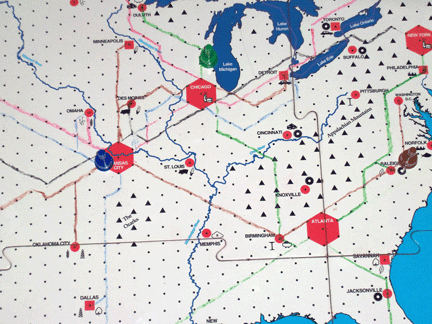
For those of you who are not familiar with the game, Empire Builder is about building railroads in order to deliver various goods to various cities. Each player gets three demand cards, which have three potential deliveries and how much they pay. The goods are available only in certain cities, so each player spends money to build tracks connecting cities that have goods to cities that need those goods. The first player to $250 million while connecting the major cities on the map wins.

A game in process looks like this:


It occurred to me while playing with my daughter that there is a similarity between this game in process and the large scale map from D1-2 Descent into the Depths of the Earth:


I love mini-games that help inform game and setting design. My favorite part of Traveller is the character creation mini-game — especially the expanded versions for military, scout and merchant careers. I find the process that GDW went through to produce the Traveller 2300 setting to be fascinating (I only wish they would let me play so I could produce my own version of the universe). Of course, I adore How to Host a Dungeon.

Therefore I began to wonder if it weren’t possible to create a large scale underground map ala Descent into the Depths of the Earth using a game of Empire Builder. Assign a classic underground race to each color (Black = Drow, Blue = Svirfneblin, Green = Kuo-Toa, etc.); re-skin the various goods found in the game with appropriate fantasy stylings (cars = giant striders, tourists = slaves, cotton = spider silk, etc.); and then play the game.

The race that wins become the dominate race of the underworld, with pecking order depending how the game ends. Railroads become underground passages. Cities become encounter areas, with major cities being major dungeons. The goods represent what encounter areas have in abundance. The various colored railroads determine who controls these encounter areas and which ones are in dispute.

Using the game pictured above, here is a large scale map of the depths one might come up with (note, I did rotate the map 90°):


Though this might seem a bit sparse (it is only part way through a whole game), there is still a lot of implied information here.

For example, this provides some semblance of an under-earth economy. Goods are being traded or raided for. Therefore, when a party of adventurers clears out a particular encounter area, whatever goods that area produced is going to become scarce. The whole system and map will have an organic reason for adjusting to the presence of the adventurers. Does another faction try to reclaim what the adventurers have cleared out? Does the shortage heat up conflict in the underworld? Who benefits from this conflict?

In the end, it is a fun way to create a living, breathing underworld that will have enough basic information about it to really make it sing when adventurers come to play.

Saturday, April 7, 2012

Saintly Saturday: St. Lazarus and St. Tikhon

I must admit that I am torn in several directions today. While many of you are enjoying Easter weekend, I am readying myself for the marathon that is the Orthodox Christian Holy Week. Blogging will be spotty this coming week, if I manage to get in front of the computer at all. Thus today is going to be a bit of a smorgasbord.

Saturday of St. Lazarus


As I noted last year, the Saturday before Palm Sunday in the Orthodox Calendar celebrates St. Lazarus, the Friend of Christ who is called back from the tomb four days dead. Though I mentioned several things from his life, one particularly interesting detail from his hagiography that I did not note last year is that he never smiled after being brought back to life. There is a clue as to why in one of the hymns sung during the week leading up to Lazarus Saturday:

Lazarus is now two days in the tomb; he sees the dead of all the ages. There he has witnessed strange horrors, a numberless throng held fast by the bonds of Hades. Thus his sisters lament bitterly as they look on his tomb. But Christ comes to bring His friend to life, that a hymn may be raised by all in unison: "Blessed are You, O Savior, have mercy on us."

In other words, what he saw was so harrowing that it marked him for life. I will grant, this is before Christ Himself went down into Hades to break open the brass gates and preach the Kingdom to the dead, but it still is a very interesting image, particularly for those whose campaign worlds do not have (yet) Christ or a Christ-analogue.

For those who have qualms about Raise Dead and its affects upon their campaign world, the story of Lazarus gives a fascinating limiting factor — those that come back aren’t quite the same. Depending on how severe these consequences, a Referee could assign physical change (loss of Con, for example) or mental change (please roll on the insanity table, please). Such consequences would make some players think twice about using Raise Dead on their favorite characters.

St. Tikhon, Patriarch of Moscow and Enlightener of North America


Born in 1865, in the Russian region of Pskov, St. Tikhon was a monk who became bishop of Alaska and the Aleutian Islands at the end of the 19th century. In 1900 his see was extended to include all of North America. He did much for the Orthodox Christians across the United States, including the consecration and establishment of several Churches, including St. Nicholas Cathedral in New York and St. Nicholas Church in Brooklyn.

In 1917 he was elected as Patriarch of Moscow, just as the Bolshevik Revolution was about to sweep across Russia. St. Tikhon stood steadfast in the faith despite the utter destruction that followed in the wake of the communist revolution. He fell ill in 1924 and died today in 1925. Due to his sufferings, he is also considered a Confessor.

It seems that the saints are insistent that I continue to work on my campaign based on a fantasy version of 18th century Alaska. Last week, I differentiated different types of magic in terms of pseudo-science. I mentioned that found magic would likely be alien technology.

Colonial powers normally fight over territory not just for land, but for the riches that the land provides. Alaska is famous for both its gold and its oil; however, neither had been discovered until later into the 19th century. For the purposes of having something for Ruthenia and Albion to fight over, I think an interesting twist might be akin to a post earlier this week by Desert Scribe over at Super Galactic Dreadnaught — The Starship as Megadungeon.

As I mentioned in the comments, this is an idea that I have been trying to implement for years, having been deeply affected by Expedition to the Barrier Peaks. Therefore I have a plan: in a remote region of fantasy-Alaska, there is a valley created by the crash of a huge space ship. Much of the regional conflict is centered around control of the valley and its access. Scattered throughout the region are also various escape pods and smaller vessels also involved in the crash.

One candidate for these aliens are the Tuniit/Tunijuat or maybe they were slaves of the aliens who controlled the ship. Regardless, I plan to have a huge spaceship as the tentpole megadungeon of the campaign.

For those that worry about mapping such a dungeon, I offer a solution. Being an old Traveller Fan, one of my favorite aspects of the Traveller universe were all the various war games that helped form what became known as the Third Imperium. Among these board games is Azhanti High Lightning which is a game about combat scenarios aboard a huge space dreadnaught. The beauty of this game is that it provides fourteen full color deck plans. Even better, GDW has it available as a .pdf!


Thus, all you need to do is figure out what kind nasties a group of adventurers will encounter therein, once they sneak by whatever fortification is protecting the valley (depending, of course on whether or not they are aligned to whoever happens to control said fort at the time).

Friday, November 18, 2011

My First Long-Running Traveller Campaign

If I am honest, over the years I have probably spent more money on Traveller than I have on D&D — I certainly own a lot of Traveller related stuff that takes up more space on my bookshelf than my D&D books. That money, however, has never produced any kind of long-term campaign. It's not that my fiends and I didn't play Traveller (we did), it's that we had a lot more fun playing the mini-game of character and world creation than we did when we finally got around to doing something with those characters and worlds.

I mention this because in my Lost Colonies campaign, there is a real possibility that my players not only will not be heading back to Headwaters any time soon, but may be hopping from one world to the next in ways that I will not be able to predict. I do have several options available to me, one of which I don't relish at all: creating from scratch all of the various possible choices my players could make. I could also assign various pre-fab campaign worlds to each of those possible choices. While I certainly have a couple in mind to have as options, I don't have enough and too many of them are not only interchangeable, but some of my players are also intimately familiar with them.

Enter Judges Guild. Back in 1980 and 1981, Rudy Kraft produced his Portals series of mini-campaigns. Each has a radically different flavor than that found in a typical D&D world and they are all connected by a series of portals that teleport players in-between worlds (thus, giving them all a dungeon-like feel). The world that I find most inspiring is the world presented in Portals of Twilight.

Whereas the other two installments derived their uniqueness from their inhabitants, Twilight is unique because of the world itself. The rotation of the planet is parallel to the orbit so that one side is always in light and one in darkness. Thus, the only inhabitable part of the planet in the narrow strip of twilight along the equator. This sounds like something straight out of Traveller.

Thus, the inspiration for my solution for dealing with the potential meanderings of my players: revisit the mini-game of world creation in Traveller. This method has several things I find very attractive:

  • It is random — which usually results in more creativity on my part.
  • It's fun — I have literally spent days of my life creating sub-sectors for use in Traveller.
  • All the results can be recorded in a simple code wherein there will be enough information for me to be able to improvise should I need to.
  • I don't have to waste a whole lot of time creating a bunch of worlds my players will never visit.

I do this with a very real sense of irony — my very first long-term Traveller campaign has turned out to be D&D.

Monday, September 27, 2010

Thoughts on Sci-Fi RPGs Part 4

I've been under the weather this past weekend, and as I've demonstrated in the past, I tend to deal with such misery by doing thought experiments. Since a comment by Erin on my musings on Sci Fi RPGs brought my attention to this particular thought experiment, that is how I spent my weekend. Since Scott of Huge Ruined Pile has done much of the hard work with the rules themselves, I busied myself with the Inspirational Source Material at the end of Molday's Basic D&D. I felt entirely justified in doing this, because I vividly remember staking out literary territories that inspired and informed D&D worlds that my friends and I built and played in when we were first trying to feel our way through the game.

I did give myself a limitation, however. I only allowed authors and works that I had not read before. As I was ill, I was limited to free on line resources. One of the first authors that I had success with was Leigh Brackett and her fabulous tale "The Black Amazon of Mars," which was the original title and version of The People of the Talisman — one of the titles cited by Moldvay.

Please note, Leigh Brackett is a sci fi writer and "The Black Amazon" is a sci fi tale. Interstellar travel is a given. The story begins with the aftermath of a gun battle. Mercury, Venus, Earth and Mars are all mentioned as places the hero Eric John Stark has been.

Which brings me to the point of this post. Having been completely drawn into Brackett's vision of Mars and her version of the solar system and inspired enough to put on paper some kind of D&D version of this vision, I have come to the conclusion that I think James' question makes an erroneous assumption. Despite the sci fi source material, D&D (especially Moldvay's edition) is a perfectly suitable game with which to create a world and universe inspired by Brackett's work. Thus, D&D is a science fiction RPG, and the most wildly successful one, at that.

We forget that the classification of sci fi and fantasy as two separate genres is a fairly recent phenomenon. Although James is very good at mining and giving homage to the past, his question fails to remember this reality. Which brings me to what I think is the real answer to his question. D&D has been as successful as it has because it so good at pastiche. It is perfectly capable of being high fantasy, dark fantasy, pulp, sci fi, horror, etc. It doesn't matter what you want to do, D&D is quite capable of handling it. In contrast, games like Traveller are too much tied to their niche within the sci fi/fantasy spectrum. In other words, you could do the Third Imperium with D&D, but you couldn't do Greyhawk with Traveller. That narrow focus necessarily limits their appeal and thus their audience.

So the real question isn't why these other games have failed, but rather why D&D succeeded. The answer is the wonderful goulash that sci fi used to be and the fact that D&D was not only was born out of it, but embraced it.

Thursday, September 23, 2010

Thoughts on Sci-Fi RPGs Part 2

The only long term sci fi campaign I was ever involved with was a Star Wars (d6) campaign. I've played a lot of Traveller over the years, but my friends and I were more enamored with the mini-game that is character creation in CT than we were in the game itself. I've also played a lot of other sci fi games, none of which had the kind of pull that Star Wars did.

I must admit that one of the reasons that the campaign was so successful is the way it was run. The party had ties to the rebellion, and as a pseudo-military unit were sent on various missions. In the hands of a good Referee and willing players, this set-up can work very well; however, I also believe that the source material played large in the longevity of the campaign.

Firstly (and most importantly, in my opinion) religion is an integral and even central part of the Star Wars universe. As a Christian, I have some serious qualms about what George Lucas calls religion, but Star Wars cannot be Star Wars without the Force. This is a far cry from most science fiction (like Star Trek).

Secondly, Star Wars has more in common with fantasy literature than it does with sci fi. The characters are archetypes found in fantasy dressed up for space travel. The hero wields a sword and rescues a princess. We hear Obi Wan referred to as an old wizard. I could go on. In addition, just as fantasy normally does, Lucas borrowed heavily from mythology. He took very basic mythological and cultural themes, figures and tropes and recast them for a space opera. Thus, like fantasy, the Star Wars universe feels very comfortable.

Lastly, there is also one very important factor that I don't think many appreciate. Due to the geographic simplicity of the Star Wars universe, it lends itself to the fantasy sandbox style of play much more easily than Traveller or dozens of other sci fi games I've played over the years.

Let me explain. Tatooine is a desert planet. Yavin is a forest moon. Hoth is an ice planet, etc. These are akin to hexes on a hex map, where each hex indicates a different kind of terrain. When one needs to have a more detailed map of a particular section of said hex, it is easily done, but for the most part all one really needs to know is desert, forest, ice, etc. This might not seem very important, but I believe it is. Compared with the level of detail required of even the simple and abstract system used by Traveller to describe worlds, the scheme used by Star Wars makes universe creation no harder than creating a hex map for a fantasy campaign. In contrast, even in its relative simplicity, Traveller is rather quite intimidating. I firmly believe that one of the reasons my friends and I never got beyond an entertaining number of one-offs in Traveller is the fact that none of us had the confidence to pull a multi-world campaign off.

In other words, the more a science fiction RPG has in common with fantasy, the more playable it becomes.

Sunday, February 1, 2009

Why I Love the Third Imperium

Recently, I have been able to get into several boxes that haven't seen the light of day in about five years. One of these contained all of my Traveller books. I have played Traveller on and off since the late 70s. However, like many, my favorite aspect of the game has always been reading up on the setting created for Traveller — the Third Imperium.

The one aspect of this massive setting that I love the most is that when humankind finally reaches out to the stars, the first alien species they find is . . . human. To me, this is far more challenging, horrifying, and alien than any of the various alien species offered by any science fiction setting anywhere (as an aside, I also love the fact that the most unsavory of three major human cultures is the one that originated on earth). I have previously explained why humans make the best monsters, and the Third Imperium has certainly contributed to this belief. The concept of human beings as alien forces upon us a very important question — what makes us human?

The game itself offers up three answers to this question, all of which popped up in one way or another over the course of human history:

Culture. In Traveller, over 40 planets were seeded with humanity by the Ancients. Yet, all of them are culturally similar enough that the Third Imperium encompasses most of them.

Technology. In the Traveller universe there are what are called Major Races and Minor Races. The bench mark for this differentiation is the independent discovery of Jump Drive.

Genetics. The Solomani Hypothesis states that all of the various human races seeded throughout the universe are all genetically the same species and that species originated on Earth.

Yet, just as they have been historically, all three are unsatisfactory. Culture, genetics, and technology (and the human intellect and reason that created technology) have all been used as excuses for us to designate one segment of the population as sub-human. This, in turn, has resulted in discrimination, war, murder, and genocide — all inhuman behaviors that make everyone less than human.

Christianity offers an answer to the question that encompasses culture, technology, intellect, reason, and genetics and also transcends them. That answer is found in Genesis when God creates humanity in His image and likeness. In other words, what makes us human is the ability to share in divine characteristics — love, creativity, freedom, justice — and to become like God.

By defining our humanity as the image and likeness of God, we free ourselves from the limitations of culture, technology, reason, intellect and genetics. We are faced with the reality of the radical other. As created beings we are finite with a clear and definitive beginning and end. In contrast, God is beginningless and eternal. Yet, we are endowed with His image and likeness. Throw in Christ, and we are confronted with the reality that this radical other became one of us out of love to ensure that all of creation might share in His eternity.

When we limit ourselves to culture, technology, reason, intellect and genetics, the idea of a sentient alien species wrecks havoc with our belief systems. There are countless sci-fi stories out there that abandon Christianity for this very reason. However, Christianity is not limited in this way, and is far more resilient than many understand it to be. The question we need to be asking of these sentient alien species is this: are they created in the image and likeness of God — Can they love and create? Can they value and participate in freedom and justice? Can they be transformed and become more like God? If these can be answered Yes, then they are human.

I can say this with boldness for two reasons: 1) For us to say that God cannot create sentient aliens — radical others — endowed with His image, especially when He himself (a radical other) became human, is not only is nonsensical, it is to claim that we can limit God. 2) Part of our growth as human beings is a confrontation with the other — both in the form of God Himself and the immense variety found within humanity, with all its cultures, its technology and its genetics. We are called to love the other no matter how alien or different. It wouldn't surprise me in the least if God someday decided that for our own salvation we were confronted by an alien species — a radical other — that challenged us to love His creation as He loves it. Remember, His love is not limited to humanity — He became human in order to save all of creation. This includes every sentient alien species that might exist out there.

The Third Imperium expresses this concept in a real way. It forces the issue by placing an actual human face on the first alien species humanity finds when they reach to the stars. It forces us to come to terms with our own humanity and what it means to be human, what it means to be created in the image and likeness of God and what it means to love as God loves.