Saturday, May 25, 2013

Saintly Saturday: The Third Finding of the Head of St. John the Baptist

Today the Orthodox Church celebrates the Third Finding of the Head of St. John the Baptist (the first two findings are celebrated on February 24). The relic had been in Emesa (in modern day Syria), but was moved to Komana (in modern day Turkey) during Saracen raids in the early 9th century. It was subsequently hidden and buried during the second wave of iconoclasm.

When the icons were restored to the Churches, Patriarch Ignatius of Constantinople (A.D. 847-857) received a vision which told him where the head of St. John was hidden. He communicated this to the Emperor, who sent an expedition to bring the relic to Constantinople. The head was found today in A.D. 850.


One meme that keeps popping up in this corner of the internet is the complaint that the ubiquitous Sword +1 is boring and that magic items should inspire more awe and wonder. I myself have played with systems to try to alleviate this particular issue by imagining the process by which a sword is made. The story of St. John’s Head, however, suggests that giving even a boring old Sword +1 a simple history can transform it from a mere mechanic into a real magical treasure.

What follows is a series of d6 rolls which will provide an outline for the provenance of a magic sword:
Roll a d6. The result will be the number of previous owners. For each owner, roll on these two tables:

Who was the owner?


  1. Thief
  2. Fighter
  3. Knight
  4. Noble
  5. Demi-human (1-3 = Elf; 4-5 = Dwarf; 6 = Halfling)
  6. King

How was it lost?


  1. Stolen
  2. Lost in a game of chance
  3. Owner died in battle*
  4. Owner killed while adventuring*
  5. Owner killed by a magical beast (like a dragon)*
  6. Owner mysteriously disappeared

*On a 1-2 the sword was buried with the owner on a 3-6 it was taken by those who killed the owner, or the sword's fate can be determined by fiat.

As an option, one can also roll on the following table:

How did the next owner receive the sword?


  1. Stole it
  2. Won in a game of chance
  3. Awarded for services rendered
  4. Found it in a lair
  5. Found it in a tomb
  6. Found it in a dungeon

Once each owner is determined, all one has to to do is decide what order they owned the sword and fill in any details that are desired.
For example:

I rolled a ‘3’ to determine how many owners a Sword +1 has had. I rolled on all three tables and here are the results:

  • 3-2-5 Knight died in battle. The sword was buried with him and was in his tomb when found
  • 4-1-4 Noble died adventuring (sword was taken) and was found in a monster’s lair
  • 6-4-3 King had it stolen and was found in a dungeon.

Looking at this, I can fill out the details: A king had the magical sword forged, but before he was able to wield it in battle, the sword was smuggled away into a dungeon. A descendent of the king (2nd son?) went searching for the weapon and found it in the dungeon; however, he was killed on the journey home. A knight seeking fame and glory hunted down a beast in the wilderness, in the lair he discovered the sword. He went on to become famous, but died in a battle defending the realm. His sword was buried with him.

Obviously, further details can be added (such as the names of each owner and what lands they ruled and defended). Should this Sword +1 be found in a treasure hoard other than a tomb, one need only add one more layer to the story: monsters looted the tomb and, depending upon which monsters guard the hoard, either don’t know its value, don’t use swords or use it to defend the rest of the treasure.

Regardless, this lowly Sword +1 is no longer boring. It has a story. It was forged for a king. Men died trying to get it back. It took part in a great battle to try and save the realm. It is an item worthy of wonder, despite the fact in it is “only” a Sword +1.

Thursday, May 23, 2013

Meditating on Golems and Superheroes

I got to see Ironman 3 last night and given Tony Stark’s use of all the various versions of the Ironman suits with a kind of remote control as well as the trailer for the new Superman movie (which preceded this latest Ironman movie) got me thinking about golems.

Anyone who has played D&D is familiar with the concept of the golem — a figure made out of various materials and brought to life as an automaton. One of the original source materials for the concept is Jewish in origin. There are a variety of stories that involve man trying to duplicate God’s creation of humanity. An anthropomorphic earthen vessel is created and given life; however, the end-result is always imperfect and often dangerous. Thus, the core of the legend is a cautionary tale about hubris.

The most famous golem-tale is that of the Golem of Prague. The 16th century rabbi Judah Loew ben Bezalel is supposed to have built a golem out of clay from the banks of the Vltava river in order to protect the Jews of the Prague ghetto from the pogroms of Rudolf II. In the classic tale, the golem was eventually destroyed by the rabbi when he forgot to let it rest on the Sabbath; however, there are versions where it becomes a monster that goes on a murderous rampage.

In this sense, Superman can be seen as a type of golem — at least as a concept in the context of his creation. The father of Jerry Siegel, one of the creators of Superman, died during a robbery attempt of his Cleveland, OH clothing store in 1932. In addition, the creative irony of the use of Nietzsche’s Übermensch by the Nazi party when compared to Superman, who was portrayed by the Jewish Siegel and Schuster as an alien defender of the downtrodden, poor and defenseless, cannot be ignored (image from here):


However, something interesting happened with the golem Superman — despite his superior abilities and alien physiology and origin, he deeply identified with humanity. His upbringing as Clark Kent formed the foundation upon which he became a hero rather than a monster.

Indeed, I have often argued that the superhero of the Superman stories isn’t the Superman persona, but, rather, Clark Kent — precisely because he strives so hard to be a human being. I also believe that it is one of the keys to his long-term success as a literary character and one of the reasons that, despite my preference for normal human comic book characters like Batman and Green Arrow, Superman is one of my favorite superheroes. I can’t help but respect him, not because he is so irritatingly powerful, but because he tries so hard to be human despite all that power.

In a way, all superheroes are golems and the best ones are those who struggle with their own humanity (or, as Superman, to be human). One of the reasons that I collected DC rather than Marvel at the height of the popularity of the X-Men and Wolverine during the 1980s & 90s was due to the glorified golem qualities of Marvel’s Mutant Universe.

As is often acknowledged, the mutant story lines serve as a commentary on whatever shade of bigotry one wants to explore; however, other than the Us vs. Them bigotry, the concept of Homo sapiens superior is rarely, if ever, compared to what it means to be human. As a result, the debate is often stuck at: Should we make war against humanity or Should we be magnanimous and protect humanity? It always bothered me that both cases infer the inherent inferiority of humanity. The question of what it meant to be human never became a foundational principle like it did for the Superman character.

Therefore, all of Marvel’s mutants all end up being merely golems.

As with the original stories about golems, the concept is most powerful when it is an expression of hubris and its destructive consequences. Ironically, there are a plethora of monsters in D&D that are better at being golems than golems on this score. My two favorites are orcs (especially if understood in Tolkienesque terms as the result of twisted experiments on elves) and owlbears (which are described as the result of a twisted experiment by a magic-user).

Tuesday, May 21, 2013

The Green Monk and Green Sword Classes for ACKS

I find myself in an interesting situation with the ACKS custom class system. I am struggling to find a way to differentiate the Blue Mage (see the comments) from what I came up with for the White Mage in ACKS; however, ACKS gives me I the means to actually bring to life some flavor text about the Green Monks that I posted almost two years ago — something that I have never really been able to flesh out otherwise.

Thus, until such time that I find inspiration for doing something for the Blue Mage, I give you the Green Monk and the Green Sword:

The Green Monk and Green Sword Classes for ACKS


Prime Requisite: STR and WIS
Requirements: Must be Lawful
Hit Dice: 1d6
Maximum Level: 14
Green Monks are an eremitic monastic order who primarily live in the wilderness as hermits. They are known for their green robes, which are dyed with the same plants that they use to make green elixirs, for which they are well known. They shave their heads and take various vows of silence.

Green Swords are the military arm of the order. These soldiers are famous for their unarmed fighting techniques.

A player must choose at character creation whether or not their character is a Green Monk or a Green Sword. This choice cannot be changed.

Both classes fight and save as Fighters, can wear Leather armor or lighter and use any swords, daggers, spears, pole arms and all missile weapons. They can fight with either weapon and shield or two-handed fighting styles. Both build Sanctums using the Castle rules for a stronghold at 9th level.

Both Green Monks and Green Swords have the following Custom Powers:
  • Attunement to Nature: Since they spend most of their life living alone in the wilderness, Green Monks and Green Swords have a +1 to surprise rolls when in the wilderness.
  • Nose for Potions: Both Green Monks and Green Swords can make a proficiency throw of 11+ to determine the magical properties of potions or oils. At 5th level, they master the skill of brewing potions (all with their trade-mark green hue) as if a mage of their class level.
  • Combat Awareness: Both Green Monks and Green Swords gain a +1 bonus to AC if wearing leather armor or less and able to move freely. This bonus increases to +2 at 7th level and +3 at 13th. This power stacks with Swashbuckling. [This is the same as the Blade Dancing custom power].
Green Monks can cast Divine Spells as a Cleric of half their level. Though they cannot Turn Undead they do have the following additional Custom Powers:
  • Lay on Hands: At 2nd level, the Green Monk can restore 2 hit points per experience level once per day by laying on hands. Proficiency slots can be used to gain additional uses of this power per day.
  • Longevity: At 12th level, the Green Monk learns to completely rely upon God for sustenance. They have a lifespan 3 times longer than normal and become immune to ghoul paralysis.
Green Swords have the following additional Custom Power:
  • Unarmed Fighting Routine: Green Swords are trained to fight unarmed. In melee combat they may attack with this routine, attacking three times for 1d3-1/1d3-1/1d6-1 damage. [This is the same as the Fangs and Claws custom power].
Proficiency List: Alchemy, Alertness, Beast Friendship, Blind Fighting, Combat Reflexes, Combat Trickery (force back, incapacitate, overrun, sunder), Command, Diplomacy, Divine Blessing, Endurance, Fighting Style, Healing, Illusion Resistance, Knowledge (history), Laying on Hands, Leadership, Manual of Arms, Martial Training, Military Strategy, Mystic Aura, Naturalism, Riding, Running, Theology, Weapon Focus

XP Progression looks like this [Green Swords are in brackets]:
  • Level 2: 2,350 [2,300]
  • Level 3: 4,700 [4,600]
  • Level 4: 9,400 [9,200]
  • Level 5: 18,800 [18,400]
  • Level 6: 37,600 [36,800]
  • Level 7: 75,200 [73,600]
  • Level 8: 150,400 [147,200]
  • Level 9: 270,400 [267,200]
  • Level 10: 390,400 [387,200]
  • Level 11: 510,400 [507,200]
  • Level 12: 630,400 [627,200]
  • Level 13: 750,400 [747,200]
  • Level 14: 870,400 [867,200]

Monday, May 20, 2013

The Brown Mage Class for ACKS

The next type of Tolkienesque Mages from my Averoigne campaign that I am going to convert to ACKS is the Brown Mage. Originally, these were supposed to be the mages free to operate outside the Guild and who could add some of the Druid spells to their repertoire. I have therefore tried to give the Brown Mage nature/animal friendly-type Custom Powers:

The Brown Mage for ACKS


Prime Requisite: INT
Requirements: Must be Lawful or Neutral
Hit Dice: 1d4
Maximum Level: 14
Brown Mages are arcane spell casters who study the way in which the patterns of nature parallel those in the arcane. Some see this as God speaking through nature, others simply see it as an intellectual curiosity. Many are allowed operate outside the Mage Guild because their studies normally are benign. In addition, this path of study tends to garner less arcane power than that of the normal (Grey) Mage.

Brown Mages gain and cast spells like normal Mages, however, at 2/3 of their character level (with anything .5 or higher rounded up). Thus, they don’t get to do Magic Research (minor) until 7th level and major Magical Research until 13th level. In addition, they only have one fighting style — two weapons.

They do, however, have the following Custom Powers:

  • Find the Patterns of Nature At 2nd level, the Brown Mage may study the minutia of an aspect of nature (such as the pattern of veins on a leaf) for 1 hour (6 turns) to regain one spell that they have already cast. A Brown Mage may not regain the same level of spell more than once per day through contemplation. [This is the same as the Contemplation proficiency]
  • Speak with Animals At 3rd level the Brown Mage may Speak with Animals as per the spell at will.
  • Friend of Birds and Beasts At 4th level a Brown Mage has become well-versed in the natural world and can identify plants and fauna with a proficiency throw of 11+. In addition, the Brown Mage understands the subtle body language and moods of birds and beasts and therefore gains +2 to all reaction rolls when encountering normal animals, and can take animals as henchmen.
  • Muster Animal Help At 5th level, a Brown Mage can use the Summon Animal spell as a spell-like ability once per day.
  • Rally Fantastic Beast At 8th level, a Brown Mage can use the Summon Fantastic Beast spell as a spell-like ability once per day.
  • Summon Elemental 11th level, a Brown Mage can use the Conjure Elemental spell as a spell-like ability once per day.

Brown Mages fight and save as Mages and build a Conservatory using the Hideout rules at 9th level.

Brown Mage Proficiency List: Alchemy, Animal Husbandry, Animal Training, Battle Magic, Collegiate Wizardry, Craft, Diplomacy, Elementalism, Elven Bloodline, Engineering, Familiar, Healing, Illusion Resistance, Knowledge, Language, Loremastery, Magical Engineering, Mapping, Mystic Aura, Naturalism, Quiet Magic, Passing Without Trace, Performance, Prestidigitation, Profession, Sensing Power, Tracking, Unflappable Casting

XP Progression looks like this:
  • Level 2: 2,075
  • Level 3: 4,150
  • Level 4: 8,300
  • Level 5: 16,600
  • Level 6: 33,200
  • Level 7: 65,000
  • Level 8: 130,000
  • Level 9: 280,000
  • Level 10: 430,00
  • Level 11: 580,000
  • Level 12: 730,000
  • Level 13: 880,000
  • Level 14: 1,030,000

Saturday, May 18, 2013

Saintly Saturday: St. David the Martyr of Georgia

Today is the feast of St. David the Martyr of Georgia, who was born to a noble Christian family. His father died when he was still young and his uncle, a pagan, seized all of the family’s possessions. The true heir, however, was St. David. Fearing this claim, the uncle first tried to win over his sister Tagine, David’s mother. This proved to be futile. Therefore, he tried to convince David and his brother Tarichan that he was now their father and that his was a better way than Christianity. Both refused, boldly declaring that were willing to endure anything for their Lord and their true Father in Heaven.

St. David’s uncle feared reprisals from the Christians, therefore he did not immediately kill his nephews. Rather, he plotted their murder in secret. Tagine, sensing danger, smuggled herself and her sons to lands in the south. There, they lived in hiding as shepherds for many years.

Spies, however, eventually discovered their whereabouts and St. David’s uncle ambushed them in the mountains. Rather than defend himself, St. David ran to his uncle to embrace him in love. His uncle ran him through with a sword and was immediately struck blind. The staff held by St. David was transformed into a tree. Soldiers also chased down and killed St. David’s brother.

When their mother discovered that her sons were murdered, she at first was filled with sorrow and denounced her brother; however, he repented. Taking soil soaked in St. David’s blood, she covered her brother’s eyes and his sight returned.

He went on to repent before the bishop, got baptized and built a church in honor of his nephew.

***

This is a great story, which suggests two periods within a campaign world:

  1. The period where spies search the land for St. David
  2. The period where the story of David’s martyrdom and church built in his honor are freshly known.

I realize I mention it a lot, but this story marries very well with T1:The Village of Hommlet and would make one of my favorite modules even better.

In the first case, Lareth the Beautiful could be the leader of a cell of spies in search of the nephews of a noble of the Old Faith. Rather than leading the characters to the Temple of Elemental Evil, it could lead characters into the political intrigue between the followers of St. Cuthbert’s God (Christ) and those who still hold to the Old Faith (paganism).

In the second, one could replace the Church of St. Cuthbert with the church built by the uncle in honor of the nephew he martyred. Thus, both the local Christian Church and the Old Faith would have a very rich local history. In addition, the tree that miraculously appeared could be a place of both pilgrimage and a place of safety for PCs on wilderness adventures (no wandering monster checks and double the hit points regained with rest).

Friday, May 17, 2013

White Mage Class for ACKS

The next classes I will tackle for my conversion of Averoigne to ACKS are some of the alternate magic-users suggested by Tolkien’s rainbow of wizards (white, grey, brown and blue). You can see my original post on the subject here. I will begin with the color white.

This is the first major conceptual bump on my journey to converting Averoigne to ACKS. It is possible to interpret Holmes so that only magic-users can use cleric scrolls. This, in turn, suggests that the cleric spells can be both divine and arcane. I took full advantage of this with my Tolkien homage.

ACKS, however, makes a much clearer distinction between the two types of magic. Indeed, should a custom class wish to cast magic from the other spell list, the proficiency that accomplishes this (4 spells at a time) is called Apostasy and the custom power is called Forbidden Spells.

If I were to follow this internal logic, it is possible to create a mage class that can expand their spell list by 12-16 spells, but can cast fewer spells than a normal mage and gains the ability to do magical research later than a normal mage. Personally, I don’t think the trade-off is worth it.

Alternatively, I can provide a number of interesting powers, including 4-8 spells from the cleric spell list. Among these is the ability to Turn undead as a cleric half the current level of the character. Again, however, this class would cast fewer spells than a normal mage and wouldn’t get to do magical research until higher levels. I am much more intrigued by this possibility than the first; however, I still don’t know if it is worth it.

Finally, it is possible to have the mage be able to Turn undead (which could be traded in for 1 or 2 custom powers) and cast cleric spells at half the character’s current level. This would allow not only for a wider spell selection, but the ability to cast more spells and do magical research in the same way a normal mage would.

From a mechanical point of view, this last option is the most optimal and the one that most closely emulates my original Holmesian class. From a conceptual point of view, however, the water is rather muddy. The divine spells are actually divine in nature, not arcane. The spell lists and spell progressions are two different entities. This does not accomplish what I set out to do.

There is one caveat, here, and therefore hope. If I take the ACKS credo every campaign is a law unto itself at its word, I can ignore the differentiation, marry the two spell lists and spell progressions together and call it good. I just wish that the rules themselves weren’t so clear about the differentiation so that my hand-waving it away didn’t feel like I was making such a big exception. Indeed, in the description below, I can’t bring myself to completely hand wave it away:

The White Mage Class for ACKS


Prime Requisite: INT
Requirements: Must be Lawful and a member of both the Church and the Mage’s Guild
Hit Dice: 1d4
Maximum Level: 14
White Mages are men and women of faith who wish to use arcane magics in concert with their faith and the Church, sometimes even within the Church structure. Like normal mages (aka Grey Mages), White Mages begin the game with a repertoire of arcane spells modified by their INT; however, once they have proven themselves faithful to both the Church and the Mage’s Guild, the White Mage gains access to a second repertoire of spells.

At 3rd level, the character receives a second spell book filled with spells that duplicate the effects of various divine spells. These are prepared in the same way as normal arcane spells; however, due to the different way in which White Mages study magic, their spell progression and spell choice differ from normal mage progression:

What follows is a list of numbers representing the numbers of spells a White Mage can prepare each day per level. The numbers outside of brackets represent the amount of normal arcane spells that can be prepared. Numbers inside brackets represent the amount of divine-like arcane spells that can be prepared. The numbers are read left to right in terms of spell level with the furthest left being first level.

  1. 1
  2. 1
  3. 2[1]
  4. 2[1] 1
  5. 2[2] 2
  6. 2[2] 2
  7. 2[2] 2[1] 1
  8. 2[2] 2[1] 1
  9. 2[2] 2[2] 2
  10. 3[2] 2[2] 2 1
  11. 3[2] 2[2] 2[1] 1[1]
  12. 3[2] 3[2] 2[1] 2[1]
  13. 3[2] 3[2] 3[2] 2[1] 1[1]
  14. 3[2] 3[2] 3[2] 2[1] 1[1]

As do normal (Grey) Mages, at 5th level White Mages can begin doing arcane research, scribe scrolls and brew potions. At 9th level they can create greater magical items. In addition, they have the following Custom Powers:

  • Aura of Protection: Due to their chosen path of faith coupled with the arcane, beginning at 2nd level, White Mages have a +1 bonus to AC and saving throws against chaotic (evil) creatures and effects. This appears as a golden aura when viewed with Detect Good, Detect Magic or Trueseeing.
  • Divine Aura: At 12th level, the White Mage begins to project an aura of light that awes, bedazzles and persuades. The White Mage receives a +2 bonus to reaction rolls to people encountered. If this total is 12 or more, the subject acts as if charmed while in the presence of the White Mage. [This is the same as the Glamourous Aura custom power.]

White Mage Proficiency List: Alchemy, Battle Magic, Beast Friendship, Collegiate Wizardry, Craft, Diplomacy, Divine Blessing, Divine Health, Elementalism, Elven Bloodline, Engineering, Familiar, Healing, Illusion Resistance, Knowledge, Language, Loremastery, Magical Engineering, Mapping, Naturalism, Quiet Magic, Performance, Prestidigitation, Profession, Prophecy, Sensing Power, Theology, Unflappable Casting

White Mages fight and save as Mages and use the Sanctum rules to build a Stronghold at 9th level.

XP progression looks like this:

  • Level 2: 2,125
  • Level 3: 4,250
  • Level 4: 8,500
  • Level 5: 17,000
  • Level 6: 34,000
  • Level 7: 68,000
  • Level 8: 136,000
  • Level 9: 272,000
  • Level 10: 422,000
  • Level 11: 572,000
  • Level 12: 722,000
  • Level 13: 872,000
  • Level 14: 1,022,000

Wednesday, May 15, 2013

The Salian Scion Class for ACKS

The next class to tackle in my conversion process to ACKS for my Averoigne campaign is my Holmesian Paladin. This class really came about as an opportunity to offer an HTH-only fighter type in the way the Holmesian Ranger is missile/thrown-only. I also took advantage of the DEX-based initiative system of Holmes by allowing the Holmesian Paladin to trade places with people on the initiative order.

Since initiative is dynamic in ACKS and a mere +1 to an individual’s initiative is considered a custom power, I am not going to try and go the initiative route. Rather, I am going to play up the original meaning of paladin which refers to a trusted military leader or imperial officer.

Since I have heavily used the history of the Merovingian Kings as a source of inspiration, I thought it apropos to allow the Salians to have a flavored version of the fighter type in the same way that I made my ACKS ranger Averni for flavor purposes. Thus, I will use the name Salian Scion to describe this conversion of the Holmesian Paladin:

The Salian Scion Class for ACKS


Prime Requisite: STR and CHA
Requirements: Must be Salian or have an approved backstory for a non-Salian
Hit Dice: 1d8
Maximum Level: 14
Although the Salians are recent interlopers in Averoigne, theirs is a Kingdom that has lasted nearly a thousand years. Thus, the noble families of the Salians are both well-established and steeped in tradition. There is also a need for those who are not first born to go out on their own and make a name for themselves, since they are not to inherent the family title or lands. Salian Scions represent these title-less noble born who seek to carve out lands of their own.

Salian Scions may wear any type of armor but their sense of honor and military tradition frowns upon any weapons other than swords, daggers, morning stars, maces, or lances. Likewise, they eschew one fighting style according to their Family Military Tradition (see below). When the player chooses a weapon, the primary way that weapon is used will determine the fighting style the character will not have available:

  • If the weapon uses the two weapon fighting style than no two handed fighting style.
  • If the weapon uses the two handed fighting style than no weapon and shield fighting style.
  • If the weapon uses the weapon and shield fighting style than no two weapon fighting style.

In addition, Salian Scions have the following Custom Powers:

  • Blood of Kings: Due to their noble lineage, Salian Scions are allowed to take one more henchmen than their CHA allows and all henchmen have their morale raised by 1.
  • Family Military Tradition: Salian families are closely associated with certain weapons. For example, those who are descended from the Merovingians are known for their prowess with the Two-Handed Sword. A Salian Scion is trained starting at birth using this family weapon. Therefore, the player may select one weapon as a family weapon at character creation which cannot be changed later. The Salian Scion receives a +1 to attack rolls with this weapon. In addition, readying or sheathing this weapon counts as a free action.
  • Inspire Courage: At 2nd level, Salian Scions have perfected the art of improving morale of troops. Prior to battle, the Salian Scion may spend one round encouraging those around the character (50’ r.) and these allies gain a +1 to attack throws, damage rolls, morale rolls and saving throws against fear. This bonus lasts 1 turn. This can be done to any given character once per day per class level. This does not work on characters already engaged in combat.
  • Command of Voice: At 4th level, Salian Scions have earned enough of a reputation that their very words hold power. They receive a +2 bonus to reaction rolls to creatures spoken to. If the result is 12 or more, the subject acts as if charmed. Creatures with a higher WIS than the character’s CHA are immune.
  • Heroic Resilience: At 9th level, the Salian Scion has established himself as a hero and a leader. As a result, when the character is required to consult the Mortal Wounds table, the player may roll twice and choose the preferred results. The character may also subtract class level from the number of days of bed rest required to recover. [This is the same as the Savage Resilience custom power.]

Salian Scions fight and save as fighters, have the same proficiencies as fighters and use the Castle rules to build a Stronghold at 9th level.

XP progression looks like this:

  • Level 2: 2,600
  • Level 3: 5,200
  • Level 4: 10,400
  • Level 5: 20,800
  • Level 6: 41,600
  • Level 7: 83,200
  • Level 8: 164,400
  • Level 9: 328,800
  • Level 10: 448,800
  • Level 11: 568,800
  • Level 12: 688,800
  • Level 13: 808,800
  • Level 14: 928,800

Tuesday, May 14, 2013

A Note to Tavis, Andrew & Dan and about ACKS Players Companion

I would just like to take a moment to thank both Tavis and Andrew for dropping by and commenting on some of my meditations on ACKS, especially Andrew’s suggestions for improving my Burglar Class. This is what I love about this little corner of the internet and what I love about the philosophy about many of the publishers who target the OSR community — they actively support and encourage folks to actually use their products in ways that the end-user wants to. To that end, I should mention that Dan of Goblinoid Games has also dropped by and endorsed my use of S&S 2e to fiddle with the LL Thief, which is really cool.

I’d also like to mention that having fiddled now with the Custom Classes section of the ACKS Players Companion, that this is probably one of the best things that has come out of the OSR. As I have mentioned before, ACKS is a great system if you want a character build opportunity with your B/X. Not being one of those guys, ACKS would not be my personal first choice of rulesets. That being said, however, the Custom Class section is easily portable to B/X or LL and allows players to add all kinds of flavor-filled classes to their campaign worlds to make them come alive. It also scratches that character build itch quite excellently. Therefore, I highly recommend getting yourself a copy, even if ACKS doesn’t seem to be your cup of tea.

Saturday, May 11, 2013

Saintly Saturday: The Consecration of Constantinople

Today the Orthodox Church commemorates the consecration of the city of Constantinople, which gives me a chance to do things a little differently this Saturday. Normally, I would go through the story of a saint’s life and pull something interesting or inspiring to apply to RPGs. This (hopefully) demonstrates how useful it is to plum the history of Christianity and how truly rich that history is.

Today, I am going start with an RPG concept and see how the story of Constantinople fits that concept. When designing an RPG environment, especially those that PCs are going to explore — the dungeon, the wilderness or a urban area — it is useful to have multiple layers of history to that area. These multiple layers give the DM/GM/Ref/Judge/LL/etc. a rich tapestry from which to improvise information about a specific area.

If I know that a particular area now occupied by orcs was once used as a temple by elves and before that was a nursery for metallic dragons, I can give a variety of interesting details that clue the PCs into the history of what this place once was:

  • Skulls of various humanoids for orcs.
  • Leaf designs and the image of a great tree (protected by a dragon?) on the stone work (possibly de-faced by orcs) for the elves.
  • A strange pattern of circles in bas relief in the floor for the dragons.

Knowing these two larger details (the elven temple and dragon nursery) lead to a far more interesting and cohesive set of smaller details, which can then spin off into adventure hooks or interesting NPCs interactions (say an elf or a dragon looking for evidence that these places still exist).


The city of Constantinople is an historical example of how to add these layers and how these layers affect what comes later:

  • Byzantium was a Greek colony founded in 657 B.C. and named after a king of great renown by the name of Byzas.
  • St. Andrew the Apostle preached in Byzantium in the first century A.D., setting up a Christian community and ordaining St. Stachys of the Seventy as bishop.
  • The city sided with Pescennius Niger, an usurper to the Roman thrown. The city was besieged by roman forces and heavily damaged in A.D. 196.
  • St. Constantine, the first Christian emperor, chose to make the city the new capital of the Christian Roman Empire, renaming it Constantinople. It was consecrated today in A.D. 330.
  • Despite many attempts, the city stood firm and ruled over the Roman Empire for 1000 years.
  • It was finally conquered by the Ottomans in A.D. 1453.
  • The city was renamed Istanbul (which is really a mutation of a Greek phrase meaning to the City).
  • Churches were subsequently taken over and turned into mosques or torn down (Hagia Sophia, for example — shown above in an image from Wikimedia Commons).
  • The term Byzantine Empire was coined by a Frenchmen in the 16th century.
  • Today, the Patriarch of Constantinople still has the title Ecumenical Patriarch due to its historic association with the capital of the Roman Empire and he traces his Apostolic Succession to St. Andrew.

Thus, in a Mutant Future campaign where modern Istanbul lays in ruins and is crawling with irradiated monsters, there is a rich tapestry of historical clues one can give PCs along with a great hook for adventures: the remnant Christian church is hoping to find relics from when the city was still occupied by humans.

Thursday, May 9, 2013

The Averni Ranger Class for ACKS

The second class that I am attempting to convert to ACKS for my Averoigne campaign is the Holmesian Ranger. Although, the impetus for the original was my own interpretation of the missile combat rules in Holmes (which implied random targets), ACKS still has one hold-over from the Holmes rules. No one can fire into melee without a special proficiency. Therefore, that is where I began constructing what I call the Averni Ranger (thus named to add a bit of color and to differentiate it from the plethora of other rangers that exist):

The Averni Ranger for ACKS


Prime Requisite: STR and DEX
Requirements: Must be Averni or have an approved backstory for a non-Averni
Hit Dice: 1d6
Maximum Level: 14
Averoigne has large swaths of land that are wilderness creeping into the lands of civilization. Therefore, there is a long warrior tradition within Averni culture that learns the ways of the wilderness in order to protect civilization from the wilderness.

Averni Rangers may wear chain-type armor or lighter, use all missile weapons and one-handed weapons and have the fighting styles weapon and shield as well as two weapons. They also have three Thieving Skills: Hide in Shadow, Move Silently and Backstab. HS and MS require leather or lighter armor to use.

In addition they have the following Custom Powers:

  • Accuracy: Averni Rangers are trained marksmen. That are at a +1 to attack rolls with all missile weapons.
  • Precise Shot: as trained marksmen, Averni Rangers can fire into melee at a -4 to the roll. This stacks with the Proficiency Precise Shooting to reduce the penalty to hit.
  • Sniper: if an Averni Ranger can attack from ambush or is eligible to use backstab, they can do so using a ranged weapon at up to short range. [This is the Proficiency Sniping used as a Custom Power].

Averni Rangers fight and save as Fighters and use the Hideout rules to build a Stronghold at 9th level.

Averni Ranger Proficiency List: Alertness, Animal Husbandry, Blind Fighting, Climbing, Combat Trickery (disarm, incapacitate, knock down), Eavesdropping, Endurance, Fighting Style, Land Surveying, Mapping, Mountaineering, Naturalism, Navigation, Passing Without Trace, Precise Shooting, Riding, Running, Skirmishing, Survival, Swashbuckling, Tracking, Trapping, Wakefulness, Weapon Finesse, Weapon Focus

XP progression looks like this:
  • Level 2: 2,150
  • Level 3: 4,300
  • Level 4: 8,600
  • Level 5: 17,200
  • Level 6: 34,400
  • Level 7: 68,800
  • Level 8: 137,600
  • Level 9: 275,200
  • Level 10: 279,200
  • Level 11: 399,200
  • Level 12: 519,200
  • Level 13: 639,200
  • Level 14: 759,200

Wednesday, May 8, 2013

The Burglar Class for ACKS

My first step in converting some of my ideas about a Homes/Cook Averoigne campaign to ACKS is the idea that the primary purpose of the Thief is that of door opener. As such, I have re-cast the Thief as Burglar and have replaced the Thieves Guild with the Adventurer’s Guild.

Mechanically and philosophically, it is important for the feel of the game I want to play that PCs will encounter a semi-intelligent and hostile environment whenever they enter a dungeon. One way to emulate this is that all doors are locked. As such, the primary way of opening doors is to muscle through them. If the attempt fails, however, all chance at surprise is gone. Therefore, PCs have two alternative ways of attempting to open a door without giving up that chance of surprise should that attempt fail. One is magical (Knock) and the other is the Burglar.

Enter the ACKS Player Companion. Ostensibly, it is filled with extra classes, races, spells and equipment for use in Autarch’s house campaign world. However, they live by the credo that Every campaign is a law unto itself. Therefore, they provide a section wherein they brake down all of the mechanics that they used to create every class in ACKS (including the core classes) making it possible for Judges (the ACKS version of the DM) and players alike to create custom classes for their own campaigns.

This is, by far, my favorite aspect of ACKS. It is mechanically sound, balanced and backward compatible. The first part of my attempts to convert Averoigne to ACKS will heavily involve these custom class rules. First up is the aforementioned Burglar:

Burglar Class for ACKS


Prime Requisite: DEX
Requirements: None
Hit Dice: 1d6
Maximum Level: 14
Burglars are adventurers who specialize in the opening of doors (thus the title burglar). They may wear chain-type armor or lighter and are able to use axes, bows and crossbows. They can use the fighting styles weapon + shield or two-handed weapons.

Burglars have three Thieving skills: Open Locks, Find Traps and Climb Walls.

In addition they have the following Custom Powers:

  • Difficult to Spot: Burglars are very good at seemingly disappearing into shadow, nooks and crannies found within dungeons. If they are quiet and hold still while in cover, they can escape detection on a roll of 3+ on a d20. They can put this skill to use in wilderness conditions as well; however, the roll required is 14+ on a d20. [Note: the original Custom Power reverses these two rolls for Explorers and Elven Rangers]
  • Keen Eyes: Burglars can detect hidden and secret doors with a roll of 8+ on a d20 if they are actively searching and a 14+ on a d20 if only casually inspecting.
  • Loremastery: The burglar can decipher runes, remember ancient history, identify artifacts, etc. with a roll of 18+. This improves by 1 per level of experience.

Burglars fight and save as Thieves and can build an Adventurer’s Guild at 9th level (same rules as a Hideout). They also have the same Proficiency list as Thieves with the exception of Skulking and Sniping which are replaced with Blind Fighting and Eavesdropping. XP progression looks like this:

  • Level 2: 1,400
  • Level 3: 2,800
  • Level 4: 5,600
  • Level 5: 11,200
  • Level 6: 22,400
  • Level 7: 44,800
  • Level 8: 89,600
  • Level 9: 179,200
  • Level 10:279,200
  • Level 11: 379,200
  • Level 12: 479,200
  • Level 13: 579,200
  • Level 14: 679,200
Please Note: I deliberately chose not to give the Burglar the ability to Remove Traps specifically because I do not like having the process of disarming traps reduced to a die roll. I much prefer coming up with the traps and seeing how players figure ways to overcome them. I also chose axes over sword/dagger for allowable weapons because an axe can also be used to open a door. Additionally, in Averoigne swords are something primarily reserved for fighters.

***

This was the first big test for the Custom Class system of ACKS: could it emulate what I was looking for in the Bilbo Baggins inspired thief/burglar archetype? I think it has done so better than my own earlier attempts at  making the Thief class something that I would not only allow in my games, but would actually like to play.

Tuesday, May 7, 2013

Meditating on ACKS and Averoigne

One who has read this blog over the years may have noticed that I haven’t posted a Lost Colonies Session report in a long time. This is not because the campaign has ended, but rather that the sessions are few and far between and nothing has really happened that I was inspired enough to write about. This is due to the fact that I am not inspired enough by the campaign in its current state to do much more and none of the guys I play with have championed more sessions than the few that we have done.

In the meantime, my group has been primarily playing AD&D with a few forays into Pathfinder. At the moment, the guys I play with are enamored by AD&D’s fiddliness — to them it represent more “choice” than other older editions of the game. I could argue that I could accomplish much of the same feel and choices with a much cleaner and simpler ruleset such as S&W or LL + AEC, but I would be missing the point.

One has to understand that the group I play with were virtually all introduced to the game with 3rd edition. As such, character builds are very important to them — it is a part of the gaming experience that they really enjoy. I have meditated on this before. I have, in contrast, scratched that itch with various war games which these guys never had as part of their gaming experience.

Every couple of months, someone at the table suggests that we play Pathfinder for a while (it being the 3ed emulation of choice). We play awhile until everyone remembers why we don’t like playing 3ed/Pathfinder. I don’t mind terribly much because I have learned to enjoy the game at lower levels and I know we will sooner rather than later go back to an older ruleset or its emulation.

What this all means, in the long run, is that I am not ever going to be able to run an Averoigne campaign with the guys I play with the way I want to — with a Holmes/Cook mash-up using either LL or S&W as a jumping off point. While it is incredibly interesting to me and something I would really like to play-test one day, it isn’t something that is going to interest my group. Thus, I am having to re-think about my approach so that I can start play-testing Averoigne and the Chateau des Faussesflammes as concepts.

Enter, of all things, Dwimmermount. My faith in that project and my patience have born fruit. One of the things that has come out of all the complications of the project is the generosity of the guys at Autarch. Via a promise made to backers, I have gotten my hands on .pdfs of ACKS and the ACKS Player Companion and done some serious reading and fiddling.

I have to say that both are excellent products, if lacking in a few tables & examples here and there which would have made my understanding and use of the products easier. I really like the fact that at its root, ACKS is B/X. I also really appreciate their interpretation of its mechanics extrapolated into the concept of proficiencies/feats, world building and the end-game.

In the end, however, I find it too fiddly. I prefer a far more organic/random interaction with world creation than these rules imply and I have never much cared for proficiencies, especially when they really emulate skills and feats that imply more roll playing than role playing. There are aspects that I think will prove very useful in the long run, but won’t really know until I actually use them at the table.

This is where I insert the however of this blog post. Even though I don’t care for the fiddliness of ACKS, I do think the guys who I play with will. It scratches the character build itch in a way that AD&D can’t but without all the stuff we don’t like about Pathfinder (I hope). For my own taste, I prefer the fiddliness of ACKS over the fiddliness of AD&D because it represents true player choice and is mechanically cleaner (and did I mention that it is basically B/X — my favorite edition of the game — with a bunch of stuff added on?).

Thus, the best chance I have of playing in my version of Averoigne with the guys I play with may very well be ACKS. As such, in the coming days I will be converting some of the work I have done on Averoigne to the ACKS system to see if what emerges is something I am still interested in playing.

Sunday, May 5, 2013

Christ is Risen!


It is the day of the Resurrection! Let us shine brightly for the festival, and also embrace one another. Brethren, let us say even to those who hate us, "Let us forgive everything for the Resurrection." And thus let us cry aloud, "Christ is risen from the dead, by death trampling down upon death, and to those in the tombs He has granted life!" — Doxastikon of Pascha

Saturday, May 4, 2013

Saintly Saturday: Holy Saturday

Today is Holy Saturday according to the Orthodox Calendar. We Orthodox Christians do a funny thing this week. We are so eager to celebrate Pascha (aka Easter) that we turn the clock ahead 12 hours this week. All the morning services happen the night before and all the evening services happen in the morning. Thus, we actually celebrate the Vesperal Liturgy of the Resurrection this morning and will celebrate the morning Divine Liturgy tonight at midnight.

As a result, this hymn was sung this morning:
Today, Hades groans and cries out, "My authority has been destroyed. I took One who died, as though He were mortal, but I am powerless to contain Him. Along with Him I lose all those, over whom I had ruled. I had held the dead from all ages, but behold, He raises them all." Glory to Your Cross and Your Resurrection, O Lord!
I have meditated before on the idea that Christ turns the classic hero story on its head. Normally, the hero descends into the Mythic Underground in order to gain something lost or something that they need in order to defeat whatever nemesis they happen to need to get rid of. As can be seen by this hymn, Christ goes into Hades (aka Sheol aka the Mythic Underground) to conquer it.

Thus, the classic trope of the megadungeon that is always restocking itself, morphing and reacting to the PCs as they delve deeper into its bowels also gets turned on its ear. It occurred to me that a previous post might give an interesting answer as to how to reconcile the Christ-as-hero story with the classic D&D megadungeon.

Awhile ago, I blogged about something I called The Gnomic Highway, which I equated to the idea of a kind of faerie road that could shorten the distance between two given points, but which would also be far more dangerous than a normal road. Subsequently, I came across the idea of the gnomic will which suggests a deliberate choice away from a path that results in the fulfillment of one’s being.

Thus, in a Christian context, it would be possible for PCs to defeat a megadungeon — that once cleared or once a particular goal has been met, that megadungeon ceases to exist in the normal sense; however, one can still find it on the Gnomic Highway — where one can deliberately choose to enter into the Mythic Underground and all its subsequent dangers even though it has ceased to exist as a normal part of the world.

Saturday, April 27, 2013

Saintly Saturday: Lazarus Saturday and St. Eulogius the Innkeeper

Apologies for the durth of posts around here recently. Life. Apologies also ahead of time for the brevity of this post, but, again: Life (and Holy Week).

Today, being the Saturday before Palm Sunday in the Orthodox calendar, we celebrate the raising of Lazarus. I have written on this topic before, and therefore will kindly point folks to my thoughts from the last two years.


Today is also the feast day of Eulogius the Innkeeper. He lived in the fourth century in Constantinople and would offer hospitality to wanderers. It seems to me that he would make an interesting model for an NPC, especially in a low-level campaign.

Saturday, April 20, 2013

Saintly Saturday: St. Theodore the Trichinas

Today is the feast of a very popular saint among monastics — St. Theodore the Trichinas. The title Τριχινᾶ refers to his practice of wearing a hair shirt. He grew up in a pious family, chose the monastic life and entered into one of the monasteries in the imperial city of Constantinople. He wore the hair shirt the rest of his life.

For me, the most interesting part of St. Theodore’s story happened several centuries after his death in the late 4th/early 5th century: a liturgical poem called a Canon was composed for St. Theodore by one of the great hymnodists of the Orthodox Church, St. Joseph the Hymnographer.


Continuing with my theme that the monastic life is a good metaphor for D&D if one externalizes the internal struggle that the spiritual warfare of the Christian life holds, here are some interesting excerpts from the Canon for St. Theodore written by St. Joseph:
Cutting down the assaults of passions with a spiritual sword, O righteous Theodore, you raised up trophies of victory against them; wherefore you have been crowned with graces of miracles and healings. — Ode One

With vigorous abstinence you slew the beasts of the flesh, O righteous Father, and made manifest all the powers of the soul. — Ode Three

With temperance, you killed the passions O Theodore and became a divine habitation of the Holy Spirit, by Whom you have gushed forth gifts of healings for all. — Ode Four

You broke the arrows of the foe, O righteous Theodore, using the arms of humility against him; and with the co-working of Christ, you have carried off the victory. — Ode Six

When you stretched out your hands to God, O righteous Father, you muzzled with prayer the noetic beasts that gaped against you; and in joy you did chant with a pure mind: O all you works of the Lord, bless the Lord — Ode Eight
Since this time of year is so very busy, I am not going to have time to do more than pull some of the interesting possibilities that might be externalized for a D&D campaign:

  • The word “passions” has as its root the Greek πάθος which is the root of the English word pathogen and has the connotation of disease.
  • A spiritual sword.
  • Beasts of the Flesh.
  • A divine spell which breaks or deflects arrows or attacks from creatures of evil.
  • Noetic beasts.

I wish I had more time to play with some of these ideas. For those not staring down the end of Lent and Holy Week, maybe some of these will inspire something more than a bullet point.

Saturday, April 13, 2013

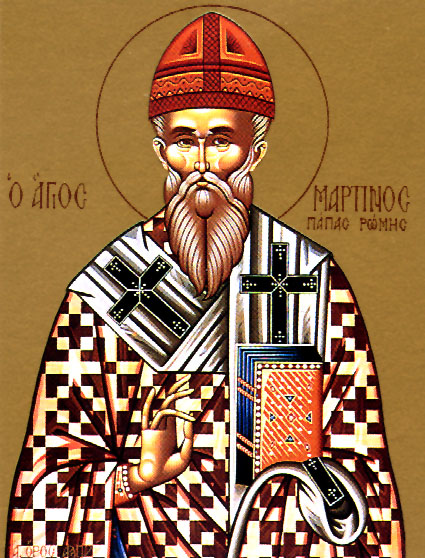
Saintly Saturday: St. Martin the Confessor

Today is the feast of St. Martin the Confessor. He was born in Tuscany in the 7th century. Prior to being elected as bishop of Rome, he served several years as a papal legate in Constantinople. During the reign of Emperor Constans II (A.D. 641-668), St. Martin was encouraged by the emperor to support a theological treatise called The Typos. Not only did St. Martin not support it, but convened a Lateran Council in 649 to condemn it.

The Typos espoused a heresy called Monothelitism, which held that there is only one will and energy in Christ. This runs counter to St. Gregory the Theologian’s axiom that whatever part of humanity Christ doesn’t assume as His own isn’t saved. Thus, under Monothelitism, our will and energy are not saved because they are not part of Christ’s humanity. To put it simply: the salvation of a Monothelite Christ is incomplete.

As a result of his defiance, St. Martin was arrested in A.D. 653 under false charges (conspiring with the Saracens) and exiled to Cherson on the Black Sea. He died there two years later.


Given that so much of St. Martin’s life is centered around Rome and Constantinople, it has me meditating upon one of the campaign tropes that I personally have the least experience with: The City. There was a brief period where I toyed with the idea of an urban campaign, but it proved to be short lived. It is a style of play that requires a level of detail that I am not good at, nor is it the easiest medium for the improvisational style I prefer to play.

Of course, The City State of the Invincible Overlord was never something that I or any of my friends owned back in the day. For those unaware, Judges Guild just released The Guide to the City State which is Bob Bledsaw’s original in-house 1976 edition. Though a delightful read, (I especially find it fascinating that many of the rumors to be found are about events that are supposedly occurring right now), I am not convinced that had my friend’s and I had access, that we would have had any more interest or success in urban campaigns.

The Invincible Overlord is portrayed as an inaccessible, untouchable and indifferent ruler whose only real interest is maintaining power. In contrast, the denizens of dungeons and wilderness areas are tangible things that can be encountered and overcome, if need be. I can understand the need for an Invincible Overlord — it simplifies the urban environment by keeping things at the immediate street level; however, I know my friends and I would have preferred a campaign that would allow us to be like St. Martin — to stand defiantly against the unjust rule of the Overlord/Emperor.

Unfortunately, this adds a level of complication to the urban environment that is much easier to handle in the classic dungeon/wilderness campaign. In the former, politics can color every single aspect of the game, and keeping track of all the various factions can be a real headache (at least for me) — even when the players are not that much interested. In the latter, politics can be kept at a background noise level until such time that the players choose to scratch that itch, by which time they have probably established strongholds or are seeking places to do so. As such, the political situation can be very simplistic and even binary.

Thus, whereas St. Martin’s life took place in urban environments with complex political issues, being able to emulate his conflict with Emperor Constans II is much easier in context of the classic dungeon/wilderness environment.

Saturday, April 6, 2013

Saintly Saturday: St. Methodius Archbishop of Moravia

Today is the feast of St. Methodius, Equal to the Apostles and Archbishop of Moravia, Enlightener of the Slavs. This ninth century saint was born into an illustrious family in Thessaloniki along with his younger brother Constantine (who would become known as St. Cyril). Early in his life, he served as a soldier in a Slavic speaking region dependent upon the Byzantine Empire. This is where he most likely learned to speak Slavonic. After serving for about 10 years, he received a monastic tonsure and retired to a monastery at Mt. Olympus, where he was joined by his brother Cyril.

These two brothers, however, were soon summoned to become missionaries to the Slavic peoples, due, in large part, to the knowledge St. Methodius had of their language and culture. The two brothers would go on to translate the Gospel, Epistles, Psalter, and collected services, into the Slavic tongue using an alphabet they devised based upon what knowledge they had of the Slavic written language. This alphabet is known as Glagolitic. Their disciples would later refine the alphabet and it would become known as Cyrillic (after St. Cyril) and is still the alphabet used in the national languages of Belarus, Bosnia and Herzegovina, Bulgaria, Kazakhstan, Kyrgyzstan, Macedonia, Mongolia, Montenegro, Russia, Serbia, Tajikistan and Ukraine.

St. Methodius would outlive his brother, who died in Rome while the two defended their use of Slavonic to the bishop of Rome. The two had come into conflict with German bishops who insisted that there were only three holy languages: Greek, Hebrew and Latin. Sts. Cyril and Methodius would say:
You only recognize three languages in which God may be glorified. But David sang, ‘Praise the Lord, all nations, praise the Lord all peoples (Ps 116/117:1).’ And the Gospel of St Matthew (28:18) says, ‘Go and teach all nations....’
St. Methodius would spend the rest of his life in conflict with German bishops over this and other issues. He died on this day in A.D. 885.


Thus, these two saints stand as champions of preaching the Gospel in the language of the people. Anyone who insists upon a particular language or particular translation (in the case of English) stand in contradiction to these two great saints. Thus, I am sore tempted to play with language.

What follows is a language I have dubbed VOX, which is Latin for utterance which happens to be the meaning of the root of Glagolitic. I have taken various characters from several versions of early Slavonic and assigned them to various sounds in English. Thus, it can be used to write out code for the purpose of having cool looking props at an RPG table:


For example, a Protection from Evil scroll might be labelled thusly:


In addition, I have devised a way to use the VOX alphabet to duplicate something akin to the Greek numeric system:


Besides the normal treasure map or riddle that would look cool using VOX, I also think it might be fun to introduce new spells using VOX. When a player finds a scroll, hand them the spell and its mechanics in VOX. Personally, I would find such a spell a whole lot more precious because I would have earned it.

Friday, April 5, 2013

Tinkering with Weighted WMTs

I first encountered the idea of weighted Wandering Monster Tables in the MMII, where encounter tables were designed to use 2 dice (1d8+1d12) to produce a number from 2-20. Due to the bell curve produced by this set-up, it is possible to arrange WMTs based on frequency — Very Rare, Rare, Uncommon and Common.

Recently, I have been meditating upon a different way to weigh a WMT based upon time. For years, my mom has had a bird feeder on her porch. In that time, she has noted that there is a general pattern as to when a type of bird is most likely to be feeding. It isn’t identical every day, but there are times when there are types of birds that will not be there.

One might use such a concept in a dungeon or wilderness area where the longer one stays, the more dangerous it gets because bigger and badder monsters come out to play. This could also be used in an area being contested by different factions. During the first part of a day, each side is preparing and planning, therefore most encounters at the beginning of a day will simply be one faction or another; however, later in the day (when these plans come to fruition), most encounters will find the factions in combat with each other.

To set up such a WMT, a chart with 19-23 slots can be made (the following example might be used in a 1st-level dungeon):
  1. 1/2 HD Creature
  2. 1/2 HD Creature
  3. 1/2 HD Creature
  4. 1 HD Creature
  5. 1 HD Creature
  6. 1 HD Creature
  7. 1 HD Creature
  8. 1+1 HD Creature
  9. 1+1 HD Creature
  10. 1+1 HD Creature
  11. 1+1 HD Creature
  12. 2 HD Creature
  13. 2 HD Creature
  14. 2 HD Creature
  15. 2 HD Creature
  16. 2+1 HD Creature
  17. 2+1 HD Creature
  18. 2+1 HD Creature
  19. 3 HD Creature
  20. 3 HD Creature
  21. 4 HD Creature
  22. 4 HD Creature
  23. 5 HD Creature
To use the table, roll 1d12. For every hour spent in the area add an additional +1 to the roll. Thus, if a '10' is rolled for an encounter with an adventuring party that has been in the area for 4 hours, the final result will be 14 (10+4). If the party has just arrived and has yet to spend an entire hour in the area, nothing is added to the roll.

Using this method, such a table could represent an 8-12 hour period of time (where 19 slots = 8 hours and 23 = 12 hours). This would allow for the above process to be reversed with a 12 hour table (the 8 hour table would sit on the low end or high end of the table for several hours). Alternatively, one could add the bonus for every 2-3 hours and have the whole process cover a 24-hour period.

Monday, April 1, 2013

Green Lantern Movie: A Primer on Arianism

This weekend, I finally got around to seeing the 2011 Green Lantern movie. I had been avoiding this due to the bad reviews it received and my own immense distrust of everything Hollywood. Green Lantern has a special place in my heart because my first real exposure to the medium of the comic book came through a bunch of Hal Jordan stories.


I have to admit, I was pleasantly surprised, but for a completely unexpected reason, because the reviews were right — this was a deeply flawed movie. The reason (unsurprisingly) is theological: The Green Lantern Movie is an excellent primer on the Christian heresy of Arianism. It beautifully illustrates the basic tenets of its beliefs, what those beliefs look like and, ultimately, its fatal flaw.

Arius famously stated that there was a time when the Son was not. Rather than uniting humanity to the being of God, Christ merely united us to His Will. Now, take a listen to the opening sequence to the GL movie:


The Guardians of Oa are described as immortal — they are the Arian Christ figures of this story. They created Oa as a means to allow access to the most powerful energy in the universe: Will. The rings can be seen as a stand-in for ordination: the GL corp is the clergy of the Arian Church. They go about ensuring that the universe bends to the Will of the GL corp creed:
In brightest day, in blackest night,
No evil shall escape my sight.
Let those who worship evil's might,
Beware my power, Green Lantern's light!
There are two fatal flaws with this cosmology:

The first is magnificently illustrated by the fascistic overtones of the GL Corp led by the charismatic Sinestro: What is evil? In a world where the Guardians are willing to make a weapon like the Yellow Ring and the leader of the GL Corp is willing to use it, evil devolves into the relativism of whoever owns the biggest baddest weapon and is willing to use it gets to determine what is good and what is evil. Historically, the biggest proponents of Arianism were the Emperors for exactly this reason.

The second is wonderfully embodied by the movie’s main villain Paralax. According to the movie, Paralax is one of the Guardians who became overwhelmed by the yellow energy of fear and subsequently became a threat to Oa and the the Guardians themselves. I hope I won’t spoil anything for those who have yet to see the movie, but Paralax is ultimately destroyed by being lured into the sun.

All of this demonstrates the ultimate problem of Arianism. Though they are immortal and grant access to Will, both the Guardians of Oa and the Arian Christ are created beings. Ultimately, this means that they have a beginning and an end. Therefore, we gain nothing by uniting ourselves to them, other than a very temporary access to power. In the end, we all end.

This is why the Church fought so vigorously against Arianism in the fourth century. It completely undermines the true Gospel — God Himself became a human being in the person of Jesus Christ so that we might overcome our end and share in Christ’s eternity.

Therefore, I really liked this movie (despite the fact that in just about every other aspect is was barely average). It goes to show that the politically correct assumption that all religions are basically the same and that those of us who believe in some kind of divine being are all just going to end up in the same place by different paths is itself fundamentally flawed.